
Coolant drops. Temp barely twitches. Hours later, flames shoot out from behind the engine cover. The 1.6 EcoBoost was built to punch above its weight.
Turbo boost, direct injection, and featherweight aluminum meant big torque and lean fuel use. On paper, it ended the old 2.5 Duratec. On the road, it cooked itself alive.
Aluminum heads warp. Gaskets leak. Cylinders crack. Oil sprays the turbo and lights up the firewall. Ford’s Recall 17S09 put a sensor on the coolant bottle, but left the flawed head in place.
Misfire codes, low-speed knock, carbon-clogged valves, and belt-driven top-end failure round out the weak points.
This guide breaks it down. Where the 1.6 was used, how its compact design turned into a heat trap, which failures matter most, what fixes actually hold, and how to spot a ticking engine before it seizes, melts, or ignites.
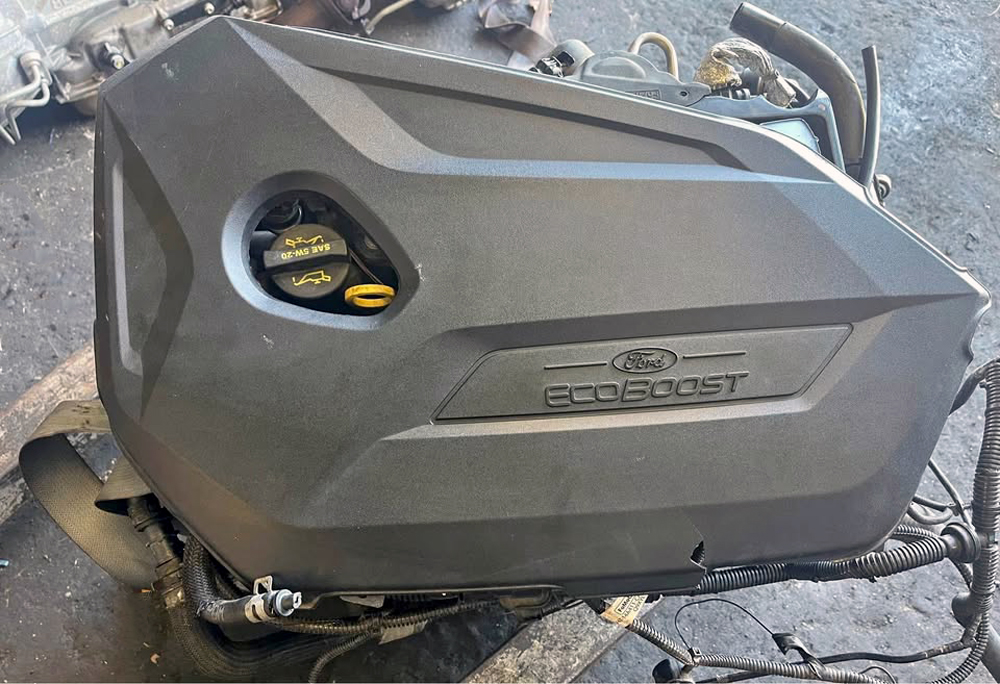
1. Overstressed by design before it ever hit the road
Where the 1.6 GTDI was dropped and how it was tuned
Ford stuffed the 1.6L EcoBoost into compacts, crossovers, and fleet vans between 2013 and 2019. Same core engine, different loads and tunes.
The Escape got a high-stress duty cycle with towing and idling. The Fiesta ST got more boost and driver abuse. The Fusion sat in the middle, where failures still triggered a full recall.
Here’s where it showed up and how hard each use case pushed it:
| Model | Years | Output (hp / lb-ft) | Transmission | Notes |
|---|---|---|---|---|
| Escape | 2013–2016 | ~178 / 184 | 6-speed automatic | Overheat and fire-prone; high load duty |
| Fusion | 2013–2014 | ~178 / 184 | 6-speed automatic | Core recall target for cracked heads |
| Fiesta ST | 2014–2019 | ~197 / 202 | 6-speed manual | High cylinder pressure, LSPI risk |
| Transit Connect | 2014–2016 | ~178 / 184 | 6-speed automatic | Long idle time, hot shutdown cycles |
Every variant used the same 1.6 GTDI block and head: die-cast aluminum, open-deck, single-scroll BorgWarner KP39 turbo, GDI fueling, and dry timing belt up front. Some late heads got minor casting tweaks, but the core design never changed.
How the aluminum block and turbo layout locked in failure paths
The 1.6 came from the Sigma family. Lightweight, high-revving, and compact, but not built to take repeated heat cycles with a turbo bolted to the side of the head. Ford chased peak power and kept packaging tight. What they got was a pressure cooker.
The exhaust manifold was cast into the head. The turbo sat right behind the engine in transverse layouts, inches from the firewall.
Coolant flowed through narrow jacket zones with poor circulation behind exhaust ports. Cylinder pressures spiked under boost. Oil temps climbed with long uphill pulls, tow loads, or just AC-on traffic.
Block design made it worse. The open-deck structure left minimal support between cylinders. Those thin bridges twisted under heat and torque. Even fresh off the line, the 1.6 sat close to its mechanical ceiling. Add years of thermal cycling, and the failure window widened fast.
Ford spec’d a 150,000-mile belt change and long oil intervals. That let weak gaskets, soft castings, and thin fluids sit too long. Failures weren’t random, they were baked in.
2. Overheat once and it never runs the same again
Coolant drops fast, head temps spike faster
The 1.6 runs a small-volume cooling system. A slow leak or air pocket doesn’t buy time, it buys damage. Just a few ounces low, and the hottest zones inside the head stop circulating. That’s where the exhaust ports meet the turbo flange.
The aluminum head expands unevenly. Flow stalls behind the ports, metal temps climb past 480°F, and localized fatigue kicks in.
Add a hill climb, tow load, or stuck fan clutch, and the head’s thin casting can crack around oil galleries before the temp gauge flinches. Once that crack forms, the engine’s shot whether it’s smoking yet or not.
Oil hits red-hot turbo housing and ignites
The fracture leaks oil straight onto the turbo or exhaust manifold. Pressurized lube atomizes against the heat. Flashpoint hits, and flames trail up the cowl or melt the plastic firewall liner.
Before the fire, you’ll usually smell it, burnt oil with no puddles, faint smoke near the firewall, maybe a misfire or power cut. Then it escalates. Kuga fires overseas left entire engine bays charred. A few units in South Africa went fully up, fatal crash cases followed. Ford logged over 40 fire claims before it moved.
What Recall 17S09 actually did to stop the fires
Ford issued Recall 17S09 / NHTSA 17V209 in 2017, targeting around 230,000 units with the 1.6. The fix wasn’t a new head or casting change. It was a sensor and a software update.
| Piece of remedy | What changed | What it’s meant to prevent |
|---|---|---|
| Coolant level sensor | Added to degas bottle | Early warning before coolant runs too low |
| PCM calibration | New overheat logic, limp mode | Cuts power before head reaches crack temps |
| Cluster messages/chimes | “Engine over temp, stop safely” etc. | Pushes driver to shut down immediately |
| Shields/diverters (some) | Redirects leaking oil away from turbo | Lowers fire chance if a crack still forms |
The core casting stayed untouched. Heads already micro-cracked kept failing. And if the sensor didn’t trigger in time, fire risk still rode with you.
3. Coolant sneaks into the cylinders and eats the block from inside
Where the open-deck block starts to give out
The 1.6 block uses an open-deck layout. Coolant flows around the cylinders, but the tops of the bores float free, no full ring support, just thin aluminum bridges. Over time, those bridges warp. The head gasket flattens. Pressure finds a way past the fire rings and into the combustion chamber.
Cylinder 2 and 3 bridges are the weak link. Heat cycles push them out of round. In some castings, a slit-style coolant notch between the bores cracks wider under pressure. Coolant doesn’t just pool near the gasket. It pushes right into the cylinder.
Misfires, white smoke, and pressure where it shouldn’t be
Owners usually spot it on cold start. One or two cylinders misfire, but it clears after a few seconds. Tailpipe puffs white. Coolant bottle’s low, but there’s no drip on the driveway. That’s the early stage.
Once the breach grows, combustion gases push back into the coolant. The bottle bubbles. Pressure builds fast even before the thermostat opens. Some 1.6s trigger limp mode after warm-up because the system sees overtemp with no coolant flow.
These codes show up most:
| Code | Meaning | What it usually means on a 1.6 EcoBoost |
|---|---|---|
| P0300 | Random misfire | Coolant wetting multiple cylinders |
| P0302/3 | Misfire cyl 2 or 3 | Classic between-cyl 2–3 bridge problem |
| P0316 | Misfire on startup | Coolant pooling overnight, burned off at start |
| P0217 | Engine over-temperature condition | Coolant volume already badly depleted |
| P1285/1299 | CHT over-temperature / protection mode | PCM has seen head temps in the danger zone |
Even with no leaks, a pressure test often shows a fast drop. Pulling plugs usually confirms coolant wash on one bank.
The only fix that holds, and why most don’t
Ford’s own tech docs are blunt: if coolant’s reaching the cylinders, swap the short block. The updated units come with reinforced bridges and revised deck geometry. Anything less invites repeat failure.
Quick shops pitch head gasket jobs, stop-leak, or used engines off eBay. All waste time. Once the block has opened up near the bridge or the gasket’s torched, nothing seals it back down.
Expect to pay $5,000 to $8,000 for a proper short block and head swap with labor. On a 2013 Escape or Fusion, that often totals out the car before the first bolt gets pulled.
4. Intake valves choke up long before the turbo gives out
Why carbon coats the valves on every high-mile 1.6
Direct injection skips the intake valves. Fuel fires straight into the chamber, leaving the valves dry. PCV vapors flow upstream and bake on. Heat from boost cycles and EGR overlap turns it to hard soot.
Port flow narrows fast. Idle turns choppy. High-RPM pull weakens. In cold weather, some units stumble off the line like they’ve got dead plugs. The valve stems glow orange under borescope once buildup hits full thickness.
Ford never included cleaning in the maintenance schedule. By 80,000 miles, most 1.6s run dirty even if compression’s still strong.
What knocks it off and what barely scratches it
Spray cleaners are cheap but don’t get far once buildup hardens. Only walnut blasting cleans it back to clean metal. Some shops use media ports, others pull the manifold and tape off runners.
| Method | When it works best | Effectiveness on heavy 1.6 deposits | Typical interval | Ballpark cost |
|---|---|---|---|---|
| Spray/induction | Light, early-stage buildup | Low–moderate | Preventative 20–30k | Low–medium |
| Walnut blasting | Thick, baked-on carbon | High (back to clean metal) | 80–100k or as needed | Medium–high |
DIY jobs with vac adapters can work if the blast stays contained. Miss the seal, though, and walnut shell grit gets pulled into the cylinder, especially on open-valve cycles.
Many Fiesta ST and Escape owners report smoother idle and throttle response right after their first full blast. It’s the one cleaning job that actually shows up on a stopwatch.
How coking tips off misfires, LSPI, and mpg drops
Uneven deposits throw off mixture delivery across cylinders. Some run lean, some drown rich. That imbalance adds misfires, especially off-idle or during slow pulls.
Under boost, hot carbon pockets pre-ignite the mix before the spark hits. That’s the start of LSPI, low-speed pre-ignition, and on the 1.6, one knock event is sometimes enough to fracture a piston.
Fuel trims chase stability by adding pulse width and pulling timing. MPG tanks. You’ll never spot it on the dash, but long-term averages tell the story, hard-driven 1.6s with dirty valves can lose 3–4 mpg even before codes start logging.
5. Superknock shatters pistons before you hear the rattle
When low-speed pre-ignition hits and what it destroys
LSPI hits hardest in 2nd or 3rd gear, right as the driver rolls into throttle under 2,000 rpm. The mix ignites too early, before the spark fires, creating a pressure wave that slams the piston mid-rise. That one shock load can snap a ring land or bend a rod.
Stock 1.6s with dirty valves or knock-prone oil are vulnerable. Tuned Escapes and hard-driven Fiesta STs push it further with higher boost and torque requests at low revs. Failures don’t build up slowly. One clean hit, and compression’s gone on a cylinder.
What breaks inside when LSPI blows the bottom end
Teardowns usually show cracked pistons, often on cylinder 3 or 4. The ring land breaks into sharp segments. The rod may bend or buckle outright. If it exits the block, it leaves a window in the crankcase big enough to fit your wrist through.
Ring gaps close or collapse. Skirts scuff. Valves stay clean because the head survives, but the short block’s junk. Some events log a knock count just before failure, others show nothing at all in the PCM. The only clue is sudden power loss or a loud clank before shutdown.
What fuel, oil, and habits do to LSPI risk
| Factor | High LSPI risk choice | Lower LSPI risk choice |
|---|---|---|
| Fuel octane | 87 under boost | 91–93 where available |
| Oil spec | Older SN, high-calcium blends | API SP / ILSAC GF-6, LSPI-safe formulations |
| Driving style | Lugging in high gear at low RPM | Downshift before heavy throttle |
| Tune strategy | Aggressive low-RPM boost | Torque-limited below ~2,000–2,500 rpm |
Later Ford calibrations cut torque at low revs to dodge LSPI events. Some units saw spark map updates that softened ramp-in throttle.
Even with the right tune, owners who lug the engine on bad fuel keep rolling the dice. If the oil’s not right or the valves are dirty, the next knock might end the block.
6. Turbo heat soaks the bearings, then scorches the oil
Why the KP39 turbo lives on borrowed oil
The 1.6 uses a BorgWarner KP39, mounted low and tight to the firewall. It runs hot even under light load. On highway climbs or short-run errands, oil temps spike. Then the engine shuts down, and the heat has nowhere to go.
The turbo housing heat-soaks the center section. Oil stops flowing. What’s left inside cooks into carbon. That buildup doesn’t just sit, it restricts feed and return flow, starving the next cycle. Repeat that pattern enough, and the shaft starts walking in the housing.
Noise, smoke, and metal grit from a dying turbo
Whining or siren-like boost sounds are the first signs. Then comes blue smoke off throttle or under decel, oil leaking past turbine seals. Boost drops. Codes like P0299 or underboost show up as the wastegate sticks or the compressor blades slow.
Intercooler hoses start filling with oil. Some 1.6s go lean enough to misfire. Others trip rich codes from fouled downstream sensors. Wastegates rattle. On teardown, the turbine wheel often shows shaft play or burnt oil packed into the feed hole like tar.
What the full turbo swap actually costs and why shortcuts fail
| Item | Typical parts cost | Labor range | Why it matters |
|---|---|---|---|
| OEM replacement turbo | $800–$1,200 | $600–$1,000 | Correct fit, OE durability |
| Aftermarket/reman turbo | $400–$700 | $600–$1,000 | Cheaper, quality varies |
| New oil feed & return lines | $150–$250 | Usually included | Clears coked passages |
| Gaskets, hardware, fluids | $100–$200 | Included/extra | Prevents leaks and repeat teardowns |
Used turbos without fresh lines often fail again in under 10,000 miles. Coked returns backfeed into the new unit.
Every 1.6 that loses a turbo needs an oil flush, new feed line, and tighter oil change intervals, especially if the old one blew seals and sent metal downstream.
7. One skipped belt and the whole top end folds
Why the 1.6 belt matters more than most
The 1.6 EcoBoost runs an interference layout. Belt-driven cams, no chain. When timing slips, valves and pistons collide. There’s no warning, just a misfire, a stumble, then a no-start or full stall.
Ford specs the timing belt at 150,000 miles or 10 years. Real-world failures hit closer to 100,000. Heat, front-seal oil leaks, or skipped maintenance cut that life fast. Some owners never touch the belt until the engine’s already bent.
What fails when the belt gives up mid-spin
When the belt slips a tooth or snaps, cam timing’s gone. The crank keeps turning. Valves hang open as pistons rise. Damage hits fast. Intake and exhaust valves bend. Pistons get impact marks. Some seats crack. Guides fracture.
Shops usually skip teardown quotes. When 2 or 3 cylinders drop compression, they pitch a reman head or full engine instead. Rebuilding bent-valve 1.6s doesn’t pencil unless the car’s worth it, which most high-mile Escapes and Fiestas aren’t.
What smart timing service looks like and why it’s bundled
| Service bundle | What’s included | Typical cost range | Why bundle it |
|---|---|---|---|
| Belt-only job | Belt, basic tensioner | $500–$700 | Bare minimum, not ideal |
| Belt + tensioner + idlers | Full timing kit | $600–$900 | Reduces chance of roller/tensioner failure |
| Belt kit + water pump + seals | Timing kit, pump, front seals, coolant | $750–$1,100 | Best long-term protection on high-mile 1.6 |
Water pump failure can throw the belt. So can an idler that seizes. Every 1.6 over 100,000 miles with no belt record is a risk, especially if it’s already seeping coolant or oil from the front cover. Miss the window, and the head’s toast.
8. What changed after the fires and what didn’t
Head revisions and PCM tweaks that came too late
In 2015, Ford changed the head casting on the 1.6. The updated version ran thicker material around the exhaust flange and added internal baffles to keep coolant moving near the turbo mount. It reduced crack risk but didn’t eliminate it.
Some variants swapped hydraulic for mechanical belt tensioners. Others got updated sensors and limp strategies. Late PCM flashes pulled low-RPM torque and hardened LSPI response. But none of these changes fixed the open-deck block or retrofitted earlier builds. Engines built before the change kept failing.
What replaced the 1.6 and what problems carried over
The 1.5L Sigma took over in most markets by 2014–2015. It ran cooler thanks to an integrated exhaust manifold and electronically controlled water pump, but the open-deck structure stayed. Coolant intrusion still showed up by 60,000 to 100,000 miles on the worst units.
The next evolution, the 1.5L Dragon 3-cylinder, ditched the 4-banger layout entirely. It used a wet timing belt in oil and moved the intake over the turbo side. Carbon issues stuck around. So did turbo heat, but the Dragon didn’t crack heads from coolant loss like the old 1.6.
Recalls, lawsuits, and why documentation matters now
Recall 17S09 addressed the fire risk. It didn’t address internal cracking or coolant intrusion. Ford issued TSBs like 19-2139 to guide block replacements and rolled out limited CSPs, like 21N12, to cover short-block swaps on select VINs.
| Legal Status | Region | Engine | Key Issue | Outcome or Phase |
|---|---|---|---|---|
| Miller v. Ford | U.S. | 1.5L, 1.6L | Coolant intrusion, known defect | Trial set for June 2026 |
| Kuga Fire Litigation | S.A. | 1.6L | Thermal failure, fatal crashes | Settlements, heavy fines |
| TSB 19-2139 | U.S. | 1.5L, 1.6L | Block crack repair guidance | Active in dealer systems |
| CSP 21N12 | U.S. | 1.5L, 1.6L | Limited extended coverage | One-time repair offer |
Any used 1.6 car without proof of a replaced head or short block carries the full risk. Clean coolant and oil history help, but once it starts misfiring or pressurizing the degas tank, you’re not fixing it with sensors or sealants.
Sources & References
- The 5 Most Common Ford 1.6 EcoBoost Problems – 1.6L Reliability | PDF – Scribd
- Every Ford EcoBoost Engine Ranked Worst To Best – SlashGear
- Is The 1.6L EcoBoost A Good Engine? Here’s What You Need To Know – SlashGear
- Ford Motor Company of Australia Limited — Ford 1.6L EcoBoost Kuga and Fiesta ST Recall : r/FiestaST – Reddit
- Ford EcoBoost engine – Wikipedia
- Ford 1.6L EcoBoost – Cylinder Head Gasket
- Ford 1.5L EcoBoost Dragon Engine: Specs, Reliability, and Performance Review | RealTruck
- Ford Ecoboosts. Are they really that bad? | Motoring discussion | Back Room Forum
- Ford 1.6 EcoBoost Engine Replacement Guide: Real-World Insights from a DIY Mechanic Who Fixed His Own S-Max – AliExpress
- Ford Escape Turbocharger Assembly Replacement Cost Estimate – RepairPal
- Recall – Ford
- Ford Escape EcoBoost Recall Roundup For 1.6-Liter Engine
- Ford To Fix Coolant Leaks In Vehicles Recalled For Fire Risk – CBS News
- Ford 1.6 EcoBoost GTDI Engine — Specs, Problems, and Reliability! – YouTube
- Ford Ecoboost Engine Coolant Leaks – Lieff Cabraser
- Ford EcoBoost Engine Problems | John’s Auto Care Center
- TECHNICAL SERVICE BULLETIN 1.5L EcoBoost – Low Coolant, White Exhaust Smoke And/Or Illuminated MIL – Built On Or Before 06-Apr-2019 19-2139 – NHTSA
- The 1.6 EcoBoost | Common Problems & Reliability – YouTube
- Ford EcoBoost Coolant Intrusion – Block Crack Fix (14-19 Fusion/Escape) – YouTube
- Customer Satisfaction Program 21N12 Certain 2017-2019 Model Year Fu – NHTSA
- 5 Ford 3.5 Ecoboost Problems & How to Fix Them – The Lemon Law Experts
- EcoBoost Challenges pt. 3: Navigating Internal Issues: Carbon Buildup and Timing Chain Stretch – Stage 3 Motorsports
- Has Ford resolved the carbon issues on the Ecoboost engines? If so when? – Reddit
- Do I Need Walnut Blasting? How Carbon Buildup Affects Your Engine (and What to Do About It) – King’s Auto Center
- Is Walnut Blasting the Answer to Ford’s Ecoboost Carbon Issues? – YouTube
- How do y’all keep your intake valves clean on the 1.6 ecoboost? : r/FiestaST – Reddit
- The 5 Most Common Ford 1.6 EcoBoost Problems – Reliability
- Low-Speed Pre-Ignition in the MazdaSpeed DISI and Ford EcoBoost Motors
- Understanding Ford Ecoboost Octane / Knock Control – Motorsport Developments
- Good article on LSPI, worth a read | MaverickTruckClub
- LSPI- How Afraid Should I be? Are focus ST’s the time bombs they are often made out to be? : r/FocusST – Reddit
- The 3 Most Common Turbocharger Problems | Blue Springs Ford Parts Blog
- Common Problems With The Ford EcoBoost engine – ClickMechanic Blog
- Turbocharger Replacement Cost – Synchrony
- 2013 SE, 113K miles. Turbo failure : r/fordescape – Reddit
- How much would it cost to replace my turbo? It’s for a 2015 Ford Escape 1.6L?? – Reddit
- Bought 1 week ago, found out it has coolant intrusion : r/fordfusion – Reddit
- Ford Fiesta 1.6L Casting #RFBM5G – eagleeyeenginerebuilders.com
- Ford Ecoboost
- Screwed by Ford for coolant intrusion : r/fordescape – Reddit
- Ford Coolant Engine Defective Class Action Lawsuit | Sacramento Attorney
- How Concerned should I be about coolant intrusion : r/fordescape – Reddit
- Ford Eco boost 1.6 & 2.0 reliability opinions – Submit Your Question HERE – CarKiller
Was This Article Helpful?