
Fire it up on a cold morning. Hear a quick rattle. Catch a faint oil smell after a long drive. That’s how 2.7 EcoBoost problems usually start.
Ford rolled out this Nano V6 in 2015 with a CGI block, twin turbos, and boost near 29 psi. Early trucks fight oil pan leaks and carbon buildup. Mid-cycle engines improve, then 2021–2022 models run into brittle intake valves and a federal recall.
This guide breaks down what fails, which years carry risk, what Ford changed, and when the 2.7 makes sense over the 3.5 or 5.0.
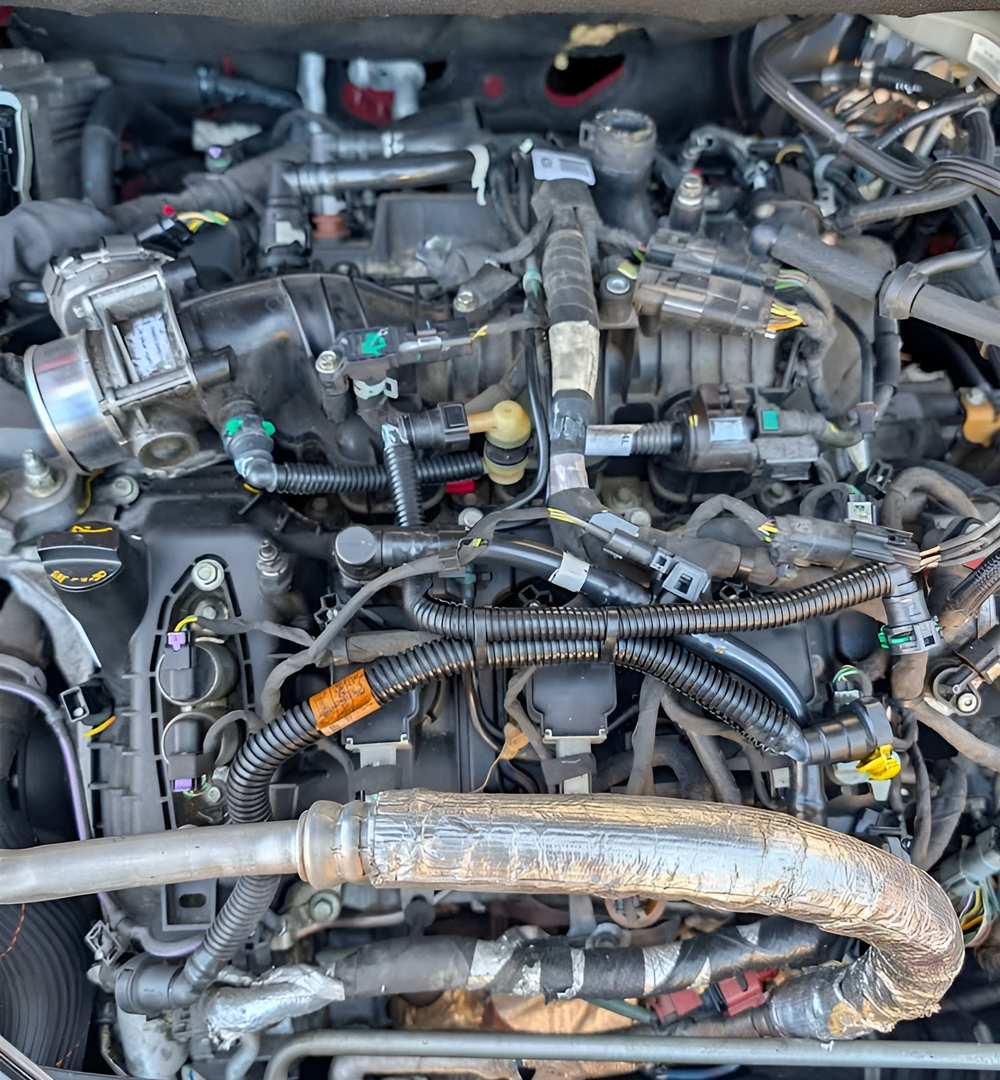
1. Nano block design and how it shapes failure patterns
Diesel-grade bones under a gasoline badge
Cast the upper block from Compacted Graphite Iron. Bolt it to a die-cast aluminum ladder frame. Clamp it down with fractured main caps and a forged steel crank. That’s the 2.7’s foundation.
CGI brings about 75 percent more tensile strength than gray iron. Boost peaks near 29 psi in stock trim. Piston cooling jets spray the crowns to control detonation under load. Bottom-end failures are rare unless oil level drops or metal circulates through the bearings.
Thermal expansion rates between CGI and aluminum differ. The joint line sees repeated heat cycles from cold soak to 220°F oil temps. That interface becomes critical at the oil pan and lower block flange. Oil sealing depends on surface prep and RTV bond strength.
Generations that quietly changed the risk map
Roll out Gen 1 in 2015 with direct injection only. Add dual injection in 2018. Update cylinder heads in 2021. Each shift moved the failure pattern.
| Model years | Fuel system | Key hardware shift | Typical engine complaints |
|---|---|---|---|
| 2015–2017 | DI only | Early composite pan, first timing layout | Oil pan leaks, intake carbon, some startup smoke |
| 2018–2020 | PFDI | Dual injection, revised pan flange | Reduced carbon, lingering pan leaks, left turbo smoke TSB |
| 2021–2022 | PFDI | Updated heads, Silchrome Lite valves | Intake valve fractures, sudden stall, recall 24S55 |
| 2023+ | PFDI | Calibration updates, hardware tweaks | Minor leaks, isolated timing noise reports |
DI-only engines spray fuel at about 2,150 psi straight into the chamber. Intake valves see oil vapor but no fuel wash. Carbon buildup shows up between 60,000 and 100,000 miles. PFDI engines cut that accumulation rate sharply.
Head updates in 2021 introduced brittle intake valves from an overheat machining defect. Many failures occurred under 20,000 miles. Ford tied the fix to recall 24S55 with a 10-year, 150,000-mile extended engine warranty on affected VINs.
Why the core survives while peripherals fail
Offset connecting rods reduce piston side loading. Bowl-shaped pistons shape the burn for strong low-end torque. The deck height shrinks 3.0 mm with a bushingless piston pin bore. These design choices lower friction and stress at high boost.
The ladder frame stiffens the crankcase and cuts NVH. Oil capacity sits around 6 quarts. Long oil intervals stretch that volume thin under twin-turbo heat. Dirty oil accelerates VCT solenoid wear and chain stretch.
Rotating assembly failures remain uncommon. Most catastrophic events originate from lubrication loss, valve metallurgy defects, or ignored leaks. A dry sump bearing will wipe out in minutes once pressure drops below spec.
2. Oil system failures that start as a seep and end as a rebuild
Plastic oil pan, RTV bond, and why it keeps coming back
Seal a composite pan to an aluminum ladder frame with RTV alone. Heat it from ambient to 220°F oil temp thousands of times. The bond line starts to shear. That’s the early 2.7 oil leak story.
2015–2017 trucks use a plastic pan with no molded gasket. Any oil film left on the flange ruins RTV adhesion. Ford addressed this in TSB 19-2205 and later 23-2083, calling out Motorcraft ZC-31-B surface prep wipes and overnight drain-down before reseal. Skip that prep and the leak returns in months.
Leaks show up at the rear flange near the bellhousing. Oil tracks down the crossmember and coats the transmission case. Many owners think it’s a rear main seal. A proper reseal runs $700 to $1,200. A rushed reseal often fails before 20,000 miles.
Revised pans, part numbers, and what actually changed
| Model years | Pan type | Seal method | Typical fix path | Repeat leak risk |
|---|---|---|---|---|
| 2015–early 2017 | Composite | RTV only | Remove, clean, reseal per TSB | High if prep rushed |
| Late 2017–2020 | Revised composite | RTV, improved flange | Updated pan + strict prep | Moderate |
| 2021–2022 | Updated composite | RTV on refined surface | Reseal or updated pan | Lower |
| Select later builds | Aluminum (ML3Z-6675-J) | Gasket plus RTV joints | Pan swap | Lowest |
Ford revised composite pans under part numbers like JT4Z-6675-E. Later configurations moved to aluminum pans in some applications. The aluminum design uses a molded gasket and RTV only at corner joints. That reduces dependence on perfect chemical bonding.
Even with updates, surface prep still matters. Oil trapped in the ladder frame bolt holes seeps back out during cure. Torque specs must be followed in sequence. Miss the sequence and flange distortion opens a leak path.
Run it low and the damage moves upstream
Ignore a slow seep and oil level drops a quart every few thousand miles. Twin turbos cook oil at high shaft speed. Cam phasers rely on steady pressure to hold position. Chain tensioners need clean oil to maintain preload.
Low oil triggers P0524 or P06DD in severe cases. By then, bearing material may already circulate. Turbo bearings score first. Cam phasers start to rattle longer than 2 seconds at cold start.
A pan reseal costs under $1,200 at most dealers. A turbo replacement can cross $2,000 per side. A long block after bearing damage runs $7,000 to $10,000 installed.
3. Fuel system and carbon buildup that chokes early DI engines
Direct injection only and the baked-on valve problem
Spray fuel straight into the chamber at 2,150 psi. Leave the intake valves dry. Feed them oil vapor from the PCV system. Carbon starts to build.
Gen 1 engines from 2015–2017 never wash the back of the intake valves. Oil mist and blow-by settle on hot metal. Heat cycles bake that layer hard. Airflow drops and mixture quality suffers.
Drivers report rough idle at stoplights. Tip in the throttle and it hesitates. Under load, misfires show up with P0300–P0306. Walnut blasting usually runs $400 to $800 once buildup gets thick.
How PFDI slowed the problem after 2018
Add port injectors alongside direct injectors. Run port injection at low load. Let fuel wash the intake valves again. Carbon rate drops.
2018–2020 and later engines use this dual system. Port injectors operate during cruise and light throttle. Direct injection takes over under boost. Valve deposits form slower and stay thinner.
Severe short-trip use still creates buildup. Long oil intervals increase vapor load in the intake. Even PFDI engines may need cleaning past 100,000 miles. DI-only engines often need blasting before 80,000.
| Generation | Injection type | Valve wash present | Carbon risk window |
|---|---|---|---|
| 2015–2017 | DI only | No | 60,000–100,000 miles |
| 2018–2020 | PFDI | Yes | Reduced, varies by duty cycle |
| 2021+ | PFDI | Yes | Lower, still possible with poor maintenance |
PCV flow, oil carryover, and catch can debates
Boost increases crankcase pressure. PCV routing pulls vapor into the intake. Oil film collects in charge pipes and intercooler tanks. That oil feeds deposits on DI engines.
Some owners add catch cans between the PCV valve and intake. They trap condensed oil before it reaches the manifold. Results vary with climate and driving style. Warranty claims may be denied if plumbing changes are found.
Heavy oil in charge pipes points to blow-by or high crankcase pressure. Inspect intercooler outlets during service. A saturated intercooler can cause stumble on throttle tip-in. Misfires from oil ingestion often clear after hard acceleration, but repeated fouling ruins spark plugs in under 30,000 miles.
4. Intake valves that snap and destroy engines in seconds
Brittle Silchrome Lite valves and keeper groove cracks
Overheat the valve during grinding. Harden the keeper groove past spec. Make it brittle under normal load. That’s what hit 2021–2022 2.7 engines.
Supplier data traced the defect to Silchrome Lite intake valves. The groove where the keepers lock in developed microcracks. Under boost and heat, the crack propagated. The valve head separated from the stem.
When that head drops, it slams the piston at thousands of RPM. The cylinder loses compression instantly. Many failures occurred under 20,000 miles, with a large share under 5,000. Restart usually fails because the valve destroys the chamber on impact.
Federal investigation and recall 24S55 / 24V635000
NHTSA opened PE22-007, later escalated to EA23-002. Field reports showed early-life catastrophic failures. Ford traced it to a defined production window. Over 90,000 vehicles fell under the campaign.
| Item | Details |
|---|---|
| Affected years | 2021–2022 2.7 EcoBoost |
| Root cause | Overheated Silchrome Lite intake valves |
| Failure mode | Valve head separates, drops into cylinder |
| Common mileage | Under 20,000 miles, many under 5,000 |
| Recall | 24S55 / 24V635000 |
| Warranty extension | 10 years / 150,000 miles |
Dealers perform an engine cycle test under the recall. Engines that fail the threshold test receive a long-block replacement. Replacement includes updated valve material and revised parts. Long-block jobs can exceed $9,000 outside warranty.
What the failure looks like in the real world
Engine runs fine one minute. Sudden metallic knock follows. Power drops sharply. The truck may stall at speed.
DTCs vary and may not set before shutdown. Compression loss shows immediately on affected cylinders. Spark plug removal often reveals metal fragments. A borescope usually confirms piston crown damage.
If the valve head embeds in the piston, the cylinder wall scores. Repair means full long block. There’s no top-end patch for a dropped valve at 29 psi boost.
5. Timing chains and cam phasers that rattle before they fail
Cold-start clatter and worn phaser lock pins
Start it cold. Hear a sharp rattle for 1 to 3 seconds. That noise often traces to cam phaser lock pin wear. Oil pressure hasn’t built yet, so the phaser can’t hold position.
The phaser uses a spring-loaded locking pin to hold zero-degree timing at shutdown. Repeated hot restarts wear the pin seat. Once worn, the internal vanes slap until oil pressure fills the chamber. Rattle longer than 3 seconds points to hardware wear, not normal startup noise.
Dirty oil thickens the problem. Sludge slows VCT solenoid response. Low oil pressure increases phaser movement at idle. Ignoring persistent rattle can lead to cam/crank correlation codes like P0016 or P0018.
Chain stretch, tensioners, and the dual-chain update
Early 2.7 engines use a single primary chain layout. Later versions moved to a dual primary chain system. Load spreads across two chains instead of one. That reduces individual chain tension.
Hydraulic tensioners rely on steady oil pressure. Aerated or degraded oil reduces damping. Chain stretch shows up as correlation faults before mechanical noise grows loud. Cam timing drift alters boost response and fuel trims.
| Component | Failure behavior | Typical DTC | Repair range |
|---|---|---|---|
| Cam phaser | Startup rattle, rough idle | P0016–P0019 | $1,500–$3,000 |
| Timing chain | Correlation drift, misfire | P0016, P0021 | $2,000–$4,000 |
| Tensioner | Rattle at hot idle | None at first | Included in chain job |
Phaser jobs require front cover removal. Labor climbs quickly due to tight packaging. Combined phaser and chain repair often exceeds $3,500 at dealer rates.
Oil intervals that decide chain life
Factory oil-life monitors can stretch changes past 8,000 miles. Turbo heat loads the oil with fuel and soot. VCT solenoids gum up first. Chain wear accelerates after 80,000 miles with long intervals.
Many high-mileage owners cut intervals to 5,000 miles. Use 5W-30 synthetic that resists shear at high bearing speed. Monitor startup noise after hot soak. Extended phaser rattle past 5 seconds signals mechanical wear, not a software issue.
6. Turbo failures that start with smoke and end with broken studs
Cold-soak smoke and the left turbo oil feed tube
Park it hot. Let it sit overnight. Fire it up and watch a blue cloud roll out. That pattern points to the left turbo oil supply issue.
Ford addressed this under TSB 20-2207 for 2018–2020 trucks. Oil drains into the turbine housing while parked. On startup, it burns off in seconds. The revised oil supply tube, part number JU7Z-9T516-A, limits that pooling.
Smoke that clears within 10 to 30 seconds usually ties to the feed tube. Smoke that lingers under throttle points to worn turbo seals. Replacing the oil line runs about $600 to $1,200. A full turbo replacement often exceeds $2,000 per side.
Wastegate rattle, underboost, and loose flappers
Hear a metallic tick on decel. Feel weak pull under load. Scan it and find underboost codes like P0299. That’s often a wastegate problem.
Early units use vacuum-actuated wastegates. Later ones move to electronic control. Linkage wear creates a loose flapper inside the housing. That rattle grows louder as bushings wear.
Underboost limits peak torque. Fuel trims climb as the ECU compensates. Ignore it and exhaust gas temps rise under load. Broken manifold studs during removal can add hours of labor.
| Failure area | Symptom | DTC | Repair cost |
|---|---|---|---|
| Oil feed tube | Startup smoke | None or oil consumption | $600–$1,200 |
| Turbo seals | Smoke under boost | P0299 possible | $2,000–$3,000 each |
| Wastegate linkage | Rattle, low boost | P0299 | $1,000–$2,500 |
Heat, studs, and why turbo jobs snowball
Exhaust manifolds integrate into the heads. Turbo mounting bolts see extreme heat cycles. Rust and carbon lock them in place. Snapped studs turn a turbo swap into a head repair.
Coolant lines and oil return tubes must seal perfectly on reassembly. A minor oil leak at the turbo return line can drip onto the hot downpipe. That creates a burning smell and smoke at idle.
Twin-turbo layout doubles parts count. Replace both units and lines, and parts alone can top $4,000. Labor pushes the full job past $6,000 in many markets.
7. 2016–2017 cylinder heads that drink oil and foul plugs
Valve guide machining defects and blue smoke on restart
Build date between April 1, 2016 and January 1, 2017. Notice blue smoke after a hot soak. See the dipstick drop faster than expected. That window ties to faulty valve guide machining.
Improperly finished guides let oil slip past the valve stems. Oil pools in the combustion chamber after shutdown. Restart it warm and the oil burns off in a cloud. Many trucks set P0300–P0306 from plug fouling.
Ford addressed this under TSB 19-2384 and earlier 18-2237. The repair calls for replacing both cylinder head assemblies. Head replacement at dealer rates often lands between $4,000 and $6,000.
Oil consumption tests and when engines get replaced
Dealers run measured oil consumption tests over several hundred miles. Consumption over about 1 quart per 3,000 miles often triggers deeper inspection. Misfire plus low oil pressure codes like P0524 or P06DD raises concern for bottom-end wear.
If bearing damage appears, Ford authorizes long-block replacement. Once metal circulates, head repair alone won’t fix it. A long block under warranty solves it. Out of warranty, total cost commonly exceeds $8,000 installed.
| Build window | Symptom pattern | Common DTCs | Typical repair |
|---|---|---|---|
| 4/1/2016–1/1/2017 | Blue smoke, rough hot restart | P0300–P0306, sometimes P0524 | Heads or long block |
What shows up on a used truck
Warm restart smoke is the first clue. Pull the plugs and look for oil-fouled electrodes. Scan history for repeated misfire codes. Check service records for head replacement.
A truck with replaced heads and clean oil pressure data may run fine long term. A truck still burning a quart every 2,000 miles risks bearing wear and turbo damage. Sustained oil starvation ruins rod bearings in minutes once pressure falls below spec.
8. Ignition and sensors that fake major engine failure
Spark plugs that can’t hold under 29 psi
Mash the throttle. Feel a sharp stumble at 3,000 RPM. Scan it and see P0302 or P0305. High boost exposes weak ignition fast.
Cylinder pressure rises hard under twin turbos. Stock plug gaps widen past 0.030 inch over time. The spark struggles to jump under load. Misfires show up during wide open throttle before they show at idle.
Factory intervals suggest long plug life. Real-world EcoBoost trucks need plugs every 30,000 to 50,000 miles. Wait to 80,000 and coils start to fail from overwork. A full set of plugs and coils usually runs $400 to $900.
| Component | Typical interval | Failure behavior | DTCs |
|---|---|---|---|
| Spark plugs | 30,000–50,000 miles | Hesitation under load | P0300–P0306 |
| Ignition coils | 80,000–100,000 miles | Persistent cylinder misfire | P030X |
| O2 sensors | 100,000+ miles | Rich/lean trims, limp mode | P013X, P015X |
Oil in plug wells from leaking valve covers makes it worse. Carbon tracking forms along the coil boot. That creates intermittent misfire even with new plugs. Replace the gasket and coils together to prevent repeat failure.
Sensors that point fingers at the wrong parts
Heat cooks under-hood electronics. Cam position sensors fail intermittently. MAF sensors skew airflow readings. O2 sensors slow down after years of high exhaust temps.
A bad cam sensor can mimic timing chain stretch. The engine may log P0016 without actual mechanical drift. MAF errors distort fuel trims and reduce boost response. Technicians who skip live data often chase the wrong repair.
Mode $06 data reveals misfire counts before the light turns on. Short-term fuel trims over plus 15 percent under boost signal airflow or sensor faults. Replace a failing sensor for a few hundred dollars. Replace a timing set by mistake and the bill jumps past $3,000.
9. Ownership math and which 2.7 years actually make sense
Big-ticket failures and what they cost in the real world
Stack the common repairs and the pattern shows up fast. Oil pan reseal sits at the low end. Turbo or phaser work climbs quickly. A dropped valve ruins the whole engine.
| Repair | Typical mileage window | Parts + labor range |
|---|---|---|
| Oil pan reseal | 40,000–90,000 miles | $700–$1,200 |
| Turbo replacement (one side) | 80,000–140,000 miles | $2,000–$3,000 |
| Cam phasers + chains | 90,000–150,000 miles | $2,500–$4,000 |
| Cylinder heads (2016–2017) | 30,000–80,000 miles | $4,000–$6,000 |
| Long block (valve or bearing damage) | Any, defect-driven | $8,000–$10,000 |
Fuel economy helps offset risk. Many owners see 22–26 MPG highway. A 5.0 V8 often lands closer to 18–21 MPG. Over 150,000 miles, that gap can equal $4,000 to $7,000 in fuel at $3.50 per gallon.
Oil capacity sits at 6 quarts. The 5.0 takes 8 to 10 quarts. Tune-up parts count stays lower on the V6. Two turbos still double forced-induction exposure.
2.7 vs 3.5 vs 5.0 under long-term pressure
| Engine | Common high-cost issue | Repair risk level | Ownership feel |
|---|---|---|---|
| 2.7 EcoBoost | Oil pan leaks, 2021–2022 valve defect, turbo wear | Moderate | Strong torque, best MPG |
| 3.5 EcoBoost | Cam phasers, timing chains, more turbo failures | Highest | Highest tow rating |
| 5.0 Coyote | 2018–2020 oil consumption, DFM lifter concerns | Moderate | Simpler layout, V8 sound |
The 3.5 carries more timing system complaints. Phaser jobs show up earlier and more often. The 5.0 avoids turbo heat but burns oil in certain years. Cylinder deactivation adds valvetrain complexity after 2021.
Many technicians favor 2018–2020 2.7 trucks. They avoid early DI carbon buildup and the 2021–2022 valve batch. 2023 and newer engines also sidestep the brittle valve window.
Long-term success still depends on 5,000-mile oil changes and fast response to leaks, because a 2.7 running low on oil can spin a bearing in under 5 minutes at highway load.
Sources & References
- Ford EcoBoost engine – Wikipedia
- Ford’s new 2.7-L EcoBoost V6 designed for lighter aluminum F-150 SAE-MA-00663
- Ford F-150 2.7L EcoBoost V6 Engine Specs & Performance Guide
- Ford 2.7L EcoBoost Specs & Turbocharged-V6 Engine Performance
- Ford’s New 2.7-L EcoBoost V6 Designed for Lighter Aluminum F-150
- Ford 2.7L EcoBoost Specs & Turbocharged-V6 Engine Performance | J.C. Lewis Ford Savannah
- 2024 Ford 2.7L EcoBoost® V6 Engine Overview
- Ford 2.7 Ecoboost Problems – CoPilot for Car Shopping
- What is Ecoboost? 3.5L Ford Ecoboost V6 Generations Explained – Full Race
- 5 Ford 2.7 Ecoboost Problems & How to Fix Them – The Lemon Law Experts
- Common 2.7 EcoBoost Problems Every Ford Owner Should Watch Out For
- 2.7 EcoBoost Problems You Might Run Into And Which Models To Avoid
- What’s the difference between the 2.3L ecoboost on my ’24 and the new ’25 MY ? : r/FordBronco – Reddit
- TECHNICAL SERVICE BULLETIN 2.7L EcoBoost – Oil Pan Leaking
- TECHNICAL SERVICE BULLETIN 2.7L EcoBoost – Oil Pan Leaking 19-2205 – nhtsa
- Ford is back to metal oil pans : r/f150 – Reddit
- TECHNICAL SERVICE BULLETIN 2.7L/3.0L EcoBoost – Oil Pan Leaking 22-2181 – OEMDTC
- TECHNICAL SERVICE BULLETIN 2.7L EcoBoost – Excessive White Or Blue Smoke From The Exhaust At Start Up After A Cold Soak 20-2207 – nhtsa
- TECHNICAL SERVICE BULLETIN 2.7L EcoBoost – Oil Consumption, Rough Idle, Misfire With Or Without Blue Exhaust Smoke – Built On 1-Apr-2016 And Through 1-Jan-2017 19-2384 – nhtsa
- 2018 f150 2.7 ecoboost notorious oil pan leak. : r/Ford – Reddit
- 2018 3.5L plastic oil pan leaking TSB : r/f150 – Reddit
- Genuine Ford Pan Assembly – Engine Oil Jt4z-6675-e for sale online | eBay
- Oil Pan – Ford (ML3Z-6675-J)
- 2.7 or 3.5? : r/f150 – Reddit
- Safety Issue Type: Recalls Engine Intake Valves May Break Affected Products (12) Associated Documents (3)
- Ford recalls over 90K vehicles for Ecoboost engine failures – WardsAuto
- Engineering Analysis (EA) – ODI RESUME
- NHTSA Closes Probe Over Engine Defect Risks of 411,000 Fords – Autobody News
- Intake Valve Caution on Ford 2.7L & 3.0L Ecoboost Engines
- Is this cam phasers ? 2016 f150 2.7 ecoboost – Reddit
- Ford 3.5L Ecoboost Series – Cam Phaser Issues Explained – Newparts.com
- What exactly is the cam phaser issue? : r/f150 – Reddit
- 2.7 safe from cam phaser issues? : r/f150 – Reddit
- Ignoring Cam Phaser Rattle? : r/f150 – Reddit
- 3.5 ecoboost Cam Phasers that bad? : r/f150 – Reddit
- Smoke on Startup. Need Opinions : r/f150 – Reddit
- Ford F-150 Turbocharger Oil Line Replacement Cost Estimate – RepairPal
- Has anyone had the 3.5 Ecoboost turbo coolant leak? How much did it cost to repair? : r/f150 – Reddit
- Shocked at these repair cost. Am I getting screwed over here? : r/f150 – Reddit
- 2015 3.5l EB passenger side turbo…Is this a coolant leak? How hard is it to fix? : r/f150
- TECHNICAL SERVICE BULLETIN 2.7L EcoBoost – Oil Consumption, Rough Idle, Misfire And/Or White Or Blue Exhaust Smoke – Built On 1-Apr-2016 And Through 1-Jan-2017 18-2237 – nhtsa
- What would you do? : r/f150 – Reddit
- 5.0, 3.5 or 2.7? Which is more reliable? : r/f150 – Reddit
- 2022 engine for lowest 20 year ownership cost : r/f150 – Reddit
- Looking for feedback on your experience between the three: 2.7 vs 3.5 vs 5.0 f150 – Reddit
- A lot of people recommend the 5.0v8 over the ecoboost engines because of durability. Is there fact behind this or just based on what people grew up with? : r/f150 – Reddit
- The Ford F-150: Model Years to Avoid (and to Buy) – Camera Source
- ’21 2.7 EB bad cam phasers : r/f150 – Reddit
Was This Article Helpful?