
Stall in the fast lane. Dash says “Stop Safely Now.” No engine noise, no throttle, just blinking hazards. That’s how the 3.5L PowerBoost can fail; fast, quiet, and with no warning.
This guide cuts through the hybrid complexity and breaks down what actually fails. We’ll dig into engine-side faults, 10R80M transmission issues, thermal overloads, Pro Power quirks, and why Ford’s dual-voltage setup can flatten batteries overnight.
You’ll see which recall hits matter, when software saves the day, and who this powertrain truly suits.
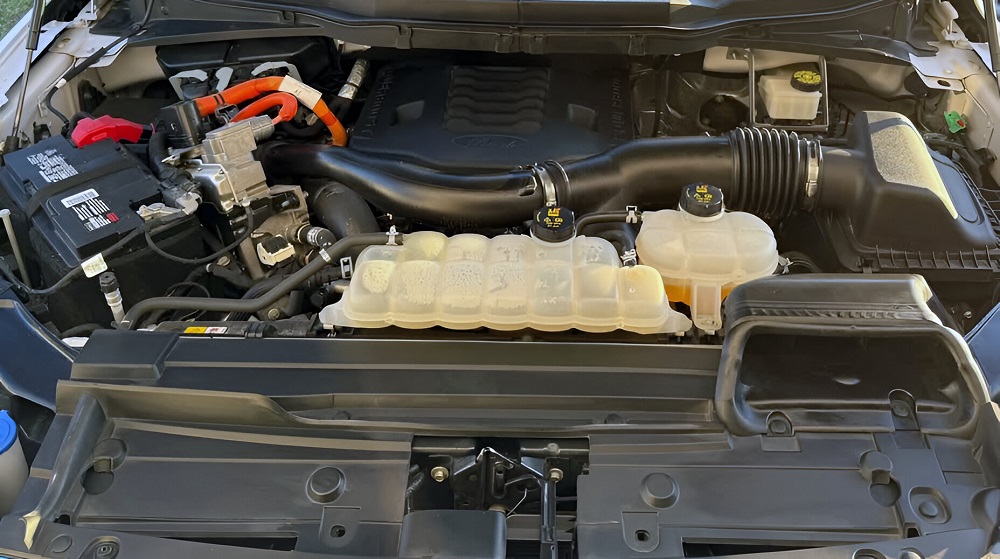
1. Hybrid layout, torque stacking, and the mechanical fuse points
What the PowerBoost layout really stacks together
Ford’s 3.5L PowerBoost runs a P2 hybrid layout. The electric motor lives between the twin-turbo V6 and the 10R80M transmission, tied together by a disconnect clutch.
When you hit the throttle, torque comes from the motor, the engine, or both, blended by software. That electric motor also drags power back in during regen braking, charging a 1.5 kWh lithium-ion battery behind the seat.
That sounds seamless on paper, but every transition hits hardware. Starting the gas engine while rolling slams the timing system. Blending torque between motor and engine pounds the clutch packs and converter.
Lugging in hybrid mode loads the valvetrain at RPMs where oil pressure is weakest. The architecture pushes smoothness and response, but it leans on delicate pieces to get there.
Where the system actually breaks (component-level failure table)
| Component | System job | Typical failure | What you feel in the truck |
|---|---|---|---|
| 3.5L EcoBoost V6 | Primary powerplant | Cam phaser wear, timing stretch, rod knock | Cold-start rattle, ticking, low oil pressure |
| 35 kW electric motor | Launch torque + regen braking | Thermal overload, transaxle failure | Reduced EV assist, “Coolant Overheating” alerts |
| 10R80M hybrid transmission | Shift logic + torque blending | CDF bushing walk, rough shifts, neutral slips | Bang into gear, flare, delayed response |
| HV battery & contactors | High-voltage switching & storage | Contactor weld, shutdown, failsafe limp | “Stop Safely Now,” complete loss of drive |
| DC-DC & 12V system | Module power, cranking, accessories | Battery drain, SOC misread, deep sleep trap | No-start, FordPass dead, warning clusters |
| Pro Power Onboard gear | AC export (2.0 to 7.2 kW) | Ground fault trips, moisture intrusion | Generator off, “Ground Fault Detected” error |
Shared parts vs PowerBoost-only hardware
The block, heads, and turbochargers all originate from the standard 3.5L EcoBoost, including oil flow quirks, valve carboning, and cam phaser issues. Even the torque converter and planetary gearset in the 10R80M match gas trucks. But several key parts are exclusive to the hybrid:
• The 35 kW traction motor
• HV battery pack and contactors
• DC-DC converter (no alternator)
• Exhaust heat exchanger
• Electric transmission fluid pump
• Pro Power Onboard inverter stack and outlets
This split matters. Gas-only issues like timing rattle and oil dilution still show up, but hybrid-specific failures pile on top. That includes battery contactor shutdowns, regen brake jerk, and sudden no-starts from a drained 12V. Used buyers rarely check both sets of problems, and that’s where the real cost creeps in.
2. Engine-side failures that wreck PowerBoost trucks early
Start-stop grind: cam phasers under hybrid pressure
Hybrid logic restarts the engine constantly. At every stoplight, during regen, even while rolling. Each start hits the timing system before full oil pressure builds. That’s where the variable cam timing system takes the first blow.
Phaser rattle on cold starts or while creeping forward is the giveaway. The knock lasts 1–2 seconds, then vanishes. But the wear adds up. On short trips, the phasers cycle more in one week than a gas truck sees in a month.
Timing correlation codes follow. Rough idle. Stalls during throttle tip-in. Ford’s revised phasers and PCM calibrations cut some noise, but hybrid restart frequency keeps chewing at the same weak link.
Chain tension and oil degradation beat down timing hardware
Stop-start wear doesn’t stop at the phasers. The timing chain, guides, and tensioners also take heat. Low-rpm hybrid cruising means long stretches without full oil pressure surge. Long oil intervals compound it. Early guides show scoring. Plastic in the pan. Metal shavings on the drain plug.
Once the timing starts drifting, DTCs flag cam/crank mismatch. Too late and you’re into valve contact. Older EcoBoosts wore timing systems past 120,000 miles. PowerBoost trucks hit the same failure markers as early as 50,000 if oil changes slip or short-trip driving dominates.
Recalls for rods and oil loss: 25S55 and 25S30
Two major recalls hit engine integrity hard:
| Recall ID | Model years affected | Defect | Driver impact |
|---|---|---|---|
| 25S55 | Select 2024–2025 PowerBoosts | Rod/bearing manufacturing deviation | Sudden knock, stall, internal failure |
| 25S30 | Select 2024–2025 PowerBoosts | Misaligned cup plug, oil dump | Fire risk, oil starvation, engine seize |
25S55 targets bad rod bearings. Some trucks seize without warning. Others knock at start-up or under light load before throwing a rod.
25S30 deals with a plug misalignment that sends oil pouring out near the exhaust. Even a short drive after the leak starts can ruin the bottom end, or light it up.
Induction buildup and power loss over time
Ford added port injectors to help clean the intake valves, but carbon buildup still creeps in, especially in cold climates where port injection doesn’t fire as often. EV-mode idling and light throttle cruising reduce valve wash even further. That’s when deposits form.
Symptoms stack slowly: weak throttle response, misfires, lower MPG. Some owners run induction services every 30,000–50,000 miles. Others go for walnut blasting when power loss becomes obvious. Ignore it, and the loss sneaks up. No codes. Just a truck that feels dull and underpowered.
3. 10R80M hybrid transmission failures and what actually breaks
Motor torque and hand-off shocks hammer the shift logic
The 10R80M doesn’t shift like a regular 10-speed. It blends power from the electric motor and the gas engine while deciding which clutch to fire next. That torque overlap pounds the geartrain harder than most drivers realize.
Shift quality depends on how well the Hybrid Powertrain Control Module (HPCM) and Transmission Control Module (TCM) stay in sync.
Get it wrong, and you feel it; hard 2–3 upshifts, bang-into-gear engagement after coasting, or a moment of neutral before Drive grabs. These aren’t wear symptoms. They’re logic failures. When the software hesitates, the transmission slams to catch up.
CDF bushing walk and 3rd/5th shift slams
One weak spot is the C-D-F clutch drum bushing. Under repeated thermal load, the bushing can move, blocking an internal oil passage. That starves the clutch. Pressure builds late. Then it slams.
You feel it in 3rd or 5th gear. Hard engagement. A clunk on downshift. A pause when shifting into Drive or Reverse after slowing down.
Ford issued TSB 22-2428 and 23-2350, with an updated drum that uses a machined lip to hold the bushing in place. But installing it means tearing the trans halfway down. Out of warranty, you’re into $5,000–$6,500 depending on labor and damage.
Aux pump faults leave the truck dead in EV mode
Unlike the gas-only 10R80, the hybrid runs an auxiliary electric fluid pump to keep pressure up when the engine’s off. Without it, the truck won’t engage Drive from EV launch.
Common codes include:
| Code | Fault | Symptoms |
|---|---|---|
| P2797 | Aux pump performance | Slipping or delay off the line |
| P0C2A | Pump motor stalled | Won’t move in EV mode |
| P0C2B | Pump feedback issue | Surging or harsh shifts |
| P0C2C | Pump signal out of range | “Enable Engine for Performance” message |
Most issues originate from the pump connector, specifically the yellow feedback wire. Moisture, road salt, or corrosion destroys signal. Diagnosing it means checking continuity and voltage at the housing.
If the pump’s dead, the fluid has to be drained before replacement. Wait too long, and burned clutches show up next.
Converter temps rise fast under tow or steep grades
The PowerBoost converter uses a thinner stator and a friction surface that can’t shed heat fast under load. On long climbs or while towing, the converter slips more to balance hybrid and gas torque. That slip creates heat. Heat weakens ATF, causes valve body cross-leaks, and accelerates CDF drum walk.
Owners who tow often report better behavior with a deep sump pan or external coolers. Factory ATF change intervals don’t cut it under thermal stress. Stick to 30,000–40,000 mile changes if the truck sees regular tow duty or sits in stop-and-go summer traffic.
4. Electrical bugs, battery drain, and hybrid shutdown triggers
12V drain, deep sleep mode, and no-start mornings
The PowerBoost ditches the alternator. A DC-DC converter pulls voltage down from the hybrid battery to run the 12V system. That works fine, until something keeps the truck awake overnight.
The FordPass modem is the top offender. Some trucks never enter sleep mode after shutdown. Third-party apps connecting to the API keep the system online. The result? Dead battery in the morning. No remote start. No cranking. Just warning lights and silence.
Even without app interference, 12V loads run high in hybrids. Every module, camera, and HVAC setting runs off the 12V side during EV-only driving. Let it sit too long and you’ll find “Battery State of Charge Low” flashing when you open the door.
BMS logic failures and bad state-of-charge math
Ford’s Battery Management System (BMS) tracks voltage and triggers load-shedding when it thinks the battery’s low. But if the SOC logic drifts, it cuts power early, even when the battery has enough charge to run.
TSB 24-2442 and related updates reflash the software that calculates charge. The change reduces false “Low Battery” warnings and prevents deep sleep triggers when voltage is still above the limit.
Some trucks still report voltage swings after the reflash. The issue splits between an aging AGM battery and software that doesn’t learn correctly. Replacing the battery alone won’t help if the BMS wasn’t reset with a scan tool afterward.
High-voltage contactors and sudden loss-of-drive
The hybrid traction battery uses high-voltage contactors to switch power in and out. When they fail, they either weld shut or fail to close. If they weld shut, the truck logs a fault and refuses to start next time. If they don’t close, the truck dies mid-drive.
That’s what triggered Recall 23S56. Some trucks would show “Stop Safely Now” and shut off while moving, leaving only steering and brakes active. Ford’s fix adds improved junction box hardware and insulation.
But failure still creeps up. A faint click from the rear seat during startup, repeat powertrain faults, or random dropouts in hybrid mode all point toward weak contactors.
5. Cooling system weak points and how hybrid heat piles up
Four separate loops, four chances to overheat
The PowerBoost runs four cooling circuits: one for the engine, one for the turbos, one for the hybrid electronics, and one for the HV battery. Each loop runs its own pump, thermostat, and plumbing path. When one fails, the rest don’t always catch the slack.
Small leaks matter more here. A little air in the wrong loop can trigger shutdowns. The truck logs separate temps for each zone. Engine temp spikes throw a traditional “Over Temp” warning. Battery and inverter loops pull hybrid-only alerts, or kill EV drive and dump torque to the gas engine.
Exhaust heat exchanger cracks and coolant loss
Ford uses an exhaust heat exchanger to help the engine warm faster after cold starts. It also heats the cabin faster in winter. But the plastic coolant spigots on top of the exchanger crack under thermal stress or vibration.
The leak starts slow. A faint sweet smell. Coolant drops with no puddle. Eventually the level drops below the sensor and throws a light. This failure is covered under SSM 51485, but often gets missed until it causes an overheat.
The part sits low, near the firewall. You won’t see the leak unless you’re looking for crust trails or dried coolant at the rear of the engine bay.
Battery cooling valve faults and degas hose leaks
The battery cooling valve meters flow into the HV battery loop. When it sticks or fails, the battery overheats, drops EV assist, and throws P0D1B and related codes. This usually shows up after a long drive, fast charging cycle, or in hot weather with regen active.
Early 2021 trucks also had coolant leak issues near the thermostat housing. The plastic hoses at the degas bottle would crack or split, causing rapid coolant loss. Ford revised the design in later model years.
| Cooling component | Failure mode | Symptoms in the truck |
|---|---|---|
| Exhaust heat exchanger | Cracked spigot | Coolant smell, low level, gradual overheat |
| Battery cooling valve | Stuck solenoid or flow fault | Reduced EV power, high battery temps |
| Thermostat/degas assembly | Hose split or seal leak | Fast coolant drop, “Engine Over Temp” alert |
| Inverter/motor cooling | Pump or flow restriction | Hybrid shutoff, fallback to gas-only drive |
Heat accelerates wear in the timing system and gearbox
Thermal stress doesn’t stop at the cooling loop. Once ATF temp spikes, timing chain guides soften, oil thins, and bushing clearances in the CDF drum start shifting. Summer towing without a trans cooler or ignoring slow leaks at the exchanger sends those failures forward fast.
High-mileage PowerBoosts with towing history often show signs of early phaser wear, slipping converters, or valve-body cross-leak, long before trucks that were left stock and driven light.
6. Pro Power Onboard faults and how the generator system fails
How generator mode connects to the hybrid stack
The Pro Power Onboard system ties directly into the hybrid architecture. Power flows from the HV battery through an inverter to the rear-bed outlets. The system pushes 2.0 to 7.2 kW, depending on trim, and can run engine-off for light loads, or force the engine to stay on when demand climbs.
The logic runs continuous GFCI checks. If the system sees a current imbalance, it shuts off instantly. This protection loop is fast, and it doesn’t wait for a physical short to trigger it.
Ground fault errors and water-triggered trips
Moisture intrusion triggers the most common Pro Power complaint: “Ground Fault Detected – System Turned Off.” Light rain, wet plug ends, or leftover water from a wash can bridge terminals in the bed-mounted outlets or underbody connectors.
SSM 50036 covers false GFCI triggers from exposure. Ford tried to patch it with software, but the real weakness sits in the hardware. The rear connections aren’t sealed against road spray.
Owners use compressed air and dielectric grease to keep the outlets dry, but long-term reliability still depends on keeping the terminals clean.
Generator heat, long runtimes, and hybrid stress
Hours of generator use doesn’t just burn fuel; it heat-soaks the drivetrain. The engine runs hotter. Transmission fluid stays near peak temp. Inverter temps climb. Some owners have logged 30°F–40°F higher ATF temps during extended Pro Power use, especially with 5 kW+ draws.
Overnight jobsite loads and camper duty push thermal limits. If the coolant’s low, or one fan fails, the system can downrate or cut hybrid mode entirely. In trucks already close to cooling limits, Pro Power runtime makes minor issues turn major.
7. Payload loss, axle stress, and how hybrid weight changes the rules
Heavy hardware cuts deep into payload ratings
The PowerBoost drivetrain adds roughly 1,100 lb to curb weight, motor, battery, cooling gear, inverters, and control units. That weight eats into payload even on trims with higher GVWR.
Sticker numbers may show 1,400–1,800 lb payload, but in real setups with passengers and gear, available tongue weight disappears fast.
Owners hit the limit without realizing it. A couple passengers, full tank, generator load, and a trailer hitch can max the axle long before the GVWR or tow rating flags a problem. Some drivers report trailer sag with tongue weights under 800 lb due to already-loaded rear springs.
Rear axle and hub loads push the limits
More static weight sits over the rear axle than on a gas-only truck. Add dynamic load, trailer bounce, generator cycling, jobsite cargo, and the hub takes a beating.
Recall 23V896 targeted rear hub assembly issues on select F-150s, including PowerBoost builds. Failures included early bearing noise, lateral play, or complete hub failure under load.
Most didn’t show codes, just growing howl or uneven tire wear. A few failed catastrophically on rough pavement or steep descents while loaded.
Towing heat ramps fast, hybrid benefits fade early
Tow mode keeps the converter locked longer and the engine on, reducing shift shock. But that also erases most fuel savings. The hybrid motor backs off. The gas engine hauls the weight solo while the battery’s locked into charge mode.
Long climbs, trailer braking, and higher electrical draw from trailer circuits heat the system faster. Fluid temps stay elevated longer. EV assist cuts out earlier. On long hauls, PowerBoost behaves more like a regular EcoBoost, only with higher curb weight and tighter thermal windows.
8. Real MPG, drive feel, and long-term cost of PowerBoost ownership
EPA numbers vs. how it runs in the wild
Ford rates the PowerBoost at 24 mpg combined. That happens, under ideal suburban conditions. In real use, numbers bounce.
| Use case | EPA label | Real-world range | Notes |
|---|---|---|---|
| Suburban stop-and-go | 24 mpg | 22–27 mpg | Best regen use, EV launches frequent |
| Mixed commute | 24 mpg | 20–23 mpg | Depends on throttle habits |
| Highway, 70+ mph | 24 mpg | 18–20 mpg | Aero drag wins, hybrid assist falls back |
| Winter or heavy towing | N/A | 12–15 mpg | Cold battery, engine-on cycles dominate |
Some owners track every trip. Others just drive it like a normal truck. Those chasing MPG stay in the EV Coach, throttle lightly, and brake early to bank regen. The rest see figures closer to regular EcoBoost numbers.
Low-speed jerk and blended brake weirdness
The brakes mix regen from the motor with friction from the pads. At low speeds, that mix gets clumsy. Common complaints: bite too early, grabby under 10 mph, or a soft pedal that tightens suddenly.
Transitioning from EV to gas also stumbles. Hit the throttle at just the wrong moment, mid-roll, creeping out of a turn, and the engine slams in late. Ford pushed out calibration updates on 2021–2023 trucks to smooth this, but reports still pop up.
Workarounds help. Some drivers stay in Tow/Haul to keep the gas engine on, smoothing power handoff. Others adjust foot pressure early, easing off regen before the final stop.
Repair costs, reputation, and who PowerBoost actually fits
Some trucks sail past 50,000 miles clean. Others chew up phasers, converters, or contactors by year two. And when it breaks, it stings. A hybrid battery junction box runs $2,000–$3,000. Transmission work starts near $4,500. A full engine swap can cross $12,000.
PowerBoost fits best when the system earns its keep; contractors running Pro Power hard, commuters who drive light and keep software fresh, and torque-first buyers who want low-end pull without caring about complexity.
For anyone chasing low maintenance over clever tech, the standard 3.5 EcoBoost or 5.0 still brings more peace.
Sources & References
- 5 3.5L Powerboost Full Hybrid V6 Engine Problems & How to Fix Them
- Is the Ford F-150 Hybrid Worth It? A Comprehensive Guide for Yukon, OK Drivers
- 2025 Ford F150 MPG: All About Fuel Economy | Way Scarff Ford
- Our Ford F-150 Hybrid Is Far Thirstier Than Its EPA Figures Suggest | Edmunds
- For anyone curious about real world Powerboost MPG. : r/f150
- Top 5 Ford PowerBoost Hybrid Engine Issues and Solutions – Lemon Law Lawyer
- 3 Common 3.5L PowerBoost Full Hybrid V6 Problems – RSSing.com
- Powertrain control module pcm software update – Ford
- 2021 F-150 – stage.fordservicecontent.com
- Ford Battery Drain FIX | Stop 12V Issues from FordPass, LincolnWay & Third-Party Apps
- TECHNICAL SERVICE BULLETIN 3.5L PowerBoost – “12V Battery State Of Charge Low” Or “Charging System Service Soon” – nhtsa
- Powerboost 3rd worst reliability per consumer reports : r/f150
- What Is the Horsepower of a Ford 3.5L Twin Turbo EcoBoost V6? – CarInterior
- Which f150 is best 3.5 or 5.0 in terms of reliability and longevity? – Reddit
- For 2021-2024 Ford F-150 3.5 Powerboost Hybrid Water Battery Cooling Valve Genui | eBay
- Anyone with 10R80 transmission issues? : r/fordexpedition
- Ford 10R80 Transmission • Problems, Solutions & Upgrades – Next Gen Drivetrain, Inc.
- Recall – Ford
- 3.5L Ecoboost and Powerboost Losing HP for 2026 Model Year : r/f150
- Powerboost owners, would you recommend it? : r/f150
- Ford F-150 Recall List (2025 Update) – The Lemon Law Experts
Was This Article Helpful?