
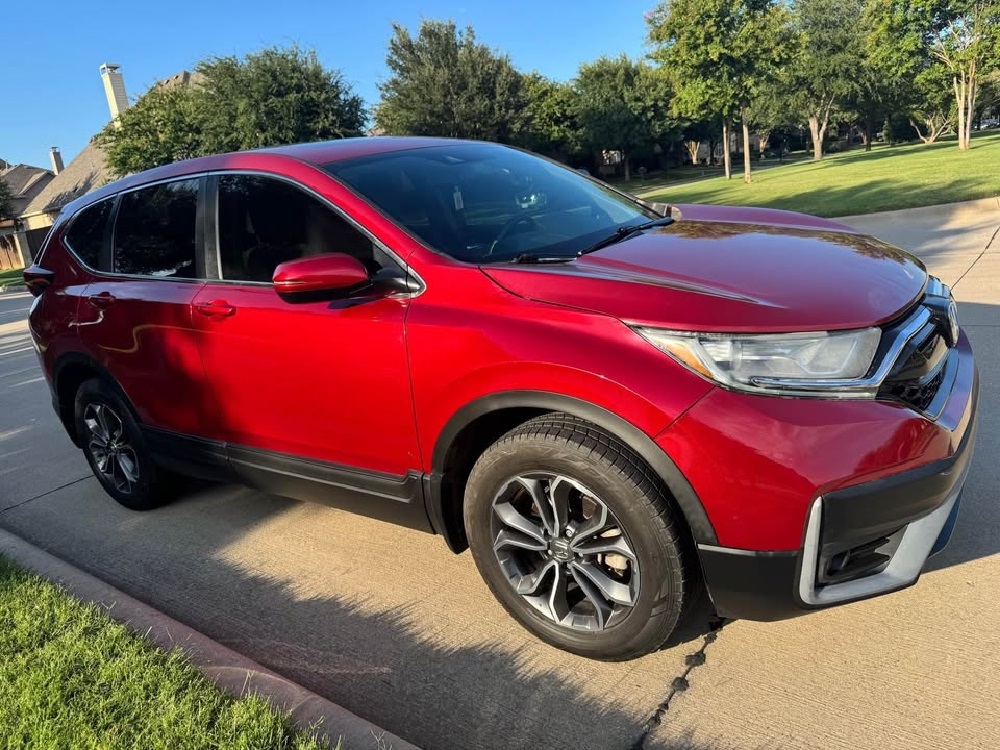
Press the gas, the revs jump, but the CR-V barely gains speed. Smooth glide or early trouble? Honda’s belt-and-pulley CVT ditches fixed gears for a constant ratio sweep aimed at fuel economy and seamless acceleration.
It can feel strange if you’re used to shift points, and sometimes that odd feel signals a real problem. Here’s what the CR-V’s CVT is actually doing, which model years got hit hardest, and the fixes that work.
From fluid swaps that buy you time to dealer updates that solve the stumble to full replacements when nothing else will.
1. Inside Honda’s CVT: What’s Really Happening
The belt-and-pulley handshake under the hood
Two cone-shaped pulleys face each other with a steel belt looped between. As speed changes, the cones slide in and out, shifting the belt’s path and creating an endless range of “ratios” without a gear change.
That’s why a CR-V can feel like it’s stretched on a rubber band, engine revs climb, then the car follows. It’s normal when healthy. The upside is efficiency; the cost is heat and fluid breakdown if upkeep slips.
Why Honda keeps doubling down
From Civic to Accord, HR-V to CR-V, Honda’s backed CVTs for over a decade. The 10th-gen Civic proved they can last, but bulletins and recalls show the tech’s still maturing. Each generation gets hardware and software tweaks to smooth quirks and counter early wear.
Perks you actually notice
A good CR-V CVT delivers better mpg than a geared automatic, smooth acceleration with no shift shock, and frees space under the hood. There’s also a built-in “limp” safeguard; if temps climb or pressure drops, it’ll cap power so you can reach a shop before it eats itself.
The trade-offs built in from day one
Even at its best, a CVT can feel odd if you expect a kickdown. They’re picky about fluid, only Honda HCF-2, and hate heat. Failures usually mean full replacements, not rebuilds, and that’s where the big bills start.
2. The problems CR-V owners actually face
Shudder when pulling away
Many 2012–2015 CR-Vs shake like they’re crossing rumble strips when easing into the throttle. The causes: worn HCF-2 fluid, outdated software, or a torque converter not locking in. One drain-and-fill may help, but stubborn cases need repeated changes and a dealer flash to reset pulley pressure.
Heat that robs your power
Push hard in summer traffic, tow, or run on bad fluid, and temps spike. The CVT’s safety logic cuts power to save the belt. If you smell burnt oil, you’re past the warning stage. A solid cooler, fresh fluid, and sane driving keep it from coming back.
Hesitation off the line
Press the gas and wait? Belt or pulley wear can do it, but so can a lazy TCM. Sometimes it’s not the CVT, dirty MAF sensors, clogged injectors, or weak ignition parts can copy the same lag. Rule out the engine before blaming the transmission.
New noises that don’t belong
A steady whine often means low fluid or bearing wear. Grinding or clunks point to growing mechanical damage. Because CVT noise can travel and mimic wheel bearings or diffs, a test drive with a tech who knows these units is worth it.
Leaks that start a downhill slide
A brown-pink puddle under the CR-V means low fluid, more heat, more wear. Fix the leak fast and refill with HCF-2 only. Anything else risks altering belt grip and damaging pulleys.
Limp mode isn’t permission to keep going
When the CR-V won’t go faster than neighborhood speeds, that’s limp mode. It’s telling you to fix it now or lose the transmission. You can make it to the next exit, not the next state line.
3. The CR-V years that really mattered
The early 4th-gen shudder years
In 2012–2014 CR-Vs, light-throttle shudder was so common it had its own service bulletins. Owners reported vibration or surging under gentle acceleration.
Honda’s TSB 15-086 and later 17-040 called for a software update and HCF-2 fluid change, with coverage extended to 8 years or 80,000 miles for this defect.
The stubborn 2014–2015 cases
Even after updates, some 2014–2015 CR-Vs kept vibrating, especially at 40–50 mph in the 1,800–2,200 RPM range. Repeated fluid changes and software flashes could tame it, but many cases pointed to deeper torque-converter or pulley wear.
2021 AWD pulley defect
Some AWD EX, EX-L, SE, and Touring trims built for 2021 left the factory with a driven pulley that wasn’t heat-treated correctly. Result: belt wear, slipping, odd noises, and sometimes no forward motion after a stop. Product Update 22-053 replaced the CVT outright, no partial fixes.
2023 Hybrid eCVT recall
In August 2023, Honda recalled certain CR-V Hybrids for an eCVT generator rotor defect that could cut all drive power. NHTSA 23V-588 covers this with a full eCVT swap. If you’re buying used, run the VIN; this one’s safety-critical and free if open.
4. The CR-V CVT owner’s game plan
Start with a VIN check
Before spending a dime, run your VIN on Honda’s owner site. If you’re in the 2021 AWD pulley or 2023 Hybrid eCVT groups, you could get a new transmission for free. Extended warranties and product updates aren’t always publicized; check even if you think you’re clear.
Change fluid right, and only with HCF-2
Honda’s CVTs are picky. The wrong fluid ruins pulley grip, scrambles shift logic, and shortens life. Use only Honda HCF-2, and if shudder’s present, plan on multiple drain-and-fills a few hundred miles apart. One change won’t flush enough.
Get the latest software calibration
Early-gen CR-Vs with judder often improve instantly after a dealer flash. TSB updates alter hydraulic pressure and pulley timing; it’s a proven fix, not a sales pitch.
Spot the AWD shudder that isn’t the CVT
Chatter on tight turns at low speeds often comes from the rear differential, not the transmission. Fresh Honda DPSF fluid cures it, don’t tear into the CVT chasing a ghost.
Know when to stop spending
If the CVT still slips, whines, or drops into limp mode after fluid and software fixes, you’re looking at hardware damage. Belts and pulleys won’t heal, and patch-job repairs just drain your wallet. At that point, replacing the unit, new, used, or rebuilt, is the smart move.
5. Maintenance moves that keep a CR-V CVT alive
Stick to the right fluid and interval
Honda’s CVTs drink one thing only, HCF-2. Anything else risks belt slip, erratic ratios, and voided warranty claims. Change intervals range from 25,000 miles in hot, heavy-use conditions to 60,000 miles in light-duty driving.
The Maintenance Minder’s Sub-code 3 tells you when it’s due. If you’re in heat, towing, or constant stop-and-go, shorten the cycle.
Fluid, intervals, and what drives them
| Item | Spec / Interval | Notes |
|---|---|---|
| Fluid type | Honda HCF-2 only | Other fluids can damage operation and durability. |
| Interval guidance | 25,000–60,000 mi; follow Maintenance Minder Sub-code 3 | Hot climates, heavy loads, stop-and-go shorten the interval. |
| Cost reality | Fluid is cheap compared to a CVT | Preventive service beats a multi-thousand-dollar swap. |
Drive like you want it to last
Smooth throttle and light brake transitions keep belt tension steady and heat down. In cold weather, give the drivetrain a minute to warm before you load it. On hills, drop into S or lower range for engine braking instead of riding the brakes, less pulley heat, more control.
Watch the support systems
A clogged cooler or weak pump can send temps soaring without warning. On AWD CR-Vs, change the rear differential fluid (Honda DPSF) when tight-turn chatter appears, so you don’t mistake it for CVT failure. Small, cheap services here prevent far bigger bills later.
6. CVT repair bills, and where to draw the line
The cheap wins; fluid and software
A drain-and-fill with Honda HCF-2 is the first move for shudder or sluggishness. Expect $100–$200 at a shop, less DIY. Some cases need two or three cycles to flush it clean. Dealer software updates tied to TSBs are often free, though you might get a diagnostic charge if it’s not covered.
Mid-tier hits that still sting
If the torque converter’s the problem, budget around $2,300 parts and labor. Pricey, but far less than a full transmission. Make sure fluid and software have been tried first, no point in replacing parts for the wrong cause.
When it’s time for the full-send
Worn belts, scored pulleys, or repeated limp-mode events push you into replacement territory. New CR-V CVTs run $3 000–$8 000 installed, sometimes over $10 000. Used or rebuilt units are cheaper, $660–$1 495 for the part, but come with risk. For 2021 AWD and 2023 Hybrid models with open recalls, a full swap may be free.
Typical CR-V CVT repair economics
| Repair | Ballpark Cost | When It Makes Sense |
|---|---|---|
| CVT drain-fill with HCF-2 | $100–$200 | First step for shudder, maintenance by mileage/Minder |
| Software update | Often free with TSB; else diagnostic fee | Early-gen judder or surge complaints |
| Torque converter | ~$2,300 | Only after fluid and software fail to help |
| Full CVT replacement | $3,000–$8,000+ (new) / $660–$1,495 (used part) | Severe slip, whine/grind, no-move, or recall-eligible 2021 AWD |
| Hybrid eCVT replacement | Recall remedy on 2023 Hybrid | Safety recall, check VIN before paying |
7. Where the CR-V’s CVT really stands
How it stacks up in the small-SUV crowd
Horror stories online don’t tell the whole story. The CR-V ranks near the top for CVT-equipped small SUVs. RepairPal gives it 4.5/5.0 for reliability, and iSeeCars scores it 8.7/10.
Many owners see 150,000–300,000 miles on the original transmission with timely service. Failures happen, but they’re less frequent than in some rival brands.
Toyota’s different play
The RAV4 avoids CVTs altogether, sticking with geared automatics. That costs a bit of mpg but delivers a transmission most buyers consider tougher long-term.
Consumer ratings often place the RAV4 on par with, or ahead of, the CR-V for reliability, and its AWD system handles rougher terrain. CR-V wins on CVT smoothness and efficiency; RAV4 wins on shift feel and durability perception.
Nissan’s hard-learned lesson
Nissan’s CVTs have experienced high failure rates, resulting in widespread warranty extensions. Against that backdrop, Honda’s issues look tame. The CR-V posts fewer catastrophic failures, better resale, and higher reliability scores.
Subaru’s close competition
Subaru’s Lineartronic CVTs, in the Forester and Outback, run just behind the CR-V in iSeeCars’ rankings. They share Honda’s sensitivity to fluid quality but pair it with a robust AWD system that earns high marks.
Owner checklist that keeps the CVT alive
Run your VIN before you spend a cent, recalls and product updates on some 2021 AWD and 2023 Hybrid models can mean a free CVT replacement.
Use Honda HCF-2 fluid only, change it on schedule (or sooner in heat, towing, or heavy traffic), and expect multiple drain-and-fills if the shudder’s already set in. Always ask for any software updates, they can smooth pulley operation and tame judder on older units.
On AWD CR-Vs, low-speed turn chatter often comes from the rear differential, not the CVT, fresh DPSF fluid fixes it. If your CVT is whining, grinding, slipping, or stuck in limp mode, stop guessing and scan it.
When symptoms survive fluid and software fixes, it’s likely internal wear; at that point, replacing the unit, whether new, rebuilt, or used, is the most cost-effective move. Staying ahead of these steps is the difference between a routine service bill and a four-figure surprise.
Sources & References
- Are Honda CVT Transmissions Reliable Over Time?
- How are everyone’s CVT’s holding up? What mileage are you at and …
- What Are Common Honda CVT Transmission Problems – Car From Japan
- 8 Honda CVT Transmission Problems & How to Fix Them – The Lemon Law Experts
- Honda CVT Reliability: What You Should Know – Shadetree Automotive
- Product Update: 2021 CR-V CVT Replacement – nhtsa
- Find Existing Honda CR-V Hybrid Car Recalls – DealerRater
- Service Bulletin – nhtsa
- Service Bulletin – nhtsa
- Service Bulletin – nhtsa
- What Causes a Transmission to Slip? | Ken Ganley Honda
- 2014 Honda CRV transmission seems to shudder or jump when shifting bet… – CarGurus
- How much does a CVT Transmission cost? – The Lemon Law Experts
- 2022 Honda CR-V Transmission Repair and Replacement Prices & Cost Estimates
- These Are the Honda CR-V Years to Avoid – MotorBiscuit
- Service Bulletin – nhtsa
- Honda CRV 2014 – Transmission shudder issue – Reddit
- Honda CR-V 2012-2014 vibration at idle – YouTube
- Honda CR-V Questions – Shutter while driving – CarGurus
- EASY Fix for Honda Transmission Shudder! – YouTube
- Honda CRV Transmission 2025 Essential Guide for Drivers
- Honda CRV Hesitation Acceleration – ISS Automotive
- Honda CR-V Whining sound when car is in gear Inspection Costs – YourMechanic
- www.yourmechanic.com
- Recall Information for Safety & Defects | Honda Owners Site
- Honda Recall Lookup | Check Recall Status | Germain Honda of Naples
- 2016 Honda CR-V Recalls & Safety Notices | Kelley Blue Book
- Transmission Fluid | CR-V 2024 | Honda Owners Manual
- Honda CR-V Automatic (CVT) Fluids – Advance Auto Parts
- What is Maintenance Minder Sub Symbol 3 – Midtown Honda
- How Often Should I Service my Honda CR-V?
- www.mymetrohonda.com
- Honda Maintenance Minder Service Codes Explained | Luther Hopkins Honda
- Honda Maintenance Codes – Main Honda Service Codes & Sub-Codes – Honda East Cincinnati
- www.hondaeastcincy.com
- Honda Maintenance Code Minder
- Honda HCF-2 Transmission Fluid – eBay
- Honda CVT Fluid HCF-2 – 08200-HCF2
- How does Honda’s faulty CVTs not hurt the brand’s reputation? – Reddit
- Honda CRV Shudder when turning – GDL Automotive
- Optimization of Hydraulic Pressure for CVT – ResearchGate
- CVT Servo-Pump Flow Control
- Automatic Transmissions for 2020 Honda CR-V – eBay
- Toyota RAV4 vs. Honda CR-V – Toyota of Renton
- Nissan Rogue vs. Honda CR-V – RepairPal
- Best CVT Small SUVs for 2025 – iSeeCars.com
- Honda CRV vs Nissan Rogue – Slowtwitch Forum