
Cold morning. Hit the starter. The 2.0 EcoBoost rattles hard, spits white smoke, then settles into a shiver. That’s coolant in the chamber.
Ford’s turbo four was pitched as a V6 replacement. But the second-generation 2.0L, built from 2015 to 2019 with a slotted block deck, carries a design flaw cast into the metal.
Under heat and pressure, coolant pushes past the head gasket and into the cylinders. The result? Misfires, hydro-lock, and sometimes full engine failure.
This guide maps which engines are affected, how Ford responded with TSBs, recalls, and class actions, and what owners, shoppers, and techs should look for, before the block fails or the heater starts a fire.
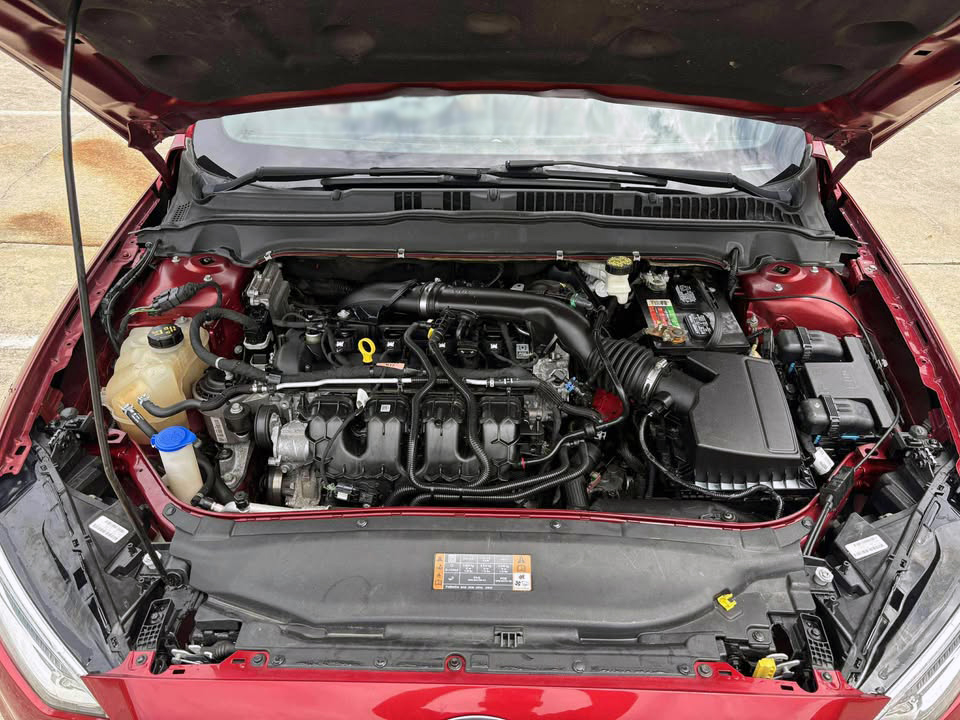
1. Why the 2.0 EcoBoost’s block design cracked under pressure
Gen 1 held the line, Gen 2 opened the floodgates
The first-generation 2.0 EcoBoost block (2010–2014) ran a closed-deck design with internal coolant jackets and steel sleeves. It had meat around the cylinders and enough clamping surface for the head gasket to hold boost. Failures were rare.
Then came the 2015–2019 update. To manage heat from the new twin-scroll turbo and integrated exhaust manifold, Ford slotted the deck surface with coolant grooves.
These open cuts between cylinders thinned the gasket’s sealing path right where pressure peaks. That compromise, more cooling, less structure, turned into a time bomb under boost.
Narrow slits meet high heat: the integrated manifold risk
Ford dropped the old bolt-on exhaust manifold and cast it straight into the cylinder head. That move cut turbo lag and saved space.
But the tighter packaging drove combustion temps up, especially between the center cylinders. So engineers carved narrow coolant channels through the top of the block to keep the area cool.
Problem is, those slits sat right under the gasket. Under load, the aluminum deck flexed just enough to break the seal. Coolant began seeping across the gap, cylinder to jacket, and into the fire.
Gen 3 brings back structure with cross-drilled cooling
In 2020, Ford scrapped the slot system. The third-generation block switched to a solid deck with angled cross-drilled holes, small, precise coolant paths that kept flow near the hot zones without cutting into the gasket’s sealing surface.
This change put the structure back where it belonged. It’s the same redesign used in long-block warranty replacements and crate service engines, easily spotted by the lack of slotted grooves across the deck surface.
2.0 EcoBoost block generations and relative risk
| Generation | Approx. Model Years | Deck / Cooling Design | Typical Applications | Coolant Intrusion Risk |
|---|---|---|---|---|
| Gen 1 | 2010–2014 | Closed-deck, internal jackets | Early Fusion, Focus ST, some early Lincoln use | Low |
| Gen 2 | 2015–2019 | Slotted/open deck, cast-in slits | Edge, Escape, Fusion, MKC/MKZ, some Explorer | High |
| Gen 3 | 2020–present | Solid deck, cross-drilled holes | Later Escape, Edge, Fusion, newer Lincoln twins | Low (revised casting) |
2. How coolant sneaks past the gasket and wrecks the engine
Pressure drop after shutdown opens the door
When the engine shuts off, combustion pressure disappears, but the cooling system stays pressurized.
That difference pushes hot coolant through any weak spots in the head gasket, especially where those slotted Gen 2 decks undercut the clamping surface. Fluid creeps across the narrow seal and lands in a cylinder. Leave it overnight and it pools.
First symptom? Cold-start misfire. You’ll get a rough idle, white vapor out the exhaust, maybe a surge as the plug finally fires through the steam.
From steam to bent rods: the hydro-lock chain reaction
If enough coolant piles up in the cylinder, the next crank forces the piston to hit a wall of liquid. There’s no compression, just a dead stop. Rods bend, blocks crack, and sometimes the head lifts clean off the deck.
This failure hits fast. One misfire turns into total mechanical lock. Drivers report sudden power loss, dashboard chaos, and engines that seize without warning.
DTC patterns that point toward coolant intrusion
| DTC | Description | What It Often Means on a 2.0 EcoBoost |
|---|---|---|
| P0300 | Random/multiple misfire | Coolant contamination causing unstable ignition across cylinders |
| P0301–P0304 | Misfire cylinder 1–4 | Targeted coolant intrusion into a specific bore |
| P0316 | Misfire on startup | Coolant pooling in a cylinder while parked, then burning off |
| P0128 | Coolant temp below threshold | Low coolant level delaying warm-up, often from slow internal leak |
| P1285/P1299 | Cylinder head over-temperature / protection | Overheating from loss of coolant volume |
| P0217 | Engine over-temperature condition | System-wide cooling failure; may follow continued driving with leak |
When a wear defect turns into a safety case
Misfires are bad. Hydro-lock is worse. But what brings the lawyers is what happens when the system keeps running hot. Low coolant eventually triggers over-temp warnings.
On some cars, it ends in limp mode. On others, the PCM doesn’t react fast enough. The engine overheats in traffic or shuts down mid-drive.
NHTSA gets involved when a performance issue crosses into public safety. That’s what pushed the block-heater recall forward. For Gen 2 engines, it’s what turns coolant leaks from a warranty fight into a recall waiting to happen.
3. What Ford’s repair procedure says when coolant hits the cylinders
TSBs don’t guess, they pressure test, soak, and scope
Ford doesn’t jump to replacements. Techs have to follow a strict TSB chain, starting with 22-2229 and older versions like 19-2346 and 22-2133.
The drill starts with a 20 psi pressure test, held for hours. If pressure drops, the soak begins. Once the engine’s cold, they pull the plugs and run a borescope inside each cylinder looking for fluid.
It’s not just about finding coolant. The block has to match a known casting code from a slotted-deck batch. If it does, Ford greenlights a long-block. If not, the claim stalls.
Short-block won’t cut it when the deck’s already warped
Dealers don’t patch these engines. They swap them. Ford specs a long-block, head, block, internals, and all, because the failure cuts across every layer. Once coolant chews into the head or seeps through the rings, a partial rebuild won’t hold.
Out of warranty? That long-block quote starts around $7,000 and climbs past $11,000 with labor, turbo transfer, and new gaskets. It’s a gut punch.
TSB 22-2229 model coverage and prescribed remedy
| Model | Affected Years | Build Date Cutoff (On/Before) | Primary Concern | Prescribed Remedy |
|---|---|---|---|---|
| Ford Edge | 2015–2018 | Full listed range | Coolant in cylinders | Long-block replacement |
| Ford Escape | 2017–2019 | May 16, 2019 | Coolant in cylinders | Long-block replacement |
| Ford Fusion | 2017–2019 | Apr 8, 2019 | Coolant in cylinders | Long-block replacement |
| Lincoln MKC | 2017–2019 | Apr 18, 2019 | Coolant in cylinders | Long-block replacement |
| Lincoln MKZ | 2017–2019 | Apr 8, 2019 | Coolant in cylinders | Long-block replacement |
Warranty stops at 5 years or 60,000 miles, many owners miss it
Ford’s standard powertrain warranty won’t budge: 5 years, 60,000 miles. Most failures land just after that. When they do, owners face three doors: beg for goodwill, lawyer up for lemon-law arbitration, or pay out of pocket.
Some dealers fight for partial coverage. Others push diagnostics and bill full freight. Ford has backed a few goodwill cases, but there’s no CSP safety net like there is for the 1.5L. One day past warranty and you’re on the hook for a $10,000 engine, no matter how many TSBs are stacked on your VIN.
4. The 2025 block-heater recall hits EcoBoost drivers from a different angle
When coolant hits the plug, the engine catches fire
Ford’s block-heater defect doesn’t wait for driving temps. It starts when the vehicle is off. If coolant leaks into the heater element, it dries into a conductive salt crust.
Plug it into household power and that residue arcs. The resistance spike generates enough heat to melt plastic and start an underhood fire, even in park.
Ford confirmed 46 fire reports by fall 2025, most from Canada. That’s where block heaters are standard gear, not an accessory.
The 2.0L shows up in nearly every model tied to 25V-685
This recall isn’t limited to one platform. It spans seven Ford and Lincoln models, all built between 2016 and 2024, and most offered with the 2.0 EcoBoost. Fusion, Escape, Corsair, Explorer, Bronco Sport, Maverick, every one of them overlaps with the coolant-intrusion engine pool.
Some owners now face both ends of the defect chain: coolant wrecking the block, and that same coolant frying the heater and torching the engine bay.
Vehicle population and scope of Recall 25V-685
| Model Line | Model Years | Approx. U.S. Units | Typical Engines Involved | Block-Heater Hazard Description |
|---|---|---|---|---|
| Ford Explorer | 2016–2023 | ~19,700 | 2.0L / 2.3L EcoBoost | Coolant leak into heater pins, fire risk |
| Ford Ranger | 2019–2024 | ~12,700 | 2.3L EcoBoost | Conductive deposits, resistive short |
| Ford Bronco / Sport | 2021–2024 | ~12,100 | 2.0L / 2.3L EcoBoost | Short circuit when plugged in, underhood fire |
| Ford Maverick | 2022–2024 | ~4,300 | 2.0L EcoBoost / 2.5 HEV | Localized melting and fire risk |
| Ford Escape | 2020–2022 | ~3,700 | 2.0L / 1.5L EcoBoost | Component damage, potential fire |
| Lincoln MKC / Corsair | 2016–2022 | ~5,100 | 2.0L EcoBoost / 2.5 HEV | Short to ground via evaporated coolant |
| Ford Fusion | 2019–2020 | ~1,300 | 2.0L EcoBoost | Fire while stationary during heater use |
Stop using it. That’s the official fix, for now
Until the redesigned heater parts arrive, Ford told owners to unplug and leave the block heaters off. That’s not a suggestion. It’s a safety directive baked into the recall bulletin.
For drivers in northern states or Canada, that removes winter-start protection. Ford hasn’t rolled out software patches or alternate hardware yet. Owners just get the stop-use order, and cold mornings.
5. Software updates, CSP red tape, and who Ford actually helped
The 1.5L got a patch to keep coolant moving after shutdown
CSP 19B37 reprogrammed the PCM on 1.5L EcoBoost engines to keep the coolant pump running after shutdown. The goal was to remove hot spots near the deck and stop coolant from flashing into steam. No parts replaced. Just a logic tweak meant to slow down gasket failures in parked cars.
It wasn’t aimed at fixing damage, only delaying it. And it came too late for many engines that had already started leaking.
The 2.0L got no CSP, just a TSB and a ticking clock
While the 1.5L got a full-blown customer satisfaction program, the 2.0L got nothing but internal service bulletins. TSB 22-2229 spelled out the long-block replacement path, but only if the engine failed during powertrain warranty.
No reflash. No proactive coverage. Just the same slotted-deck castings and a limited repair window. Owners outside the 5/60 rule were left chasing goodwill or footing the bill.
How CSPs, TSBs, and recalls differ for EcoBoost owners
| Program ID | Engine | Action Type | Core Fix | Time / Mileage Limits | Proactive or Complaint-Based? |
|---|---|---|---|---|---|
| 19B37 | 1.5L | CSP (software) | PCM reflash, after-run pump logic | Campaign window, no mileage cap | Proactive if dealer-informed |
| 21N12 | 1.5L | CSP (hardware) | Short-block replacement | ~7 yrs / 84,000 miles | Complaint + prior 19B37 needed |
| 22-2229 | 2.0L | TSB (service) | Long-block replacement if failed | Within powertrain warranty | Complaint-driven |
| 25V-685 | 2.0/2.3 | Safety recall | Block-heater replacement / disable | No mileage limit, date bound | Proactive recall notice |
Missed CSPs mean missed engines for second owners
Ford tied several CSPs to dealer-recorded history. If a prior owner skipped 19B37, the next owner couldn’t claim 21N12, even if the engine failed the same way. That shut out used buyers from full replacement.
The 2.0L crowd had even less room to fight. No software update. No preemptive block swap. Just a warranty clock, a slotted deck, and no appeal once the gasket let go.
6. Class actions, hard data, and what Ford faces in court
Miller v. Ford drags coolant intrusion into the spotlight
The lead case, Miller et al. v. Ford, consolidates claims from owners of 1.5L, 1.6L, and 2.0L EcoBoost vehicles sold between 2013 and 2019.
The suit accuses Ford of knowingly selling engines with defective block architecture, applying software patches instead of fixing the mechanical flaw, and using warranty replacements with the same slotted-deck design.
Plaintiffs argue that Ford knew by 2015 that coolant was breaching gaskets through deck slits, and that it kept building and installing those engines anyway.
Metallurgy and field failure rates add up against Ford
The case leans heavy on engineering evidence. Experts point to how slotted decks cut into head-gasket sealing zones, thinning the clamp load between cylinders. Thermal cycling widens the breach. Tests show repeat failures on replacement engines using the same casting.
Internal part numbers and TSB instructions confirm that Ford tracked which blocks carried the slot design. The switch to cross-drilled decks in 2020 shows the company had a fix, but didn’t recall the ones already on the road.
2026 trial could force broader coverage, but only for documented cases
Trial’s set for June 2026 in federal court. If the jury sides with plaintiffs, Ford could be forced to refund repairs, extend coverage for specific VINs, or offer new blocks under court order. But any relief likely depends on documentation, diagnostic records, coolant test logs, and dealer service histories.
No paperwork, no payout. That’s already baked into how CSP eligibility works. Class action outcomes won’t change that. Missed a coolant leak on paper? You’re out.
7. How the 2.0L fits into Ford’s turbocharged engine fallout
Ford’s aluminum blocks ran hot, tight, and too close to the edge
The 2.0L isn’t alone. Ford’s small turbo engines all rode the same thermal tightrope, high cylinder pressure, thin aluminum castings, and cooling systems that couldn’t always keep up.
The 1.6L EcoBoost flared first, with head cracks and fire recalls. The 2.5L HEV followed, dropping rods and venting oil near exhaust heat shields.
The failures change, but the setup doesn’t: thin walls, small decks, and no margin when things run hot.
Some engines got bailouts. Others got boxed in by warranty clocks
Ford threw full hardware fixes at some engines, CSP 21N12 for the 1.5L, Recall 23S27 for the 2.5L HEV, CSP 23N06 for bearing failures. Those owners got long-blocks and 10-year coverage.
The 2.0L didn’t. No CSP. No extended warranty. Just TSB 22-2229, locked to the standard 5/60 window. That split created two EcoBoost owner camps: those with a safety net, and those hanging by paperwork.
Recent Ford engine recalls/CSPs and where the 2.0L stands
| Program / ID | Engine(s) | Core Failure Mode | Action Type | Owner Relief Level |
|---|---|---|---|---|
| 25V-685 | 2.0L / 2.3L | Block-heater coolant fires | Safety recall | High – heater disable/replace |
| 21N12 | 1.5L EcoBoost | Slotted-deck coolant intrusion | CSP (short-block) | High – long-term engine cover |
| 23S27 | 2.5L HEV / PHEV | Block breach, oil/fuel fire | Safety recall | High – hardware modifications |
| 23N06 | 2.5L HEV | Rod-bearing failure, block damage | CSP (long-block) | High – 10yr/100k on failures |
| 22-2229 | 2.0L EcoBoost | Coolant in cylinders, white smoke | TSB (long-block) | Medium – only in warranty |
| 19B37 | 1.5L EcoBoost | Early coolant-intrusion risk | CSP (software only) | Low–medium – mitigation only |
Ford’s “quality pivot” admits the bill came due
Ford didn’t just shift to cross-drilled blocks. It shifted the whole strategy. CEO Jim Farley called out quality costs as a drag on profit and product rollout. Warranty expenses spiked into the hundreds of millions. EV development stalled.
The 2.0L isn’t the only anchor. But it’s part of the reason Ford is now scaling back turbo-first engines, pulling hybrid systems forward, and rewriting what “EcoBoost” means going forward.
8. What to do when your EcoBoost starts coughing coolant
For current owners already seeing the signs
Start with the VIN. Check it at both Ford’s recall portal and NHTSA.gov. Don’t trust one alone, Ford often flags coverage before it shows in federal records. If you’re in the heater recall batch, unplug the block heater. No power, no fire.
If coolant loss or white smoke shows up, push hard for a long-block, not just a gasket swap. Reference TSB 22-2229 and have the dealer confirm if your casting falls in the failure group. A short fix won’t hold if the block’s already compromised.
For used shoppers eyeing 2.0L models in the risk window
Skip the 2015–2019 slotted-deck years unless there’s clear proof of a replacement block, and not just paperwork saying “engine replaced.” Ask for the casting photo or part number.
Favor 2010–2014 Gen 1s or 2020+ Gen 3s with the cross-drilled redesign. Cold-start misfire, low coolant history, or ghost-white tailpipe? Walk.
For techs and fleet managers stuck with suspect builds
Run a pressure test, 20 psi for five hours minimum. Any drop calls for a soak and borescope. Track coolant trims, idle misfires, and cylinder wash patterns. If the block’s slotted, log it now and quote the long-block. Skip partial rebuilds. They don’t hold.
Always pull full recall and CSP history before quoting repairs. If it’s missing a 19B37 flash or early campaign, you may be locked out of CSP-based replacements, no matter how cooked the engine is.
Sources & References
- Ford Eco Boost Engine Defects – California Lemon Law
- EcoBoost Engine Types – JEM-Sport
- Ford EcoBoost engine – Wikipedia
- Ford 2.0 EcoBoost Recall: Explaining the Problems and Recent Legal Developments
- PSA: Ford 2.0 EcoBoost Coolant Intrusion — If This Happened to You, Please File an NHTSA Complaint – Reddit
- Ford Engine Block Heater Fire Risk Recall: Here’s What You Need to Know
- What build date or model year did the 2.0L Ecoboost change to the coolant intrusion engines? : r/fordfusion
- 2.0 ecoboost engine. How to know if you have the revised block from the outside? : r/fordfusion
- Cylinder Block Caution on 2017-2019 Ford 2.0L Ecoboost Engines
- Ford Sued Over ‘Band-Aid’ Fix for Allegedly Defective EcoBoost Engines
- Can anyone confirm that in 2020 and newer, Ford moved away from this open chamber block design? : r/ecoboostmustang
- U.S. Ford and Lincoln Dealers SUBJECT: Customer Satisfaction Program 19B37
- TECHNICAL SERVICE BULLETIN 2.0L EcoBoost – Coolant In Cylinders, White Exhaust Smoke And/Or Illuminated MIL 22-2133
- TECHNICAL SERVICE BULLETIN 2.0L EcoBoost – Coolant In Cylinders, White Exhaust Smoke And/Or Illuminated MIL 19-2208
- Anyone have a 2.0L Ecoboost with coolant intrusion? : r/fordfusion
- 2019 LINCOLN MKC Recalls, Complaints and Investigations – The Center for Auto Safety
- TECHNICAL SERVICE BULLETIN 2.0L EcoBoost – OEMDTC
- TECHNICAL SERVICE BULLETIN 2.0L EcoBoost – Coolant In Cylinders, White Exhaust Smoke And/Or Illuminated MIL 19-2346
- TECHNICAL SERVICE BULLETIN 2.0L EcoBoost – Low Coolant Level, White Smoke From Tailpipe 20-2234
- Engine failure at 44k miles on 2018 escape due to known coolant intrusion issue : r/fordescape
- Ford’s 120th 2025 Recall: Engine Block Heaters May Cause Fires – Lemon Law Help
- Ford Recalls 60,000 Vehicles for Fire Risk Linked to Block Heater – Autoguide
- Ford recalls 59,000 vehicles over engine block heater fire risk | wcnc.com
- Fords Recalled Due to Fires – Fixed Ops – Auto Dealer Today
- Customer Satisfaction Program 19B37 – Supplement #4
- Ford Ecoboost Lawsuit 2022-2024: Should You Join the Class
- NHTSA reviews Ford recall of cars prone to overheating, fires
- Screwed by Ford for coolant intrusion : r/fordescape
- Customer Satisfaction Program 21N12
- Customer Satisfaction Program 21N12 : r/fordescape
- Customer Satisfaction Program 21N03 – Supplement #1
- Customer Satisfaction Program 21N08
- Customer Satisfaction Program 21N03
- Faulty EcoBoost Engines Bring Ford To Court – Autoblog
- Consumer Class Action Lawsuit Against Ford
- Ford ‘EcoBoost’ Engine Defect Lawsuits Consolidated in California – Lieff Cabraser
- What years had the coolant intrusion issue on the 2.0 EcoBoost? : r/FordEdge
- Ford class action over oil pump defect escapes dismissal
- 2020 2022 Lincoln Corsair Engine Manufacturing Recall
- 23N06 Customer Satisfaction Program (Hybrid Maverick) – Maverick Truck Club
- New Lawsuit Targets Ford EcoBoost Four-Cylinder Coolant Leaks – Maverick Truck Club