
Clatters once, stalls, then cranks dry. A five-figure rebuild starts before the hood’s even popped. The 3.0 EcoDiesel was built for torque and range; 480 lb-ft, 900 miles per tank, and 30 mpg highway. On paper, a commuter’s dream and a tower’s sidekick. But field data tells a different story.
Main bearings seize. Fuel pumps explode. Emissions parts cook the intake. By 100,000 miles, enough failures pile up to turn a low-RPM cruiser into a no-start liability.
This guide breaks down what breaks, when it breaks, and how to keep the bottom end alive long enough to make the fuel savings worth it. Every major weak point, every real-world cost, and which version might still be worth owning; or dropping before the next regen cycle ends in limp mode.
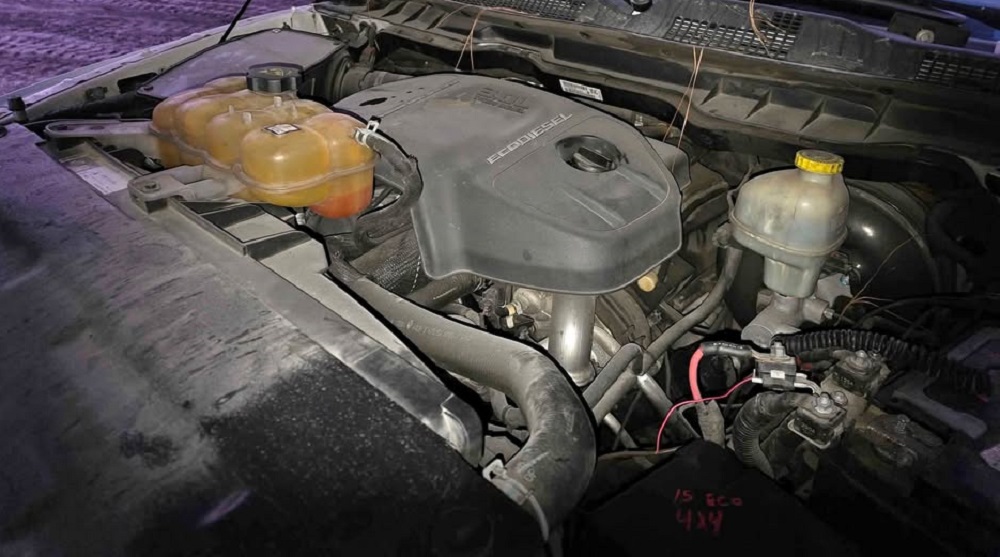
1. Design sets the trap for future failures
CGI block strength hides tight-tolerance risks
The 3.0 EcoDiesel’s compacted graphite iron block is a stiff foundation. It’s 75% stronger and 2× as rigid as conventional cast iron, allowing thinner castings and tighter packaging without losing strength. Add the 60° V6 layout, and the block keeps the center of gravity low while saving weight up front.
The bottom end bolts down like a tank. A bedplate ties all main journals together, secured with 12 fasteners per journal; four 14 mm mains and eight 12 mm bedplate bolts; mimicking a six-bolt layout.
Under that clamping force sits a forged 4140 steel crank, paired with keystone-shaped rods that shave weight without giving up tensile strength.
This whole setup depends on flawless geometry. The block’s stiffness only works if the mains are bored with torque plates, the clearances are dead-on, and the oiling system feeds evenly.
Miss that, and distortion creeps in. Bearings pinch. Journals cook. And the failure doesn’t show until the crank seizes cold on a jobsite morning.
Gen 1–2 vs Gen 3: The parts list changed, the tight margins stayed
The first two generations pushed 420 lb-ft at 2,000 RPM. The Gen 3 raised it to 480 at just 1,600 RPM; more twist, earlier load. Compression dropped from 16.5:1 to 16.0:1. Oil capacity shrank from 10.5 to 8.5 quarts. Torque rose. Margins thinned.
Gen 3 swapped in a new turbo, redesigned EGR loops, updated pistons and heads, and added a gear-driven intake cam. FCA claimed “80% new parts.” But failure data didn’t disappear. It moved.
Bottom-end issues shifted to oil cooler and oil pump complaints. DEF sensor failures climbed. And owners still report bottom-end knock past 100,000 miles; just with different triggers.
What Gen 3 fixed on paper, field shops now diagnose in new spots. The system changed. The risk stayed.
EGR soot, cylinder pressure, and oil film breakdown
This engine runs hot, pressurized, and dirty. EGR rates stay high to keep NOx down. That shoves soot back into the intake and crankcase. Oil becomes abrasive. Films shear off. Bearings grind under pressure that gas engines never touch.
The long-drain marketing; 10,000-mile intervals; clashes hard with diesel reality. Tow heavy. Idle long. Skip a change. Sludge forms fast. Soot clogs galleries. And by the time a light pings on the dash, the bearings already lost the fight.
Gen 3’s lower compression helped NVH and reduced peak cylinder pressure, but didn’t erase the soot problem. The dual-loop EGR setup just rerouted the source, not the wear.
2. When the bottom end gives out, it takes the whole engine with it
Cold knock, no restart, and how the failure hits in real time
Failures start quiet. The first sign might be a rhythmic tap when cold, then a dip in oil pressure, then nothing. One crank, no fire. On teardown, it’s spun mains, cooked journals, and metal in the pan. Sometimes the crank’s locked to the block. Other times it walks.
Most owners never see it coming. Trucks with 70,000 miles and perfect service history seize just like neglected beaters. And once the thrust bearing wipes or a main spins, no amount of fresh oil or filter changes will buy it back.
Crank loading from flawed machining and block distortion
Torque the mains wrong, and the bearings won’t live. FCA’s own field bulletins point to early assembly flaws; specifically skipped torque plates during line boring and under-torqued caps from initial VM Motori runs. That combo loads mains unevenly, especially #3, which takes side thrust and houses the thrust bearing.
On a CGI block, there’s no give. A misaligned journal pinches hard. Oil film thins out. And once the journal starts polishing itself dry, friction turns the surface blue, then black. By the time oil analysis shows high iron, it’s already too late.
Why 5W-30 lost to soot and high load
Early manuals called for 5W-30. Towing shops swapped to 5W-40 almost immediately. The thinner spec couldn’t hold pressure under sustained torque or fight soot thickening at idle. Oil film collapsed, bearings starved, and galleries choked with black gel.
FCA eventually endorsed thicker oil; Rotella T6, Delvac 1 ESP, Delo 400; but only after failures stacked up. Even then, long intervals stayed in place. Trucks running 8,000 to 10,000 miles between changes with dirty fuel and high EGR loads kept wiping bearings.
Who gets hit hardest and why the mileage spread is wide
Failure bands stretch from 60,000 miles to over 160,000 depending on how the truck’s used. Short trips and heavy tow loads stress the oiling system. Cold starts with old oil scrape bearings faster than highway pulls. Plow trucks and jobsite idlers rarely make it to six figures without bottom-end noise.
Gen 1 and Gen 2 see more failures. But Gen 3 isn’t immune. Shops still report crank knock and bearing debris in later engines; just fewer cases so far due to lower fleet miles.
Bottom-end failure patterns by generation
| Generation | Approx. model years | Typical failure mileage band | Main symptoms at failure | Common issue emphasis |
|---|---|---|---|---|
| Gen 1 | 2014–2016 | 60,000–140,000 miles | Knock, stall, no restart, metal in oil | Assembly issues + marginal oiling + soot loading |
| Gen 2 | 2017–2019 | 80,000–160,000 miles | Bearing noise, low oil pressure | Soot-contaminated oil, long intervals, high load |
| Gen 3 | 2020–2023 | 100,000+ miles (less data) | Intermittent knock, oil-pressure warnings | Isolated oil-pump/cooler issues, service errors |
3. Fuel pump failure doesn’t stall; it detonates the whole system
CP4.2 eats itself under U.S. diesel conditions
The Bosch CP4.2 high-pressure pump runs on a razor-thin lubrication margin. It was built for high-lubricity Euro diesel (EN 590, ≤460 µm wear scar). U.S. ULSD allows 520 µm; dryer, rougher, and legal. In EcoDiesel trucks, that gap means metal-on-metal scuffing.
Once the cam roller inside the pump scores its lobe, steel shavings start moving. They travel from the pump to the rails, injectors, and back through the return line to the tank. Most owners hear it too late; a chirping pump, a flashing MIL, then power loss under load.
Some pumps die clean. Most don’t. The second one roller starts gouging metal, the damage spreads. By the time pressure drops, the entire system’s been contaminated.
Recall 23V-263: what it covers and what it doesn’t
In 2023, Stellantis recalled over 45,000 trucks and SUVs under 23V-263 / FCA 01A. Ram 1500, Wrangler, and Gladiator models from 2021–2023 were included. The core issue: Bosch CP4.2 failure and high risk of fuel starvation.
Coverage varies by VIN and region. Some owners get full pump and fuel system replacement: CP4, rails, injectors, lines, tank cleaning. Others get only the pump if dealers don’t see visible contamination. No loaner. No goodwill.
Warning signs start early; pump whine, delayed throttle, or a P0087 code. Wait too long, and a stall under load triggers a cascade of sensor faults, usually with no restart.
Metal contamination drives repair costs past $10K
Once shavings hit the injectors and return to the tank, a full teardown follows. That means new pump, rails, injectors, return lines, high-pressure lines, and often tank replacement. DEF components sometimes get pulled, too, if sensors get fouled or misread fuel quality.
Dealer repairs push $8,000 to $12,000. Independent diesel shops sometimes go lower, but only if the tank stays clean and injectors survive inspection. Few do. Most trucks that suffer full CP4 failure don’t drive out on the same engine.
Lubricity additives like Archoil or Hot Shot’s Secret help, but can’t reverse damage once scoring starts. Trucks outside recall range are on their own.
EcoDiesel vs Duramax and Power Stroke HPFP risk
GM’s early 3.0 Duramax also ran a CP4 pump in 2020–2021. Failures surfaced, but GM switched to a more robust DCR pump on later builds. Ford’s 3.0 Power Stroke had the same CP4 vulnerability and exited the market entirely after 2021.
Unlike GM, Stellantis stuck with the CP4 deeper into the production cycle. That left more owners exposed, especially in areas with poor diesel quality. No factory retrofit exists. Owners either roll the dice or upgrade out of pocket.
HPFP/CP4 exposure across half-ton diesels
| Engine | Approx. years with CP4 | Known issues | Typical repair scope when it fails | Ballpark cost (out of warranty) |
|---|---|---|---|---|
| 3.0 EcoDiesel V6 | ~2020–2023 (select) | Internal wear, metal shavings, stalling | Pump, rails, injectors, lines, often tank clean | $8,000–$12,000+ |
| 3.0 Power Stroke V6 | 2018–2021 | CP4 wear, no-start, metal contamination | Similar full fuel-system replacement | $9,000–$13,000+ |
| Early 3.0 Duramax I6 | 2020–2021 (region dependent) | HPFP scuffing, low-pressure DTCs | HPFP and rail/injector clean or replace | $7,000–$11,000+ |
| Later 3.0 Duramax I6 | 2022+ (updated hardware) | Improved pump and calibration, fewer events | Usually limited to pump/lines if caught early | $5,000–$9,000 |
4. Emissions gear that clogs, cracks, and shuts trucks down
EGR cooler cracks and burns intake systems alive
The original 2014–2019 EGR cooler couldn’t take the heat cycles. Aluminum walls hairline crack under constant expansion and contraction.
Once that crack opens, coolant vapor enters the intake, pools in the manifold, and cooks off during throttle transitions. The result isn’t a check engine light. It’s a small explosion under the hood.
FCA launched Recall VB1 / 19V-757 to address this. Around 158,000 vehicles, including Ram and Jeep models, were called in for EGR cooler swaps. But that recall only covered the cooler; not warped manifolds, scorched sensors, or plastic intake melt-downs that happened before failure was caught.
Shops still pressure-test the new coolers. Failures haven’t stopped; just gotten quieter.
Soot buildup turns intake systems into tar traps
High EGR flow and oil vapor from the crankcase team up to lay sludge across the intake runners. It cakes around the intake valves, slows throttle response, and chokes cold starts. Drivers feel it as a dead pedal or rising fuel use; until the DTC stack shows EGR flow and MAF sensor errors.
City driving is worst. Short trips and cool temps never let the engine clear its throat. Blowby vapor condenses. Soot sticks. And every startup adds more until the intake turns solid.
Clean-outs require media blasting or full teardown. Oil catch cans help, but won’t stop it once buildup starts.
DPF overload from babying the throttle
The diesel particulate filter only works when it gets hot. It traps soot during normal driving, then burns it off through regeneration cycles. But regen needs high temps; over 1,100°F; and sustained load. Shut down too early, idle too long, or drive soft, and soot keeps stacking.
Once the backpressure hits the threshold, limp mode kicks in. If regen won’t complete, the truck derates until it hits zero. In some cases, the only fix is a forced regen with a scan tool; or full DPF replacement.
Passive regen works on the highway. Active regen kicks in under load. Neither works with short suburban loops.
DEF system failure from cold weather and tank crystallization
DEF is two-thirds water and freezes at 12°F. EcoDiesel tanks include heaters and sensors, but both have weak points. If the heater fails, the DEF gels. If the sensor misreads level or quality, the truck throws warnings like “Service DEF” or “See Dealer.”
The bigger issue is crystallization. DEF that sits too long; or evaporates through a leaking cap; forms crystals. These clog the injector, confuse the level sensor, and jam the pump. By the time the countdown-to-no-start begins, the system’s already compromised.
The only long-term fix is tank replacement. Temporary clears; like flushing or hot water; rarely hold up through the next freeze.
Common emissions-component failures and on-road impact
| Component | Typical failure mode | Common DTCs / warnings | On-road effect |
|---|---|---|---|
| EGR cooler | Internal crack, coolant leak into intake | Coolant loss, white smoke | Fire risk, misfire, overheating |
| EGR valve | Sticking from soot/sludge | EGR flow codes, rough idle | Hesitation, poor fuel economy |
| DPF | Plugged from incomplete regens | DPF full / regen required | Power reduction, limp mode |
| NOx sensors | Sensor failure or contamination | NOx efficiency codes | Derate, increased DEF use |
| DEF tank/heater | Heater failure, crystal buildup, sensor faults | “Service DEF”, “See dealer” | Limited speed, countdown to no-restart |
5. Gen 3 fixes some flaws; and builds in new ones
New EGR layout and VGT reduce soot but bring new risks
Gen 3 engines use a dual-loop EGR system. The second loop pulls exhaust after the DPF, sending cleaner gas back into the intake to cut soot. It works; less carbon loads the valves; but heat still builds in the cooler and valve. Failures still happen. They’re just harder to trace.
A water-cooled electronic VGT replaced the earlier turbo setup. It’s smoother, quicker, and runs cooler under load. But the electronic actuator adds failure points, and the center section still relies on clean oil and sharp install discipline. Over-torque the feed line or reuse the wrong crush washer, and turbo death isn’t far behind.
Compression dropped from 16.5:1 to 16.0:1. Piston mass came down. NVH improved, especially at idle and under light throttle. But load margins stayed tight. Field data still shows injector rattle, boost issues, and exhaust tone changes under sustained load; all signs that not every Gen 3 build lands clean.
Oil system failures from cap swaps and cooling faults
The Gen 3 oil filter cap looks like the Gen 2 version; but it’s not. The bypass valve is built into the cap. Use an old filter or aftermarket cap, and the valve won’t open at the right pressure. That sends unfiltered oil across the bearings. Failures don’t happen that day; but they will.
Some 2020–2023 trucks also show early oil cooler and oil pump failures. In some cases, the cooler leaks internally and thins out the oil with coolant. In others, pressure drops under load without warning, triggering a P06DD code or flashing gauge. Either way, bottom-end wear ramps fast once the film breaks.
Even dealer shops have swapped in the wrong oil cap. Teardown photos from EcoDiesel forums show wiped bearings with clean oil and fresh filters; because none of it was flowing where it should.
What teardown benches say about Gen 3 reliability
Gen 3 bottom ends hold up better in fleet reports, but failures haven’t vanished. Techs still find crank walk, main scoring, and EGR valve clogging. The engines just take longer to break.
Oil quality and change intervals still dictate survival past 100,000 miles. Trucks with sloppy maintenance still wipe bearings. DEF tanks still crystalize. And sensor drift still sends trucks into limp mode mid-trip.
Lower NVH and better throttle response don’t mean fewer shop visits. They just mask the issues longer. When they hit, the price tag still lands in four digits.
6. Gas-truck habits ruin EcoDiesels before 100,000 miles
Factory service intervals miss the mark in the real world
FCA called for 10,000-mile oil changes, 20,000-mile fuel filter swaps, and occasional DEF refills. On paper, that worked. On the road, it backfired. Trucks running long intervals loaded with soot saw bottom-end wear spike. Oil sheared down. Filters clogged early. Bearings failed before 90,000.
Diesel shops don’t follow the book. Most push 5,000–6,500-mile oil changes, 10,000-mile fuel filters, and annual coolant checks; especially on trucks that idle, tow, or see cold starts daily. DEF tanks still need full refills with every oil change, or owners face countdown faults from low levels or sensor errors.
The trucks that reach 200,000+ without a rebuild all show the same pattern: short intervals, filter discipline, and clean fuel.
Small changes that decide if the engine lives or quits
Oil quality matters more than brand. Every shop favorite; Rotella T6, Delvac 1, Delo 400; runs 5W-40 synthetic with proper diesel certifications (API CK-4, dexos DHD, ACEA E9). Skip that, and soot loads rise faster. Cold pressure drops. Oil film thins under load.
Fuel lubricity additives matter for CP4 survival. Archoil AR9100 and Hot Shot’s Secret LX4 top the list. They don’t undo damage, but they cut friction between the pump’s cam and roller. Some shops blend it in at every fill-up, others once a month. Trucks that skip it risk full pump failure.
Driving style also affects failure rate. Steady highway pulls complete DPF regens and keep oil hot. Short local hops, idle-heavy use, or babying the throttle traps soot, boosts EGR rates, and shortens engine life.
When cost savings vanish in the shop bay
On a clean highway loop, the EcoDiesel pulls 24 mpg easy; 7 better than the 5.7 Hemi. Over 100,000 miles, that saves roughly 1,700 gallons. At $3.50–$4.00 per gallon, that’s $6,000–$7,000 saved at the pump. But diesel oil, filters, fuel system parts, and DEF chip away fast.
A single HPFP failure wipes all fuel savings. So does a DPF or EGR failure out of warranty. Even routine service runs higher; more oil, pricier filters, and dual fuel filter jobs most shops charge separately.
The breakeven point depends on how the truck’s used; and whether the major repairs hit before the fuel savings stack.
Simplified 100,000-mile cost comparison (illustrative)
Assume mixed use, U.S. fuel prices, and one major repair event on the EcoDiesel.
| Item | Ram 1500 3.0 EcoDiesel | Ram 1500 5.7 Hemi gas |
|---|---|---|
| Average real-world mpg | ~24 mpg | ~17 mpg |
| Fuel used over 100k miles | ~4,170 gal | ~5,880 gal |
| Fuel cost (@ $4.00 diesel / $3.50 gas) | ~$16,680 | ~$20,580 |
| DEF over 100k miles | ~10–12 jugs (~$200) | N/A |
| Routine oil + filters | Higher volume, pricier oil (~$1,600) | Lower volume, cheaper oil (~$1,000) |
| Fuel filters / diesel-specific | ~$600 | N/A |
| One major diesel repair (HPFP/DPF/EGR, out of warranty) | $5,000–$9,000 | N/A (or similar for cam/lifters only if it happens) |
| Net cost swing vs Hemi | Can be cheaper if no big failure; far more expensive if it does | More predictable, higher fuel spend |
7. Recalls and emissions claims that still leave gaps
Fire risk, stalling, and emissions campaigns that patch part of the problem
Recall VB1 / 19V-757 replaced faulty EGR coolers after dozens of fire reports. Around 158,000 trucks and SUVs were called in.
Dealers swapped the cooler, but skipped damaged intakes or warped sensors unless they failed post-repair. Many owners didn’t know the manifold had been partially cooked until a month later when the idle got rough.
Recall R69 focused on SCR catalyst failures, mostly early builds. Dealers flashed emissions software, replaced select catalysts, and reset the monitors.
In some cases, new parts clogged faster than the old ones. Repeated regens and limp modes followed, with few options but a second round of warranty work; if the clock hadn’t run out.
Recall 23V-263 / FCA 01A addressed CP4 pump failures on 45,000+ trucks. But many VINs outside the recall show identical failures. If the tank wasn’t fouled yet or if “visible damage” didn’t show, owners were turned away.
These campaigns buy time. They don’t buy a rebuilt bottom end.
Emissions settlements that helped some and missed others
Early Gen 1 and Gen 2 EcoDiesel owners saw extended emissions warranties after class action lawsuits over NOx levels. Software updates, hardware changes, and buyback offers followed.
But only certain VINs qualified. And only emissions components were covered; bottom-end failures, oiling problems, and CP4 grenades weren’t included.
Even covered owners hit brick walls. One dealership replaced a SCR under warranty, then denied injector work when shavings showed up. The emissions warranty stopped at the pump. The powertrain warranty stopped at “wear item.”
Every fix had a carve-out.
What voids coverage fast; and how to protect your claim
Tuning ends warranty dead. Even if the tuner’s been removed, the ECU logs it. Same with deletes. Even a shop-installed EGR block plate or a “mild” DEF tune shows up in warranty history and gets flagged fast.
Lift kits, gear swaps, oversized tires; anything that changes load behavior; can be blamed for transmission, regen, or fuel pressure faults. Once flagged, the burden flips. The owner has to prove their parts didn’t cause the failure.
Shops that document every service, log fuel filter dates, and flag issues early get farther in claim disputes. Trucks without receipts don’t get calls back.
Major EcoDiesel campaigns and what they touch
| Campaign / settlement | Main focus component(s) | Model years most affected | Typical owner benefit |
|---|---|---|---|
| VB1 / 19V-757 | EGR cooler cracking / fire | ~2014–2019 | Cooler replacement, fire risk mitigation |
| R69 (emissions) | SCR catalyst / NOx control | Selected early years | New catalyst, updated calibration, warranty |
| 23V-263 / FCA 01A | Bosch CP4.2 HPFP | ~2021–2023 | Pump and fuel-system repair under recall |
| EcoDiesel emissions settlement (U.S.) | EGR/DPF/SCR and software maps | Mostly Gen 1–2 | Extended emissions warranty, some payouts |
8. EcoDiesel vs. Duramax, Power Stroke, and gas; who wins where
Duramax takes hits early, but holds stronger long-term
GM’s 3.0 Duramax I6 puts down 460–495 lb-ft with smoother balance thanks to its inline layout. Early builds used the same CP4 pump that doomed the EcoDiesel and Power Stroke.
Failures hit in 2020–2021 models, but GM switched to a DCR pump on the LZ0 revision. That move cut fuel-system failures sharply.
Shops report fewer bottom-end failures on the Duramax. The crank and block setup is more tolerant to load, and oil pressure stays steadier under tow. Emissions issues still happen; NOx sensors, injector faults; but less frequently than EcoDiesel’s constant DEF and DPF complaints.
Duramax owners still need to watch regens and oil intervals, but overall failure risk drops fast after the pump update.
Power Stroke dies with the pump; and takes Ford’s half-ton diesel with it
Ford’s 3.0 Power Stroke V6 also ran a CP4 and paid the price. Failures spiked by 2020. Metal in the rails, injector wipeouts, no-restart faults. Add in valvetrain ticks, DPF limp modes, and a timing chain that rattled under load, and warranty claims climbed fast.
Ford dropped the engine in 2021. Parts support still exists, but shops are seeing fewer rebuilds and more full swaps. Used buyers back away fast once injectors or crank noise show up.
Some high-mileage Power Stroke trucks survive on clean diesel and easy highway miles. Most owners who hit 100,000 sold them by 120,000 to avoid a $10,000 parts bill.
Hemi and Hurricane fight with fuel; not with failures
Ram’s 5.7 Hemi burns more fuel, but breaks less often. Lifters still wipe cams in some years. MDS solenoids fail. But the bottom end rarely cracks, and the intake won’t catch fire under load. Most trucks go 200,000 with basic service and a cam swap at worst.
The new 3.0 Hurricane I6 hits 450–510 lb-ft with twin turbos and direct injection. Early signs show tight clearances, finicky oil pressure, and heavy reliance on calibration updates. Still, it beats the EcoDiesel on throttle response, cold-start consistency, and part support.
The biggest strike against the EcoDiesel now is value. One turbo failure on the Hurricane costs less than a CP4 rebuild. One bad EGR valve on the Hemi costs a tenth of a DEF tank and heater module.
Quick spec and problem-profile comparison
| Engine | Layout | Peak torque (approx.) | Highway mpg (real-world) | Signature problem areas | Current status |
|---|---|---|---|---|---|
| 3.0 EcoDiesel V6 | 60° V6 | ~480 lb-ft | Low-20s to mid-20s | Bottom-end failures, CP4, EGR/DPF/DEF issues | Discontinued after 2023 |
| 3.0 Duramax I6 (GM) | Inline-6 | ~460–495 lb-ft | Mid-20s | Early HPFP issues, some emissions faults | Still offered (updated) |
| 3.0 Power Stroke V6 (Ford) | 60° V6 | ~440 lb-ft | Low-20s | CP4 failures, timing, emissions hardware | Discontinued 2021 |
| 5.7 Hemi V8 | 90° V8 | ~410 lb-ft | Mid-to-high teens | Lifters/MDS, cam wear, higher fuel usage | Still widely used |
| “Hurricane” 3.0 TT I6 | Inline-6 | 450–510 lb-ft | High-teens to low-20s | Early production learning curve, complexity | Growing deployment |
9. Who should still run an EcoDiesel; and how to spot one that’ll survive
Long-haul owners who rack up clean miles
EcoDiesel works best when it stays warm and moving. Highway commuters who knock out 25,000 miles a year with light load and clean diesel see the fewest problems. Rural owners with access to quality fuel and time for full regens stretch the platform past 200,000 miles.
Fleets with strict logbooks also make it work. When filter changes land on time, DEF stays topped, and idle hours are tracked, the odds of fuel or emissions system failure drop hard. These engines don’t forgive missed service or weak oil.
Short-hop city trucks die young. Stop-and-go loads the DPF, thickens the oil, and triggers limp mode cycles the DEF system can’t keep up with.
Used-buy red flags that end in shop bills
Gen 1 trucks (2014–2016) carry the most bottom-end and EGR cooler risk. Gen 2 (2017–2019) added torque but kept the same vulnerabilities. Gen 3 (2020–2023) moved the failure points; but not the cost of fixing them.
Watch for missing fuel filter records or 10,000+ mile oil intervals on service logs. Listen for cold-start knock, long cranks, or ticking under load. If regen doesn’t complete on a short loop or the oil smells cooked after 5,000 miles, skip it.
Fuel rail whine or pump buzz at idle often means the CP4 is already worn. DEF errors, even after sensor replacement, point to tank crystallization.
A wiped EGR valve or metal in the filter screen means a teardown’s coming fast and expensive.
What a “sorted” EcoDiesel needs to actually last
Trucks with HPFP recall completed, EGR cooler replaced, and emissions software updated under settlement show better long-haul odds. Additives in the fuel, shorter oil intervals, and confirmed 5W-40 use help hold the line. So does a clean DEF system and a working DPF that doesn’t plug at every idle.
But no fix solves bottom-end machining flaws. Once the crank journals lose oil film, the teardown clock starts ticking. Clean oil can delay it, not reverse it. Most EcoDiesels that live long lives stay with one owner. The moment they change hands, those habits tend to break.
Sources & References
- EcoDiesel – Wikipedia
- 2022 3.0L v6 Eco-Diesel Engine Review & Specs – Planet Chrysler Jeep Dodge RAM
- 3.0L Chrysler / Dodge/ RAM Ecodiesel Engine | Fraser Engines and Transmissions
- Ram 1500 Ecodiesel Problems: 2020-2023 RAM 1500 | ABCO Diesel Mechanic Shop
- FCA EcoDiesel Fuel Pump Recall Overview [2025 Update] – Lemon Law Firm
- Safety Recall VB1 / NHTSA 19V-757 Diesel EGR Cooler
- An Inside Look At The Ram 1500 3.0L EcoDiesel – Diesel Army
- 2014 Ecodiesel Engine Failure : r/ram_trucks – Reddit
- Knock, knock, knock goes the ecodiesel : r/Justrolledintotheshop – Reddit
- Ecodiesel Engine failures, and our engine rebuilds – YouTube
- JUNK Jeep Ram 3.0 ECODIESEL Engine Teardown. Why Do These …
- 4 tips to keep your ecodiesel alive – 10 years / 300000 km – YouTube
- Jeep Recall: Nearly 12,000 Wrangler EcoDiesels May Have Faulty High-Pressure Fuel Pumps – TFLcar
- CP4 Failure: Symptoms, Causes, Prevention, & Upgrades – Diesel Power Products
- Diesel Lubricity Explained: Prevent CP4 Pump Failure & Improve Fuel Lu – Archoil
- CP4 Fuel Pump Failure: Why It Happens & How to Prevent It – North Texas Truck Stop
- Is Diesel the Same Everywhere in the World? – Hot Shot’s Secret
- Part 573 Safety Recall Report 23V-263 | NHTSA
- Stellantis Recalls 45,711 EcoDiesel Vehicles For HPFP Failure – MoparInsiders
- Top 3 Causes of EGR and DPF Failure: What Every Diesel Owner Needs to Know
- Examining 5 Causes of DPF and EGR Failure – Blessed Performance
- 3.0L EcoDiesel Specs, Tow Ratings, and Fuel Economy – Diesel …
- Common issues of 3.0L EcoDiesel Engines – Paul and Sons Automotive and Towing
- EGR Coolers, Turbo Failures, and Aftertreatment Performance – Roadwarrior Inc
- Def system see dealer : r/EcoDiesel – Reddit
- Technical Service Bulletin (TSB) – Diesel Exhaust Fluid (DEF) Fluid Freezing – nhtsa
- Emissions Recall R69 Selective Catalytic Reduction Catalyst – nhtsa
- ECODIESEL P20E9 DPF INJECTOR PRESSURE CLEANING FIX REPAIR – YouTube
- Gen 3 issues? : r/EcoDiesel – Reddit
- GEN-2 and GEN-3 – 3.0L Oil Filter Cartridge – nhtsa
- 2020-2023 RAM 1500 EcoDiesel Service Guide (Oil, Differential, Fuel Pump)
- Comprehensive Ram 1500 3.0L EcoDiesel Maintenance Guide – Parts List
- RAM Maintenance Schedule | RAM Service Intervals – Sam Leman CDJR of Champaign
- New Gen 3 Owner. Tips? : r/EcoDiesel – Reddit
- Ram EcoDiesel 3.0L V6: Tips For Performing A Proper Oil Change – YouTube
- Any 2020-2023 1500 Ecodiesel owners : r/ram_trucks – Reddit
- Ram 1500 MPG & Fuel Efficiency Ratings – Turlock CDJR
- Video: Ram EcoDiesel vs Ford Power Stroke vs Chevy Duramax – What’s The Best Affordable Diesel Half-Ton Truck?
- 3.0L Duramax Vs. 3.0L EcoDiesel | DrivingLine
- Ram 1500 3.0L EcoDiesel V6 Engine | MPG, Towing & More