
Rattle the lifters, then eat the cam; that’s how the 6.4 Hemi knocks itself out of service. This V8 was built to bridge brute torque and gas simplicity, but the longer it idles, the louder it ticks.
Trucks snap manifold bolts under heat soak. Cars stress lifters at redline. And both lose metal into the oil when needle bearings seize and lobes flatten.
This guide lays out where the 6.4 fails, how BGE and SRT versions differ, why MDS makes things worse, and which fixes actually hold. You’ll see how it compares against Ford’s 7.3 Godzilla and GM’s 6.6 L8T, and what keeps this V8 earning its spot, not draining your wallet.
1. Where 6.4 Hemi problems show up first
Truck-grade block vs street-tuned 392
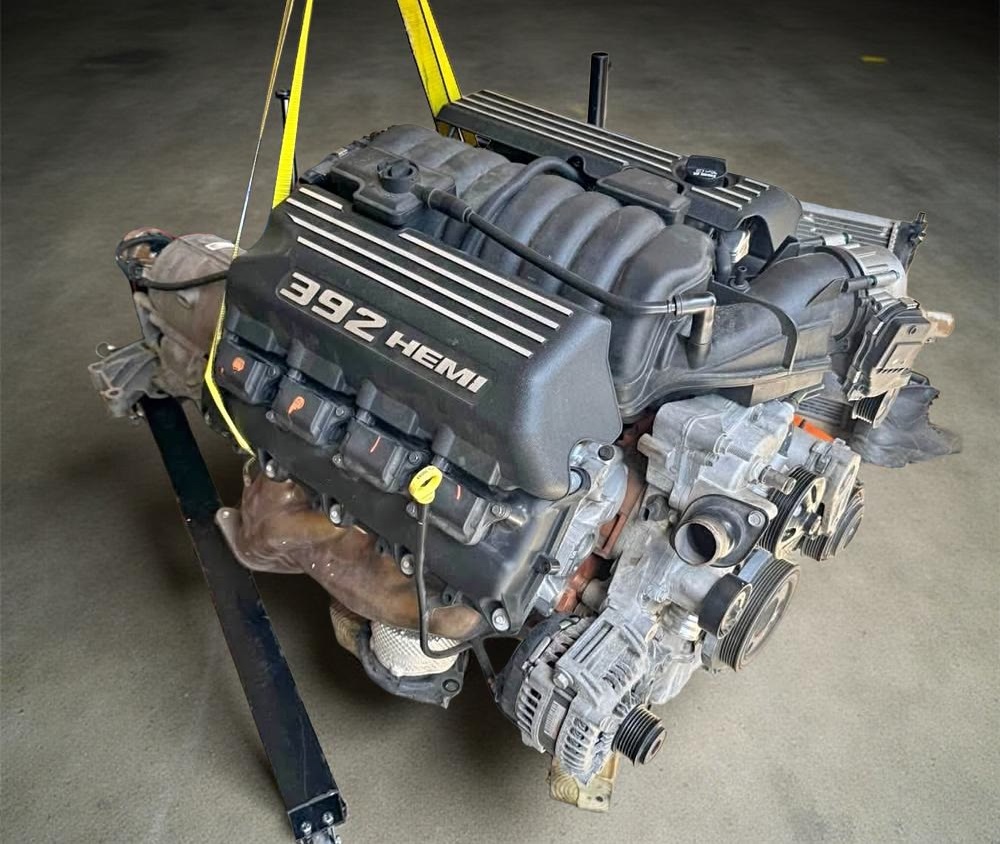
The BGE block under heavy-duty Rams isn’t the same engine bolted into Scat Packs. It’s heavier, stiffer, and cast with more nickel to take long-haul abuse.
Cooling jackets are shorter to thicken the walls. Piston squirters come standard to keep crown temps down. The heads are T356 aluminum, not the lighter castings from cars.
Trucks pull 410 hp at 5,600 rpm on 87 octane. They run 10.0:1 compression with a cam tuned for grunt. Cars push 485 hp, hit 10.9:1 compression, and live above 6,000 rpm with more aggressive lobes and variable-length runners.
Same displacement, but very different battles, towing heat in the Ram, rev stress in the Charger.
Where trucks crack manifolds and wear the valvetrain from low-rpm lugging, cars push oil temps and lifter geometry at high rpm. Both fail, just on different schedules.
MDS hardware multiplies failure points
Every MDS-equipped 6.4 runs collapsible lifters, solenoids, and gallery tweaks to shut down half the cylinders under light load. Ram 2500 trims like Laramie and Big Horn often carry it.
Automatic-equipped Scat Pack and SRT 392 cars also carry the system, while manual versions skip it. Some fleet-spec Rams skip it too, but most trucks from 2014 to 2022 carry the system
MDS lifters fail more often. They collapse, lose pressure, seize bearings, and throw off the cam’s oil supply. Solenoids stick. PCM logic delays reactivation. The oil circuit feeds change depending on whether the system’s engaged or not.
Non-MDS setups still use the same basic valvetrain and can fail the same way, but they dodge the moving parts and gallery disruptions that come with cylinder deactivation.
Idle hours destroy engines faster than miles
Fleet trucks rack up hours sitting still, PTO on, crane idling, plow lights burning. The odometer says 60,000. The engine’s lived more like 180,000. And in that time, the crank turns slow, the pump puts out minimal pressure, and the valvetrain’s starving.
SRT cars rack up fewer idle hours but live hotter. They fire up cold, run short trips, or get flogged at high rpm. More splash oil, better crank speed, but the temps push the edge and heat soak loads the oil system hard once parked.
What wears out changes by use case, but both push the same weak spots: lifters, cam lobes, and cooling systems aged by either chronic low-flow or repeated thermal spikes.
6.4 Hemi configurations and typical problem profile
| Use case | Engine variant | Key features | Problems usually seen first |
|---|---|---|---|
| Ram 2500/3500 tow rig | 6.4 BGE truck | High-nickel, squirters, MDS | Lifter/cam tick, manifold bolts, pump |
| Fleet HD gas chassis | 6.4 BGE, high idle | Hours >> miles, lots of MDS time | Early valvetrain wear, cooling age |
| Scat Pack / SRT 392 car | 392 car engine | Higher compression, 8-speed auto (with MDS) | Lifter/cam tick, heat soak, knock risk |
2. Lifter and camshaft failure takes the engine with it
Needle bearings seize and the roller stops doing its job
Each lifter rides a cam lobe on a tiny roller packed with needle bearings. In later Gen III builds, that bearing set got smaller while axle diameter grew, raising contact stress right where oil film matters most.
Once heat thins the oil or splash falls short, the needles pit and grab. The roller skids across the lobe instead of spinning, and the hardened surface disappears fast.
That skid cooks the lobe locally, knocks lift and duration down, and chokes airflow on that cylinder. Power drops first at low rpm, then everywhere. The damage starts microscopic and turns visible before the noise gets loud.
The tick escalates into misfires and oil contamination
Early on, the sound is light and rhythmic on one bank, easy to brush off as injector chatter. As the lobe flattens, the cylinder falls behind, idle roughens, and misfire counts stack. Scan data shows cylinder-specific faults like P0300 variants while trims creep as combustion quality falls.
Keep driving and metal leaves the cam and lifter face. That debris rides the oil through bearings, VVT screens, and control valves. Once glitter shows up in the oil or OCV screens, guidance pushes toward full teardown or replacement because the contamination doesn’t stay local.
Why one engine dies early while another runs long
Parts variation matters. Not every lifter batch leaves the plant equal, and small metallurgy swings show up later under heat. Maintenance habits amplify it, short trips with stretched intervals and cheap filters thin the margin until the bearings give.
Use pattern matters too. Long hot idle starves splash and cooks oil. Lugging under load keeps rpm low while cylinder pressure stays high. Engines kept in a healthy rpm band with frequent oil changes often carry stout bottom ends well past 200,000 miles, until the valvetrain sets the clock.
3. Oil flow problems take down lifters before mileage does
Oiling geometry leaves rollers dry at the worst time
The 6.4 Hemi’s oil path starts strong; crank-driven pump feeds the mains, then lifter galleries. But up top, the valvetrain depends more on splash than direct feed. Cam lobes and roller wheels sit where oil gets slung, not sprayed. That works at speed. At idle, especially hot idle, it falls apart.
With low rpm, low pump volume, and thin hot oil, splash turns to mist. The rollers run dry while the engine keeps idling, especially in fleet trucks that rack up hours in park. That’s where most needle-bearing failures start, quietly and without warning.
Cylinder shutdown changes how the oil moves
MDS lifters collapse when the solenoid opens their oil circuit. Here’s the twist, those lifters see their best pressurized flow when MDS is active. Once the engine switches back to full eight-cylinder mode, flow to those lifter bores actually drops.
That flips the expected wear pattern. Long highway runs with active MDS keep oil moving well through the bores. Stop-and-go trips with MDS disabled run hotter with worse oiling. The system meant to save fuel ends up protecting the valvetrain more than short-trip city driving ever does.
Thicker oil and high-volume pumps help, if matched right
Factory calls for 5W-20 in trucks and 0W-40 in SRT cars. Those picks favor MDS timing and cold flow. But shops running 5W-30 or 5W-40 full synthetic see less hot idle wear, especially in fleet or tow use.
High-volume pumps like Hellcat or Melling units push 25–30% more oil at idle. That extra flow helps during hot idle, not just full load. But thicker oil and more volume can trigger cam phasers or throw MDS timing if the tune doesn’t expect it. Every upgrade adds margin, but only if it matches the system.
Typical 6.4 usage scenarios and lifter lubrication stress
| Scenario | Oil flow and splash quality | Lifter risk level |
|---|---|---|
| Hot extended idle (plow, PTO) | Low pressure, weak splash | Highest |
| Light-load highway, MDS active | Good gallery flow, steady temps | Moderate (best-case) |
| Heavy tow, low rpm in high gear | Higher load, modest splash | High – avoid lugging |
4. Exhaust leaks that tick like lifters and break like clockwork
Manifold bolts shear from heat cycling, not abuse
The rear bolts on 6.4 Hemi trucks snap without warning. Not from torque abuse or bad install, just heat. The T356 aluminum head expands faster than the thick cast-iron manifold.
Each heat cycle pulls the bolts in two directions. Over time, that shear force stretches and cracks the steel, usually at cylinders 7 and 8 where the heat builds hardest.
Some front bolts go too, depending on casting tolerance and load. Once the bolt breaks, the manifold warps slightly and the seal fails. Now the engine leaks, chirps cold, and throws techs off the trail.
Cold-start chirp or RPM tick, how to tell which one you’ve got
Exhaust leaks hit loudest at cold start, then fade as metal expands and seals the gap. Lifter tick doesn’t fade; it tracks RPM and usually comes with rough idle, misfires, or fuel trim shift.
Manifold leaks leave clues: soot at the flange, faint exhaust smell in the cab, or ticking that disappears hot. A scan tool catches what the ear can’t. If the noise rides with RPM but misfire counts stay clean, it’s likely a flange. If the tick brings fuel trim shifts, codes, or power loss, bet on a cam lobe.
What unsealed exhaust does to engine response and sensors
Air pulled into the exhaust tricks the O₂ sensors into reading lean. The ECU responds by dumping extra fuel. That bloats trims, nukes fuel economy, and eventually scorches the catalytic converters.
Long-term leaks also shift idle feel, stall recovery, and cold-start emissions. If the leak’s near the firewall, it can even push exhaust into the cabin under load. Engine response suffers, even when the tick doesn’t.
Repair options from bolt kits to full header swaps
Fixing a snapped manifold bolt means drilling or extracting the stub, cleaning the flange, and refitting with fresh hardware. Some owners switch to ARP studs or stainless replacements to stop the cycle. Others go full header, shorty or long-tube, to eliminate the cast iron/aluminum mismatch altogether.
Late-model Rams may get some help under extended coverage, especially if leaks show under warranty. But once out of mileage, it’s usually on the owner; dealers often quote 5–7 hours labor even before parts.
5. Cooling failures show up early in trucks that work
Water pump leaks start slow, end hot
The 6.4’s mechanical pump fails the way most do; weep hole leaks first. Coolant drips or cakes on the timing cover. Bearings start to hum. Ignore it, and overheating warps the aluminum heads against the iron block.
Chrysler’s issued updated part numbers like 04893133AF, replacing older pumps with reworked seals and bearings. But weak pumps still slip through. And when they go in high-load conditions, grade towing or hot idle, the damage adds up fast.
Plastic tanks and hot thermostats don’t mix well
The radiator’s plastic end tanks are crimped to the aluminum core. That joint splits under heat and vibration, especially on trucks pulling long grades. Once it starts seeping, coolant level drops, temps spike, and oil thins out.
The factory thermostat keeps things hot, over 200°F, to hit emissions targets. But that raises oil temps and lifter stress, especially during back-to-back climbs. Many owners drop in a 180° stat to cut heat soak and bring oil temps back into range, especially in desert or mountain states.
SRT heat soak hits hard in tighter bays
Durangos and 392 cars don’t breathe like open-nose trucks. Less airflow around the heads and manifolds means heat builds faster and stays longer. At high rpm or during track use, temps saturate the bay and recovery stalls.
Cooling upgrades help, but smart habits matter more. Let the fans pull heat after shutdown. Clean the condenser, flush old coolant, and check the clutch fan on trucks. Even fresh 50/50 with proper pressure cap can buy time before things boil over.
6. Block strength and drivetrain pairings that shape failure risk
Truck BGE block holds up where others crack
The BGE casting used in 6.4 Ram trucks packs more nickel into the iron mix. That adds stiffness, keeps bores round under load, and shrugs off heat that warps lighter blocks. Water jackets are shorter, cylinder walls thicker. It’s built for long pulls, not lap times.
Piston squirters keep crown temps in check. T356 heads handle detonation better than standard aluminum. These engines stay mechanically sound below the heads, even when the valvetrain gives out early.
SRT hardware is sharper, but not always tougher
SRT cars run higher compression, longer cams, and intake runners tuned for high RPM. That shift chases peak power, not longevity. Oil pans in the Scat Pack are baffled for G-loads. Trucks care more about capacity and grade control.
Same valvetrain layout either way. Lifter failure still hits both. But where the truck gets destroyed by idle, the car gets there by revs and heat soak. Two sides of the same defect, just different speed limits.
Transmissions don’t cause the tick, but they sure shape it
Early 6.4 Rams came with the 66RFE 6-speed. Wide gear gaps, poor downshifts, and a habit of lugging the engine on climbs made it easy to ride in high load at low rpm, exactly what beats up lifters and oils them worst.
The ZF 8HP70 (cars) and 8HP75 (trucks) change that. Tighter ratios, smarter shifts, and better torque handling keep the engine spinning where it wants to live. The tick doesn’t vanish, but the conditions that feed it show up less often.
7. How the 6.4 compares against Ford and GM gas big blocks
Power curves and tow ratings tell the real story
The 6.4 Hemi makes 410 hp and 429 lb-ft in Ram HD trucks. Ford’s 7.3 Godzilla puts out 430 hp and 475 lb-ft. GM’s 6.6 L8T lands at 401 hp and 464 lb-ft. On paper, they’re close, but the torque curves split fast.
Godzilla hits hard down low, making it ideal for heavy trailers. The L8T spreads torque wide across the midrange. The Hemi revs higher and pulls later, which works for performance but makes it feel light under early throttle, especially in tall gears.
Towing confirms it. Ram’s 6.4 maxes out near 17,540 lbs. Ford clears 20,000 lbs. GM sits in the middle. Real-world owners echo it: Hemi hauls clean, but you’ve got to spin it.
Each engine’s got a weak spot, just not the same one
The 6.4’s biggest failure point is the lifter/cam setup. Throw in manifold bolts and water pump leaks, and you’ve got a solid trio of known repairs. Failures cluster around heat and idle time.
Ford’s 7.3 isn’t immune. Some see lifter and cam noise, plus oil pressure quirks in early builds. But the system’s simpler, no MDS, no cylinder shutoff, and the oiling seems better suited for idle hours.
GM’s L8T rarely breaks hard parts. But direct injection brings carbon buildup on the intake valves, and some owners report moderate oil burn as miles climb. Still, it’s stout through the block and heads.
Why the 6.4 still works for the right owner
None of these gas HD V8s sip fuel. Expect 8–11 mpg towing and 12–15 mpg mixed. Diesel still wins on efficiency, but costs more to feed, maintain, and repair.
The 6.4 shines for buyers who want NA simplicity, strong output, and a smooth ZF 8-speed. It’s not the torque king. It’s not the cheapest to fix. But for owners who stay ahead of valvetrain wear and swap exhaust hardware early, it earns its keep, and dodges diesel drama.
HD gas V8 quick comparison
| Engine | Injection | Transmissions | Main weak spots | Stand-out strengths |
|---|---|---|---|---|
| 6.4 Hemi | Port | 66RFE, 8HP70/8HP75 | Lifters/cam, manifolds, pump | Strong power, smooth 8-speed |
| 7.3 Godzilla | Port | 10-speed | Lifters/cam, some oil issues | Simple layout, big low-rpm torque |
| 6.6 L8T | Direct | 6- or 10-speed | Carbon, some oil burn | Broad torque, robust short block |
8. Keeping a 6.4 Hemi alive without rebuilding it early
Oil and filters that match how these engines fail
The factory stretch to 8,000 miles won’t cut it on a fleet truck or tow rig. Go 3,000 to 5,000 miles if idle hours stack or the truck hauls heavy. Use full synthetic. Stick with 5W-30 or 5W-40 in hot or loaded conditions, unless you’re MDS-equipped and untuned, then 5W-20 still applies.
Filters matter more than most think. Cheap units cut flow and trap less debris. Stick to Wix, Royal Purple, or Mopar MO-899 level filters. If metal’s floating in the oil, a tight media filter buys time, but it won’t fix the wear. Catch it early.
Lifter and manifold upgrades that stop repeat failures
Deleting MDS cuts down parts count and soft spots. Go to non-MDS or Hellcat lifters, swap the cam, block off the ports, and tune out the MDS logic. Done right, oil feeds stay pressurized and the PCM won’t chase phantom codes.
Add a high-volume pump like Melling or Hellcat-spec, especially in trucks with long idle cycles. Prime it carefully; dry starts destroy fresh lifters fast. On the exhaust side, use multi-layer gaskets, heavy-duty studs, or just switch to headers to ditch the iron/aluminum fight for good.
Driving habits that lower risk without babying the truck
Don’t idle hot for hours. If you must, use high-idle mode if the truck supports it, keeps the pump spinning and splash up. During tows, downshift early, keep the tach healthy, and don’t lug in tall gears under load.
Watch for early signs: scan misfires, inspect OCV screens for glitter, smell for exhaust in the wheel well, check fuel trims. Once the tick starts, every mile matters. Wait too long, and a flat lobe turns into a new long block.
Sources & References
- How 6.4L Hemis Differ In Cars Vs Trucks – HotCars
- GEN III HEMI ® Engine Quick Reference Guide Part IV …
- 4 Chrysler 6.4 Hemi Problems & How to Fix Them – The Lemon Law …
- 392 HEMI 6.4 Liter Engine – Lifter and Camshaft Issues
- Gen3 HEMI Lifter Failure Tech Article by MMX
- The Fatal Flaw of the 5.7L Eagle Hemi V8 Engine Fully Explained (2009+ Lifters and Camshaft Failure) – YouTube
- First time doing a teardown on my 6.4 hemi and found a smoothed out lifter – Reddit
- Why HEMI Lifters Are So Prone To Failure – SlashGear
- Engine Problems Explained: Cam And Lifter Wear – Powertrain Products
- STAR On-Line Case – nhtsa
- Best camshaft, lifter, oil pump replacement for the 5.7l hemi MDS : r/ram_trucks – Reddit
- GM 6.6 Gas vs Ford 7.3 Godzilla : r/FordTrucks – Reddit
- Hemi Lifter Failure – Derby Town Tuning
- Is there a solution for HEMI lifter and cam failure? : r/ram_trucks – Reddit
- Opinion on MDS? : r/ram_trucks – Reddit
- 2500 6.4 MDS concerns: Is time or miles more significant? : r/ram_trucks – Reddit
- HEMI MDS Delete Kit Install – Melling Tool Company
- Hemi lifter issue overblown? : r/ram_trucks – Reddit
- 3 Signs It’s Time For An Exhaust Manifold Repair: Replace & Repair Broken Bolts
- Hemi Exhaust Manifold Issues – REV Outfitters
- 6.4 exhaust manifold leak? : r/Dodge – Reddit
- How bad are broken manifold bolts : r/ram_trucks – Reddit
- 2019 Dodge Ram – how safe to drive with broken exhaust manifold bolts? : r/ram_trucks – Reddit
- The stock oil pump is fine, any commentary to the contrary is myth/opinion. – Reddit
- The Scat Pack vs SRT 392 Guide: Which is Better? – Katzkin
- 2014-2026 Ram 2500 Water Pump – GMB 120-4540 – PartsGeek.com
- Hemi Replacement Waterpump 5.7/6.4 – 797 Performance
- 2014-2026 Ram Water Pump 04893133AF – Mopar Online Parts
- Water Pump and Related Parts for 2020 Ram 2500
- Which heavy duty truck is the most reliable : r/ram_trucks – Reddit
- No Diesel Needed? Comparing the 3/4 Ton V8 Options from Chevy, Ford and Ram
- 6.4 Hemi or 7.3 Ford Gassers : r/MechanicAdvice – Reddit
- 5.7L 6.2L 6.4L High Volume Oil Pump by Melling – MMX Modern Muscle Xtreme
- Hellcat Oil Pump VS 6.4 SRT Oil Pump: Which Is Better To Prevent Hemi Tick? – YouTube
- Find Existing Ram 2500 Car Recalls – DealerRater
- Understanding Ram Exhaust Manifold Leak Warranty Coverage Options
- Stellantis RECALLS MILLIONS Of Ram, Chrysler, Dodge, & Jeep vehicles! – YouTube
- Stellantis recalls over 1 million vehicles – YouTube