
Start the 6.4 and it sounds right, tight clatter, crisp idle, no smoke. Then the coolant drops, the oil level climbs, and regen locks you into a 30-minute idle while the turbo cooks.
The 6.4 Powerstroke was built under pressure. EPA targets loomed. The 6.0’s failure record haunted Ford. So Navistar cranked out a block with bedplate mains, bigger head bolts, and twin turbos feeding a high-pressure common-rail system. Power jumped. So did complexity.
Every upgrade came with a compromise. K16 pumps scatter metal. Piezo injectors wash down cylinders. Regen loads the oil with fuel. And when coolant slips past the EGR or front cover, bearings die fast.
This guide breaks down the engine’s architecture, real failure points, what can be fixed, and when to walk.
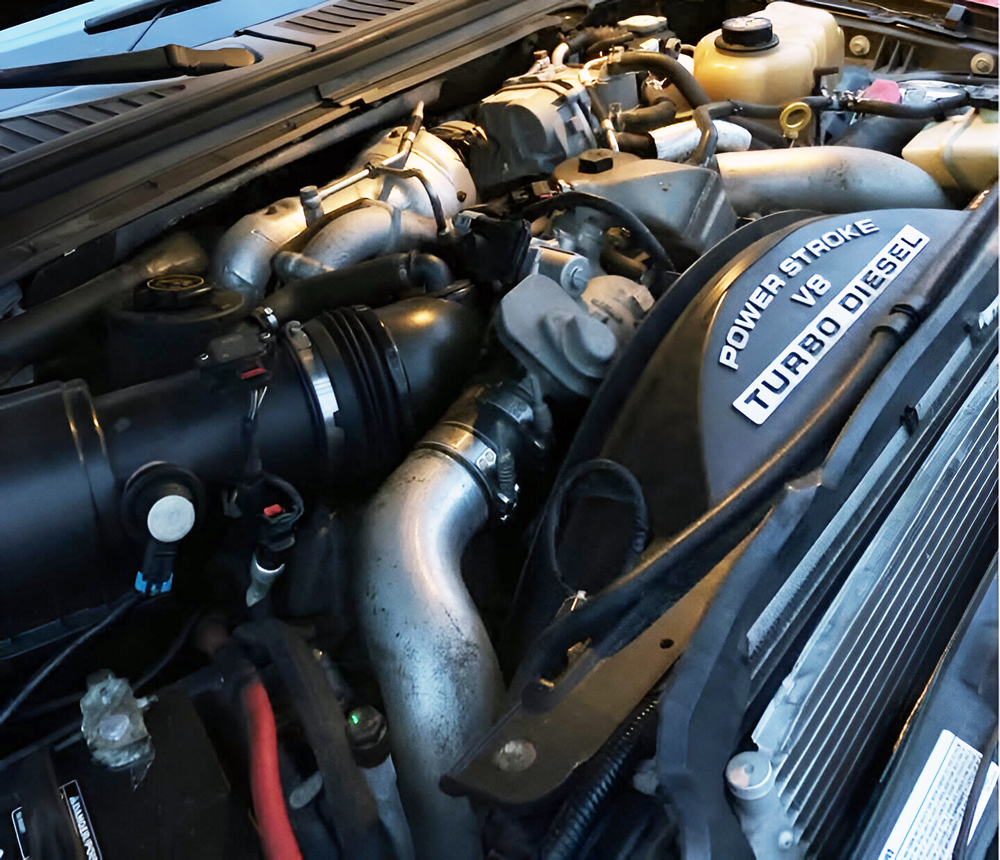
1. How the 6.4 Powerstroke is built and why it fails differently
Ford chased torque. Navistar raced the EPA
The 6.4L came out swinging in 2008. Ford needed power. Navistar needed emissions compliance. So they dropped hydraulic injection and cranked the complexity.
Gone was the old HEUI system. In came Siemens K16 high-pressure common-rail, piezo injectors, and an exhaust setup built around active regeneration.
At launch, the 6.4 hit 350 hp and 650 lb-ft without breaking a sweat, but it burned fuel to do it. And every new system introduced failure modes the 6.0 never had.
Core hardware beefed up. Head bolts jumped from 14 mm to 16 mm. The bottom end got a bedplate to anchor the mains. Forged powdered-metal rods could take serious boost. Compression dropped to 17.5:1 to tame combustion temps and hold gaskets under load. On paper, it looked ready to work.
But Ford didn’t control the design. Navistar pushed a platform meant to survive the emissions test bench, not a decade of plowing snow in Wyoming. The 6.4 walked a line between strength and fragility, oversized hardware wrapped around ticking subsystems.
Where the spec sheet stops saving you
| Spec / feature | 6.0 Powerstroke | 6.4 Powerstroke | 6.7 Powerstroke (Gen 1) | Real-world angle |
|---|---|---|---|---|
| Injection system | HEUI, HPOP | Siemens K16 common rail | Bosch CP4.2 common rail | 6.4 gains refinement, loses tolerance to bad fuel |
| Head bolt size | 14 mm | 16 mm | 12 mm (6 per cyl) | 6.4 gaskets stronger but not invincible under tune |
| Block / bottom end | Cast iron, separate caps | Cast iron, bedplate, stout rods | CGI block, revised bedplate | 6.4 rotating assembly overbuilt vs pistons |
| Emissions hardware | EGR only | EGR + DPF (first on Powerstroke) | EGR + DPF + SCR | 6.4 is first deep dive into DPF/active regen |
The bottom end can take a beating. The top end can’t. Injectors crack. Pumps scatter metal. Regen dumps diesel into the crankcase. And once coolant hits the oil, you’re down to hours before bearings and lifters check out.
Every spec hides a compromise. The 6.4 was never soft, it was overbuilt where it didn’t fail, and delicate where it did.
2. Common-rail fuel system problems that take out the whole top end
K16 pump wears fast, fails loud, and takes the rest with it
The Siemens K16 sits at the heart of the high-pressure system, fed by a frame-rail supply pump. Unlike a CP3, the K16 has no internal bypass and relies completely on diesel lubricity. One bad tank, a little water, or worn filters, and it starts cutting itself apart from the inside.
When the rollers and cam ring wear, they shed metal. That glitter enters the rails and makes a straight shot for the piezo injectors. Every part downstream gets contaminated. There’s no screen that stops it.
Once the regulator or rail shows swarf, the entire high-pressure side gets condemned. No shortcuts, no partial repairs.
Piezo injectors don’t stick, they melt things
Piezo injectors fire fast and clean, until they don’t. Each one has a stack of ceramic wafers that crack under heat or stress. Add metal debris or varnish from bad fuel, and the failures show up three ways: stiction, leaks, or stuck-open melt-downs.
| Failure point | Issue | Downstream risk |
|---|---|---|
| Internal “stiction” | Varnish, contaminated fuel | Misfires, rough idle, white/gray haze |
| Stuck-open nozzle | Debris, cracked piezo stack | Over-fueling, piston crown meltdown |
| Leaky injector body | Cracks from heat/cycle stress | Fuel in oil, rising oil level, bearing wear |
Over-fueling doesn’t just ruin mileage. It torches pistons. Cylinders 7 and 8 already take the heat from post-injection regen. Add a stuck-open injector, and the crown burns through in seconds.
Even if the truck runs, fuel pooling in the crankcase thins the oil and shreds bearings. One bad injector ignored through a few regens is enough to ruin the engine.
Full contamination means full replacement, no exceptions
| Contamination finding | Standard repair response | Typical owner cost (parts + labor) |
|---|---|---|
| Metal in rail/regulator | Replace HPFP, all 8 injectors, rails, lines | $8,000–$11,000 |
| Localized injector debris | Limited injector/line replacement, heavy flushing | $3,000–$5,000+ |
Flush jobs rarely hold. If metal’s in the rails or injectors, the debris keeps cycling and the next injector fails sooner. Fuel shops don’t take chances here, they replace everything, or they walk.
The job isn’t just parts. Most repairs need the cab lifted. It’s 25+ labor hours, and that’s if everything comes off clean. Trucks over 200,000 miles with frame rust or prior cut-corner fixes often get totaled on this repair alone.
3. DPF, active regeneration, and oil dilution that ruins the bottom end
Post-injection dumps fuel into the oil pan
The 6.4 was the first Powerstroke with a Diesel Particulate Filter (DPF). To burn off soot, it injects extra fuel late in the stroke, after combustion, using cylinders 7 and 8 as heat generators. That raw diesel hits hot exhaust valves, lights the DPF, and triggers regen.
Problem is, not all of that fuel stays in the pipe. Some of it washes down the cylinder walls, removes the oil film, and lands in the crankcase.
On a stock truck, this happens every 100–300 miles depending on load, idle time, and how clean the filter is. On short-trip or heavy-idle rigs, it can happen more than once a day.
Diesel-thinned oil ruins bearings and valvetrain fast
| Observation at service | Likely condition inside the engine |
|---|---|
| Draining more than 15 qt | Significant fuel dilution of engine oil |
| Thin, diesel-smelling oil | Viscosity drop, weak hydrodynamic film |
| Persistent valvetrain tick | Rocker/lifter wear from poor lubrication |
Fuel-soaked oil loses viscosity. That thins the oil film at the bearings, flattens the hydrodynamic wedge, and turns every metal surface into a wear point. Rockers and lifters get hit first. Once they tick, it usually means metal has already started to move.
Pushrod oil passages don’t forgive low viscosity. They’re tiny and feed high-load pivot points. Even short-term dilution wipes out the film strength needed to float the valvetrain.
Some trucks make it longer, but duty cycle decides the odds
Long-haul rigs with steady load and few cold starts keep the regen count low and oil cleaner. But city trucks, plow rigs, and fleet units get hammered. Frequent shutdowns mid-regeneration flood the crankcase. Extended idling forces back-to-back regens.
Stretching oil changes past 5,000 miles only makes it worse. Emissions-intact 6.4s can survive, but not on Ford’s original intervals. Any owner not watching oil level monthly is risking the bottom end.
4. EGR coolers, front cover erosion, and coolant in the oil
Dual coolers clog, crack, and leak straight into the cylinders
The 6.4 runs a two-stage EGR cooling setup: a horizontal primary cooler and a vertical secondary. Both take coolant flow, and both run hot under load. Soot builds up fast, choking flow and spiking internal temps. Over time, the cores crack.
When that happens, coolant sneaks into the intake. On startup, the engine hydro-locks. If it’s hot and parked level, coolant can seep into open cylinders and sit. Crank it, and rods bend without warning.
The other path is through the exhaust. That’s when you get clouds of white smoke, random misfires, and rising coolant loss without external leaks.
Front cover pinholes send coolant straight into the crankcase
| Failure mechanism | What’s happening at the front cover | Owner-visible symptoms |
|---|---|---|
| Cavitation / flash boiling | Super-hot coolant erodes aluminum passages | Slow coolant loss, unexplained |
| Pinholes into oil galleries | Eroded spots open into pressurized oil passages | Milky oil, bearing failure, lifter noise |
Coolant exits the horizontal EGR cooler at high velocity and temp, then flows straight into the aluminum front cover. At the thinnest casting points, coolant boils, vapor pockets form, and cavitation eats through.
Once those pinholes reach the oil gallery, the crankcase fills with a slow coolant leak. It emulsifies with the oil, destroys the bearings, and knocks out lifters. You won’t see external drips. Just dropping coolant and rising oil.
Detection depends on routine checks. Miss it, and the next sample you pull will drain out milky and ruined.
Hydrolock bends rods before you can blink
Coolant in the intake doesn’t always burn off. Leave the truck hot, and EGR leakage fills the cylinders. The next crank tries to compress fluid instead of air. Rods bend instantly, usually on cylinders near the EGR inlet. Compression drops, the engine runs uneven, and blow-by spikes hard.
Warning signs show up at idle: white smoke, bubbling in the degas bottle, and random hard starts. If the cooling system’s pressurized before the engine fires, something’s leaking into combustion.
Catch it early and you might save the block. Miss it and you’re shopping for a long block.
5. Piston cracking, bottom-end limits, and rebuild paths that actually last
Cast pistons fail long before the rods or block
The 6.4 bottom end is built like a brick, bedplate mains, thick rods, stiff crank. But the pistons? Cast aluminum with a re-entrant bowl lip designed to swirl fuel and lower emissions. That lip is the weak spot.
During regen, the heat piles up in cylinders 7 and 8. Add a stuck injector or over-fueling tune and the bowl edge starts to fracture. The crack runs across the crown toward the wrist pin bore. From there, compression drops, blow-by spikes, and oil consumption goes vertical.
The rods hold. The block holds. But a cracked piston ruins the whole cylinder.
Signs of piston failure aren’t subtle
| Symptom | What it usually means on a 6.4 |
|---|---|
| Heavy white smoke under load | Piston crown cracked, fuel not fully burned |
| Rhythmic oil-cap “puffing” | Excess blow-by from one or more cylinders |
| Single-cylinder contribution drop | Mechanical issue in that hole, not just injector |
Techs check for cracked pistons with relative compression, cylinder cut-out, and crankcase pressure tests. Pull the oil fill cap, if it pulses rhythmically at idle, there’s blow-by. That’s a mechanical issue, not electronics.
Often, these failures follow months of over-fueling or oil dilution. The piston cracks, burns unevenly, and takes the ring seal with it.
De-lipped pistons fix the weak link
The best 6.4 builds ditch the emissions bowl. MaxxForce 7 pistons, used in vocational-spec Navistar engines, swap in a flat or de-lipped design with thicker crowns and fewer hot spots.
Builders pair them with upgraded rings, ARP head studs, and fresh bearings. No wild cam or oversized rods needed. Just removing the lip and restoring oil control gives the bottom end a fighting chance, even tuned.
The block can take 800 hp. The pistons couldn’t. Swap the right parts, and the 6.4 stops dying young.
6. Turbocharger and up-pipe problems in the sequential twin-turbo system
Small turbo spools fast. Big turbo handles load
The 6.4 runs a sequential BorgWarner turbo setup. Up top is the high-pressure VGT for spool and throttle response. Down low is the larger fixed-geometry unit that feeds airflow under heavy load.
When the system works, it hits hard and pulls clean, even with a trailer. But that performance leans on high exhaust temps. During regen or mountain climbs, the EGT spikes crush the bearings and cook the oil if the truck’s shut down hot.
Turbo sync is software-controlled. If the VGT sticks or lags, the whole system falls out of balance, boost drops, drive pressure tanks, and limp mode locks in.
High EGT cooks seals. Soot locks vanes
| Turbo component | Typical 6.4 failure mode | Driver symptoms |
|---|---|---|
| VGT vanes (HP turbo) | Soot-sticking, corrosion | Lag, overboost/underboost, limp mode |
| HP turbo oil seals | Heat-baked seals, coked oil | Blue smoke, oil in downpipe |
| LP turbo bearings | Long-term high-EGT stress | Whine, shaft play, low boost |
| Turbo drain tubes | Flattened O-rings, sludge | Oil leaks down back of engine |
Most failures come down to heat. Shut off right after towing, and oil stops moving. The bearing housing heat-soaks, cokes the oil, and eats the seals. That dumps oil into the downpipe and loads the DPF with ash.
Turbo removal means fighting studs and heat-shrunk gaskets. On clean trucks, it’s doable cab-on. But rust or seized bolts usually push techs into a cab-lift to finish the job right.
Up-pipes crack at the bellows and leak boost pressure
The up-pipes feeding the turbos run flexible bellows to handle engine movement. But thermal cycling wears them out. Once they crack, exhaust leaks out and drive pressure drops.
Signs are sharp: hissing or screeching under load, slow spool, and high EGT with low boost. Over time, it drags the turbos down with it.
Many owners preemptively replace the up-pipes during turbo or EGR work. Upgraded aftermarket sets ditch the weak factory bellows and stop the leak before it starts.
7. Cooling system weak points that overheat everything fast
Radiators can’t handle chassis flex
The stock 6.4 radiator runs an aluminum core with plastic crimped end tanks. Under normal load, it’s marginal. Add frame flex, especially on lifted or hard-towed trucks, and the tanks start separating at the seams.
Leaks usually start in the lower corners. Small at first. Then constant. On trucks that tow or plow, some owners report going through two or three radiators in under 100,000 miles.
The design flaw isn’t the core, it’s the crimp joint. That plastic tank and gasket seal moves every time the frame twists. And it always loses.
Cheap hose fittings and dual thermostats don’t hold up
| Component | Common issue on 6.4 | What the owner notices |
|---|---|---|
| Quick-connect hoses | O-rings flatten, clips loosen | Coolant drips at cold temps, low level |
| Dual thermostats | Sticking open | Cool running, incomplete DPF regens |
| Degas bottle | Cracks at seams/neck | Coolant mist, steam, dried crust |
The 6.4 uses quick-connect radiator hoses with clip locks and soft O-rings. When cold, the O-rings shrink and weep. In winter, they leak constantly. Once they flatten, even new clips won’t reseal right.
Stuck-open thermostats are just as bad. The engine runs cool, the regen doesn’t trigger, and the DPF overloads. The system enters limp mode with no warning, just a dash message and a choked exhaust.
Cracked degas bottles finish the cycle. Steam seeps out, crusts the neck, and lowers pressure. The truck starts running hot under load long before the gauge shows it.
Upgrades only work if you do the whole system
Aftermarket all-aluminum radiators fix the tank separation issue, no crimps, no plastic, no flexing seams. But the rest has to match. That means fresh hoses, both thermostats, and a clean degas bottle.
Some owners add coolant filtration kits to stop debris and protect the front cover. Others run nitrate test strips every oil change to keep cavitation in check.
Half-fixes don’t hold. Cooling work on the 6.4 is all-in or wasted.
8. Diagnostic patterns that separate fixable from fatal
Long crank or no-start almost always points to fuel
| Symptom / code | Likely 6.4 fuel-side cause |
|---|---|
| Long crank, low rail pressure | Weak low-pressure supply, K16 wear, PCV leak |
| P0087/P0088, erratic pressure | Volume Control Valve harness or valve issue |
| No-start with swarf in pump | K16 self-destruct, full system contamination |
Start with low-side pressure, should be 5–7 psi at the frame. If that’s good, check commanded vs actual rail pressure during crank. If it lags, pull the regulator and check for glitter. Any metal = full system replacement.
Injector return tests and PCV flow checks confirm what the scan tool flags. If return is high or the PCV leaks internally, the pump can’t hold pressure, and the truck stays dead.
Power loss, smoke, and limp mode usually come down to airflow or EGR
| Complaint | Common issue on 6.4 |
|---|---|
| Lack of power, black smoke | Stuck VGT, boost leak, cracked up-pipes |
| White smoke, coolant loss | EGR cooler leak, front cover pinholes |
| Frequent regens, DPF full | Failed thermostat, stuck EGR, bad drive cycle |
Scan for MAF frequency, VGT position, and EBP vs boost pressure. If MAF reads low and the truck smokes, the issue’s downstream. Stuck EGR? Cracked pipe? VGT full of soot?
Pressure test the charge-air system before chasing turbos. A $20 clamp or cracked bellow can dump boost and trigger limp mode before any hard part fails.
Walk once. Push it, and it costs five figures
Catch oil level rising? Pull a sample. Milky? Park it. Hear a sharp injector knock or see crankcase vapor pulse through the cap? Shut it down.
These aren’t soft symptoms. Every one of them points to catastrophic fuel or coolant contamination. Keep driving, and you’re not replacing sensors, you’re buying a short block.
Good diesel techs don’t chase codes one at a time. They trace the chain, fuel, air, coolant, bottom end, and stop the cascade before it takes out everything above the frame rails.
9. Failure prevention, maintenance reality, and when a 6.4 is worth saving
What counts as “bulletproofed” on a 6.4
A 6.4 can run clean if the weak points are blocked before they crack. That means emissions-legal upgrades for daily drivers: coolant filtration, all-aluminum radiator, fresh hoses, dual thermostats, reinforced up-pipes, and ARP studs during top-end work.
Off-road and comp-use trucks go further, DPF and EGR removal, retuned post-injection to cut oil dilution, and boost control to manage EGTs.
But those builds only last if they’re matched with fuel system protection and proactive cooling work. Power doesn’t save pistons. Deletion doesn’t stop cavitation.
Book intervals don’t work here
| Task | “Book” interval | Realistic 6.4 severe-duty interval | Why owners shorten it |
|---|---|---|---|
| Engine oil & filter | 7,500–10,000 miles | ~5,000 miles | Control fuel dilution and valvetrain wear |
| Fuel filters (primary/sec.) | 15,000–20,000 miles | ~10,000 miles or yearly | Protect K16 from water/particulate |
| Coolant service / testing | 100,000 miles | Nitrate testing yearly, flush ~50,000 | Prevent liner/front-cover cavitation |
| Transmission fluid | 60,000 miles | ~30,000 miles towing/working | Keep heat-loaded 5R110 alive |
Monthly checks aren’t optional. Oil level, coolant level, and degas pressure all point to failure before it spreads. Any truck that idles, plows, or gets shut off mid-regeneration needs even tighter intervals than what’s listed here.
Know when to fix, rebuild, or bail
| Major failure event | Typical total bill (USD) | Common owner decision |
|---|---|---|
| Full fuel-system contamination | $8,000–$11,000 | Fix only on clean, low-rust chassis |
| Head gaskets + studs | $4,500–$6,500 | Worth it if bottom end still healthy |
| Cracked pistons / full engine | $13,000–$20,000 | Often exceeds truck value, many bail out |
Mileage, rust, and past maintenance decide the math. If the cab’s clean, studs are done, and you’ve caught dilution early, the truck’s worth saving.
If the bed’s flaking, the oil’s milky, and the turbo’s lagging, it’s a donor. Sorted 6.4s tow hard and hold power. But they don’t run cheap and they don’t forgive lazy owners.
Sources & References
- Boost the Performance of Your Ford F-250 Super Duty – Pedal Commander®
- Navistar VT engine – Wikipedia
- 2008–2010 Ford 6.4L Powerstroke: Specs, Reliability & Maintenance
- How To Identify Your Powerstroke Engine – Norcal Diesel Performance
- 6.4L: Long List of Failures – Diesel World
- The Power Stroke Blues: 6.4L Edition | DrivingLine
- The Engineering of 6.7L Powerstroke: Hot-V, CGI Block & History – SPELAB
- Buy a 6.4L Ford Diesel Remanufactured Engine – Fraser Engines
- 6.4L vs 6.7L: Which Power Stroke is Really Better? | DrivingLine
- Ford Power Stroke engine – Wikipedia
- Seeking advice – f450 6.4L Powerstroke. Replace engine or sell? : r/Diesel – Reddit
- XDP Fuel System Contamination Kit (Stock Replacement) XD610 – 6.4L Powerstroke
- Ford Diesel Diagnostics – Oregon Fuel Injection
- Fueling Your Ford: A Deep Dive into Powerstroke Injectors – G2 Diesel Products
- high pressure fuel system replacement labor time – 6.4L Power Stroke® Diesel Engines
- Diesel Fuel Injector Failure: Common Causes, Symptoms, and How to Diagnose It
- 6.4 Powerstroke EGR DPF Delete Pros and Cons Explained – EGR …
- 2008–2010 6.4L Ford Powerstroke Guide: Specs, Issues & Proven Solutions – EngineGo
- The 6.4L Bible | Everything a 6.4L Ford Owner Needs to Know …
- 6.4L Power Stroke engines: maintenance intervals and common failure modes
- Can you drive in fail safe mode? : r/FordDiesels – Reddit
- Bought a non running 6.4 cheap : r/Diesel – Reddit
- The Most Common 6.4 Powerstroke Problems | FASS Motorsports
- Top 7 6.4 Powerstroke Problems & How to Prevent Them – SuncentAuto
- 08-10 Ford Powerstroke 6.4 Diagnostics – Oregon Fuel Injection
- Complete 6.4L Powerstroke Maintenance Schedule & Parts – DR
- 6.4 Powerstroke 2008-2010 High Pressure Fuel Pump – OE New | InjectorsDirect.com
- Powerstroke 6.4L Fluid Capacities | Complete Guide – Hot Shot’s Secret
- How much would a engine replacement cost : r/Diesel – Reddit
- Is the 6.4 powerstroke really that bad? : r/Diesel – Reddit
- Ford F-250 Super Duty Radiator Replacement Cost Estimate – RepairPal
- CSF 3642 OEM Replacement Radiator 08-10 6.4L Ford Powerstroke
- cracked piston – 6.4L Power Stroke® Diesel Engines – Diesel Technician Society
- Enginetech Pistons? 6.4L : r/Diesel – Reddit