
Hit Tow/Haul, throttle in, and it flares. Then slams. The load jerks, and the 6R140’s game face cracks.
This transmission was built for big numbers; 1,000 lb-ft diesels, 8,000 lb trailers, PTO duty, and chassis-cab work. On paper, it delivers: six gears, full electronic control, stout ratios, and a deep first gear that hauls like a low-range. But under real torque and heat, trouble brews in known corners.
Torque converters slip and scatter. Valve bodies leak pressure. Solenoids misfire. Shafts twist. Bypass valves stick. And if one problem doesn’t take it down, the cascade might. This guide hits every failure point, shows what takes the 6R140 out, and what keeps it alive under load.
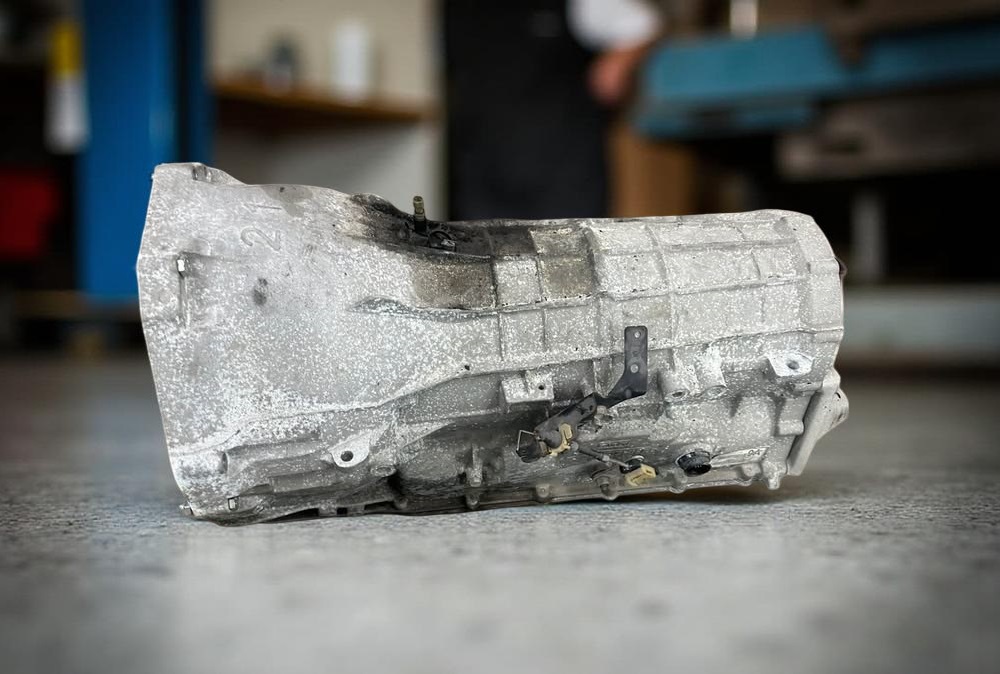
1. Why the 6R140 cracks under pressure and where it doesn’t
Internal layout pushes the limits of aluminum and clutch timing
The 6R140 runs a Lepelletier geartrain, marrying a simple planetary with a Ravigneaux to get six forward speeds. It cuts down on size and part count, but leaves five clutch packs, three rotating, two brake, doing all the gear juggling. Flares and bind-ups trace straight back to how those packs hand off under load.
Clutch C handles launches. B grabs the mid-range. D locks down top gear. If any one of them slips, the others scramble, and that’s where you start getting “neutral at a stop,” harsh downshifts, or 3-4 hangups that feel like the trans is confused. It’s not confused. It’s losing pressure or fighting a worn drum.
Matched to the 6.7L Power Stroke or the 6.2L gas V8, the unit lives near the ceiling of what a cast aluminum case and pump can take. Tuned trucks blow past that line. In upfit fleets, ambulances, bucket trucks, F-550s, the sheer torque and hydraulic cycling wear it down faster than light-duty haulers ever see.
| Parameter | Typical 6R140 Value |
|---|---|
| Transmission | 6-speed, full electronic control |
| Layout | Lepelletier (Simple + Ravigneaux) |
| Clutch Packs | 3 rotating, 2 brake |
| 1st Gear Ratio | 3.97:1 |
| 6th Gear Ratio | ≈0.67:1 |
| Fluid Type | Mercon LV (low-viscosity ATF) |
Why usage pattern shapes failure more than mileage
A half-ton hauler that tows on weekends might never see issues. But throw that same transmission into a snowplow or a hotshot truck logging 1,000 miles a week with a trailer hooked and everything changes. It’s not the age, it’s the duty cycle.
Tow/Haul mode changes shift logic and ramps up torque management. It helps with brake wear, sure, but it also spikes converter heat and cycles the clutches harder. Same goes for grade braking. Every downshift adds wear to the hydraulics. Every hard 3-4-5 handoff chips away at the rotating assembly.
In F-250s used for RV duty, you’ll see units go 200,000 miles. In F-450s with landscape trailers or city-plow configs, some don’t last past 80,000 without internal scarring or valve body warpage.
The hardware’s tough, but its lifespan rides on how hard you push it.
2. Torque converter failures that turn into full-blown rebuilds
Spring and rivet failures that start the chain reaction
The 6R140’s torque converter runs a captive clutch design. Instead of the friction plate pressing against the front cover, it’s trapped between two steel plates and backed by leaf springs. Those springs are riveted to the plate’s outer tangs. Pop one, and it scatters metal into the converter.
Once the rivets shear or the springs snap, that debris carves into the friction surface. Lockup turns sloppy. Shudder creeps in at light throttle. The TCC slips, then sets codes.
And that’s before the unit ever trips a real fault. By then, fine metal has already worked its way through the fluid and straight into the valve body and pump.
| Failure mode | Cab symptom |
|---|---|
| Rivet or spring failure | Rumbling shudder at 40–55 mph in lockup |
| Scored friction plate | Repeat TCC slip codes, rising temps under load |
| Overheated single-disc lockup clutch | Burnt ATF, degraded shift feel, early valve wear |
Converter stator and heat overload in tuned trucks
The factory converter uses a single-disc clutch and high-stall stator. Fine for stock Power Stroke output. But with tunes, big tires, and 10,000 lb in tow, it stays in partial slip too long. That slip cooks the ATF and sends heat right back into the clutch lining.
Shops tracking these failures say the converter almost always goes first. Metal fines from the shredded clutch end up in the solenoids, control bores, and pump bushings. Even if you swap the converter, the damage path stays active unless the valve body’s checked and the cooler flushed hard.
Why billet converters actually fix the issue
Aftermarket billet converters don’t just feel tighter. They use a multi-disc clutch, thicker cover, upgraded stator, and stronger spring hardware. Instead of one big slip surface, they share the load across multiple frictions.
That keeps lockup solid under throttle, reduces heat buildup, and nearly eliminates the shudder that shows up when the stock clutch starts to glaze. For trucks running hot or hauling daily, it’s not a comfort upgrade, it’s a line of defense that buys the whole transmission more time.
3. Valve body wear that leaks pressure and loses gears
Boost valve bore wear and the lockup ghost
The TCC boost valve inside the valve body is supposed to firm up lockup by ramping apply pressure when needed. But it rides in a soft aluminum bore, and over time, that bore wears into a waist. Pressure bleeds off. Lockup fades.
Drivers don’t see a warning light. They feel a flutter or light shudder in 5th and 6th. A slip that comes and goes. Most chase sensors, blame fluid. But once that bore leaks, no solenoid can band-aid it. You’re losing pressure before the clutch even engages.
| Hydraulic issue | In-cab symptom |
|---|---|
| Worn TCC boost valve bore | Wavy lockup, no firm pull in 5th or 6th |
| Cross-leaks in clutch feeds | Delay into Drive or Reverse, 2-3 flare |
| Debris-lodged control valves | Sudden neutral at stop, jerky 5-4 downshift |
Sticking valves and the “phantom neutral” stoplight scare
Converter clutch material, when burned, turns into fine powder. That powder flows straight to the valve body. The 1-2-3-4 control valve has a narrow bore that gums up first. When it sticks, the transmission drops to neutral during a stop, then bangs back into gear.
It feels like a slip. Feels like something let go. But open the unit and hard parts are often fine. It’s hydraulic. Just clogged. Left unchecked, it turns into a repeated event that eventually scars the clutches and overdrives the pump.
How to tell if you can save the valve body, or not
If the converter’s intact and slip history is light, a valve body rebuild can save the unit. Look at TCC slip data, cold vs. hot line pressure, and response to solenoid commands. If they track but the shift feel’s off, you’ve probably caught it early.
But if the fluid’s scorched, pan’s glittery, or you’ve got gear-ratio codes showing up, the whole hydraulic path is suspect. Reman valve bodies with sleeved bores and updated plugs buy time.
But they can’t fix scorched clutches or a pump already worn from metal washout. In those cases, it’s full teardown, or you’re just delaying the next comeback.
4. Solenoid mismatches that wreck shift timing
What banded solenoids do and why swapping blindly breaks things
Each 6R140 solenoid gets flow-tested at the factory. Based on how it behaves under current, it’s labeled with a band number, 1 through 5, and a type: Normally High or Normally Low. These bands compensate for production variance. Put the wrong band in the wrong spot, and pressure control goes sideways.
The TCM adapts to the band it’s told is installed. If you change a solenoid without matching the original band and NH/NL type, the shift will feel off: delayed, harsh, or slipping under load. A bad match in Solenoid A or B alone can throw off the 2-3 and 3-5-R handoff hard enough to ruin a rebuild early.
| Solenoid type | Low-output band | High-output band | If you install the wrong band |
|---|---|---|---|
| Normally Low (brown) | Band 1 | Band 5 | Flares, shift overlap, failure |
| Normally High (black) | Band 5 | Band 1 | Harsh downshifts, pressure spikes |
Strategy codes that must match or the trans never learns
Each solenoid body has a 13-digit strategy code and an 8-digit ID. These tell the TCM how to tailor line pressure and timing to that specific set of solenoids. Skip reprogramming after a swap, and the unit tries to use old adaptives on new hardware.
That mismatch causes hunt shifts, lag, and failed relearns. Most “bad” remans aren’t failing mechanically, they were installed without flashing the new strategy. The trans has no clue how the new solenoids behave. It guesses. And guessing at 700 lb-ft doesn’t last long.
Why most “problem” rebuilds just need a full relearn
After fluid work, valve body swap, or solenoid changes, the TCM keeps its old memory, unless you clear Keep Alive Memory (KAM) and run the relearn. That means warming the trans, shifting N–R–D–R–D with pauses, then running light and moderate throttle through all gears. Twice.
Skip this, and you’re asking the unit to hit pressure targets from the last clutch set on the new one. That’s how fresh builds glaze in under 200 miles. It’s not a bad rebuild. It’s bad setup, and it costs the same to fix.
5. Shaft failures that start with torque and end with teardown
Input shaft cracks at the turbine spline
The 6R140’s input shaft takes every pound-foot of torque straight from the converter. In tuned 6.7 diesels or F-450s under full load, it hits its limit, right at the turbine spline. That’s where it twists, cracks, or shears.
When it goes, it’s sudden. No warning. You’ll lose drive mid-pull. Pan’s full of metal. TCC pressure drops off. Converter charge pressure codes follow, and the trans drops into limp. If the shaft splits clean, the rest of the internals might survive. If not, debris takes out the drum and pump on the way out.
Why the intermediate shaft’s the weak link in tuned trucks
Tuners love fast shifts and locked clutches. But that strategy dumps shock into the intermediate shaft, especially during 2-3 and 3-4 transitions. Raise line pressure, add torque, tighten shift timing, and it snaps.
This isn’t a race-only problem. Hotshot haulers see it in high-mileage trucks running tow tunes and big loads. Rebuilders swap in 300M billet shafts not for performance, just for survival. Stock shafts can’t keep up with modern torque curves or real-world shift aggressiveness.
Spin-weld failure that slips but passes a bench check
Ford spin-welded the input shaft to the 4-5-6 overdrive drum. It holds under normal load, but tuned or overloaded trucks break that weld loose. Once separated, the drum can spin independently under load, but still pass an air-check.
That’s the trap. No codes, no clear sign in basic tests. But in gear, it slips. Rebuilders check shaft-to-drum integrity by locking one and spinning the other. If they move separately, the weld’s done, and sending that unit back out means another comeback.
6. Cooling system failures that cook the trans without warning
Bypass valve sticks and hides the real temperature
The 6R140 uses a thermal bypass valve to keep ATF off the cooler until it warms up. But in many 2011–2016 units, that valve sticks shut. When that happens, the fluid never reaches the cooler, it just cycles inside the case, baking the converter and clutches while the dash reads “normal.”
Burnt fluid, early lockup shudder, and gear-ratio codes creep in. By the time the driver sees anything wrong, the damage is baked in. These stuck valves don’t just raise temps, they create a closed loop that silently destroys the converter and valve body from the inside out.
| Bypass valve state | Cooler flow | Use case | Risk level |
|---|---|---|---|
| Working normally | Temp-based | Standard towing and daily driving | Baseline |
| Stuck open (bypassed) | Full-time | With delete kit, cooler always on | Lower temp, slower warmup |
| Stuck closed (no flow) | None | Faulty OE valve | High overheat risk |
Diesel coolant loop failures that mask trans overheating
6.7L Power Stroke trucks use a secondary coolant loop to handle trans fluid, EGR, and fuel cooler duties. If the secondary reservoir runs low, or the electric pump fails, the transmission overheats even if the main engine gauge looks fine.
There’s also a known failure where the pump stator sleeve inside the 6R140 rotates slightly and blocks converter charge oil to the cooler. You’ll never see it on a scan tool. But fluid turns brown fast, the converter starts slipping, and the driver’s left chasing phantom heat with no DTCs to point the way.
When deep pans and extra coolers are worth it
Deep aluminum pans help. So do plate coolers. But only when the truck runs hot enough to justify them, mountain states, commercial tow duty, or hotshot rigs working 6 days a week.
Bypass-delete kits force full-time cooler flow, but that comes with thick-fluid drag on cold mornings. They pair best with regular service and clean ATF. Otherwise, you’re just circulating slop faster, and that doesn’t save anything.
7. Real codes, real symptoms, and the failures behind them
The DTCs that actually mean something on a 6R140
Most codes don’t say much. These do. P0751 and P0756 almost always mean solenoid or valve body wear. TCC slip codes mean the converter’s already on borrowed time. Gear ratio errors in 5th or 6th point straight to drum or shaft damage.
Get one of these on a loaded truck, and you’re not chasing an issue. You’re already in the failure path.
| Code / complaint | Likely failure in a 6R140 |
|---|---|
| P0751 (Shift Solenoid A stuck off) | A-solenoid mismatch or valve body cross-leak |
| P0756 (Shift Solenoid B stuck off) | B-solenoid wear, VB debris, 3-5-R feed issue |
| Repeated TCC slip | Boost valve bore wear or failing converter |
| Incorrect gear ratio in high gears | Shaft crack or spin-weld separation |
| Intermittent neutral at stop, no code | Debris-lodged 1-2-3-4 valve |
How real-world complaints sound and what they mean
Owners rarely say “TCC slip.” They say “it shudders at 45” or “feels like it’s in neutral at the light.” Cold, it’s fine. Hot, it flares. Or drops to neutral. That’s valve body debris, a sticking valve, or a converter on the edge.
If you’ve got flutter in 5th or 6th, especially with light throttle and the trailer on, the TCC clutch is glazing or the boost valve is losing pressure. No scan tool needed. You’ll feel it before the PCM flags it.
When a reman fails fast, check what feeds it
Most failed “rebuilt” 6R140s didn’t fail because of bad parts. They got cooked by dirty coolers, clogged bypass valves, or skipped relearns. The shop installs a fresh unit, but hot, contaminated fluid starts the next failure cycle on day one.
Before blaming the build, check bypass flow. Check for strategy code mismatch. Flush the cooler. Run the relearn. If you skip any of that, it’s not a reman issue, it’s a setup trap that ruins good hardware fast.
8. Service that actually works and upgrades that make it last
Why waiting for factory intervals ruins these units early
Ford says the 6R140 fluid can go 150,000 miles. That number only works on paper. In real trucks, the Mercon LV shears down, oxidizes under tow heat, and carries clutch dust long before that.
Fleets don’t wait. Neither do diesel shops. They drop the pan every 30,000 to 50,000 miles, swap filters, and watch for converter slip or TCC shudder as the first warning. Plow trucks and hotshots go even tighter, 20,000 to 30,000 between services.
| Duty cycle | Fluid change target | Notes |
|---|---|---|
| Light towing or commuting | 50,000–60,000 miles | Pan drop, new filter, visual check |
| Moderate/heavy trailer use | 30,000–40,000 miles | Watch ATF color and converter behavior |
| Severe (plow, hotshot, F-550) | 20,000–30,000 miles | Consider bypass delete, deep pan, upgrades |
Which parts solve problems, not just boost ratings
Some “performance” parts add capacity. Others fix what breaks. Start with a billet multi-disc converter. That stops TCC shudder and internal rivet failure cold.
Next, sleeve the TCC boost valve, the stock bore always wears. Add a cooler bypass delete to keep temps in check. If the truck’s tuned or hauls heavy, step up to a billet input or intermediate shaft to survive shock loads.
Not every upgrade adds horsepower. Some just stop the loss of fluid.
How the 6R140 compares today and when to upgrade it
The 6R140 holds its own against the newer 10R140, even with fewer gears. Its internals are beefy, its geartrain is proven, and it handles big torque without the compound clutch overlap issues newer 10-speeds face.
Where it fails, it fails in patterns: converter first, then hydraulics, then shafts. That makes it predictable, and fixable. If you’re willing to service it early and upgrade where it counts, the 6R140 doesn’t just survive. It earns its keep past 250,000 miles in the real world.
Sources & References
- 6R140 Transmission: The Heavy-Duty Workhorse for Ford Super Duty Trucks
- Ford 6R140 Transmission Guide: Specs, Common Issues & Remanufactured Upgrades
- Ford 6R140 Transmission: Next Gen Drivetrain Addresses 9 Common Problems
- Ford 6R140 Transmission Review, Specs & Features | Ford Component Sales, LLC
- The Ford 6R140 Transmission: All You Need To Know – Powertrain Products
- Discover the 6R140 Transmission Common Problems and Solutions: Call 855-CLE-AUTO Today for Expert Service!
- Ford 6R140 Transmission • Problems & Solutions – Next Gen Drivetrain, Inc.
- Ford 6R140 – Repairing Elusive Intermittent Neutral Condition | Sonnax
- 6R140 Transmission Common Problems & Warning Signs
- The 6R140 torque converter: Common fault codes and how to rebuild
- Problems and Fixes! Revisiting the 6R140 Transmission – Gears Magazine
- Breaking Down the Basics of Banded Solenoids – Sonnax
- SPE Motorsport 6.7L Powerstroke 6R140 Solenoid Body – Snyder Performance Engineering
- spe motorsport 6r140 proprietary solenoid body | ford powerstroke 6.7l 2011-2019
- Ford Solenoid Strategy 6F30/6F35/6F50/6F55 – Sonnax
- Quick Tip: Ford® 6.7L Transmission Solenoid Characterization – Snap-on
- 6R140 Shift Diagnosis – Driveline: Transmissions, Clutches and Axles – Diesel Technician Society
- Troubleshooting Ford 6R80 & 6R140 2-3 Shift Quality | Sonnax
- 6R140 Transmission Solenoid Strategy Code: Don’t Break Up the Band – Sonnax
- Attention: 6R140 Installation Guide | PDF | Transmission (Mechanics) | Machines – Scribd
- FORD 6R140 TRANSIMISSION – RevMax Converters
- Bypass Blocker Valve Kit Sonnax 6r140 2011/16 – Sun Transmissions
- Thermal Bypass Valves 101 – What are they and How do they Work – Mishimoto
- Prevent Overheating: Bypass Delete Kit for Reman Transmissions Explained
- TransGo FOMO-COOL Cooler Bypass Delete Kit – XDP
- p0751 Code – Shift Solenoid “A” Performance/Stuck Off | KBB
- PartsAvatar Repair OBD Error Code P0751 Solution
- P0751 Code: Shift Solenoid “A” Performance/Stuck Off – In The Garage with CarParts.com
- P0756 Code: Shift Solenoid “B” Performance / Stuck Off – In The Garage with CarParts.com
- P0756 OBD-II Trouble Code: Shift Solenoid B Performance or Stuck Off/2-3 Shift Solenoid Valve Performance – YourMechanic
- TECHNICAL SERVICE BULLETIN 6.2L/7.3L – 10R140 – Illuminated Powertrain Malfunction (Wrench) Indicator With DTC P07F7 And Loss – nhtsa
- Sonnax Troubleshooting Ford 6R80 & 6R140 Timing-Related Shift …
- When Should You Change Your Ford Transmission Fluid?
- When to Change Transmission Fluid | Richmond Ford West
- Ford 6R140 Transmission: A Closer Look – Tier One
- TSB 13-4-5
- TECHNICAL SERVICE BULLETIN Vibration/Shudder During Light Throttle Tip In At Highway Speeds (8,9,10 Gear) With No DTCs Present 25-2383 – nhtsa
- 6R140 Transmission Relearn – Snyder Performance Engineering – SPE Motorsport
- Ford Recalls About 4000 Trucks Due to Transmission Problems – Strong Law, P.C.
- CSR-3118-Ford 23S54 – 6R140 E-Series and F-650 – nhtsa
- 2015 Ford F-Series Super Duty Trucks Recalled for Transmission Calibration Problem