
Spot a cheap Ram 1500 with a “strong 4.7” and the temp needle creeping up? That’s your warning. The 4.7L PowerTech V8 was Chrysler’s leap from pushrod grunt to overhead-cam efficiency; a clean-sheet design with modern flow but zero margin for slop. It can hit 300,000 miles when babied.
Miss an oil change, let it overheat once, or stretch service intervals, and the damage accumulates fast: sludge, dropped valve seats, shattered timing, top-end clatter, mystery no-starts.
This guide breaks down what this engine’s made of, where it fails hard, what still saves it, and when to walk.
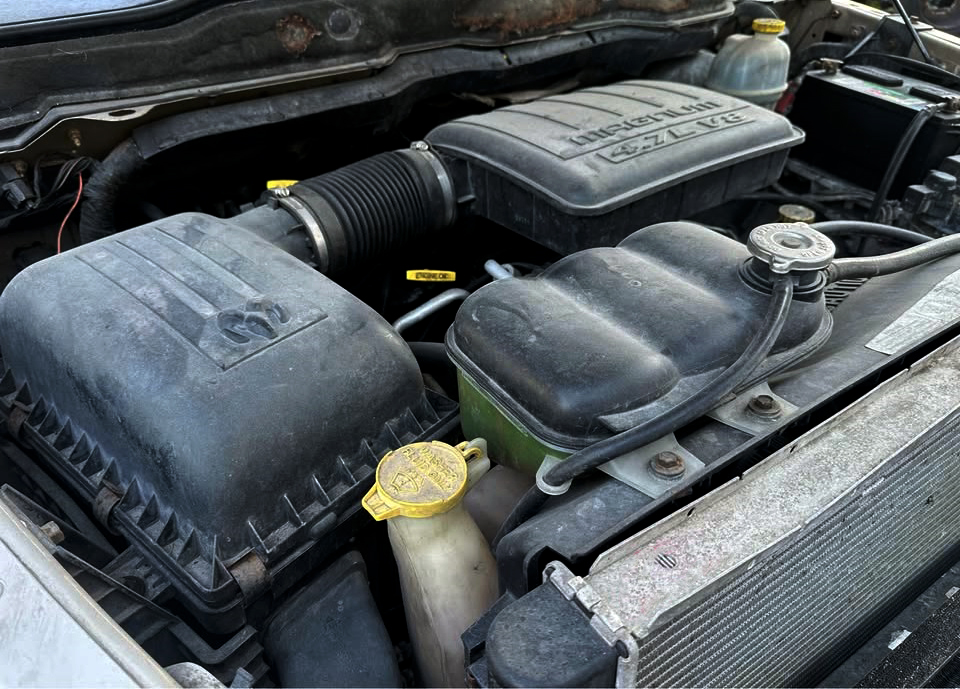
1. Why the 4.7’s architecture leaves no room for mistakes
Cast-iron bottom, aluminum top, and a three-chain trap
The 4.7L PowerTech runs a cast-iron block with aluminum heads and a single overhead cam per bank. Timing is handled by three chains: one primary to a jackshaft, then two secondaries to the cams.
That layout shaves bulk but adds friction, heat, and complexity, especially when the jackshaft bearings age or pressure dips.
Aluminum expands faster than iron. That expansion pounds gaskets, widens valve seat pockets, and warps sealing surfaces. Add tight oil passages and a high-rev interference valvetrain, and the engine’s survival depends on perfect cooling and clean, high-pressure oil, every mile.
Generational changes and which version punishes neglect hardest
The early standard 4.7 (1999–2007) laid the foundation, modest power, single plugs, 9.0:1 compression. The High Output variant (2002–2008) added hotter cams and a new intake to stretch torque and bump compression.
But the biggest shift came in 2008 with the Next Gen redesign: dual plugs, dual knock sensors, 9.8:1 compression, and a jump to 310 hp. More power, yes, but more reliant on sensor health, tighter tolerances, and cleaner burn.
| Spec / Version | Standard 4.7 (’99–’07) | 4.7 High Output (’02–’08) | Next Gen 4.7 (’08–’13) |
|---|---|---|---|
| Rated power | 235–245 hp | 265–270 hp | ~310 hp |
| Peak torque | 295–300 lb-ft | ~330 lb-ft | ~334 lb-ft |
| Compression ratio | 9.0:1 | 9.7:1 | 9.8:1 |
| Valvetrain | SOHC, 2 valves/cyl | SOHC, 2 valves/cyl | SOHC, 2 valves/cyl |
| Spark layout | Single plug | Single plug | Dual plug per cylinder |
| Typical homes | Ram 1500, Dakota | Grand Cherokee, Dakota HO | Ram 1500, Aspen, Dakota |
What works in the 4.7, and what locks you into failure
The 4.7’s compact design fits tight bays and keeps the front end lighter than a Hemi. It revs smooth, holds decent torque in mid-size platforms like the Dakota, and skips modern troublemakers like MDS or AFM.
But it brings sharp limits. Head warping starts fast. Powdered-metal valve seats lose grip with one bad overheat. Chain-driven cams offer no forgiveness if tensioners collapse. And the oiling system can’t tolerate sludge, tight clearances choke flow before the gauge ever blinks.
2. Cooling failures that turn one hot day into a dead engine
Aluminum heads, iron block, and a narrow temperature ceiling
Heat moves fast through the 4.7’s aluminum heads and slow through its iron block. Each heat cycle stretches the head more than the deck below it, scrubbing head gaskets and loosening valve seat pockets a little at a time. Push coolant past about 220°F and the aluminum starts to lose its grip, even if the gauge never pegs.
Fans often don’t hit full speed until the mid‑230s. That gap leaves the engine cooking while the dash still looks “almost fine.” One hard pull, one long idle in traffic, or one missed bleed after coolant work can cross the line.
How real overheating starts and how the damage accumulates
Most failures don’t begin with a blown hose. They start small: a radiator with half its fins packed, a thermostat that opens late, a tired fan clutch, air trapped after a water pump job. Tow on old coolant or idle through summer traffic and temps climb steadily, not suddenly.
First comes creeping heat. Then cabin air goes cold as coolant drops. Oil turns cloudy, starts spike rough, and compression fades on one hole. Keep driving and a valve seat lets go, ending the engine without warning.
| Dash or under‑hood sign | What’s failing underneath |
|---|---|
| Temp rises on grades or towing | Restricted radiator or weak airflow |
| Sudden heat spike, no cabin heat | Coolant loss, gasket breach likely |
| Sweet white smoke on cold start | Coolant entering a cylinder |
| Runs hot after “all new cooling parts” | Warped heads or air trapped in the system |
180° thermostats, bigger radiators, and where upgrades stop helping
Dropping to a 180°F thermostat gives headroom. Average temps fall, heat soak slows, and towing margins improve in hot climates. Paired with a clean radiator and solid fan control, it can delay gasket and seat damage.
It can’t save a weak system. A clogged core still chokes flow. A slipping fan still starves airflow. Lower setpoints hide problems until the engine loads up, then the failure hits just as hard.
The 4.7 survives only while coolant flow, fan response, and bleed quality stay perfect. Once that balance slips, aluminum moves, seats loosen, and repairs escalate fast.
3. Dropped valve seats that destroy the top end
Why intake seats fall out after an overheat
The 4.7L uses powdered-metal intake valve seats pressed into the aluminum head. That press-fit only holds while the head stays cool and tight. Overheat the engine, and the aluminum expands faster than the steel ring holding the seat. Grip weakens. The seat rocks in its pocket. Then it falls.
When it drops, the piston doesn’t pause. It smashes the hardened steel into shrapnel. That debris bounces through the chamber, gouges the walls, bends the valves, and blasts back into the intake runners before the engine even stalls.
Chain-reaction failure after a dropped seat
One dropped seat means destruction across multiple systems. The piston takes the first hit; crown chipped, ring lands cracked. The cylinder wall scars deep.
The head’s combustion chamber is chewed. Valves don’t just bend, they chip. And the manifold holds shrapnel that waits to ruin the next cylinder.
Many “fixed” 4.7s fail again within miles. Why? The intake wasn’t cleaned and scrubbed to bare metal. One sliver of hardened seat gets sucked into a clean cylinder and starts the whole cycle again.
| Hit component | Common damage | Correct repair move |
|---|---|---|
| Piston crown | Pitting, cracked ring lands | Replace piston, check rod and bearings |
| Cylinder wall | Vertical gouging | Hone or bore/sleeve; new block if damage is deep |
| Combustion chamber | Scarring, gouged valve seat pocket | Replace head or fit upgraded seats with machining |
| Intake/exhaust valves | Bent stems, chipped faces | Replace valves, regrind all seats |
| Intake plenum interior | Metal fragments in runners | Complete teardown, solvent and brush cleaning |
Are 2008+ heads actually safer?
Later Next Gen heads saw better seat machining and materials. They’re tougher, but not immune. A bad overheat still stretches aluminum beyond safe limits. Cooling system health, not model year, is the real insurance.
Engines with the updated heads buy more time, but if coolant pushes past the danger zone, the result is the same: steel seat turns projectile, chamber takes the hit, and the rebuild bill looks the same.
4. Sludge, foam, and oil starvation from the pan up
Early PCV design and how it starts the sludge spiral
Early 4.7L engines vented crankcase vapors through a PCV valve stuck in the oil fill neck, right where cold air hits first. In cool weather, moisture condenses inside that tube. Mixed with oil vapor, it turns to yellow foam under the cap.
That “mayo” doesn’t stay harmless. It forms sludge that clogs the heads’ narrow drainbacks and thickens in the pan. Chrysler moved the PCV to the back of the left head in 2007, but by then thousands of engines were already on the path to failure.
How thick oil destroys the top end before the bottom knows
Sludge strangles the 4.7L from the top down. Once drainback slows, oil pools in the heads. The pickup starves on hot idle. Pressure drops just enough to hurt, especially at the lash adjusters and cam journals. Tensioners collapse. Tick starts. Cam lobes wipe. Bearings spin.
Most failures don’t show codes or pressure lights until damage is baked in. The real signal is sound: louder top-end noise after warmup, longer tick on cold start, or erratic idle after a hard pull.
| Sludge stage | What shows up first | What’s already failing |
|---|---|---|
| Light foam, dark oil | Yellow goop under cap | Early PCV restriction, slow drainback |
| Varnish, delayed flow | Idle tick, slow pressure build | Cam wear, collapsed HLAs |
| Pickup half-blocked | Warning lights, loud ticking | Starved bearings, tensioner failure |
What actually stops sludge on a 4.7L
Fix the PCV layout, run full synthetic, and cut oil change intervals to 3,000–5,000 miles. Every time. No long-interval gimmicks. No bulk-lube sludge traps.
Pull the cap often. If you see yellow or dark goo, don’t “flush” it, flushing knocks loose chunks that plug passages. Clean gradually with heat, short drains, and detergent-rich oil. Replace the PCV valve every 15,000–30,000 miles and make sure it vents clean. The 4.7 doesn’t give you a second warning once pressure dips.
5. Rocker arm ejection and why the top end won’t stay quiet
Why rollers jump loose and slap the engine dead
The 4.7L uses roller rockers on hydraulic lash adjusters (HLAs), but neither part forgives carbon, bad oil, or low pressure. The system works fine, until a sticky intake valve hangs just slightly open. Now there’s play. The rocker loses contact, shifts on the pivot, then fires off like a clip spring at 3,000 RPM.
Most ejections start cold. Oil hasn’t filled the HLA yet, valve stem drag opens the lash gap, and a loose rocker flips off its seat. The damage often follows seconds later when that cylinder dead-fires and back-pops through the intake or exhaust.
What the noise means and why shops misread it
Ticking alone isn’t the giveaway. The real sign is a dead cylinder, sharp clatter, and sometimes air-pulse sounds from the intake. It’s not a rod knock. It’s not a lifter tick. It’s a dropped rocker, usually from a worn adjuster, sticky valve, or over-revving a cold top end.
Some heads make it worse. Machining flaws left adjuster bores too deep on early castings, putting the HLAs near full extension even at rest. That leaves no room for oil swell. On a cold start, they bottom out and let go.
Shop fixes that work and what keeps the rockers seated
Old-school builders shim the HLAs with ~0.085-inch washers to lift their range and keep them snug. Done right, it works. But that’s not the only fix.
Start with fuel. Run detergents. Clean intake valves periodically. Always use quality adjusters, not white-box junk with uneven bleed-down. And don’t chase “mystery ticks” without checking rocker movement directly. Most quiet down until they fly out. Then the cost jumps fast.
6. Timing slack, guide wear, and chain jumps in a no-clearance engine
Three-chain setup with one weak point
The 4.7L runs three chains: a primary from crank to jackshaft, and two secondaries from jackshaft to cams. The chains hold up. The plastic-lined guides don’t. And the real weak point is the hydraulic tensioners, fed by engine oil, loaded by startup pressure.
If oil’s clean and pressure’s stable, the chains stay tight. If sludge builds or tensioners collapse, they slap. Left unchecked, they stretch. The secondaries jump time. The engine still spins, but piston and valve paths cross, and one tooth off means bent valves.
Warning signs before the timing lets go
A loose chain doesn’t throw a check engine light at first. It rattles on cold starts. It knocks near the front cover. Eventually, P0016 sets for cam/crank correlation, and by then, it’s already running late.
Ignore the rattle and the next startup might be its last. One bump in timing on this interference engine means instant valve-to-piston contact. No cranking out of that.
What it costs to fix and what else to do while it’s open
Most timing jobs on the 4.7 run $1,400–$2,100. That includes all three chains, guides, tensioners, front seal, and often the water pump, since you’re already in deep.
Shops push to do it around 150,000–200,000 miles before codes hit or slack gets noisy. Wait longer, and you’re not buying a timing set, you’re rebuilding the top end. Or walking.
7. Outside failures that get blamed on the engine
Exhaust tick from snapped manifold bolts
The 4.7L is infamous for cold-start ticking, but not all of it comes from inside the engine. Rear exhaust manifold bolts love to shear from heat cycles. Once they snap, the manifold warps, leaks hot gas, and ticks loud until everything heats and expands shut.
It’s sharp, rhythmic, and comes from down low, not under the valve cover. Leave it alone too long and the leak cuts grooves into the head. Fixing it means drilling broken bolts, replacing gaskets, and sometimes swapping the whole manifold.
Intake gasket leaks that mimic blow-by
Oil-fouled plugs don’t always mean worn rings. On the 4.7, a leaking intake manifold gasket can suck oil up from the lifter valley. That means oil burn without visible smoke, knocking under load, and misfires that point you toward the wrong fix.
By the time plugs foul and knock starts, most shops guess at a rebuild. But if the oil’s vanishing with no leaks, pull the intake first. It might be feeding oil straight into the runners.
TIPM faults that fake major failures
2008–2012 Rams with the 4.7L often carry another issue: failing TIPMs (Totally Integrated Power Modules). When they glitch, symptoms mimic engine death, no-starts, stalling, dead fuel pumps, coil cutouts, and phantom misfires.
Before you call the engine toast, confirm power and grounds. If the injectors or pump are silent, it might be a $1,000 TIPM problem, not a mechanical one. Always test voltage at the components before opening up the engine.
8. 4.7 vs. 5.7 Hemi: what you gain, what still breaks, and what’s worth owning
Power, MPG, and how both engines feel under load
On paper, the 4.7L hits up to 310 hp. In reality, most trucks with the standard version make 235–270 hp. That’s enough for a Dakota or Grand Cherokee. But in a full-size Ram, especially when towing, it can feel gutless.
The 5.7 Hemi brings 345–395 hp, better throttle response, and smoother pulls up hills. And with MDS on later models, it often matches or beats the 4.7 in fuel economy, 13–19 MPG vs the 4.7’s 14–18.
| Feature / Metric | 4.7 PowerTech V8 | 5.7 Hemi V8 |
|---|---|---|
| Typical power rating | 235–310 hp | 345–395 hp |
| Typical combined MPG | 14–18 MPG | 13–19 MPG (with MDS on later years) |
| Tow feel in full-size Ram | Adequate but can feel “gutless” loaded | Strong, easier highway merges and grades |
| Best platform match | Dakota, Grand Cherokee | Full-size Ram, heavier trailers |
Both engines break, but in different ways
The 4.7L eats itself when you miss oil changes or overheat once. Sludge builds. Seats drop. Timing jumps. One mistake turns into a full teardown.
The Hemi lasts longer with mild abuse, but it brings its own price. The big issue is lifter and cam failure. When MDS solenoids fail or oil pressure dips, lifters stick, rollers score the cam, and metal spreads through the engine. That fix often costs more than a full 4.7 rebuild.
Neither engine is bulletproof. The Hemi fails later but costs bigger. The 4.7 punishes early and often.
When the 4.7 still makes sense
It’s the right call when the price is low, the truck is light, and the history is clean. A 4.7 in a Dakota or Grand Cherokee can go long with tight cooling and oil discipline.
In a Ram, it’s only worth it if the price gap to a Hemi truck covers a full cooling system overhaul and timing job. Otherwise, the savings vanish the first time a valve seat drops or pressure dips. Don’t pay high for a clean 4.7 unless you’re prepared to keep it clean every 3,000 miles.
9. What it costs to keep a 4.7 alive, or bail when it’s too far gone
Pay now or pay later: routine costs vs. failure bills
This engine doesn’t tolerate shortcuts. Skip cheap maintenance and you’ll pay thousands later. Stick to short intervals, good parts, and smart replacements before things fail.
| Item / service | Typical cost range (USD) | Why it matters on a 4.7 |
|---|---|---|
| Synthetic oil + filter | 50–100 | Slows sludge, protects tensioners and HLAs |
| PCV valve and hose updates | 20–60 | Cuts condensation and sludge formation |
| Cooling system service/flush | 100–200 | Keeps temps below gasket/seat danger zone |
| Spark plugs (all cylinders) | 150–400 | Prevents misfires that stress cats and valves |
| Timing set/tensioners (big job) | 1,400–2,100+ | Prevents chain jump in an interference engine |
Wait too long and you’ll spend $4,000–$6,000 on a full rebuild or crate swap. By then, resale value is usually underwater.
Which trucks are worth buying and which aren’t
4.7-equipped Rams, Dakotas, and Grand Cherokees usually sell for less than Hemi models, often $1,000–$2,000 less. But that discount only works if the truck wasn’t overheated, sludged, or starved of oil.
Best bets? 2008–2010 Next Gen 4.7s with clean records, low idle hours, and full-service documentation. Worst? Any 1999–2007 engine with a known overheat, ticking, or oil in the coolant. Most pre-2008 heads can’t be trusted after failure without full seat replacement or new castings.
Rebuild or walk?
A clean used 4.7 long-block runs $2,000–$3,500. Add labor, gaskets, timing set, cooling parts, and you’re close to or over market value on most trucks.
If the platform is clean, rust-free, and suits your use, maybe it’s worth it. If you’re chasing repeated misfires, mystery stalls, or past overheats with no clear history, walk. The 4.7 isn’t a platform that tolerates half-fixes. Either stay ahead of the failure curve or step away before the second rebuild breaks the bank.
Sources & References
- The 4.7 Dodge Engine: Unveiling Power Secrets – Patsnap Eureka
- Will a Dodge Durango Last 200000 Miles? Here’s the Truth!
- The 4.7 V8 PowerTech Engine | Common Problems & Reliability – YouTube
- Dodge Ram 1500 Timing Chain and Gear Set Replacement Cost Estimate – RepairPal
- Bad Lifter: Symptoms (Noise), Replacement Cost, and More – In The Garage with CarParts.com
- 2008 Dodge Ram Pickup 1500 Review & Ratings – Edmunds
- Dodge Ram 1500 3rd Gen – What To Check Before You Buy | CarBuzz
- Remanufactured 4.7L Chrysler / Dodge / Jeep Crate Engines – Fraser Engines
- How To Stop Sludge From Clogging Your Car’s Radiator – Jalopnik
- Dodge 4.7 Engine Problems – CoPilot
- Dodge 4.7 still running hot after everything in cooling system changed : r/mechanic – Reddit
- 180 Degree Thermostat Install – Do You NEED a Tune? Budget Mod Series #1 – YouTube
- Dodge 4.7 still running hot after pretty much everything in cooling system changed – Reddit
- Dodge Ram Cooling Parts | Aftermarket Upgrades & Parts – Fas – FastHemis
- Dodge Auto Warranty & Common Ram 1500 Repair Problems – carchex
- Question about 2013 Ram 1500 4.7 L : r/ram_trucks – Reddit
- Typical Intake Valve Seat Failure – Southeast Cylinder Head
- Dodge & Jeep 4.7L Valve Seat Drop Prone Problem – YouTube
- Apparently dropped valve seats are a thing? : r/Justrolledintotheshop – Reddit
- Broken Valve Seats | Southeast Cylinder Head | Auto Machine Shop Orlando
- Sludge & Freeze Problem Cure Dodge, Jeep, Chrysler & Mitsubishi 3.7 & 4.7 (PCV upgrade)
- Dodge 4.7 with sludge myth? Or truth… : r/MechanicAdvice – Reddit
- REPLACE YOUR PCV VALVE ON YOUR TJ – YouTube
- Common Problems with Dodge Ram 1500 Pickup Trucks – Raybuck
- 3.7 /4.7 Chrysler Jeep Rocker Arm Problems FIX RESOLVED WITH WASHERS – YouTube
- Misfire 3.7, 4.7 Dodge or Jeep – Falling Rocker Arm Problem – Denlors Auto Blog
- Dodge 4.7 Hylift-Johnson lash adjusters – Don Terrill’s Speed-Talk
- How Long Does a Timing Chain Last? | YourMechanic Advice
- How Long Should a Timing Chain Last in Modern Vehicles? – Jeff’s Automotive, Inc
- 2002 Dodge Dakota 4.7L Timing Chain – Not rod bearing!! – YouTube
- Common 4.7L Dodge Engine Problems – Recurring Faults & What To Expect – YouTube
- How to know you have a Manifold Exhaust Leak by Ticking Sound #exhaust #rvlife #autorepair – YouTube
- How Do I Know If My Spark Plugs Need Replacing? – Kelley Blue Book
- 4.7 Magnum vs 5.7 Hemi? : r/Dodge – Reddit
- Ram 5.7L Hemi vs. Chevy 5.3L Engine Comparison – Alma CJDR
- Which year had the best/most reliable Dodge Ram 1500 to offer? : r/ram_trucks – Reddit
- How does the 4.7 engine conpare to the Hemi? : r/Dodge – Reddit
- Thoughts on the 4.7 engine? Is it garbage? : r/DodgeRam – Reddit
- Can someone help is this tick the lifters or maybe the exhaust : r/Dodge – Reddit
- Quick & Easy way to Diagnose a Rod Knock vs a Lifter Tick on your engine – YouTube
- 2001 Dodge Dakota 4.7L PCV Valve Replacement Guide Step by Step EASY! – YouTube
- Best Year for Dodge 4.7 Engine – Oreate AI Blog
- How many miles could the 4.7 V8 go with regular maintenance before giving up or having major problems? : r/DodgeDakota – Reddit
- RAM Truck Maintenance Costs: How Do They Compare to Ford and Chevy?