
Tick starts at the valve cover. Wet streak forms under the freeze plug. Fuel rail pressure dives under load. The 5.9 Cummins just blinked.
Built for tractors and brought into trucks, the B-series held torque like a vice. But push it hard, tow hot, or tune past stock, and known failure points show.
Each generation brings its own: KDP on 12-valves. Cracked 53 blocks and cooked VP44s on early 24-valves. Melted pistons and runaway injectors on common rails.
This guide tracks how each version fails, what you can fix, and when to walk from a sick Cummins.
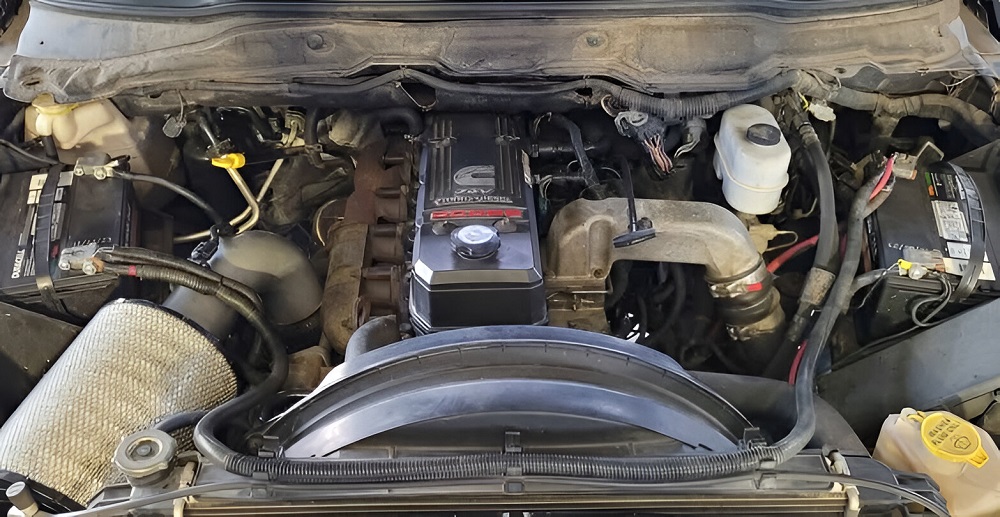
1. How 5.9 Cummins design and power creep set up its failure pattern
Cast-iron bottom end that can take a punch, until heat stacks up
The 5.9 starts with a deep-skirt cast-iron block and cross-bolted mains that clamp a long, balanced inline-six crank. That base holds up under boost, even with forged-steel rods and high compression. Bearings go the distance. Bottom ends rarely flinch.
But the long layout stretches the coolant path. Coolant enters up front and loses heat cylinder by cylinder. By the time it reaches #6, it’s already loaded. Under towing or tuning, rear cylinders get heat-soaked. Freeze plugs start to sweat. Head gaskets stretch thin back there first.
Every injection jump raised pressure, heat, and break points
Cummins built these for industrial gear. But once fueling jumped, first with P-pumps, then with VP44s and CP3 rails, power climbed, and so did thermal and mechanical stress. What worked in tractors started cracking in trucks.
| Generation | Years | Injection system | Valves | Rated power | Rated torque |
|---|---|---|---|---|---|
| Early 12-valve VE | 1989–1993 | Bosch VE rotary | 12 | ~160 hp | ~400 lb-ft |
| Late 12-valve P-pump | 1994–1998 | Bosch P7100 inline | 12 | up to ~215 hp | ~440 lb-ft |
| 24-valve VP44 | 1998.5–2002 | Bosch VP44 rotary | 24 | up to ~245 hp | ~505 lb-ft |
| Early common rail | 2003–2004 | Bosch CP3 HPCR | 24 | ~305 hp | ~555 lb-ft |
| Late common rail | 2004.5–2007 | Bosch CP3 HPCR | 24 | ~325 hp | ~610 lb-ft |
The stronger the fueling, the faster weak links show, thin castings, hot heads, stressed sensors, and valve seats that don’t last under hard use.
What stays strong vs what fails under pressure
Most 5.9 bottom ends don’t quit first. Thick cylinder walls (on the right castings), simple fixed-geometry Holsets, and no emissions tangle on pickup models give it clean airflow and high rebuild value. The rotating assembly holds its own.
But traps are baked in. The KDP walks on untouched 12-valves. 53 blocks split under load. VP44 and CP3 trucks rely on steady pressure, and when they don’t get it, pumps eat themselves.
Rear cylinders cook, freeze plugs blow, and if you chase phantom faults, electrical ghosts in the ECM or TIPM can leave you stuck.
2. Classic 12-valve 5.9 Cummins problems and mechanical triggers
KDP drops steel into the gears and shreds the front cover
Cummins used a simple alignment dowel in the timing case, just a loose steel pin tapped into the front of the block. Over time, heat cycling and vibration work that pin out. Once it falls, it drops straight into the spinning cam and injection pump gears.
If it hits at the wrong moment, it can crack the aluminum timing case, shear gear teeth, and knock the cam out of sync. That’s how piston-to-valve contact happens. In worst cases, debris enters the oil system and scars the bearings before you can shut it down.
Every untouched 1989–2002 block is suspect. The fix is simple: pull the cover, check the dowel, and tab or retainer it so it can’t walk again.
P7100 pump weak spots that look like age, not failure
The P-pump earned its “forever” rep for good reason, but it’s not immortal. The overflow valve holds internal pressure, and when its spring weakens, fuel pressure sags. The drop doesn’t end the pump, but it dulls the whole system.
You’ll feel it in throttle response first. Low-rpm haze, hard starts, lazy spool, and poor top-end power that feels like big tires or old injectors. It’s not. It’s internal fuel loss.
Another issue hides at the pump gear taper. If oil gets into the taper or the gear bolt loosens, the pump can slip timing. That throws idle off, cuts economy, and smokes more under load without making power.
Valve lash and head gaskets don’t tolerate neglect
The 12-valve head needs regular lash checks. Skip it and the valves start sealing late or floating open. That drives up EGT, hurts spool, and burns valve faces under load.
High-boost fueling from P-pump tuning adds more risk. Once the head lifts or the gasket starts to seep, hot gas cuts channels through the fire ring. Overheating seals it: cracked seats, coolant loss, or exhaust smell in the overflow.
Most 12-valves end from neglect, not design
Stock rods, crank, and pistons go the distance. The real issues are preventable: skipped lash checks, untabbed dowels, clogged cooling, and mistimed pumps. That’s why these engines end up in crawlers, marine swaps, and pre-emissions builds, they hold together when you actually touch them.
3. VP44 24-valve problems and the fragile middle years
Block-mount lift pumps starve the VP44 and set up failure
From the factory, Dodge mounted the lift pump to the engine block, hot, vibrating, and too far from the tank. These pumps degrade slowly. When pressure drops, the VP44 keeps running by sucking fuel on its own. But that low supply pressure removes both cooling and lubrication from the pump housing.
What starts as minor starvation escalates. Internal heat cooks the electronics, dries out the rotating group, and leads to solder cracks or rotor damage. That’s why upgraded frame-rail lift pumps, return filtration, and fuel pressure gauges aren’t optional on 24-valves, they’re life support.
VP44 internals fail hard once pressure or heat wins
Failures show up fast and ugly. If the PSG board overheats, the solder fractures and the pedal dies. If the rotor wears or binds, the engine stops under load. If the diaphragm inside cracks, cold starts stretch into full crank-fests.
| Symptom on a VP44 truck | Likely internal issue | Realistic fix |
|---|---|---|
| Sudden “dead pedal,” stall | PSG board / solder failure | Quality reman VP44, upgraded lift pump |
| Instant engine shutoff at load | Rotor seizure, broken drive | Reman VP44, clean debris from system |
| Long cold crank, then start | Internal diaphragm cracking | Reman VP44, verify supply pressure |
| Hot restart hard, smoky | Distributor wear, low pressure | Reman VP44, filtration + lift pump |
Once metal damage starts, no additive or “relearn” brings it back. It’s a core at that point.
Cracked 53 blocks make even clean trucks a risk
Some 1999–2002 engines carry the thin-walled 53 casting from TUPY Brazil. These blocks crack down the passenger side, just below the freeze plugs. Stress builds slowly, heat cycling, towing, tuning. The fracture leaks under pressure, then constantly, then catastrophically.
Coolant loss means hot spots. Overheating spirals into head-gasket failure or scored bearings. Some seal it with epoxy or stitch repairs, but on a truck that works, it never holds long. The only real fix is a non-53 replacement block, and that cost tips a build into no-go territory fast.
Electrical ghosts: APPS, ECM, and false fuel faults
The Accelerator Pedal Position Sensor wears its tracks and creates throttle lag, jumpiness, or full “dead pedal” that mimics pump failure. On many 24-valves, the ECM sits on the block and soaks heat and vibration. Cracked solder or corroded circuits cause no-starts, surging, or power cuts with no clear trigger.
Before blaming the VP44, sweep voltage at the APPS, confirm clean ECM power and grounds, and rule out corroded connectors. Plenty of healthy injection pumps get scrapped chasing electrical noise.
4. Common rail 5.9 Cummins problems in 2003–2007 trucks
Injectors fail dirty and take pistons with them
The HPCR injectors in these trucks run over 23,000 psi. That pressure turns water and dirt into grit. Ball seats erode. Return flow spikes. Rail pressure drops. Cold starts stretch out and idle turns white with smoke.
It gets worse when tips crack. A leaking injector floods one cylinder. The fuel washes down the rings, heats the crown, and melts the piston under load. Miss it early and you’re not swapping injectors, you’re pulling the head.
| Symptom on a common rail truck | What’s usually going on inside | Risk if ignored |
|---|---|---|
| Long crank, low rail pressure | High injector return flow | No-start, CP3 overworked |
| White smoke at hot idle | Leaking injector tip/seat | Cylinder wash, ring and bore damage |
| Random roughness under load | One or more weak injectors | Hot spots on pistons, rising EGT |
| Coolant loss + misfire | Cracked tip, piston damage | Full overhaul once crown is compromised |
Return-rate testing catches most of it. Good scan tools can log balance rates. But cheap rebuilt injectors mixed into a set? That’s how a truck eats itself.
CP3 pump lasts, but the FCA throws curveballs
The CP3 is a gear-driven workhorse. Many run 200,000+ miles untouched. But the Fuel Control Actuator that meters delivery can stick, throw surge codes, or flatten power under load.
When it sticks closed, pressure drops. When it sticks open, the rail spikes and the engine rattles hard. Unplug the FCA with the engine running, if pressure maxes out and the rattle jumps, the pump’s likely fine. The problem’s in the actuator or the wiring, not the mechanical guts.
Rear cylinder heat warps heads and pops freeze plugs
Coolant enters the head up front and travels six long chambers back. Cylinder #6 runs hottest. Under towing or with hot tunes, that heat gradient pushes head gaskets to lift or weep near the rear. Internal freeze plugs under the valve cover can blow, sending coolant straight into the oil pan.
That thins the oil, trashes bearings, and ends the crank fast. Prevention’s known: coolant bypass kits to lose rear pressure, smart tuning to cap EGTs, and cooling system flushes that keep scaling off the walls. Skip those, and the rear end of the engine goes first.
5. Exhaust manifold and turbocharger issues that raise EGT and risk
Manifold shrink cracks studs and warps flanges
The factory exhaust manifold is one long cast-iron piece. Over years of heat cycles, it shrinks unevenly and pulls hard at the ends. End studs snap. Flanges warp. Exhaust leaks open.
You’ll hear a cold tick and feel slower spool. Power comes in late. EGT creeps higher. That lost energy at the turbine shows up as heat in the pistons and more load on cylinder #6. Once that heat starts stacking, the head and gasket aren’t far behind.
Turbo wear leads to lag, leaks, and runaway risk
Every Holset wears out. Shaft play opens up. Compressor wheels touch housings. Boost lags or falls off. Late common-rail trucks with the HE351CW also deal with electronic wastegate solenoids that stick, causing overboost, underboost, or both depending on how they fail.
If oil seals let go, the turbo feeds engine oil straight into the intake. That oil can fuel the engine uncontrollably. If the throttle doesn’t stop it and you can’t choke the air fast enough, the engine runs away and eats itself.
Hot parts failure feeds bigger engine damage
Every leak, every turbo delay, drives up sustained exhaust temps. That spikes piston crown temps, boosts backpressure, and heats the rear of the head harder than it was designed to handle.
A cracked manifold or lazy turbo doesn’t just lose power, it shortens the engine’s life by feeding more heat into its weakest points.
6. Electrical and control issues that look like 5.9 engine failures
TIPM faults trigger stalls, ghost failures, and no-starts
In 2006–2007 trucks, the Totally Integrated Power Module handles everything from fuel pump voltage to headlight control. It’s a solid-state fuse box with weak spots.
When TIPM internals fail, symptoms get weird: wipers turn on with the key out, pumps cut out mid-drive, or one side of the lights dies with no blown fuse. Drivers blame the engine or ECM, but it’s the TIPM choking power to critical systems.
Dealer replacement is expensive. Reputable rebuilders open the unit, repair known faults, and often harden the board past OEM spec.
ECMs take heat, crack boards, and shut down at random
The ECM sits right on the block on many 24-valve and common-rail trucks. Years of vibration and under-hood heat bake the board. Cracked solder joints cause surging, random shutoff, no-starts, and a stuck “Wait to Start” lamp.
Failures often cool off and reset, then return the next day. Diagnosing it means checking voltage at pins, verifying clean grounds, and scanning for dropout.
When power and communication are good but behavior isn’t, the board’s cooked. Swapping in a quality programmed reman is usually the only clean fix.
Sensors and grounds throw phantom fuel and power codes
The APPS can fade and glitch throttle signals. Cam or crank sensors drop sync and cause limp mode. Block grounds corrode, load circuits backfeed, and the system lies.
That’s when owners chase fuel issues, replace injectors, swap lift pumps, only to find it was a voltage drop or bad sensor throwing ghost codes. Electrical checks come first. Clean grounds, verify sensor range, sweep throttle voltage. Hard parts don’t help if the signals are junk.
7. Fluids, filtration, and maintenance mistakes that shorten 5.9 life
Fuel filtration gaps destroy injectors and high-dollar pumps
The stock filter on common-rail trucks barely meets modern diesel quality. It misses the ultra-fine grit that erodes injector seats and CP3 internals. Even VP44 trucks suffer from poor filtration when return lines recycle debris.
Adding a pre-filter protects the lift pump. Upgrading the main filter to a tighter 10–12 micron setup keeps fuel clean before it hits the high-pressure side. Some owners run a second filter post-lift pump to protect injectors directly. But bad filters collapse or plug fast, worse than no upgrade at all.
| Component protected | Stock setup (typical) | Better choice on a hard-worked 5.9 |
|---|---|---|
| Lift pump | Single coarse filter | Added pre-filter ahead of pump |
| VP44 / CP3 pump | Factory filter only | 10–12 micron main filter with quality media |
| Injectors | Factory only | 7–10 micron secondary or upgraded main |
Ignored oil, coolant, and lash service chews top ends
Soot-thickened oil grinds lifters and cam lobes. Drag out intervals and you’ll see rocker wear, delayed throttle, and black oil by mid-change. Run cheap filters and you lose pressure before you lose power.
Coolant that’s old or wrong builds scale inside the block. Cavitation eats liners. Freeze plugs at the back start leaking. Cylinder #6 heat goes unchecked.
Valve lash service gets skipped most. Every 12-valve needs it tight and often. Every 24-valve benefits from it more than most think. Ignore it and the engine clicks louder, idles rough, and loses valve control under load.
Weak driveline loads the engine harder and heats it faster
Slipping converters, bad torque lockup, or wrong gearing force the engine to carry more rpm for the same work. That drives up exhaust temp and rear cylinder stress.
Trans fluid breaks down fast under towing. Dirty ATF means hotter shifts, longer converter stall, and higher sustained boost. Gear oil that’s old or wrong adds drag. The engine’s strong, but when the driveline fights it, even the best 5.9s get pushed past their cooling limit.
8. How 5.9 Cummins problems change with use, tuning, and generation
Stock work trucks wear slow but still have weak points
Most stock or mildly tuned 5.9s break slow, not sudden. VP44 trucks lose fuel pressure and burn pumps. Common rails erode injectors until they melt pistons. 12-valves skip lash and start clattering.
Cylinder #6 heat builds on any truck that tows. Rear freeze plugs let go. Head gaskets start to seep. Best protection: KDP tabbed, lift pump upgraded, tight fuel filtration, cooling mods on tow rigs, and strict fluid intervals.
Big-power builds walk the edge on block and head limits
Once power climbs, old weak points come fast. Stock head bolts stretch. Ring lands break. Thin 53 blocks crack wide under load.
Late castings with thicker walls, like Mexican 54s and 56s, hold 500–600 hp without flinching. But they still need studs, better pistons, three-piece manifolds, and big-fuel upgrades to stay clean under boost.
Don’t skimp on cooling. Heat ends more tuned builds than RPM or pressure.
Daily drivers and used trucks often hide prior neglect
Buyers eyeing a used 5.9 need to check: 53 block casting? KDP fix done? Lift pump upgraded? Fuel pressure gauge installed? Injector return tested? Coolant clean or milky?
Late trucks with ghost stalls or no-starts may have ECM or TIPM issues misread as fueling trouble. Most aren’t bad engines, they’re engines with bad maintenance, waiting to pass the bill.
9. What It Costs to Fix a 5.9 and When to Save or Scrap the Truck
Big-ticket repairs that fix the issue, not the symptom
Some failures on a 5.9 can’t be patched. When the VP44 ends, it’s core. When injectors overfuel, they cook pistons. But the high-dollar fixes usually solve real risks, not just symptoms.
| Repair / upgrade | Typical parts + labor (USD) | What it mainly prevents or fixes |
|---|---|---|
| KDP tab kit install | 400–1,000+ | Front gear train destruction |
| Frame-mount lift pump + plumbing | 600–1,500 | VP44 starvation and early CP3 wear |
| Set of quality common rail injectors | 1,800–3,000+ | Hard start, white smoke, piston damage |
| CP3 with FCA and filtration upgrades | 1,500–2,500+ | Rail-pressure issues, fueling instability |
| Coolant bypass / cooling upgrades | 400–1,200 | Rear cylinder heat, head-gasket failures |
| Exhaust manifold + hardware | 600–1,200 | Manifold cracks, broken studs, high EGT |
| TIPM or ECM replacement/rebuild | 600–1,500 | No-start, random stalls, “ghost” faults |
These numbers swing by region, labor rate, and how deep the failure spread before the fix landed. But most of these stop failure chains cold.
When to rebuild, when to walk, and when to part it out
If the chassis is solid, the block isn’t a 53, and it hasn’t run away or washed a piston, save it. Injectors, pumps, ECMs, and cooling fixes add up, but they put years back on the clock.
But if the head’s cracked, the block’s stitched, wiring’s hacked, or coolant mixed with oil too long, it’s not a rebuild, it’s a donor. The 5.9’s strong, but it’s not worth reviving when the whole platform’s rotten underneath.
Sources & References
- 5.9 Cummins: Engine History, Specs & Problems – The Diesel Store
- Top Cummins Engines | Best years For Cummins Diesel – Hot Shot’s Secret
- A Legacy Of Power And Reliability: The 5.9 Cummins Engine – History And Specs
- 12-Valve Or 24-Valve—Which Is The Better 5.9L Cummins? – Big Bear Engine Company
- 2nd Generation 5.9L Cummins Specs – 12V and 24V Dodge Cummins – Diesel Resource
- The Most Respected Diesel Engine In Truck History – Top Speed
- 12V Cummins vs. 24V Cummins: What’s the Difference? – Blessed Performance
- A Comparison of Cummins 12V and 24V Diesel Engines – FridayParts
- Everything You Need to Know About the 5.9 Common Rail Cummins | FASS Motorsports
- The Great Debate: 12-Valve vs. 24-Valve Cummins Engines – Oreate AI Blog
- Killer Dowel Pin (KDP) Dodge 12-valve 5.9L Cummins 1994-1998 – BD Diesel Performance
- Top 10 5.9L Cummins Problems | Big Bear Engine Company
- Industrial Injection Killer Dowel Pin (KDP) Repair Kit 89-02 Dodge 5.9L Cummins
- 5.9 12v Cummins KDP Killer Dowel Pin Kit | BD 1040182 – Full Force Diesel
- Comprehensive 2nd Gen 5.9L Cummins Maintenance Guide & Parts List – Diesel Resource
- How To Check Lift Pump Pressure On A 24-Valve Cummins (And Why It Matters!)
- Bosch VP44 Injection Pump Failures Explained
- How to Keep the VP44 in Your ‘98.5-’02 Cummins Alive | DrivingLine
- 10 Common 5.9 Cummins Engine Problems and How to Fix – Longshine
- Which Cummins Block Is Most Prone To Cracking? – SlashGear