
Pop the hood on a 3.8 JK, pull the dipstick, and find it dry, again. No puddles, no smoke. Just a V6 quietly burning a quart every 1,000 miles while throwing heat, seeping from odd corners, and ticking like a typewriter on cold starts.
This guide breaks down why the Jeep 3.8 uses oil, leaks from castings and gaskets, cracks manifolds, and suffers from electrical quirks that get blamed on the engine. It shows how the 3.8 compares to the 4.0 and 3.6, what it actually costs to keep one alive, and where fixes make a dent, or don’t.
1. What Chrysler changed and what that means for JK owners
A minivan engine redressed for off-road weight
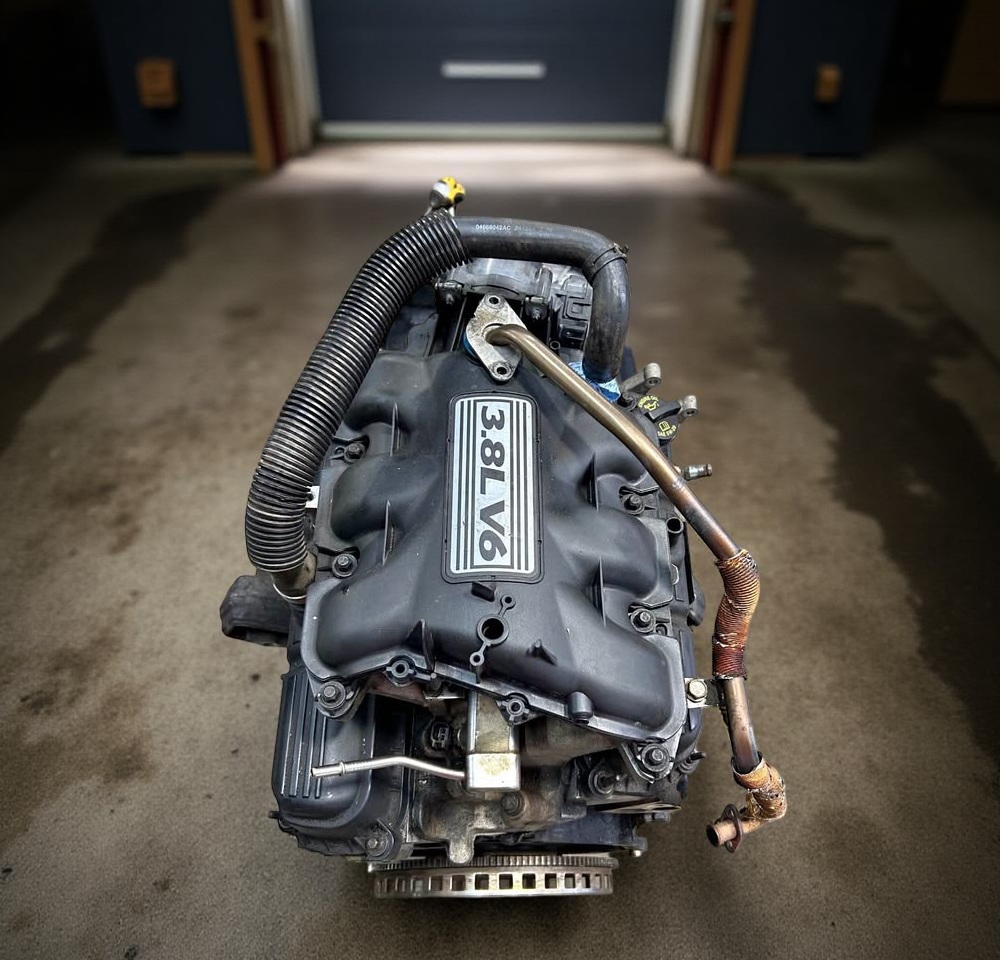
The 3.8 EGH came from front-drive Chrysler vans. To make it work in a Wrangler, Chrysler rotated the block longitudinally and cast a new housing, 4666031AB, with extra bosses for motor mounts and a new oil filter adapter.
They relocated the dipstick, revised the front cover, and changed the bolt pattern. These tweaks weren’t cosmetic. They added leak paths, torque-critical gaskets, and one more place for hot oil to blow past a seal on the trail.
Underneath, it’s still a pushrod V6. Iron block, aluminum heads, one cam, twelve valves. It revs easily, but it’s no torque anchor. Valve noise is common. So is head-gasket seepage once heat cycling warps the seal line.
Specs that look fine until the road climbs
Jeep 3.8L EGH V6 Core Specs
| Parameter | Value | Why it matters on a JK |
|---|---|---|
| Displacement | 3.8 L (231 cu in) | Similar size to older 4.0, very different feel |
| Configuration | 60° V6, OHV, 12-valve | Compact, simple, but not a torque monster |
| Block / head material | Cast iron / aluminum | Strong bottom end, sensitive gaskets |
| Bore x stroke | 96 mm x 87 mm | Slightly oversquare, likes to rev |
| Compression ratio | 9.6:1 | Happy on regular fuel |
| Rated output (JK) | ~202 hp / 237 lb-ft | Looks fine on paper, feels strained in Unlimited |
The torque curve hits its peak at 4,000 rpm, right where Wrangler drivers don’t want to be when crawling or towing. Gearing doesn’t help much.
Automatic JKs with 3.21 or 3.73 axles stay high in the revs, forcing the engine to run hot under load. Long climbs, headwind freeway drives, even soft sand, this V6 sees WOT often, and that’s what drags it into early wear.
The 3.8’s reputation and how far it really goes
Jeep loyalists never gave the 3.8 much grace. It replaced the 4.0 inline-6, then got dropped for the 3.6 Pentastar. The power bump never translated into confidence.
Most 3.8s land between 150,000 and 200,000 miles with decent care. A few cross 250,000. But skip oil checks or overheat it once, and it doesn’t take much to spin a bearing or warp the heads.
Four types of failure show up the most: steady oil use, coolant and oil leaks from gaskets and castings, heat-induced part failures, and electrical dropouts blamed on the engine but rooted in the TIPM. That stack is what defines 3.8 ownership, and what the next section opens up.
2. Oil goes missing: rings, PCV, and upside-down installs
How these engines use oil without leaving a trail
Most 3.8s start using oil before 100,000 miles. The common range is 1 quart every 1,000 to 1,500 miles. Some push worse. Owners check the dipstick, find it low, top off, and never see a drop on the ground.
No blue smoke. No warning. The engine just uses it quietly through the rings or the PCV tract. When it’s not topped off, bearings run dry. Lifters get loud. Eventually, compression falls off, and oil pressure tanks.
Low-tension rings and carbon-glued oil scrapers
Chrysler used low-tension rings on the 3.8 to cut friction. The top and second rings don’t press hard against the cylinder wall, so oil bypass climbs even when they’re still sealing compression.
Below them, the oil control rings ride in small grooves. On short trips or skipped oil changes, those grooves fill with carbon. Once that happens, the rings seize in place. Oil doesn’t get scraped clean, it gets pulled into the chamber and burned.
Cheap oil, long intervals, and cold-use patterns speed this up. Once that scraper sticks, the engine starts using oil fast.
Factory ring installs that pumped oil from day one
Early 3.8s had a bigger problem: inverted second rings. While Chrysler’s official Oil Consumption Guidelines (TSB 09-007-18) often dismissed this as ‘within spec,’ internal investigations and engine teardowns confirmed that many engines shipped with the Napier-style second ring flipped upside down.
Instead of scraping oil down, it flung it up toward the chamber. These weren’t worn engines, they were showroom-fresh 2007–2008 Wranglers losing a quart every 700 miles. No recall. No rebuild. Dealers told owners it was “within spec” and sent them home with heavier oil.
PCV valves that siphon oil like a straw
A failed PCV valve on the 3.8 can use just as much oil as stuck rings. When the valve sticks open, high intake vacuum pulls oil mist, and even liquid oil, from the valve cover into the throttle body.
Drivers notice oily intake plumbing, plug fouling, misfires, and rich fuel trim codes. Poor idle and cold-start stumbles are common.
Most aftermarket PCV valves make the problem worse. The spring tension’s wrong, or the seal doesn’t seat. Mopar valves last longer, but still need regular swaps, every 30,000 to 50,000 miles.
Where it starts, what it shows, and how it adds up
Jeep 3.8 Oil Consumption Causes and Clues
| Root cause | Mechanical issue | What the driver notices |
|---|---|---|
| Low-tension / worn rings | Poor ring seal, high blow-by | Falling oil level, mild haze, normal compression until late |
| Stuck oil control rings | Rings glued in grooves by carbon | Sudden jump in oil use, plugs fouling |
| Factory assembly error (Inverted rings) | Oil pumped into chamber from new | Heavy oil use on low-mileage 2007–2008 units |
| Failed / cheap PCV valve | Oil siphoned through PCV circuit | Oil in intake, misfires, rich codes, rough idle |
3. Gaskets, castings, and leaks that look harmless, until they aren’t
Timing cover porosity that hides in plain sight
Some early JKs leak oil from the front, not from a seal, but through the metal itself. Chrysler issued TSB 09-008-07 after finding porous aluminum castings on the timing cover. Oil doesn’t just seep around the gasket.
It pushes through microscopic holes in the cover face. The result is a slow film of oil around the front crank area that mimics a pan leak, front seal leak, or filter adapter drip.
Shops misdiagnose it constantly. You can reseal everything else, but if the cover’s porous, the leak stays until the casting’s replaced.
Lower intake gaskets that invite coolant into the crankcase
The LIM gasket has a critical job, keeping coolant out of the lifter valley and intake runners sealed tight. When it fails, coolant starts collecting in the engine V or slowly disappearing from the reservoir.
No smoke, no puddles. Just sweet smell, damp valley, or milkshake on the dipstick. That mix trashes bearings fast.
The bolts sometimes loosen from heat cycling. Gasket material breaks down. Coolant eats past it, then oil turns to sludge. Heads warp. The fix isn’t a head job, it starts at the intake.
Slow leaks that mimic rear mains and chase shops in circles
Valve cover gaskets break down and run oil down the back of the block. It drips off the bellhousing and gets flagged as a rear main every time. The oil filter adapter uses a molded gasket and torqued seal. Once it loses tension or gets warped, oil escapes down the pan rail and hides under skid plates.
The head gasket itself can leak externally, too. Not blown, just weeping at the corners. Staining is common. Diagnosis takes a clean engine, dry run, and dye, not guesses.
Leak spots by urgency, not just mess
Common 3.8 Leak Points and How Urgent They Are
| Location | Typical cause | Risk level if ignored |
|---|---|---|
| Timing cover face | Casting porosity, gasket crush | Medium, mess, low oil over time |
| Lower intake manifold (LIM) | Gasket fatigue, bolt relaxation | High, coolant in oil kills bearings |
| Valve covers | Aged rubber gaskets | Low, messy but manageable |
| Front/rear crank seals | Seal wear, crank surface wear | Medium, steady oil loss |
4. Heat, exhaust cracks, and a cooling system that can’t keep up
Why Wrangler duty runs the 3.8 hotter than it was built for
The 3.8 wasn’t made to push a 4,000-pound brick through headwinds on 35s. In a minivan, it cruised under light load. In a JK, it fights drag and weight every mile. The revs stay high, especially in automatics with 3.21 gears.
Trail work on hot days pushes coolant and oil temps even higher, especially when airflow drops. Heat builds up around the heads, the intake, and the exhaust. That’s where failures start stacking.
Manifold cracks and studs that shear flush in the head
The factory cast manifolds can’t handle repeated hot-cold cycles. Over time, they crack. Studs loosen, then snap. Most breaks happen at the flange or between runners.
The ticking starts on cold mornings and fades once the metal expands. By then, hot exhaust is leaking into the engine bay. That heat warps plastic wire looms, cooks plug boots, and melts nearby harnesses.
Extraction’s ugly. Many studs break flush. Access is tight. Labor stacks fast, and few shops do it without pulling parts around the heads.
Shared heat between engine and trans that stacks the deck
On JKs with the 42RLE automatic, the transmission cooler sits inside the radiator. That setup dumps trans heat straight into the coolant.
On slow climbs or high-load pulls, it causes a chain reaction; trans fluid gets hot, coolant can’t shed the load, oil temp rises, and everything runs on the edge. Coolant temps stay in range but spike fast when load hits.
Once heads warp or gaskets lift, there’s no warning. The dipstick shows sludge. Fans can’t catch up. You’re already out of margin.
Upgrades that cut temp and buy time
Some owners run aluminum radiators with larger cores and high-flow fans. Others add hood vents to dump bay heat at idle. The biggest change comes from isolating the transmission heat.
A separate external trans cooler takes that load off the radiator and gives the engine cooling system a fighting chance. Without it, the engine and trans keep reheating each other until something gives.
5. Electrical dropouts that get blamed on the engine
The TIPM runs more than fuses, and it fails quietly
The Totally Integrated Power Module (TIPM) isn’t just a fuse box. It controls power to the fuel pump, ignition coils, and engine sensors.
When it breaks, symptoms point straight at the engine, even when the engine’s fine. Cracked solder joints, corroded terminals, and stuck relays are common. Water intrusion pushes it over the edge.
The TIPM sits under the hood, right where heat, moisture, and vibration hit hardest. Once it glitches, it doesn’t fail cleanly, it cuts in and out.
Stalls, no-starts, and ghost faults that lead nowhere
Some Jeeps shut off mid-drive, then restart without issue. Others crank but won’t fire, with no fuel pressure and no injector pulse. Battery reads full, starter’s good, engine’s fine.
But the signal never reaches the pump or coil. Sometimes relays stay hot after shutdown, draining the battery overnight. The codes don’t help much, random P-codes, voltage drops, or no codes at all.
These symptoms get misread as bad grounds, sensor failures, or engine faults. But the problem’s upstream, power never made it to the parts you’re testing.
Sorting TIPM trouble from real engine damage
Scan it cold. Check for fuel pressure. Watch for coil and injector power with the key on. If the pump cuts out with no warning, and the engine won’t start until the relay clicks again, that’s the TIPM cutting signal. It mimics crank sensor failure, misfires, even no-compression conditions.
Some owners replace the TIPM with rebuilt units. Others buy new and flash them at the dealer. Either way, it’s not cheap. But if the power feed’s not stable, every repair downstream will fail again.
6. How the 3.8 compares to the 4.0 and 3.6
The torque curve gap you feel, not just see
Wrangler Engine Comparison (4.0 vs 3.8 vs 3.6)
| Engine | Hp / torque (approx) | Real-world feel | Typical lifespan with care | Headline problem |
|---|---|---|---|---|
| 4.0 inline-6 | 190 hp / 235 lb-ft | Strong low-end grunt | 300k+ miles common | Cracked manifolds, occasional rear main |
| 3.8 V6 (JK) | 202 hp / 237 lb-ft | Revvy, feels strained | 150k–200k+ miles | Oil consumption, heat, gaskets, manifolds |
| 3.6 Pentastar V6 | 285 hp / 260 lb-ft | Much stronger across band | 200k–250k+ miles | Oil cooler/filter housing leaks, some head issues |
The 3.8 makes similar torque to the 4.0 but peaks higher in the rev range. On pavement, it works harder to keep speed. On trails, the difference is worse. The 4.0 crawls over obstacles with throttle barely cracked. The 3.8 needs more pedal and more revs, which brings more heat and more wear.
The 3.6 fixes the power gap. Throttle response is better, and gearing fits the curve. But it brings its own problems, oil cooler leaks and early head issues in some years.
Why build type and gearing change everything
Two-door JKs with stock tires and 3.73 gears live longer. They’re light enough that the 3.8 doesn’t have to scream. Four-doors with 35s and 3.21s are a different story. The engine spends more time at 3,500 rpm just to stay on pace. That heat cycle beats the gaskets, dries the seals, and speeds up ring failure.
Lifted rigs on factory gears also push the transmission harder. In-radiator trans coolers dump more heat into the engine circuit, stacking load the system wasn’t built to handle.
Discounted entry, but the fix stack follows
Used 3.8 JKs sell cheaper than 3.6 models. That upfront savings looks good, until you price a head gasket job or a manifold swap. The gap can close fast. But some buyers get ahead of the curve.
If they know what to expect, knock out the big repairs early, and stay on top of fluid checks, the 3.8 doesn’t have to be a throwaway engine.
7. What keeps a 3.8 alive past 200,000 miles
Oil weight, intervals, and dipstick discipline
Factory spec calls for 5W-20. That works in minivans. In JKs, it disappears fast. Most long-life 3.8 owners switch to 5W-30 or 10W-30 full synthetic. The thicker oil slows blow-by and helps worn rings keep a seal. It also holds up better under heat, especially in trail rigs that idle uphill for hours.
Intervals drop too. Forget 6,000 miles. Go 3,000 to 5,000 max in hot weather, short-trip use, or off-road builds. And check the dipstick often. Once a week, minimum.
Gaskets, PCV swaps, and coolant that actually gets flushed
High-Value Preventative Maintenance for Jeep 3.8
| Task | Suggested interval | Goal |
|---|---|---|
| PCV valve (OEM quality) | Every 30,000 miles | Limit oil siphoning into intake |
| Engine oil + filter | 3,000–5,000 miles | Control sludge, reduce ring sticking |
| Cooling-system flush | Every 45,000 miles | Protect LIM gaskets and head gaskets |
| LIM bolt re-torque/check | Every 30,000 miles | Keep gasket compressed, prevent seepage |
| Transmission service (auto) | Every 50,000 miles | Cut shared heat load on engine cooling |
Each job keeps failure paths closed. A $10 PCV valve swap avoids an oil-soaked intake. One flush can buy years before gasket seepage starts. Skip these, and you’re chasing leaks, not fixing them.
When cooling and gearing mods pay off
Trail rigs with 35s need more than oil. Regear the diffs to 4.88s or 5.13s to drop RPMs and lower load. Add a standalone trans cooler to stop the heat dump into the radiator.
Aluminum radiators with higher-capacity cores keep temp swings in check. Hood vents cut under-hood soak and protect harnesses and sensors near the exhaust.
Each mod buys thermal margin. Without them, the engine sees redline heat under greenlight throttle.
When to stop patching and drop in a reman
Some engines cross the point of no return. Oil control rings stick. Cylinder pressure fades. LIM gaskets leak again. Manifolds crack. Bottom end ticks. Instead of chasing each problem, some owners drop in a remanufactured long block. Those come with fresh bores, revised rings, and resealed heads.
It’s not cheap. But if you’re already halfway through the repair list, one full teardown often beats five more patches.
8. What the big repairs cost and where the break-even hits
The jobs that break budgets fast
Common Jeep 3.8 Repairs and Cost Ranges
| Repair | Typical cost (parts + labor) | Notes on difficulty / risk |
|---|---|---|
| TIPM replacement or rebuild | $900–1,300 | Mostly module swap + programming |
| Exhaust manifold(s) with hardware | $1,200–1,600 | High risk of broken studs in heads |
| Lower intake manifold gasket | $500–800 | Upper engine teardown, cleaning required |
| Head gasket job | $1,800–2,400 | Machine work, valve job often bundled |
| Timing cover replacement | $600–900 | Front teardown, careful sealing |
| Reman long block + install | $4,500–6,500 | Best route after oil-starvation failures |
Studs that snap in the head drive up manifold repair costs. LIM gaskets need careful reseal, not just a torque-and-go. Head jobs almost always include valve work, surface milling, and full top-end refresh. The long block route cuts the risk if rings, bearings, and gaskets are all suspect at once.
Fix it, monitor it, or cash out?
If the engine runs strong but seeps or uses a little oil, run it and stay on top of fluids. One gasket job, one PCV swap, still worth doing.
But if oil use keeps climbing, compression drops, or two or more major failures stack up, you’re close to engine money. Once the tally pushes past $3,000 and more work still waits, most shops stop patching.
Value plays in too. If the Jeep books for $9,000 and the engine’s failing, a $6,000 fix doesn’t make sense. At $4,000 with known issues? A reman might pencil out if you’re keeping it.
The profile of a high-mile 3.8 that actually survives
Engines that clear 200,000 didn’t get lucky. They ran thicker oil. Got fresh filters every 3,000. PCV valves were swapped before they clogged. Coolant stayed clean. LIM bolts held torque. No shared heat from the transmission. Gearing matched tire size. Dipsticks got checked weekly.
Miss any of that, and the engine folds early. Treat it like a 4.0, and it won’t make it.
Sources & References
- Jeep Wrangler Reliability by Year [2026 Updated] – Simi Valley …
- RUINED Jeep Wrangler 3.8L V6 Engine Teardown After 286,000 Miles! – YouTube
- Jeep Wrangler Years to Avoid: Reliability Analysis & Buyer’s Guide
- Wrangler 2011 3.8L | PDF | Internal Combustion Engine – Scribd
- Everyone that has owned both, what do you think of the new 3.6 vs. the old 4.0? : r/Jeep
- How bad is the 3.8 engine in the 07-11’s? : r/Wrangler – Reddit
- Chrysler 3.3 3.8l Engine | PDF | Piston | Screw – Scribd
- Jeep Wrangler Smoke from engine or exhaust Inspection Costs – YourMechanic
- What is the Average Lifespan of a Jeep Wrangler Engine? – Simi Valley Chrysler Dodge Jeep Ram Blog
- Here’s What Killed A Jeep Wrangler’s 3.8 V6 After Nearly 300000 Loyal Miles – Reddit
- Are the 2007-2011 Jeep Wranglers THAT bad? – Reddit
- Bad PCV Valve Symptoms, Plus FAQ – In The Garage with CarParts.com
- JK: 3.6 vs 3.8: Reliability/Longevity? : r/Wrangler – Reddit
- Failing Timing Cover Symptoms – In The Garage with CarParts.com
- What happens when piston rings are installed upside-down? : r/EngineBuilding – Reddit
- 2011 JEEP Liberty Recalls, Complaints and Investigations – The Center for Auto Safety
- Oil In the Throttle Body: Causes, Symptoms, and Replacement Costs – CarParts.com
- Found out all 3.8 Jeep 07-08’s burn oil. Worth fixing and keeping it …
- Intake manifold leak or blown headgasket? 09 Jeep wrangler unlimited – Reddit
- Is Your Timing Cover Gasket Failing? Here’s How to Tell – NAPA Blog
- Diagnosing a Leaking Lower Intake Manifold Gasket on my Jeep JK Wrangler – YouTube
- 3.8L Engine Oil Seepage Due To Front Timing Cover Surface …
- Jeep Wrangler JK Lower Intake Manifold Replacement – YouTube
- Engine Rebuild/Replacement – NOVA Jeepers
- Exhaust Manifold Leak: All You Need to Know – Just Jeeps Blog
- Jeep Wrangler Exhaust Manifold Replacement Cost Estimate – RepairPal
- Exhaust Manifold/Intake Gasket leak or crack? VIDEO!!! | NAXJA Forums
- Bad Exhaust Manifold or Gasket Leaks (Know the Symptoms before Replacement)
- Exhaust manifold crack Chrysler 3.8 : r/AskMechanics – Reddit
- Exhaust Manifold Repair & Replacement Costs – SoFi
- Jeep Wrangler Exhaust Manifold Repair Costs – YourMechanic
- Cost of fixing manifold? : r/JeepTJ – Reddit
- Aluminum Radiator & Fan Combo For Jeep Wrangler JK 2007-2018 | 3.8L & 3.6L Engine Cooling Upgrade
- 3.6L Pentastar V6 Specs and Information – CJ Pony Parts
- Chrysler Pentastar engine – Wikipedia
- 5 Tips to Keep Your Jeep Running Cool this Summer | RealTruck
- 2007-2011 Jeep Wrangler 3.8L Cooling Maintenance Bundle – RIPP Supercharger
- Jeep JK Cooling System Parts for 2007-2018 Wrangler – Extreme Terrain
- Revolutionizing Your Ride: Jeep Cooling System Upgrades for Optimal Performance
- Jeep Wrangler Head Gasket Replacement Cost Estimate – RepairPal