
Pull hard at 1,200 RPM, then watch the dash flash derate on a grade. That’s how many MP8 stories start. Since 2006, the 12.8-liter inline-six has powered Mack’s vocational and highway trucks through EPA 2007, 2010, GHG 2017, and now GHG 2021 emissions cycles.
Early engines fight copper injector cup leaks and EGR soot that clogs DPFs. Mid-era models add SCR and DEF hardware, bringing NOx sensors and regen faults into the mix.
GHG 2017 and newer engines switch to common rail and wave pistons, cutting soot but raising the stakes on fuel quality and electronics.
This guide explains what fails, which years carry the most risk, what the big repairs cost, and how to keep an MP8 working past 800,000 miles instead of living in derate.
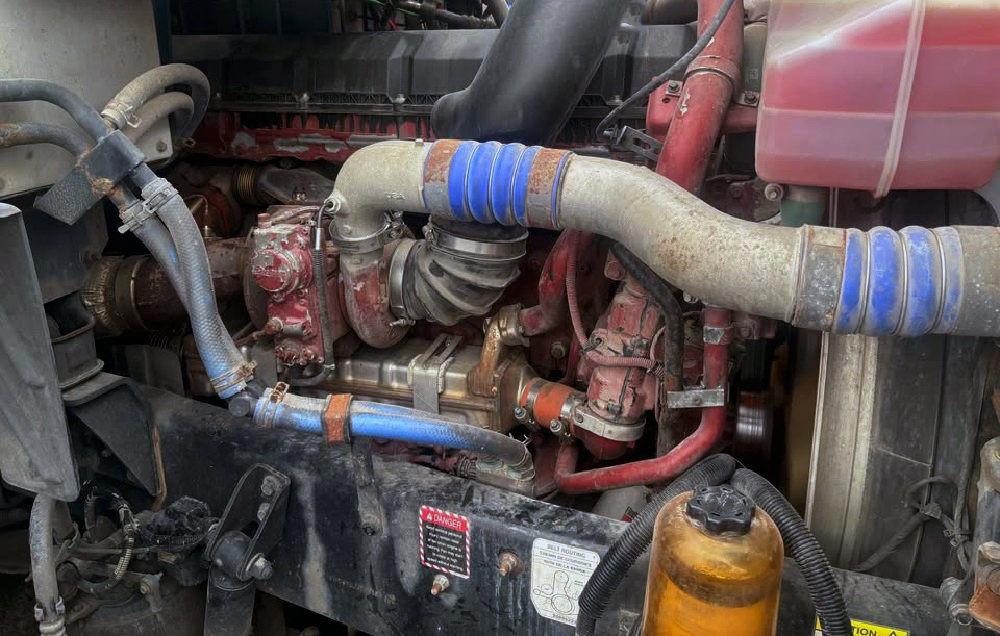
1. MP8 generations and where problems really stack up
Emissions shifts that changed the failure map
Roll back to EPA 2007. The first MP8 runs EUI fuel, cooled EGR, and a new DPF. Copper injector cups seal the injectors to the head. Many start leaking between 300,000 and 600,000 miles, pushing fuel into coolant and air into the fuel rail.
EPA 2010 adds SCR and DEF dosing. Horsepower climbs to 505 HP and torque hits 1,860 lb-ft. NOx sensors, DEF dosers, and regen logic enter the picture. Now a drifting sensor can trigger SPN 5246 FMI 0 and start a 5 MPH derate chain.
GHG 2017 flips to common rail at over 30,000 PSI. Wave pistons cut soot up to 90 percent versus older bowls. Fuel gets cleaner. Tolerances get tighter. One failing high-pressure pump can contaminate the entire rail and send metal through all six injectors.
GHG 2021 tightens diagnostics and telematics oversight. GuardDog flags boost trends and regen frequency early. Hard part failures drop. Sensor-driven derates and wiring faults rise.
| MP8 era / rating | Approx years | Fuel system | Key hardware changes | Typical problem hotspots |
|---|---|---|---|---|
| EPA 2007 MP8 | 2006–2009 | EUI | Cooled EGR, DPF added | Copper cups, early EGR clogging, heavy soot load |
| EPA 2010 MP8 | 2010–2013 | EUI | SCR + DEF, refined EGR | Cups, EGR coolers, NOx sensors, frequent regens |
| GHG 2014 MP8 | 2014–2016 | EUI | ClearTech One, tighter software | Sensor faults, harness oil wicking |
| GHG 2017 MP8 | 2017–2020 | Common rail | Wave pistons, higher rail pressure | Pump failure, injector imbalance, NOx drift |
| GHG 2017 MP8HE | 2017–2020 | Common rail | Turbo compounding, downspeeding | Compound gear wear, high exhaust heat |
| GHG 2021 MP8 / HE | 2021–present | Common rail | Updated pistons, smarter diagnostics | Sensor derates, DEF system faults |
Early engines fail from heat and sealing. Later engines fail from pressure and electronics. A common-rail pump failure can push a $3,500 injector job into a $10,000-plus full fuel system replacement.
Downspeeding and mDRIVE load the engine differently
Pair the MP8 with mDRIVE and tall rear gears. Cruise sits at 1,050 to 1,200 RPM. Cylinder pressure stays high while RPM stays low. Peak torque hits at 1,200 RPM and holds flat.
Low RPM means longer combustion duration per cycle. Exhaust heat builds fast under load. EGR flow increases. Soot control becomes critical on hills and in heavy traffic.
Long-haul trucks running steady at 65 MPH often see stable temps and fewer thermal swings. Vocational trucks idle over 30 percent of the time. Heat-soak cycles hammer EGR valves, VGT vanes, and DPF substrates.
Sustained downsped load with poor maintenance drives EGT past 1,200°F during active regen and accelerates turbo and DPF wear.
Linehaul versus vocational failure timing
Highway fleets usually see aftertreatment codes first. Rising delta pressure across the DPF. Frequent SPN 3719 FMI 16 for high soot load. NOx sensors drift out of range around 250,000 to 400,000 miles.
Vocational units show EGR and VGT issues earlier. High idle and PTO hours clog EGR coolers by 200,000 to 300,000 miles. VGT unison rings stick from soot and rust. Underboost codes like SPN 102 FMI 18 follow.
Injector cup leaks show up across both segments. Coolant smells like diesel. Surge tank darkens. Ignore it and bearing damage follows once fuel dilutes the oil.
Spec choices matter. An MP8HE in steady linehaul can return 8.5 to 9.0 MPG. The same engine in stop-and-go refuse can cut that below 5 MPG and push oil change intervals down to 35,000 miles.
2. Core mechanical failures that take trucks off the road
Injector cups that leak fuel into coolant
Start cold and smell diesel in the surge tank. Coolant turns dark. Fuel pressure drops off overnight and the engine cranks long before it lights. That’s the classic copper injector cup failure seen in EPA 2007 and 2010 engines.
Fuel migrates past the sleeve into coolant. Combustion gas pushes back into the fuel rail. Below 1,600 RPM, the engine stumbles and throws imbalance codes. Techs confirm it with a cooling system pressure test and a return-line bubble test.
Mack moved to conical stainless cups. They seal tighter under heat and resist ovaling. Mix copper and steel in one head and expansion rates fight each other, risking head cracking. A full cup job runs 8 to 12 labor hours and lands near $1,500 to $2,500 depending on region.
Camshaft lobe wander and valvetrain damage
Miss a cylinder that won’t clear with an injector swap. Overhead checks out. Fuel pressure holds steady. Pressed cam lobes can spin on the hollow shaft on higher-mileage units, usually past 400,000 miles.
When a lobe moves, valve timing shifts for that cylinder. The ECM logs misfire and learned offset faults that won’t reset. Techs mark lobes with paint, bar the engine over, and watch for movement. If the mark shifts, the cam is done.
Repair means camshaft replacement and often rockers and rollers. Parts and labor can cross $4,000 to $7,000. Ignore it and metal sheds into the oil, accelerating bearing wear.
Head gaskets, manifolds, and high-mileage bottom ends
Lose coolant with no external leak and see white haze on startup. Cooling system builds pressure fast from a cold start. Head gasket failures show up more often past 500,000 miles, especially on severe-duty trucks.
Exhaust manifolds crack between ports around 250,000 to 500,000 miles. Soot streaks appear under the hood. Boost drops and fuel economy falls before the driver hears a tick.
High crankcase pressure codes like SPN 153 FMI 0 flag liner and ring wear. Oil analysis shows rising iron and fuel dilution. An in-frame overhaul kit runs about $4,000 in parts, with 30 to 50 labor hours pushing total cost into the $12,000 to $20,000 range depending on shop rates.
3. Fuel system evolution that raised the stakes
EUI durability versus common-rail precision
Run an early EUI MP8 and injection pressure follows cam speed. At idle, pressure drops. At high RPM, it climbs. The system tolerates minor contamination better because each injector builds its own pressure.
Move into GHG 2017 and pressure stays above 30,000 PSI in a shared rail. Multiple pilot and post injections smooth combustion and cut soot. Clearances tighten. Water, rust, or fine metal can score injectors fast.
When the high-pressure pump fails, it sheds metal into the rail. That debris feeds all six injectors. Standard repair calls for pump, rail, lines, and injectors. Total job cost can push $8,000 to $12,000 depending on parts pricing.
When one injector failure turns into six
Notice rough idle and elevated soot load. Cylinder balance rates drift. One injector may stick open or leak at the tip. Fuel washes the cylinder wall and dilutes the oil.
Excess fuel drives up DPF loading. Regens increase in frequency. Fuel economy drops below 6 MPG on routes that once ran 8.5. Oil analysis shows rising fuel percentage.
Replace one injector and leave five aged units behind, and the mismatch can trigger new imbalance codes. Labor overlap is high. A full set of six injectors runs roughly $3,500 to $5,000 installed in many markets.
Oil wicking through the injector harness
Chase random misfire codes that won’t stay gone. Pull the valve cover and find oil in the injector harness connectors. Capillary action draws oil along the copper strands toward the ECM.
Oil reaches the ECM plug and contaminates pins. Intermittent injector driver faults appear. Codes clear, then return under heat. Silicone patches fail because oil pressure inside the head keeps pushing.
The fix requires an updated internal harness and careful cleaning of ECM connectors. Parts are modest. Labor adds up. Left alone, oil intrusion can damage the ECM, turning a few hundred dollars in wiring into a multi-thousand-dollar control module replacement.
4. Air handling failures that trigger derates fast
VGT vanes that seize and actuators that drown
Feel power fade under load and see boost lag behind command. The variable geometry turbo runs in soot, heat, and moisture. Unison rings rust. Vanes coke up. Movement slows or sticks.
Underboost codes like SPN 102 FMI 18 pop first. Overboost can follow if vanes hang closed. Exhaust gas temperature climbs past 1,200°F during regen. Frequent derates start showing up on hill pulls.
Actuators fail too. Internal gears wear. Position sensors drift. Coolant can leak past a bad gasket and fill the housing, shorting electronics. A VGT actuator replacement often runs $1,200 to $2,000 installed, while a full turbo job can exceed $3,000 to $4,000.
Separate actuator faults from a dying turbo core
Hear a loud whine that rises with RPM and find oil in the charge pipes. Shaft play at the compressor wheel points to bearing wear. That’s a core issue, not an actuator.
See erratic vane position data with smooth shaft rotation by hand. That leans toward actuator trouble. Commanded position and actual position diverge in live data. The ECM may log repeated boost control codes without smoke.
| Symptom | Likely actuator issue | Likely turbo core failure |
|---|---|---|
| Underboost code | Stuck or miscalibrated actuator | Worn bearings, damaged turbine wheel |
| Loud whining noise | Rare | Severe shaft play, bearing failure |
| Blue or gray smoke | Rare | Oil passing through worn seals |
| Erratic vane position data | Yes | Unlikely |
| Heavy shaft play by hand | No | Yes |
Misdiagnose it and buy parts twice. Replace a turbo when the actuator was bad, and the new unit can fail again if the control fault remains.
Turbo compounding on MP8HE adds gears and heat
Run an MP8HE and a second turbine sits downstream of the VGT. It feeds recovered exhaust energy back to the crank through a geartrain and hydraulic coupling. Torque stays strong at 1,200 RPM.
Extra hardware means extra stress. Bearings in the compound section see sustained heat. Geartrain noise can develop at higher mileage. Repairs require specialized parts and labor.
A turbo-compound assembly replacement can climb past $6,000 to $10,000 depending on damage and shop rate. The added system weight and complexity raise the repair ceiling compared to a standard single VGT.
5. Emissions hardware that shuts you down at 5 MPH
EGR valves and coolers that start the chain reaction
Feel throttle response go flat and watch boost drop under load. The EGR valve sticks open or the cooler plugs with soot. Exhaust gas flow rises when it shouldn’t. Intake charge gets dirty and hot.
Soot production climbs fast. The DPF sees higher load per mile. Active regens trigger more often. Exhaust gas temps spike during those events.
Coolant can leak inside the EGR cooler core. That mimics a head gasket with unexplained coolant loss. Pressure testing the cooler isolates it before tearing down the top end. EGR cooler replacement often lands between $1,500 and $3,000 installed.
DPF soot versus ash and the 7th injector problem
Watch SPN 3719 FMI 16 show up for high soot load. Soot burns off during regen. Ash does not. Ash builds from oil consumption and additives and stays trapped in the substrate.
Idle-heavy trucks pack soot faster. Aborted regens stack load. Delta pressure across the DPF climbs at the same fuel rate. Parked regens become routine instead of rare.
The 7th injector or hydrocarbon doser can coke up. Fuel flow drops during active regen. Exhaust temp fails to hit target. Soot stays high. DPF bake or exchange runs about $800 to $1,500, while full aftertreatment replacement can exceed $5,000.
SCR, DEF, and the path to a hard derate
See an SCR efficiency code like SPN 4364 FMI 18. NOx sensors drift or fail. DEF dosers crystallize at the tip. Pumps and heaters fail in cold climates.
The ECM monitors conversion efficiency. If readings stay out of range, it limits power. First comes reduced torque. Then a countdown. Finally a 5 MPH derate under SPN 5246 FMI 0.
Ignore the warnings and the truck will crawl at walking speed until repair. NOx sensor replacement can run $500 to $1,000 each. Let the system hit full derate and downtime often costs more than the parts.
6. Diagnostics that separate a sensor glitch from real damage
Code clusters every MP8 operator should recognize
See SPN 5246 FMI 0 and power drops fast. That’s an aftertreatment derate. The ECM believes emissions are out of range and starts limiting torque. If the condition persists, the truck can fall to 5 MPH.
Spot SPN 3719 FMI 16 for high soot load. That means the DPF is near its calculated limit. Fuel rate, boost, and exhaust temp need to be checked together. Ignore it and parked regens become mandatory.
Catch SPN 111 FMI 1 for low coolant or SPN 153 FMI 0 for high crankcase pressure. Those are engine protection events. Low oil pressure or high coolant temp can trigger shutdown logic before mechanical damage escalates.
Read trends, not just single codes
Watch delta pressure across the DPF at the same load week to week. If it rises at identical fuel rates, restriction is building. Log boost versus commanded boost under a steady 1,200 RPM pull. Drift over time points to EGR restriction or VGT wear.
Track regens per 1,000 miles. A healthy linehaul truck may see one every 500 to 700 miles. A unit doing short trips may cut that in half. Rising frequency without route change signals soot control trouble.
Monitor crankcase pressure trends. A slow climb over months can flag ring wear before blow-by becomes visible. Waiting for a hard fault often means bearing damage has already started.
Know when to limp and when to shut it down
Lose boost but oil pressure and coolant temp stay stable. That can often limp to the yard. See rising coolant temp with pressure spikes from cold start. That points to head gasket or cooler breach and should not be pushed.
Hear heavy knock under load with misfire and fuel dilution in the oil. Shut it down. Bearing damage accelerates fast once oil thins. See a 5 MPH aftertreatment derate active. The truck will not clear it by driving harder.
Driving through repeated derates can cook the turbo and DPF. What started as a $1,200 sensor or EGR repair can turn into a $20,000 in-frame when liners and bearings score.
7. Real repair costs and the maintenance math that decides profit
What common MP8 jobs cost in 2025
Book a standard oil and filter service and expect around 2.0 to 2.5 labor hours. Total ticket often lands near $800 to $1,200 depending on oil spec and region. Severe-duty units running under 5 MPG need shorter intervals, sometimes 35,000 miles or less.
Pull an EGR cooler for cleaning and plan about 5 labor hours. Parts and labor together usually sit between $800 and $1,500. Replace the cooler and valve assembly and the bill can reach $2,500 to $3,500.
Swap a VGT turbo and expect roughly 4 to 6 labor hours. A standard VGT job often totals $3,000 to $4,500. An MP8HE turbo-compound assembly can push $6,000 to $10,000 depending on damage.
| Service / Repair Task | Estimated Labor Hours | Typical Total Cost (2025) |
|---|---|---|
| Oil & filter service | 2.0–2.5 | $800–$1,200 |
| EGR cooler cleaning | ~5.0 | $800–$1,500 |
| VGT turbo R&R | 4.0–6.0 | $3,000–$4,500 |
| Full injector set (6) | ~5.0–6.0 | $3,500–$5,000 |
| Injector cups (set) | 8.0–12.0 | $1,500–$2,500 |
| DPF clean / exchange | ~3.0 | $800–$1,500 |
| In-frame overhaul | 30.0–50.0 | $12,000–$20,000+ |
Labor rates swing totals more than parts on big jobs. Dealer shops can exceed $175 per hour. Independents may run lower but vary by region.
Match service intervals to real duty cycles
Run linehaul above 6 MPG with low idle time and oil can stretch toward upper interval limits. Run refuse or mixer work with 30 percent idle and oil shears faster. Fuel dilution climbs. Soot load rises.
Use low-ash EOS-4.5 or EOS-5 oil to protect the DPF. Cheap oil raises ash accumulation. That shortens DPF service life and increases regen frequency.
Shorten intervals when EGT stays high and idle hours stack. Ignore duty classification and bearings pay the price. Severe-duty neglect often shows up as elevated iron in oil samples before 400,000 miles.
Replace parts early and cut repeat downtime
See one injector fail at high hours and the rest likely trail behind. Labor to access one matches labor to access six. Replacing the full set restores balance and reduces repeat visits.
Swap aging NOx sensors around 300,000 to 400,000 miles in high-mile fleets. A $700 sensor can prevent a derate that costs thousands in downtime. Update brittle harnesses before oil wicking reaches the ECM.
Bundle work when access overlaps. Cups plus injectors. Turbo plus actuator. Overhead set with harness inspection. Staggered repairs cost more in labor than coordinated jobs by thousands of dollars over a truck’s lifecycle.
8. MP8 versus other 13–15L engines in the real world
Where MP8 stands against X15, DD15, and MX-13
Spec a Class 8 today and the MP8 sits against Cummins X15, Detroit DD15, and Paccar MX-13. Displacement comes in at 12.8L for the MP8. Peak torque tops at 1,860 lb-ft at 1,200 RPM in most ratings. The X15 can push past 2,000 lb-ft in high-output trims.
Weight matters in vocational work. The MP8 runs around 2,597 lb dry. The X15 often lands above 2,800 lb. That 200 lb gap can translate into more legal payload in ready-mix and dump applications.
Fuel economy in steady linehaul often runs 8.5 to 9.0 MPG for well-spec’d MP8 units. Some DD15 and X15 efficiency packages can stretch slightly higher under ideal routes. High-horsepower linehaul above 500 HP remains a stronger territory for larger-displacement platforms.
Feature
| Feature | Mack MP8 | Cummins X15 (Efficiency) | Detroit DD15 | Paccar MX-13 |
|---|---|---|---|---|
| Displacement | 12.8L | 14.9L | 14.8L | 12.9L |
| Max Torque | 1,860 lb-ft | 2,050 lb-ft | 1,850 lb-ft | 1,850 lb-ft |
| Dry Weight | ~2,597 lb | ~2,820 lb | ~2,718 lb | ~2,645 lb |
| Peak Torque RPM | 1,200 RPM | 1,000–1,150 RPM | 1,100 RPM | 1,000 RPM |
Dealer network density also affects uptime. Large national fleets may favor brands with wider parts coverage. In remote regions, availability can influence downtime more than torque figures.
Reputation by era and duty cycle
Early MP8 engines gained a reputation for injector cup leaks and EGR clogging. EPA 2010 added SCR complexity and more sensors. GHG 2017 brought common rail and turbo compounding into the mix.
Fleet managers running mixed brands often report predictable MP8 failure patterns. Cups around mid-life. Aftertreatment sensors by 300,000 miles. Fuel system sensitivity in common-rail units tied closely to fuel quality control.
Tight preventive maintenance changes the story. Fleets that monitor oil analysis, regen frequency, and boost trends often see 700,000 to 900,000 miles before major internal work. Severe-duty units without strict PM can face in-frame rebuilds closer to 500,000 miles.
Smart specs for used buyers and upfitters
Shop used units and check for stainless injector cup upgrades. Verify service records for EGR cleaning intervals around 200,000 to 300,000 miles. Review regen history and NOx sensor replacements.
Choose MP8HE only if routes support steady highway load. Turbo compounding adds cost and complexity. For heavy vocational stop-and-go, a standard MP8 may lower long-term repair exposure.
Match axle ratios to operating speed. Downsped setups running 1,050 to 1,150 RPM need strict cooling and oil discipline. Miss that and bearing wear accelerates under sustained 1,860 lb-ft torque loads.
Sources & References
- Mack Engine Buyer’s Guide: How to Choose the Right One
- Are Mack MP8 Engines Any Good? | Heavy Duty Pros
- MP8 Semi Truck Engine – Mack Trucks
- Which truck/engine combo? | TruckersReport.com Trucking Forum | #1 CDL Truck Driver Message Board
- Mack Trucks Unleashes 2017 Engine Lineup, Boosting Power, Productivity and Efficiency
- On the Road to Cracking 10 – Heavy Duty Trucking Magazine
- Mack’s Pioneering Innovations Continue to Set the Bar for the Trucking Industry
- Next Generation Mack MP8HE Engine Fuel Efficiency
- Mack Anthem Maintenance Schedule & PM Software 2026 – Fleet Rabbit
- Troubleshooting Mack Truck Injector Issues Like a Boss – G2 Diesel Products
- The Best (And Worst) Class 8 Diesel Engines
- Testing for Air in Fuel on a Mack MP8 – Suspecting Injector Cups! – YouTube
- Mack MP8 Firing issues (REPOST) : r/DieselTechs – Reddit
- Injector Sleeve Cup Tool Kit For Volvo D11/D13/D16 & Mack MP7/MP8/MP10 Engines – Replaces OEM 9986174
- PAI 891989 MACK 85137065 INJECTOR SLEEVE KIT (MP8 / D13) (STAINLESS)
- 2000-2010 engine comparison | TruckersReport.com Trucking Forum
- Leaking oil out of the injector harness | TruckersReport.com Trucking Forum
- The Difference Between Common Rail and Unit Injectors – Diesel Engine Parts
- Don’t Get Stuck: Troubleshooting Your Volvo and Mack Fuel Injectors – G2 Diesel Products
- Inject Your Ride with Power: A Buyer’s Guide to Fuel Injectors – G2 Diesel Products
- Common Rail Reliability : r/Diesel – Reddit
- Beware When Using Remanufactured Common Rail Injectors | Heavy Duty Trucking
- Injector wiring harness Oil leak | TruckersReport.com Trucking Forum
- Turbo actuator symptoms vs turbo failure – Wisco Automotive
- What Causes VGT Actuator Failure? – Bear the Sealer
- Why VGT Turbo’s Fail And How You Can Prevent It | DrivingLine
- Common Problems With Diesel VGT Turbos & Actuators
- Common Mack Engine Problems and How to Fix Them – SOS Truck & Trailer Repair
- Mack MP8 Turbocharger Replacement – HD Turbo
- Mack to improve fuel economy in 2017 engines, adds Predictive Cruise to mDrive
- Semi Truck Aftertreatment Failures Explained (DPF, DOC, SCR, EGR)
- Mack Truck Repair Ohio | MP8, MP7 & mDRIVE Service
- What Happens If Your Aftertreatment System Fails? (And How to Prevent It)
- Top 3 Causes of EGR and DPF Failure: What Every Diesel Owner Needs to Know
- Examining 5 Causes of DPF and EGR Failure – Blessed Performance
- The Latest Fuel-Sipping Engines | Heavy Duty Trucking
- Mack MP8 Aftertreatment Faults? This Is Why Your 7th Injector Fails – YouTube
- The Most Common SPN Fault Codes—and What They Actually Mean – DieselScanners
- NOx sensor failure – OTR Performance
- A Practical Guide to Heavy-Duty NOx Sensors – DPF Parts Direct
- Service Information Trucks – Class8TruckParts.com
- A Guide to Understanding Truck Fault Codes – OKC Fleet Services
- Mack MP8 (2021-2025) Fault Code List – Diesel Repair
- Mack MP8 (2017-2020) Fault Code List – Diesel Repair
- Mack MP8 (2010-2013) Fault Code List – Diesel Repair
- SERVICE AT A GLANCE MAINTENANCE INTERVALS – Mack Trucks
- SERVICE AT A GLANCE MAINTENANCE INTERVALS – Mack Trucks
- Mack Anthem Preventive Maintenance Checklist Guide & Fleet Software
- Industrial Mack MP8 Engine Parts – ATL Diesel
- Diesel Injector Pricing Guide – What to Expect in 2025
- 2025 Heavy-Duty Truck Labor Guide
- Comparing Class 8 Truck Engines: Cummins, Caterpillar, Mack, and Detroit – CDLU
- Best Fuel Efficient Truck Engines In The US – Ultimate Guide
- Most Fuel-Efficient Semi Trucks | Best Fuel-Efficient Box Trucks – RK Truck Sales
- Class 8 Trucks for Ready Mix: Top US Models, Comparisons & Dependability Insights
- 10 Most Powerful Semi Truck Engines, Ranked By Torque – SlashGear
- Choosing the Right Dump Truck for the Job | CONEXPO-CON/AGG
- Cummins,Detroit,or Mack MP8? | TruckersReport.com Trucking Forum
- Mack Adopts AI-Enabled Service Contracts – Heavy Duty Trucking