
Leaks from the bellhousing, smells like burnt oil after shutdown. Then the dash warns about AdBlue and starts a no-start countdown. That’s how many OM642 stories begin.
Mercedes launched this 3.0-liter V6 diesel in 2005 and ran it into the early 2020s. It’s a 2 987 cc, 72-degree V6 with an aluminum block, 18.0:1 compression, and up to 620 Nm in EU trim. It powered C-Class sedans, ML and GL SUVs, G-Class trucks, and Sprinter vans worldwide.
The long block is tough. The bolt-ons aren’t. Valley oil cooler seals cook, swirl flaps clog and short out, BlueTEC heaters fail, and timing chains stretch when oil service gets lazy.
This guide breaks down where it fails, how to spot it early, and what keeps one alive past 300,000 km.
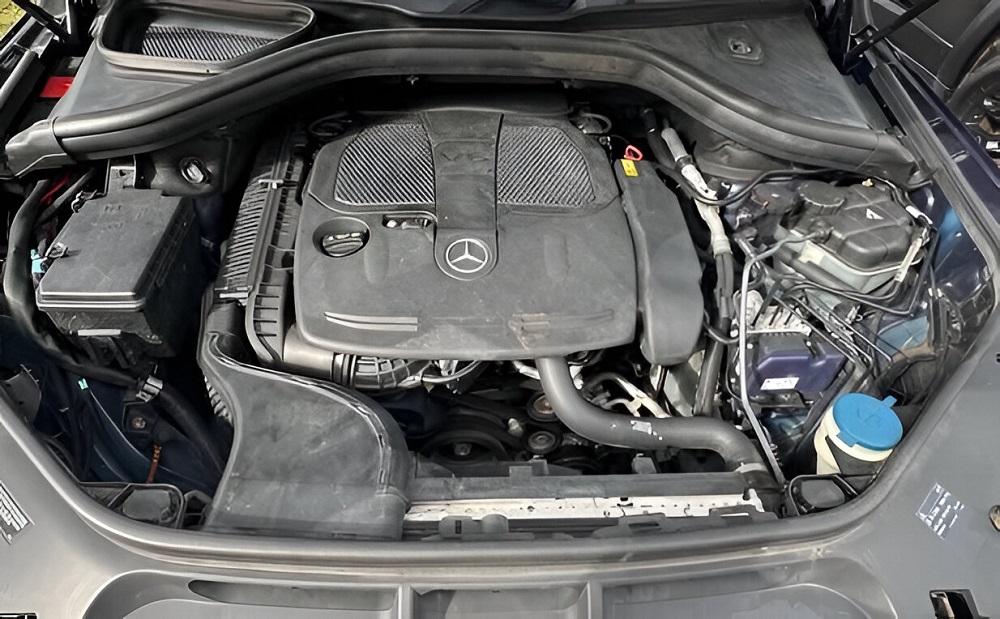
1. Inside the OM642 and why its layout breeds heat and failure
Aluminum block, 72-degree V6, and a packed valley that cooks itself
Sits at a tight 72-degree V-angle with a balance shaft buried in the valley. Bore measures 83.0 mm, stroke 92.0 mm, total displacement 2 987 cc. Compression runs 18.0:1, which drives strong low-rpm torque and high cylinder pressure.
Aluminum block and heads cut weight to about 459 lb dry. Aluminum expands more than iron under heat. Long heat cycles work gaskets and seals hard, especially deep in the V.
Packs the turbo, oil cooler, and EGR cooler inside that valley. After shutdown, heat soaks upward with nowhere to go. Valley temps stay elevated long after coolant flow stops.
Oil cooler seals sit directly in that trapped heat pocket. Early orange seals harden, shrink, and crack after years of 200°F plus cycling. Most start leaking between 80,000 and 150,000 miles.
Common rail, VGT boost, and emissions plumbing stacked in tight space
Feeds fuel through Bosch piezo injectors. While Bosch piezo injectors are capable of operating at very high pressures (up to 2,700 bar or ~39,000 psi), the OM642’s common rail system typically operates within a range of 1,600-1,800 bar (approximately 23,000-26,000 psi).
Precise injection cuts noise and boosts torque, but also raises injector and seal stress.
A Garrett variable geometry turbo sits in the valley. Vanes adjust exhaust flow to control boost across rpm. Heat, soot, and vibration hammer the electric actuator.
Routes EGR gases back into the intake under load. PCV vapors re-enter upstream of the turbo. Oil mist mixes with soot and forms tar inside intake runners.
Stacks DPF and SCR hardware downstream for BlueTEC models. Dual NOx sensors monitor conversion efficiency. If readings drift, the ECU limits restarts by law.
Most failure clusters originate from that layout. Valley oil cooler leaks, swirl motor contamination, turbo actuator heat damage, and AdBlue hardware faults all start with dense packaging and sustained heat above 200°F.
2. Valley oil cooler leak that soaks the bellhousing
Buried cooler, brittle seals, and the heat pocket that destroys them
Mounts the oil cooler at the bottom of the V, under the intake and turbo. Coolant flows through a compact aluminum heat exchanger. Two rubber seals clamp it to the block.
Early engines used orange seals. Heat cycles above 200°F harden them within 7 to 10 years. They lose elasticity, then seep.
Oil pools in the valley. Drain passages route it down the rear of the block. It exits through the bellhousing weep hole and mimics a rear main leak.
Mercedes later switched to purple Viton seals, part number 6421880580. They last longer, but most still fail between 80,000 and 150,000 miles.
Misdiagnosed rear main and what a real inspection shows
Drips form under the transmission, not the front cover. Burnt oil smell hits after shutdown. The top of the engine often looks dry.
Rear main seal gets blamed first. That job requires transmission removal and adds hours. A borescope in the valley shows wet aluminum and pooled oil.
Check the turbo pedestal and PCV puck before tearing down. If those stay dry and the valley glistens, the cooler seals are done.
Labor-heavy repair and why the bill climbs fast
Reaching the cooler means removing the intake, turbo, and EGR cooler. Most shops quote 12 to 20 labor hours. Access varies by chassis, worst on SUVs and Sprinters.
Parts stay cheap. The seal kit runs $50 to $150. Total parts with gaskets and o-rings often land between $400 and $800.
Labor drives the bill. Most owners pay $2,500 to $4,000 for a proper job. Ignore it long enough and oil-soaked mounts and clutches add more cost.
3. Swirl flaps, oil-soaked motors, and intake sludge
Swirl motor under the turbo and the leaking batwing seal
Mounts the swirl flap servo motor M16/6 under the turbo inlet. A large red “batwing” seal joins the intake duct to the compressor housing. When that seal hardens or shifts, oil mist drips straight onto the motor.
Crankcase vapors feed upstream of the turbo. Oil condenses at the inlet and runs down the housing. The swirl motor and harness sit directly below that drip line.
Oil enters the motor case and corrodes the circuit board. The ECU flags P2513 or P2526 and drops into limp mode. Engine speed caps around 3 000 rpm with reduced boost request.
Carbon buildup that jams linkages and leaks boost
EGR soot mixes with oil vapor in the intake runners. The result turns into thick tar on the swirl shafts. Flaps bind, then the plastic linkage snaps.
Worn bushings create small boost leaks. Drivers hear a whistle under load and feel soft throttle response. DPF soot load rises because charge pressure falls.
In rare cases, flap pieces break loose and enter a cylinder. That leads to bent valves or scored pistons, often ending the engine’s service life.
| Failure mode | Issue | Real-world result |
|---|---|---|
| Electrical short | Oil from turbo inlet seal | Limp mode, stored P2513/P2526 |
| Linkage breakage | Carbon drag on plastic arms | Stuck flaps, uneven airflow |
| Boost leak | Worn flap bushings | Whistle, low boost, higher soot load |
| Ingestion | Broken flap fragment | Valve and piston damage |
Replacement, delete kits, and legal fallout
New intake manifolds and a revised motor fix it correctly. Parts alone often exceed $1,000. Labor overlaps with valley work, adding several hours.
Delete kits lock flaps open and add resistor tricks to fool the ECU. Performance can stay stable, but emissions compliance fails in regulated states. Inspection stations will reject the vehicle.
Vehicles that received an Approved Emissions Modification often got updated manifolds and swirl hardware. Engines without that update remain exposed to repeat motor failure within 100,000 miles.
4. Turbo boost failures, sticking vanes, and blown charge seals
VGT actuator burnout and vane seizure
Bolts a Garrett variable geometry turbo into the valley. An electric actuator, Y77/1, adjusts vane position based on load and rpm. Heat soak and vibration cook the motor over time.
Actuator failure locks the vanes in one position. Drivers feel no boost below 2,000 rpm or sudden overboost under load. The ECU stores codes like P2510 and may trigger limp mode.
Soot builds on vane pivots during light-duty driving. Short trips never sweep the full vane range. Sticking vanes spike exhaust backpressure and raise EGT above 1,200°F under heavy throttle.
Replacement actuators run $600 to $900. A full turbo assembly pushes total repair cost to $2,000 to $3,500.
Charge-air leaks that spray oil and destroy power
Pressurized air exits through a turbo outlet pipe sealed by a single O-ring. That seal often pinches during service. Once cut, it sprays oil mist into the engine bay.
Resonator housings and intercooler couplers split under boost. Drivers hear a sharp hiss at 15 to 20 psi. Throttle response lags and DPF soot load climbs due to low charge pressure.
Sprinters doing stop-start delivery work show more hose fatigue. Highway SUVs see fewer splits but more actuator heat damage. Any sustained boost leak increases regeneration frequency below 300 miles per cycle.
5. BlueTEC countdowns, frozen AdBlue, and stranded no-starts
SCR hardware and the legal no-start trap
Routes exhaust through a DPF, then an SCR catalyst. AdBlue injects upstream of the SCR to cut NOx. Dual NOx sensors monitor conversion efficiency in real time.
AdBlue freezes at 12°F. The tank contains a heater and pump module to keep fluid moving. If the heater circuit opens, the ECU logs a fault and starts a restart countdown.
Dash warnings step down from 800 miles to zero. At zero, the engine will not restart after shutdown. Federal law requires this lockout once dosing fails.
Heater failures, pump wear, and live data clues
Heater elements corrode internally and show an open circuit. Healthy resistance sits in a low ohm range. Open readings confirm a failed heater.
Pumps wear and lose pressure over time. Low pressure appears in scan data during dosing events. Crystallized urea in lines worsens flow and triggers emissions faults.
Common codes include P20E8 for low reductant pressure and various NOx sensor plausibility faults. Replacement tank modules often cost $1,000 to $1,800 plus labor.
NOx sensors and the emissions settlement overhaul
Upstream and downstream NOx sensors sit in harsh exhaust flow. Heat and soot degrade their readings over 60,000 to 120,000 miles. Drifted signals trip the MIL and restart countdown.
Mercedes paid nearly $150 million in U.S. settlements over diesel emissions violations. The Approved Emissions Modification replaced NOx sensors, updated ECU software, and in many cases swapped SCR or DPF hardware.
Vehicles that received the AEM gained extended emissions coverage, often up to 4 years or 48,000 miles from modification. A failed SCR catalyst outside warranty can exceed $3,000 installed.
6. Timing chain stretch, injector blow-by, and oil chemistry that decides survival
Timing chain wear and cam correlation faults
Runs a double-row steel chain to drive both camshafts. Tensioners rely on oil pressure to hold slack tight. Dirty oil accelerates pin and roller wear.
Cold starts begin with a brief rattle from the front cover. As stretch increases, the rattle lasts longer than 2 seconds. The ECU stores correlation codes like P0016 when cam timing drifts.
Ignored stretch can let the chain jump a tooth. Valve-to-piston contact follows at high load. Full chain service often lands between $2,500 and $4,000.
Injector seal failure and the Black Death crust
Seals each piezo injector with a single-use copper washer. Combustion gases leak past when torque or surface prep is wrong. Hot exhaust bakes leaked fuel into black carbon.
Injector wells fill with hardened sludge. The smell of raw exhaust leaks through the cover. Removal can require drilling and puller tools after 100 000 miles of neglect.
Left alone, carbon bonds the injector to the head. Extraction damage can ruin the cylinder head, pushing repairs beyond $3,000.
MB 229.52 oil and why intervals matter
Requires low-SAPS oil meeting MB 229.52 spec. High ash oils poison the DPF with metallic residue. Soot and fuel dilution thicken oil under long intervals.
Factory intervals stretch to 10,000 to 15,000 miles. Independent specialists cut that to 5,000 to 7,500 miles. Shorter intervals slow chain wear and protect turbo bearings.
DPF replacement can exceed $2,000 when ash load crosses service limits. Using the wrong oil accelerates that failure timeline below 120,000 miles.
7. Mileage phases, platform stress, and when failures stack
Sedans, SUVs, and Sprinters age at different speeds
Carries the same OM642 across E-Class, ML/GL, and Sprinter vans. Duty cycle changes everything. A Sprinter idles for hours and heat soaks the valley daily.
SUVs tow and run higher sustained EGT under load. Sedans see lighter duty but shorter trips in city use. Short trips spike DPF soot and increase regeneration frequency.
Sprinters show earlier swirl and turbo hose fatigue. SUVs show oil cooler leaks and turbo actuator heat damage sooner. Delivery vans often cross 250,000 miles before chain noise starts.
Failure windows by mileage band
| Odometer band | Common early issues | Major risks emerging |
|---|---|---|
| 0–120,000 miles | NOx sensor faults, AdBlue heater glitches | Most long blocks remain stable |
| 120,000–220,000 miles | Oil cooler seals, swirl motor failure, boost leaks | First timing chain stretch, injector seepage |
| 220,000–350,000 miles | DPF ash load, recurring SCR faults | Turbo wear, chain service, injector removal |
| 350,000 miles plus | Depends on service history | Neglected engines become uneconomical to fix |
Chain rattle often appears past 150,000 miles with long oil intervals. Oil cooler leaks cluster near 100,000 to 160,000 miles. DPF ash load approaches limit near 200,000 miles in city-driven units.
At 300,000 miles, major jobs stack. Valley reseal, turbo, injectors, and SCR hardware can exceed $8,000 combined.
Tuned and deleted engines under heavier load
Power tunes raise boost and injection duration. Exhaust gas temps climb under towing. Sustained EGT above 1 250°F shortens turbo and DPF life.
EGR and SCR deletes remove common failure points. They also violate federal emissions law in the U.S. Resale value drops in regulated states.
Fleet vans with strict oil service often outlast low-mile SUVs with skipped maintenance. A well-documented service history matters more than a 50,000-mile odometer reading.
8. OM642 against BMW and VW 3.0 diesels
Layout differences and where each one breaks
Stacks a 72-degree aluminum V6 in a tight valley. BMW’s M57 and N57 run inline-six layouts with easier front access. VW’s EA897 uses a 90-degree V6 with rear timing components.
Inline-six packaging spreads heat more evenly. The OM642 traps heat under the turbo and intake. That design drives valley seal and swirl motor failures.
BMW N57 chains sit at the rear of the engine. Chain failure there often means engine-out service. OM642 chains live at the front and fail more gradually with rattle and P0016 correlation codes.
VW EA897 engines show rear cover oil leaks and timing tensioner wear. Turbo actuator faults appear on both VW and Mercedes units. Chain jobs on BMW N57 models can exceed $4,000 due to access limits.
Strengths, signature failures, and who should own what
| Engine family | Stand-out strength | Signature failures | Best owner profile |
|---|---|---|---|
| Mercedes OM642 3.0 V6 | Broad torque, commercial durability | Valley oil cooler, swirl motor, SCR heater | Owner ready for $3,000 valley jobs |
| BMW M57/N57 3.0 I6 | Smooth power, strong tuning support | Rear timing chain (N57), HPFP, EGR buildup | Enthusiast with specialist access |
| VW/Audi EA897 3.0 TDI | Efficiency, refined highway feel | Chain tensioners, rear cover leaks, emissions faults | Long-distance driver with strict service |
OM642 long blocks often exceed 300,000 miles with steady oil changes. Emissions hardware and valley seals usually fail first. Budget at least $5,000 to $8,000 over high-mile ownership for predictable major repairs.
Sources & References
- Mercedes-Benz OM642 engine – Wikipedia
- 3.0 CDI V6 (OM642) engines and their failures | AutoNorma
- Passenger car range, vehicles with the OM 642 – Mercedes-Benz Archive
- OM642 Engine Guide: What to Look For – CarInterior – Alibaba.com
- Fixing the #1 Problem on the OM642 Mercedes Diesel – NEWS …
- OM642 oil cooler replacement – 2012 ML350 BlueTEC | Off-Topic Discussions | 500Eboard
- Does your Mercedes-Benz have an oil cooler leak? – Ammstar
- A journey into the the infamous Om642 oil cooler leak! – Page 11 – PeachParts Mercedes-Benz Forum
- OM642 engine guide specs, issues reliability
- OM642 Oil Leak – Page 1 – Mercedes – PistonHeads UK
- ENHANCE YOUR MERCEDES BENZ SPRINTER’S PERFORMANCE WITH THE OM642 SWIRL FLAP DELETE KIT | OBDtune
- Modification of the swirl motor resistor for the OM642 engine. – MID AUTO
- My research on the OM642 engine problems (as an owner) : r/car_problems – Reddit
- Benefits/drawbacks of swirl flap delete? – BMW 3-Series (E90 E92) Forum – Bimmerpost
- A journey into the the infamous Om642 oil cooler leak! – Page 2 – PeachParts Mercedes-Benz Forum
- Mercedes-Benz to pay $149.6m in US diesel emissions settlement – Just Auto
- Mercedes Sprinter AdBlue Heater Fault: Winter Fix Guide 2025 …
- AdBlue Pump Fault or Heater Fault? 5-Minute Check – Mobile Help
- AdBlue Problems in Mercedes Vans: Heater, Pump, and Warning Lights
- AdBlue Pump Failure in Commercial Vehicles – Symptoms, Causes, and Practical Solutions
- OM642 DEF heater – PeachParts Mercedes-Benz Forum
- Daimler AG and Mercedes-Benz USA, LLC Clean Air Act Settlement FAQs | US EPA
- How Much Does a Timing Chain Replacement Cost? – SoFi
- FEBI 30321 TIMING CHAIN KIT MERCEDES OM642.8../642.9..VARIOUS 3L DIESE
- Timing Chain Replacement Cost (2026) | ConsumerAffairs®
- Mercedes Timing Chain: What it is, Common Problems & More …
- Timing Chain Replacement Cost: 2025 Guide – Car Talk
- 2015 Mercedes-Benz Sprinter 2500 Timing Chain Tensioner Replacement Cost – RepairPal
- Engine oil MB 229.52 – Oil with Mercedes-Benz approval – ADDINOL
- MB Specifications | FUCHS LUBRICANTES, S.A.U.
- Mercedes engine oil specifications – Collingwood Fine Cars
- Best Engine Oils for Different Mercedes-Benz Models (2025 Guide) – Variety Auto Solutions
- Mercedes-Benz engine oil specifications – AK24Parts.com
- Mercedes Oil Change Intervals: How Often to Service Your Engine | Benz & Jagz Specialists
- Attorney General Schwalb Announces Nearly $150 Million Multistate Settlement with Mercedes-Benz USA and Mercedes-Benz Group AG Over Emissions Cheating – Office of Attorney General for the District of Columbia
- Daimler Mercedes BlueTEC Emissions $700 Million Settlement – Hagens Berman
- Mercedes settles emissions-cheating lawsuit for nearly $150M | WardsAuto
- Mercedes-Benz agrees to nearly $150M multistate settlement over emissions, consumer fraud claims – WRNJ Radio
- $700 Million Mercedes Diesel Emissions Class-Action Settlement Details Announced
- MERCEDES OM642 EGR DELETE – ADBLUE | OBDtune
- EGR Valve Diagnosis and Cleaning Procedure using TU … – nhtsa
- Mercedes Sprinter CDI Tuning 3.0L OM642 Diesel | ECUPROGRAM Inc.
- How to install an Oil Catch Can (Provent 200 on a Mercedes Diesel GL350 OM642)