
Climb a long grade, hold 4,000 rpm, temp needle barely moves. That’s how the Toyota 2.7 earns its legend. Big four-cylinder torque, simple hardware, iron block built for abuse.
From 1994 onward, Toyota ran two main versions: 3RZ-FE and 2TR-FE. Same 2,693 cc layout. Same square 95.0 mm bore and stroke. Different weak spots once miles stack past 150,000.
The rotating assembly rarely quits. Crank, rods, and pistons survive brutal fleet duty and farm work. What fails lives around it: cooling parts, valve clearance, plastic bypass pipes, and emissions hardware that hates moisture.
This guide calls out what actually breaks, which years deserve caution, and what keeps these engines pushing past 300,000 miles.
1. Built for torque, not speed
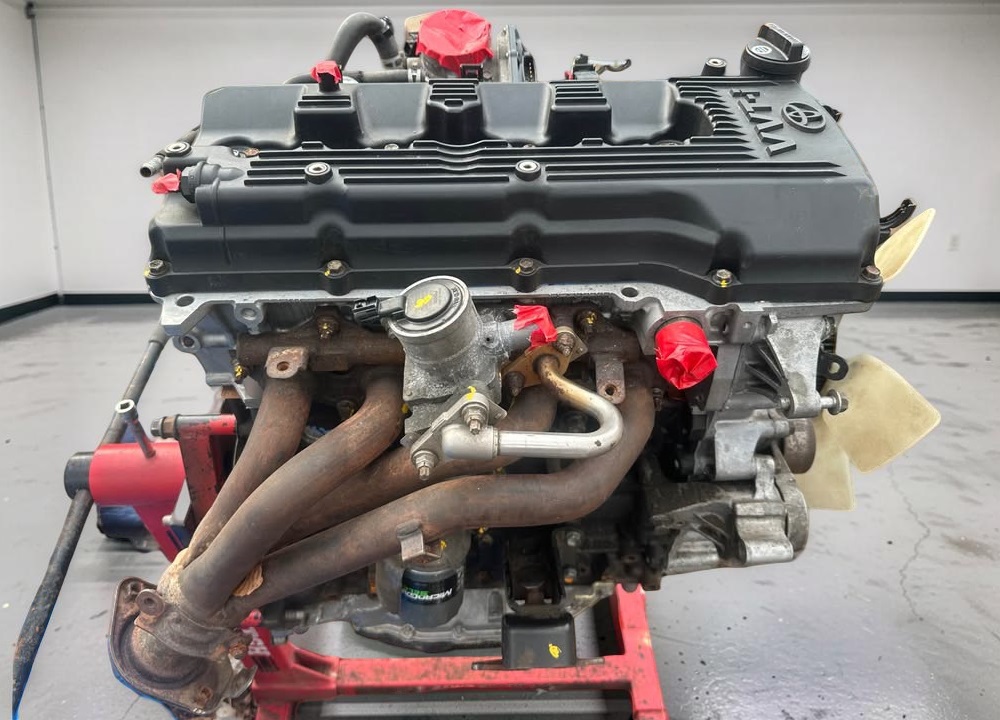
3RZ-FE and 2TR-FE under the same 2.7 badge
Launch in 1994 with the 3RZ-FE, built to replace the old R-series workhorses. Cast-iron deep-skirt block. Aluminum head. 95.0 mm bore and 95.0 mm stroke. Output lands around 148–155 hp and 177–188 lb-ft.
Shift in 2004 to the 2TR-FE. Same 2,693 cc displacement. Add VVT-i on the intake cam, then Dual VVT-i after 2015. Power creeps to 149–164 hp and about 181 lb-ft, depending on tune.
Both engines sit in Tacoma, Hilux, HiAce vans, and base 4Runner trims. Toyota chose a large naturally aspirated four to cut cost, simplify service, and deliver low-end torque without a turbo. Peak torque hits around 3,600–3,800 rpm, right where loaded trucks live.
Balance shafts spin in the crankcase to tame vibration. Timing chain replaces a belt. No factory turbo. No direct injection. Fewer high-pressure systems mean fewer $2,000 surprises.
Why the bottom end rarely dies
Pull down a 300,000-mile 3RZ and the bearings often mic within spec. Journals polish but don’t score. Oil pumps hold pressure if oil stayed clean. Rods and pistons handle sustained 4,000 rpm highway runs without drama.
The block’s deep skirt design supports the crank on more surface area. Main caps tie into the block with thick bulkheads. Cylinder walls stay thick enough to handle light overbores during rebuild.
Compression ratios stay modest, 9.5:1 to 10.2:1. That limits cylinder pressure and detonation stress. No turbo means no 20 psi spikes hammering ring lands.
What destroys these engines rarely starts at the crankshaft. It starts at heat control, valve seating, or external hardware that fails and lets temperature spike past 230°F. One severe overheat can warp the aluminum head beyond 0.004 in flatness, and machine shops start talking replacement instead of resurfacing.
2. 3RZ-FE problem pattern, heat and valve neglect
Overheat the head once and the gasket pays
Run a clogged radiator in July traffic and the 3RZ head takes the hit. The aluminum head expands faster than the iron block. Clamp load drops across the fire ring. Coolant starts sneaking into the cylinder.
Most failures show up between 180,000 and 260,000 miles on original cooling parts. Radiators plug internally. Thermostats stick half shut. Water pumps seep, then fail under load.
Drivers report cold-start misfire, white smoke, and rock-hard upper hoses. Pull the cap and see bubbles in the neck. Oil cap shows tan sludge if coolant and oil mix.
Machine shops measure more than 0.004 in warp across the deck and refuse a simple skim. Head gasket job with machining runs $1,200 to $1,800. Cracked heads push the repair past $2,500.
Cooling fault pattern
| Early warning signs | Typical damage if ignored | Ballpark repair path |
|---|---|---|
| Slow coolant loss / minor seepage | Localized head gasket leak | HG replacement + cooling refresh |
| Chronic hot running under load | Warped head, fire-ring failure | HG + head machining or replacement |
| Sudden coolant dump | Severe warp, possible head cracking | Often head replacement or long block |
One hard overheat above 240°F can distort the head enough to lose seal.
Tight valves burn, not loose ones
Skip valve checks and the 3RZ slowly loses compression. This engine uses shim-over-bucket lifters. While Toyota’s official schedule for normal conditions is every 60,000 miles, many technicians and high-mileage owners recommend inspection every 30,000 miles to prevent valve seat recession. Most trucks never see it done.
Valve seat recession tightens clearance over time. Exhaust valves stop fully seating. Heat can’t transfer into the seat. The edge of the valve face erodes.
Symptoms start small. Slight misfire at idle. Rough cold start. Eventually one cylinder shows 90–110 psi while the others sit near 170 psi.
Burnt valve repair means pulling the head. Valve job with new guides and seals runs $1,000 to $1,600 in most markets. Ignore it and compression drops until the cylinder goes dead under load.
Exhaust manifold cracks and leans the mix
Listen for a ticking sound on cold start. Many 3RZ manifolds crack between the center runners. Heat cycling and exhaust weight stress the casting.
Broken engine mounts make it worse. The manifold ends up carrying part of the exhaust system’s weight. Cracks widen and pull in outside air.
Upstream O2 sensors read lean from that extra oxygen. Fuel trims spike positive. Some trucks log lean codes and stumble under light throttle.
Weld repairs rarely hold long term. Replacement manifolds or header upgrades run $400 to $900 installed. Left unchecked, lean operation drives exhaust temps higher and shortens valve life.
3. 2TR-FE problem pattern, plastic cooling parts and emissions hardware
The plastic bypass pipe that dumps coolant fast
Spot the coolant crust on the right side of the block. Early 2TR-FE engines, roughly 2005–2014, use a plastic water bypass pipe, part 16268-75091. It sits low and close to engine heat. After years of cycling, the plastic turns brittle.
Cracks open without much warning. Coolant drains fast. Temp climbs past 230°F before the driver sees steam.
Some trucks overheat in under 5 minutes once the pipe splits. Head gasket damage follows the same pattern as the 3RZ. One highway overheat can mean a warped head and a $1,800 repair.
Bypass pipe version
| Typical years | Failure mode | Recommended action |
|---|---|---|
| ~2005–2014 2TR-FE | Brittle crack, rapid leak | Replace before 150,000 miles |
| Later / retrofit kits | Eliminates pipe cracking | Install during coolant service |
The metal pipe 16268-75131 ends the cracking issue. Parts run $60–$120. Labor adds 1.5–3.0 hours depending on access.
VVT-i rattle and timing drive shock
Start cold and hear a 1-second knock from the front cover. The intake VVT-i gear uses a spring-loaded locking pin. Oil pressure holds it in position once running.
After shutdown, oil drains down. Worn internal seals let the cam gear move. On restart, it slaps into place until oil pressure stabilizes.
Short rattle under 1 second shows up on many trucks past 120,000 miles. Longer rattle means actuator wear. Replace the VVT-i gear and gasket, expect $700–$1,200 parts and labor.
Repeated rattle hammers the timing chain and guides. Chain stretch shows up as cam-crank correlation codes and lazy throttle response.
SAIS failures that trigger limp mode
Cold start, engine sounds like a shop vacuum for 20–60 seconds. That’s the Secondary Air Injection System. It pumps air into the exhaust to heat the catalyst fast.
Moisture enters the switching valves. Valves stick open or closed. Common codes include P2440, P2442, P2441, and P2443.
Stuck-open valves let exhaust backflow into the pump. The pump motor burns out. ECM limits throttle and sets limp mode, cutting highway power.
Dealer repair often exceeds $2,500 to $3,500 for pump and valve replacement. Aftermarket bypass kits cost $300–$600 but alter emissions function and may fail inspection in strict states.
4. Oil leaks and timing wear that snowball fast
Small leaks that turn into real damage
Pop the hood and smell burnt oil. Valve cover gaskets seep on both 3RZ and 2TR. Oil runs into spark plug tubes and soaks coil boots. Misfires follow once oil pools around the plug.
Front crankshaft seals on early 2TR engines leak onto the crank pulley. Oil sprays onto the serpentine belt. Belts swell, slip, and shred at highway speed.
Rear main seals fail less often but cost more. Oil drips from the bellhousing seam. Fixing it means pulling the transmission, often a $900–$1,500 job.
VVT-i solenoid O-rings on 2TR engines seep along the timing cover. Oil collects near the front cover and drips down the block. Replace the O-ring early or chase oil smell for months.
Leak point
| Engines affected | First sign in the bay | If ignored, likely outcome |
|---|---|---|
| 3RZ & 2TR | Oil around cover, wet plug tubes | Misfires, coil failure |
| Mostly 2TR | Oil mist on pulley and belt | Belt failure, water pump or alternator loss |
| Both | Oil at bellhousing seam | Clutch contamination or costly trans removal |
| 2TR | Oil near timing cover solenoid area | Oil loss, potential VVT response issues |
Ignore a front seal leak long enough and the belt can slip off at 70 mph. Lose the belt and coolant flow stops. Overheat follows within minutes.
Timing chain and tensioner fatigue past 150,000
Hear a metallic rattle on cold start that lasts longer than a second. Both engines use timing chains, not belts. Chains stretch slowly. Guides and hydraulic tensioners wear first.
Most high-mileage units need tensioner or guide service around 150,000–200,000 miles. Sludge from long oil intervals speeds up wear. Low oil pressure delays tensioner engagement on startup.
On the 3RZ, a jumped chain means piston-to-valve contact. It’s an interference design. Bent valves follow in one crank revolution.
Chain service runs $1,200–$2,000 depending on parts replaced. Ignore a stretched chain and cam-crank correlation codes show up before mechanical contact does.
5. Recalls and factory defects that matter
The 2013–2014 valve spring recall that could drop a valve
Build date matters on 2013–2014 Tacomas with the 2TR-FE. Toyota issued recall 13V-557, internal code D0U. About 4,000 trucks in the U.S. carried over-hardened valve springs.
Springs could fracture at speed. A broken spring lets the valve float, then drop into the cylinder. Pistons strike the valve head and lock the engine in seconds.
Drivers reported sudden stall with no warning lights. Some engines seized on the highway. Toyota replaced all 16 valve springs under recall.
Verify repair by checking VIN history and dealer paperwork. No spring replacement on an affected truck means real risk of a catastrophic failure that destroys the short block in one event.
The Denso fuel pump recall that caused random stalls
Model years 2017–2020 brought another issue. Certain 2TR-FE Tacomas used low-density Denso fuel pump impellers. The impeller could deform and bind inside the pump housing.
Stalling at idle or during steady cruise became common complaints. Long crank after hot soak showed up first. Some trucks died in traffic and would not restart.
Toyota launched a broad recall campaign covering millions of vehicles across brands. Fuel pump modules were replaced free of charge.
Out of warranty, a pump module job runs $800–$1,200 parts and labor. A failed pump leaves fuel pressure near 0 psi and the engine will not fire regardless of spark.
6. Maintenance and diagnostics that keep a 2.7 alive past 300,000
Cooling system triage before the gauge spikes
Check the water pump weep hole with a dry paper towel. Light pink crust with no moisture means normal seepage. Wet residue or active drip means the seal has failed.
Toyota addressed this confusion in TSB T-SB-0103-20. A leaking pump drops coolant level slowly at first. Ignore it and temps creep past 220°F on long grades.
Radiators clog internally around 150,000–200,000 miles in fleet use. Plastic end tanks crack with age. Replace the radiator before it splits under pressure at 16 psi.
Thermostats stick more often after 100,000 miles. A stuck unit can push head temps above 240°F within minutes under load. One severe overheat can warp the head beyond 0.004 in flatness.
Valve checks, oil choice, and timing survival
Measure 3RZ valve clearance every 30,000 miles if keeping the truck long term. Intake spec runs tight as seats wear. Exhaust valves lose heat transfer once clearance closes up.
Use quality 5W-30 in most climates. In hot regions or towing duty, many techs run 10W-30 to maintain oil pressure at 220°F. Long 10,000-mile intervals accelerate chain and tensioner wear.
Listen for startup rattle that lasts longer than 1 second. Check cam-crank correlation codes if throttle response feels lazy. Budget timing service near 180,000 miles if noise persists.
On a 3RZ, a jumped chain means bent valves. Compression drops to near 0 psi in the affected cylinder within one crank event.
SAIS codes and permanent check-engine lights
Scan for P2440, P2442, P2441, or P2443 on 2TR engines. Confirm whether the air pump runs at cold start. Check switching valves for moisture intrusion.
A stuck-open valve allows exhaust backflow into the pump. Pump current draw spikes before it fails. Limp mode limits throttle angle and caps highway speed.
OEM repair often exceeds $3,000. Bypass kits eliminate limp mode but alter emissions control logic. In strict states, a permanent MIL means automatic inspection failure.
7. 2.7 vs. Toyota V6 and the new 2.4 turbo
Four cylinders and space to work
Pop the hood on a 2.7 Tacoma. Space surrounds the engine. Alternator swaps and starter jobs run faster than on V6 trucks.
The 2.7 carries one cylinder head and one head gasket. Fewer cam gears. Fewer coolant passages. Fewer rear-bank access fights.
The 4.0L 1GR-FE V6 makes about 236 hp and 266 lb-ft. The 3.5L 2GR-FKS pushes near 278 hp and 265 lb-ft in later trucks. Those numbers double the towing ceiling compared to the 2.7.
Real-world combined MPG in 4WD trucks lands near 19 mpg for the 2.7 and about 20 mpg for the 3.5. The fuel gap stays narrow while power differs by over 100 hp.
Metric
| 2.7L 2TR-FE | 3.5L 2GR-FKS | Practical impact |
|---|---|---|
| ~19 mpg | ~20 mpg | Fuel savings are minimal |
| ~3,500 lb | ~6,400–6,500 lb | 2.7 limited to light-duty loads |
| Excellent | Tight rear bank | 2.7 cuts labor hours |
| SAIS, bypass pipe | Water pump, VVT gear | Both can exceed 300,000 with care |
Tow 5,000 lb with a 2.7 and it lives near redline on grades. Sustained 4,000–4,500 rpm raises oil temp and cooling load.
The 2.4 turbo brings torque and complexity
Toyota moved the Tacoma to a 2.4L turbo in 2024. Torque jumps above 300 lb-ft in many trims. Peak torque arrives lower in the rev range.
Turbo engines run higher cylinder pressures. Add intercoolers, electronic coolant valves, and dual injection systems. More sensors, more heat exchangers, more failure points.
Long-term data on 300,000-mile durability does not exist yet. Fleet buyers track cost per mile over decades. The old 2.7 proved itself in that arena with reman long blocks priced between $2,600 and $4,500.
8. Real repair costs and when an engine swap pays off
What common failures really cost
Price out a head gasket job on a 3RZ. Machine work, gasket set, fluids, and labor land between $1,200 and $1,800. Add a cracked head and the bill climbs past $2,500 fast.
Replace a 2TR plastic bypass pipe before it fails and spend under $400 total. Wait for an overheat and you risk the same head gasket repair range. The cooling system decides whether that pipe is a maintenance item or a catalyst for a rebuild.
Fix SAIS the factory way and budget $2,500 to $3,500. Timing chain service with guides and tensioner runs $1,200 to $2,000. Front crank seal and belt service usually stay under $600 unless collateral damage hits the alternator or water pump.
Average annual repair cost for a Tacoma hovers under $500 in many studies. That number assumes routine service, not catastrophic overheat or dropped valve events.
Failure type
| Typical repair range | Downtime impact |
|---|---|
| $1,200–$1,800 | Several days at machine shop |
| $2,500+ | 1–2 weeks with parts sourcing |
| $2,500–$3,500 | 2–4 days |
| $1,200–$2,000 | 2–3 days |
| $4,000–$7,000 total | 1–2 weeks depending on shop |
A clean truck with rust-free frame often justifies a $5,000 engine reset.
Long-block swaps and resetting the clock
Order a reman 2.7 long block and expect $2,600 to $4,500 for the unit. Installed cost usually lands between $4,000 and $7,000 with labor, fluids, and incidentals. Quality remans include new bearings, rings, timing components, and machined heads.
Swap makes sense when compression drops below 120 psi across multiple cylinders. Excessive blow-by, oil consumption over 1 quart per 1,000 miles, and metal in the filter signal bottom-end wear. A straight frame and solid transmission tip the math toward replacement.
High-mileage buyers check compression, leak-down numbers, and cooling system history first. A 2.7 with even compression near 170 psi and documented cooling service often pushes past 300,000 miles. A neglected one can lose a head gasket in a single overheat above 240°F.
Sources & References
- What Is the Toyota 3RZ Engine Used For? – CarInterior
- Toyota TR engine – Wikipedia
- How to Choose a Toyota 2700cc Engine: Lifespan & Buying Guide – CarInterior
- 3RZ-FE Engine Guide: What to Look for When Buying Used – CarInterior
- What Are the Common 3RZ Engine Problems and How to Fix Them? – CarInterior – Alibaba
- 3rz vs 2tr-fe? : r/Tacomaworld – Reddit
- P2442 Secondary Air Injection System (Toyota & Lexus) | Hewitt-Tech
- Teardown Reveals How Neglect Can Kill Toyota’s Most Reliable Engine – Autoblog
- Toyota 3RZ-FE – Engine Specs
- 2TR-FE Engine Guide: What to Look for When Buying – CarInterior
- 2005-2015 Toyota Tacoma 2.7L 2TR-FE 4-Cylinder Engine Motor
- 300,000-Mile Toyota 3RZ Four-Cylinder Teardown Shows Why These Engines Are So Sought After – CarBuzz
- What Causes Head Gasket Failure? – Firestone Complete Auto Care
- Here’s What 300000 Miles Did To A Toyota 3RZ Engine – Jalopnik
- Toyota 3RZ Valve Clearance Guide | PDF | Systems Engineering | Vehicles – Scribd
- 220k miles and 25 years on a 2.7L 3RZ : r/ToyotaTacoma – Reddit
- Burnt Valve: Symptoms, Causes, Replacement Cost, & FAQ – Auto Parts by CarParts.com
- Engine Valve Issues: Prevention, Causes, And How To Fix Them – Eurocams Ltd
- What Are The Burnt Exhaust Valve Symptoms? Explained Here! – Car From Japan
- What causes burnt exhaust valves? : r/AskMechanics – Reddit
- Fix Cracked Exhaust Manifolds on Your V8 4runner Forever – Canadian Gearhead
- 3rz cracked exhaust header upgrade : r/Tacomaworld – Reddit
- 3rz cracked exhaust header upgrade : r/1stGenTacomas – Reddit
- Exhaust Manifold Cracks. Causes, Symptoms & Repair Tips | AKMI Corporation
- Cracked Exhaust Manifold – YouTube
- 2TR-FE Engine Guide: What to Look for When Buying – CarInterior
- Aramox Coolant Water Bypass Pipe Replacement For Toyota 4Runner & Tacoma 2.7L 2TR-FE
- How long to keep a 2014 Toyota Tacoma 2.7 L 4-cylinder (2TR-FE) with 100K miles?
- Engine Coolant Bypass Pipe – Toyota (16268-75131)
- New OEM Toyota Tacoma 2TR-FE Engine Coolant Bypass Pipe Metal Upgrade 16268-7513
- Water By-Passenger Pipe #16268-75131 | Autoparts.toyota.com
- Brief Engine Knock/Rattle Noise at Cold Startup (1AR/2AR) – nhtsa
- Fixed the VVT-i Rattle(!) : r/COROLLA – Reddit
- TOYOTA – nhtsa
- Help! What Am I Supposed To Replace? 2008 Toyota Highlander. t-sb-0094-09 – Reddit
- Miracle Fix for the VVT Death Rattle – 2GR-FE Toyota 3.5-liter V6 – RAV4 Camry Sienna Highlander – YouTube
- T-SB-0041-14 Cold Start Rattle : r/rav4club – Reddit
- Fixed cold start rattle : r/Toyota – Reddit
- Secondary Air Injection System Codes: Toyota & Lexus | Hewitt Tech
- P0418 Code: Secondary Air Injection System Control “A” Circuit – In The Garage with CarParts.com
- Air Injection System – Moisture Intrusion: MIL “ON” DTC P2440/P2442 – nhtsa
- Toyota Tundra AIR Injection Code P2440, P2441, P2442, P2443 – YouTube
- Toyota Tacoma Front Crankshaft Seal Replacement Costs – YourMechanic
- Anyone ever have a leak like this? 2018 2.7L SR : r/ToyotaTacoma – Reddit
- Valve Clearances 2.7 (3rz) – Toyota Hilux 4×4 Forum
- Toyota 2.7 Engine: Everything To Know About The Four-Cylinder – CarBuzz
- Front Crankshaft Seal Replacement: Cost & Symptoms – AutoGuru
- Crankshaft Seal Guide: Symptoms, Replacement & Cost – Woda Auto Parts
- Toyota Safety Recall 13V-557 – Preliminary and Remedy Dealer Notification – nhtsa
- Toyota Recalls Certain Toyota and Lexus Vehicles
- Toyota 2TR Engine Guide: Specs, Use Cases & Buying Tips – Woda Auto Parts
- Toyota Water Pump Leak Signs You Shouldn’t Ignore – YouTube
- TECHNICAL BULLETIN – US Motor Works
- Water Pump Leak Inspection and Diagnostic Tips – nhtsa
- Best 3rd Gen Tacoma Engine: Comparing the 2.7 I4 and 3.5 V6 – Canadian Gearhead
- More Reliable: Toyota Tacoma 4-cylinder or V6? Mechanic Reveals! – YouTube
- Is the 2.7 better than the 4.0 in terms of reliability : r/ToyotaTacoma – Reddit
- 2.4 Toyota Engine Guide: What to Look for in 2025 – CarInterior
- Cars With Lowest Maintenance Cost: Smart Choices for LA Drivers – CarWise LA
- How Many Miles Does a Toyota Tacoma Last? – Findlay Toyota Prescott
- Are Toyota Cars Expensive to Maintain? | Classic Toyota of Tyler
- Toyota Maintenance Schedule and Costs – CarEdge
- 2025 Toyota Tacoma Repair: Service and Maintenance Cost – RepairPal
- 2025 Toyota Tacoma: True Cost to Own | Edmunds
- How to Choose a Toyota 3RZ Engine: Complete Buying Guide – SmartBuy
- Reliability of the 2.7 inline 4 : r/ToyotaTacoma – Reddit