
Fires up smooth, then the temp needle twitches on a long hill. Sweet smell drifts from the grille. That’s how many Subaru 2.5 problems start. Since the mid 1990s, Subaru has run two main 2.5 families across Forester, Outback, Legacy, and Impreza.
Early EJ25 engines crack head gaskets. Turbo EJ models crack ringlands or wipe bearings when oil runs low. First-run FB25 engines burn oil from low-tension rings. Newer FB25D versions trip over failing thermal control valves and light the whole dash.
This guide calls out what fails, which years carry the most risk, and which fixes actually stick.
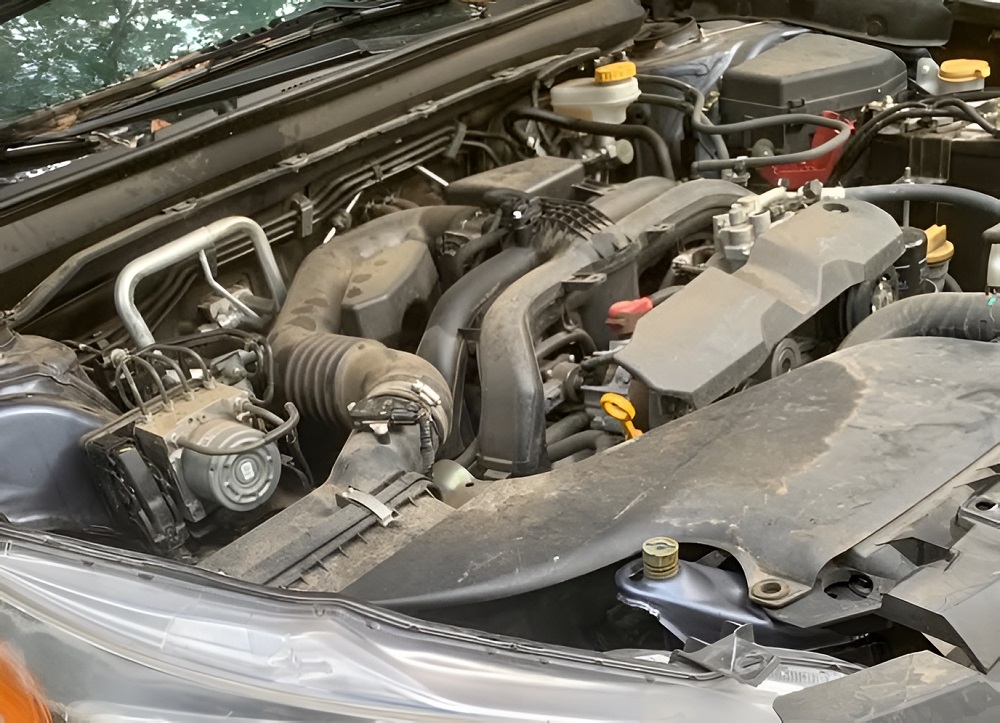
1. Boxer 2.5 family overview: EJ25 vs FB25 and what the layout really changes
Flat-four geometry and the reliability tradeoffs baked in
Lays flat in the bay, pistons punching left and right. That 180-degree layout defines every Subaru 2.5. The crank sits low, the mass spreads wide, and the car corners flatter than most inline-fours.
The engine also sits lower in a crash path. In a hard frontal hit, it’s designed to slide under the cabin. That drop-down geometry shows up in Subaru’s safety data across Forester and Outback platforms.
Oil and coolant don’t drain off the head gaskets when you shut it down. Fluids stay pooled along the lower gasket edge and valve seals. Over years, acidic coolant and fuel-diluted oil attack those sealing surfaces.
Service access stays tight. Spark plugs sit inches from frame rails. Head gasket labor runs 12 to 18 hours because the engine often comes out.
EJ25 vs FB25: two eras, two failure signatures
Runs from the mid 1990s through 2012, the EJ25 uses a timing belt and open or semi-closed deck block. Phase 1 DOHC engines carry graphite-coated MLS gaskets. Phase 2 SOHC engines moved to composite gaskets that weep externally.
Turbo EJ255 and EJ257 models ship with factory MLS gaskets. Head gasket failures are rare there. Ringlands and rod bearings become the weak points under boost and low oil.
Introduced for 2011, the FB25 switches to a timing chain and longer stroke. Friction drops with low-tension rings. Early builds from 2011 to 2014 burn oil fast enough to trigger low-oil lights before 6,000 miles.
The FB25D adds direct injection in 2019. Cooling control shifts to an electronic valve. TCV failures set P2682, P26A3, and disable EyeSight until the valve is replaced, often a $1,300 to $1,800 job out of warranty.
| Engine family | High-volume years | Key hardware change | Primary failure pattern |
|---|---|---|---|
| EJ25 Phase 1 | 1996–1999 | DOHC, belt, graphite MLS | Internal head gasket breach, combustion gas in coolant |
| EJ25 Phase 2 | 2000–2009 | SOHC, composite gasket | External oil and coolant leaks at lower head seam |
| EJ25 Turbo | 2004–2021 | Factory MLS, boost | Ringland cracks, bearing damage from oil starvation |
| FB25 early | 2011–2014 | Chain, low-tension rings | Excessive oil consumption, short-block replacements |
| FB25D | 2019–2024 | Direct injection, TCV | Thermal Control Valve failure, limp mode events |
Open-deck EJ blocks leave cylinder walls less supported at high heat. Extended overheating can warp heads and lift gaskets within a single over-temp event.
Early FB short blocks were replaced under extended coverage up to 8 years or 100,000 miles in the U.S. Many received complete short blocks rather than ring jobs to correct bore finish variation.
The flat layout never changed. The failure points did.
2. EJ25 NA head gasket failures: from hidden boil-over to driveway drips
Phase 1 EJ25D: combustion gas in the coolant
Overheats on the highway, cools off in town. That’s the early EJ25D pattern. Found in 1996–1999 models, this DOHC engine used a graphite-coated MLS gasket on an open-deck block.
The graphite layer breaks down. Combustion gas slips into the cooling jacket under load. Coolant gets displaced, pressure spikes, and the temp needle climbs fast past 220°F.
No puddle forms under the car. Instead, bubbles churn in the overflow tank. Exhaust gas can be detected in coolant with a block tester, even when compression looks normal.
Warped heads show up after one severe overheat event. Resurfacing beyond 0.002–0.004 inches risks sealing failure.
Phase 2 EJ251, EJ252, EJ253: the external leak era
Shifts in 2000 to SOHC heads and composite gaskets. The failure moves outside. Oil and coolant seep from the lower edge of the head, often driver side first.
Coolant drips onto the exhaust crossover pipe. Burnt-sweet smell fills the cabin at stoplights. Damp residue builds along the block seam near the ground strap.
Electrolysis accelerates the damage. Corroded grounds raise resistance, stray current flows through coolant, and the gasket erodes near the left bank. Measured voltage in coolant above 0.3 volts speeds corrosion.
Many leaks begin between 80,000 and 130,000 miles. Ignore it, and coolant loss leads to overheat and head warp.
| EJ25 type | Typical years | Gasket construction | Failure behavior | Repair scope |
|---|---|---|---|---|
| EJ25D Phase 1 | 1996–1999 | Graphite-coated MLS | Internal breach, combustion gas in coolant | Head removal, surface check, MLS upgrade |
| EJ251/2/3 Phase 2 | 2000–2009 | Composite single-layer | External oil/coolant leak at lower seam | Head removal, MLS retrofit, coolant service |
| Late EJ25 NA | 2010–2012 | Factory MLS | Rare failures, usually overheat-related | Inspect deck flatness, replace as needed |
Repairing EJ25 gaskets without cutting corners
Pulling the engine makes the job cleaner. Heads get measured and machined flat within spec. Surface finish must meet MLS requirements, typically 30 RA or smoother.
Updated MLS gaskets from Subaru or quality aftermarket brands hold far better than the old composite design. Head bolts get replaced or checked for stretch, torqued in sequence to spec.
Coolant gets flushed and refilled with Subaru Super Coolant. Grounds get cleaned and tightened to reduce stray current.
A proper EJ25 head gasket job runs $2,000 to $3,500 at an independent shop, more at a dealer.
3. EJ25 turbo failures: boost, knock, and bottom-end carnage
Ringland cracks under detonation
Hammers hard in third gear, then starts missing at idle. That’s classic EJ255 or EJ257 ringland failure. These turbo 2.5 engines run cast pistons with thin upper ringlands.
Detonation spikes cylinder pressure past safe limits. Cheap 91-octane fuel, aggressive tunes, or high intake temps trigger knock. The ringland between the top and second ring cracks.
Compression drops on that cylinder. Blow-by rises fast, oil consumption jumps to a quart every 300–500 miles. Blue smoke trails on throttle, and a leakdown test shows air hissing into the crankcase.
A cracked piston means teardown. Short-block replacement often runs $4,000 to $7,000 installed.
Oil starvation and spun bearings
Pulls steady on a long sweeper, then a faint knock starts. The flat oil pan lets oil slosh away from the pickup under high lateral G. Low oil level makes it worse.
Many EJ turbos consume a quart every 1,000 miles. Miss two checks, and the level drops below the pickup screen. Oil pressure dips below 20 psi at hot idle, then collapses under load.
Rod bearings wipe first. Copper flakes show in the oil filter. The knock deepens and follows RPM.
Once a bearing spins, the crank journals score. Rebuild or replacement becomes mandatory, typically $5,000 to $8,000 depending on damage.
Supporting mods and realistic limits
Forged pistons with thicker ringlands handle knock better. Baffled oil pans and upgraded pickups reduce starvation risk. Conservative boost targets below 18 psi on stock internals lower stress.
Factory EJ257 compression sits around 8.2:1. Push timing and boost without proper fueling, and cylinder pressure spikes fast. Logging knock correction and air-fuel ratio stays critical on tuned cars.
Stock internals rarely survive repeated detonation events. Two or three hard knock pulls can crack a piston at under 60,000 miles.
4. Early FB25 oil consumption: low-tension rings and short-block swaps
The friction risk that burned oil
Switches to chain drive in 2011. The new FB25 stretches stroke, tightens the combustion chamber, and chases MPG. Low-tension piston rings cut friction and boost fuel economy numbers.
Cylinder bore finish varied in early production. Rings failed to seat correctly against the walls. Oil slipped past into the combustion chamber during every power stroke.
Owners saw the low-oil light before 6,000 miles. Some engines burned 1 quart every 1,000 miles. A few consumed more than 1 quart per 800 miles under steady highway driving.
Subaru’s oil consumption test required precise top-offs and sealed dipsticks. Exceed the threshold, and the engine qualified for internal repair or replacement.
From ring jobs to full short blocks
Early fixes targeted piston rings only. Many returned with continued oil use. Bore surface irregularities remained in some blocks.
Subaru shifted to full short-block replacement under extended coverage. Coverage stretched to 8 years or 100,000 miles on many 2011–2014 models.
A new short block corrected bore finish and ring seating. Repair invoices often topped $4,000 outside warranty.
| FB25 generation | Model years | Ring design | Failure pattern | Typical repair |
|---|---|---|---|---|
| Early FB25 | 2011–2014 | Low-tension original rings | Excessive oil consumption | Short-block replacement |
| Revised FB25 | 2015–2018 | Updated rings and honing | Reduced oil use, occasional cases | Monitor and top-off |
| FB25B late | 2017–2018 | Further ring updates | Mild oil use in some units | Normal maintenance |
Post-2015 reliability and remaining limits
Production updates in 2015 reduced complaint volume. Oil use still occurs in some engines, especially under sustained high RPM. Subaru considers up to 1 quart per 1,200 miles within spec on certain units.
Extended oil intervals increase risk. Running below the dipstick’s low mark exposes rod bearings to pressure loss. Hot idle pressure below 15 psi accelerates wear.
Neglect oil checks on an early FB25, and bearing damage can begin before 120,000 miles.
5. FB25D direct injection and Thermal Control Valve failures
Direct injection raises pressure and deposit risk
Switches to direct injection in 2019 with the FB25D. Fuel pressure jumps above 2,000 psi at the rail. Compression climbs to 12.0:1 in some applications.
Fuel now sprays straight into the cylinder. Intake valves no longer get washed by gasoline. PCV vapor and EGR soot bake onto the valve backs.
Rough idle shows up around 60,000 to 90,000 miles on short-trip cars. Cold starts stumble. Power drops at higher RPM.
Walnut blasting typically costs $400 to $900 depending on region.
Thermal Control Valve failure and dash-wide shutdowns
Replaces the old wax thermostat with an electronic Thermal Control Valve. The unit uses a plastic housing, position sensor, and motorized shaft. It controls coolant routing to speed warm-up and manage emissions.
Plastic fatigues under repeated heat cycles above 200°F. Coolant intrudes into the sensor cavity. The ECM loses valve position feedback.
Diagnostic codes P2682, P26A3, P26A5, and P26A6 appear. The check engine light triggers system-wide shutdowns. EyeSight, adaptive cruise, and RAB disable instantly.
Some valves fail closed. Coolant flow stops. Overheat can occur within minutes in traffic.
| Model | Model years | Common DTCs | Typical out-of-warranty cost | Warranty extension |
|---|---|---|---|---|
| Forester 2.5L | 2019–2021 | P2682, P26A3 | $1,300–$1,800 | 15 years / 150,000 miles |
| Outback 2.5L | 2020–2022 | P26A5, P26A6 | $1,400–$1,700 | 15 years / 150,000 miles |
| Legacy 2.5L | 2020–2022 | P26A3, P26A5 | Similar range | 15 years / 150,000 miles |
| Crosstrek 2.5L | 2021 | P2682 variants | Similar range | 15 years / 150,000 miles |
Warranty coverage extends to 15 years or 150,000 miles on affected models in the U.S. Revised valves use improved sealing and upgraded internal shafts.
Outside warranty, TCV replacement averages $1,300 to $1,800 installed.
6. Maintenance moves that change 2.5 survival odds
Coolant chemistry, electrolysis, and gasket life
Circulates coolant across aluminum heads all day. Shut it off, and that coolant sits against the gasket seam. On EJ engines, old coolant turns acidic and starts attacking the fire ring area.
Stray voltage speeds the damage. Corroded battery terminals or weak ground straps raise resistance. Voltage measured in coolant above 0.3 volts accelerates gasket erosion near the left bank ground.
Phase 2 EJ engines were covered under Subaru’s conditioner campaign. The additive helped seal micro-porosity at the gasket edge. Skipping coolant service past 100,000 miles raises head gasket risk sharply.
A full coolant flush with Subaru Super Coolant typically runs $150 to $250 and costs less than 1 hour of labor.
Oil level discipline and bearing survival
Consumes oil quietly in both EJ turbo and early FB engines. Miss two checks, and the level drops below the safe range. Rod bearings depend on stable oil pressure above 20 psi at hot cruise.
Hot idle pressure under 15 psi signals wear. Extended intervals past 7,500 miles thin the oil with fuel dilution. Turbo EJ engines running 5W-30 or 5W-40 in severe use hold pressure better under heat.
Many spun-bearing EJ cases originate from low oil, not failed pumps. Replacing a short block after bearing damage runs $4,000 to $8,000 depending on parts and labor.
PCV flow, carbon buildup, and intake deposits
Routes crankcase vapor through the PCV valve into the intake. On FB25D direct-injection engines, that vapor coats intake valves. Without fuel wash, deposits harden with heat.
Rough idle and misfire codes appear without ignition faults. Walnut blasting every 60,000 to 100,000 miles keeps airflow stable.
A stuck PCV valve raises crankcase pressure. Oil leaks form at cam carriers and timing covers. Replacing the PCV valve costs under $50 in parts and takes less than 30 minutes on most models.
| Maintenance focus | Primary failure reduced | Most affected engines | Typical interval |
|---|---|---|---|
| Coolant flush + conditioner | EJ head gasket erosion | EJ25 Phase 2 | 100,000 miles or sooner |
| Frequent oil checks | Bearing and ringland damage | EJ turbo, early FB25 | Every fuel fill |
| Ground cleaning | Electrolysis at gasket seam | EJ25 NA | Annually |
| Intake valve cleaning | DI carbon misfires | FB25D | 60,000–100,000 miles |
| TCV warranty repair | Overheat and limp mode | 2019–2022 FB25D | At first DTC |
Neglect coolant, oil, or PCV service, and major engine repair costs rise past $3,000 before 150,000 miles.
7. Model-year risk map: which 2.5 to buy and which to budget for
High-risk years that demand paperwork
Carry 1996–1999 EJ25D models only with proof of gasket work. Internal breaches can cook heads in one highway overheat. A warped head often measures beyond 0.004 inches and won’t seal again without machining.
Treat 2000–2009 Phase 2 EJ cars with original composite gaskets as pending repairs. External leaks usually start between 80,000 and 130,000 miles. No MLS upgrade on record means a $2,000 to $3,500 job is still ahead.
Scrutinize 2011–2014 FB25 cars for oil consumption repairs. Ask for short-block documentation under the 8-year/100,000-mile extension. No record and visible oil use means bearing risk past 120,000 miles.
Check 2019–2022 FB25D models for TCV replacement history. An open recall or pending warranty claim signals future downtime. Out-of-pocket TCV repair runs up to $1,800 if coverage expired.
Safer bets with fewer systemic failures
Favor 2010–2012 EJ25 NA cars that already received MLS gaskets. Once upgraded correctly, repeat failure rates drop sharply. Cooling system service history matters more than mileage at this point.
Target 2015–2018 FB25 models with steady oil logs. Ring updates reduced heavy consumption cases. Engines that hold level between 5,000-mile changes tend to run past 200,000 miles without bottom-end work.
Consider 2025-up Forester models that dropped the electronic TCV. Return to a mechanical thermostat removes a major electronic failure point. Thermostat replacement costs under $300 in most regions.
| Engine / Era | Primary risk | What to verify | Financial exposure |
|---|---|---|---|
| EJ25D 1996–1999 | Internal head gasket breach | MLS upgrade, head machining receipts | $2,500–$4,000 |
| EJ251/253 2000–2009 | External gasket leak | MLS retrofit, coolant history | $2,000–$3,500 |
| FB25 2011–2014 | Excessive oil use | Short-block replacement proof | $4,000+ |
| FB25D 2019–2022 | TCV failure | Warranty extension or revised valve | $1,300–$1,800 |
| FB25 2015–2018 | Moderate oil use | Consistent dipstick records | Low if maintained |
High-mile 2.5 engines with documented service often outlast neglected low-mile examples. Ignore oil logs or coolant history, and repair bills cross $3,000 before 150,000 miles.
Sources & References
- Subaru Legacy – Wikipedia
- Subaru Impreza – Wikipedia
- What Is a Boxer Engine? Benefits & Performance | Subaru
- Subaru Outback – Wikipedia
- Subaru’s Boxer Engine Explained | Sport Subaru in Orlando
- The Heart of Performance: Understanding the Subaru BOXER Engine Advantage
- What Drivers Should Know About the SUBARU BOXER® Engine | Subaru of Macon
- Subaru Boxer Engine Explained – Balise Subaru
- Subaru Head Gasket Problems Explained. – Wheel Drive Auto
- Subaru Head Gaskets Problems Explained Part II
- The simplicity of removing or replacing a Subaru engine. – Reddit
- Are the head gasket issues on the 2.5 engines as bad as everyone says? : r/subaru – Reddit
- Which engine models blow head gaskets? – Ultimate Subaru Message Board
- Thoughts on this forester? : r/SubaruForester – Reddit
- The Subaru EJ25 Engine: Common Problems, Solutions & The …
- The 4 Subaru Models Most Likely To Need Expensive Engine Repairs – Torque News
- Subaru Changed Their Head Gasket For The 2010 2.5L – All Wheel Drive Auto
- FB25 engine reliability – Ultimate Subaru Message Board
- My 2012 Subaru Forester 2.5L FB is part of a TSB with massive oil consumption issues – Reddit
- SERVICE BULLETIN – nhtsa
- FB25 Oil consumption fix? : r/subaru – Reddit
- What year did Subaru fix the Oil consumption issue and go from a Belt to timing chain?
- SERVICE BULLETIN – nhtsa
- SERVICE BULLETIN – nhtsa
- FB25B ’13 Subaru Oil Consumption : r/AskMechanics – Reddit
- DNJ PRK4348 Piston & Ring Kit For 2011-2015 Subaru Forester/Legacy/Outback 2.5L FB25 Engine
- List of Subaru engines – Wikipedia
- What’s New for the 2025 Subaru Models? – JD Power
- Lawsuit Says Subaru Thermo Control Valve Defect Can Cause …
- Subaru Forester 2019–21: Thermal Control Valve (TCV) design flaw – Reddit
- Thermo Control Valve Warranty Extension – nhtsa
- forester 2021 thermal control valve issue : r/SubaruForester – Reddit
- Thermo Control Valve (TCV) warranty extension (2020-early 2022 models)!! – Reddit
- Outback Thermo Control Valve (TCV) Issues : r/Subaru_Outback – Reddit
- PSA: Subaru is now covering thermo control valve issues for 2019 and up models. – Reddit
- Thermo control valve : r/SubaruForester – Reddit
- Important Notice: Warranty Extension for the Thermo Control Valve – Reddit
- Thermal Control Valve : r/SubaruForester – Reddit
- Thermo Control Valve Failure at 66k Miles : r/SubaruForester – Reddit
- Crosstrek Maintenance Schedule – Bowser Subaru
- What is the maintenance schedule for my 2014 Subaru? – Customer Self-Service
- I need to complain : r/subaru – Reddit
- FB25 Oil Consumption Experiment : r/subaru – Reddit
- Subaru’s Recommended Maintenance Schedule | Jim Pattison Subaru Coquitlam
- Thinking of getting a 2025 forester, how are recent years doing with repairs? – Reddit
- Confirm TCV d/c’ed on 2025 Models? : r/subaru – Reddit
- When did they upgrade the TCV ? : r/SubaruForester – Reddit
- What’s New for Subaru in 2026?
- Glad I got a 2025 Premium rather than a 26 : r/Crosstrek – Reddit
- 2026 Subaru Impreza Review, Pricing, and Specs – Car and Driver
- 2026 Subaru Forester Review, Pricing, and Specs – Car and Driver
- Buffalo Certified Used 2025 Subaru Legacy for Sale in Amherst NY, West Seneca, Orchard Park, Rochester SR5167 – Northtown Kia
- 2026 Subaru Outback Review, Pricing, and Specs – Car and Driver
- 2026 Subaru Forester Prices, Reviews, and Pictures – Edmunds
- Two main concerns about buying a Forester: sluggishness & road noise. Your experience? : r/SubaruForester – Reddit
- What’s New in 2026 at Subaru?