
Hook up a trailer, roll into the throttle, then watch the check engine light glow. That’s how Toyota 5.7 stories often start. The 3UR-FE V8 was built to shove 381 hp and 401 lb-ft through a half-ton frame without drama. Introduced for the 2007 Tundra push into Detroit territory, it powered trucks and SUVs through 2021.
The rotating assembly rarely quits. Forged crank, stout bottom end, chain-driven cams. Most failures originate from secondary air injection pumps, cam tower seal leaks, aging water pumps, or early valve spring defects. Emissions hardware and sealing strategy cause more headaches than rods or pistons.
This guide calls out what actually breaks, what only sounds scary, and what makes one 5.7 a 400,000-mile workhorse while another turns into a slow drip and limp mode saga.
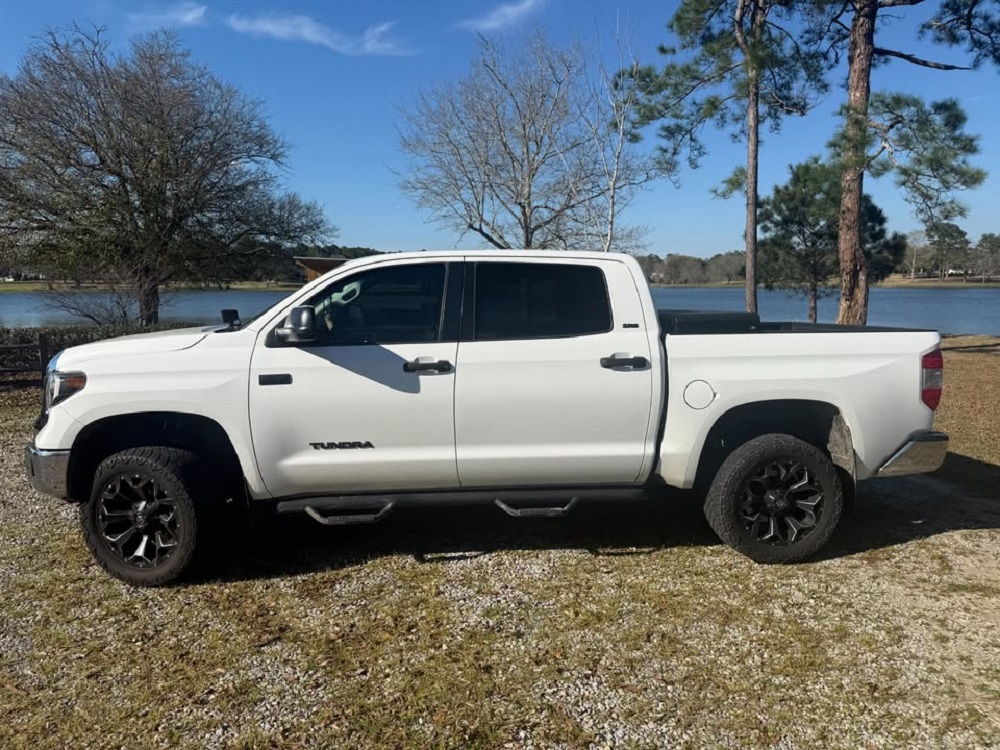
1. The 3UR-FE layout and why this V8 survives real truck abuse
Built with headroom from day one
Cast the block in aluminum, fuse in iron liners, bolt it down with a ladder-frame main support. The 3UR-FE runs a forged steel crank and 4-bolt main caps. Bore is 94 mm. Stroke is 102 mm. That long stroke builds low-end torque where trucks live.
Dual VVT-i swings intake and exhaust timing under load. Port fuel injection keeps intake valves washed with fuel. Compression sits at 10.2:1, safe on 87 octane under heavy tow. No direct injection pumps. No high-pressure fuel cam lobes to wipe out.
Four timing chains drive the cams. Hydraulic tensioners rely on clean oil and stable pressure. Oil capacity is roughly 7.9 quarts with filter. Stretch intervals to 10,000 miles and varnish builds, tensioners lose pressure, guides wear.
| Component | Spec | Mechanical impact |
|---|---|---|
| Displacement | 5.7L | High cylinder fill at low rpm |
| Bore x Stroke | 94 mm x 102 mm | Strong torque bias |
| Compression | 10.2:1 | 87-octane compatible |
| Fuel System | Port injection | Lower intake carbon risk |
| Crankshaft | Forged steel | High fatigue resistance |
| Main Support | Ladder frame | Block rigidity under load |
Peak output in Tundra trim is 381 hp and 401 lb-ft. Redline sits near 5,800 rpm. Most towing happens under 4,000 rpm, which keeps piston speed and rod load moderate. Factory rod bolts and pistons hold stock power without chronic failure reports.
Same engine, different stress lives
Bolt the 5.7 into a Tundra that tows 8,000 pounds weekly. Heat cycles climb. Oil temps spike. Water pump seals and secondary air pumps see real moisture and thermal shock.
Drop the same engine into a Sequoia that runs short school trips. Condensation builds in the secondary air system. Pumps corrode. Valves stick. Air injection DTCs like P0418 and P2445 show up long before rod bearings ever complain.
Place it in a Lexus LX 570. Weight pushes past 5,800 pounds curb. Owners keep them longer. Seals age. Cam tower FIPG seepage becomes common between 60,000 and 100,000 miles. Repair requires top-end teardown and full timing reset.
| Application | Typical duty | First weak point |
|---|---|---|
| Tundra 5.7 | Towing, payload, idle time | Secondary air pumps, water pump |
| Sequoia 5.7 | Short trips, stop-go | Air switching valves, moisture damage |
| Lexus LX 570 | Long-term ownership, heat | Cam tower oil seepage |
A highway-driven fleet Tundra can pass 300,000 miles on the original short block. A low-mile Sequoia that idles and short-trips can hit limp mode under 80,000 miles from air injection failure alone. The bottom end rarely sets the retirement date. Emissions hardware and sealing labor do.
2. Secondary air injection failure, the limp mode trigger everyone remembers
Cold start emissions hardware that hates moisture
Mount two electric air pumps on the passenger side. Add switching valves on each bank. Command them on during cold start to push fresh air into the exhaust and light off the cats faster. That’s the Secondary Air Injection System.
Moisture collects inside the pumps in humid or wet climates. Internal foam filters degrade and break apart. Bearings corrode. Impellers seize. When valves stick open, hot exhaust flows backward and melts plastic pump housings.
Toyota documented the issue in TSB T-SB-0160-11 and related campaign paperwork. Warranty coverage on affected 2007–2010 trucks extended to 10 years or 150,000 miles for pumps and valves. Later revisions added better shielding and drainage after 2012.
What failure feels like behind the wheel
Start the truck cold. Check engine light flashes. Throttle response drops hard. The ECU limits throttle opening to protect the catalysts. Power falls enough to make merging risky under load.
Common DTCs include P0418, P2445, P2441, and other P24xx codes. Bank-specific valve faults also appear. Scan data often shows commanded pump operation with no airflow change. Limp mode engages even though compression and oil pressure remain normal.
| What you feel | Likely failed part | Common DTC |
|---|---|---|
| Reduced power on cold start | Air pump seized | P0418 |
| CEL with bank-specific fault | Switching valve stuck | P2445 |
| Repeated winter failures | Moisture-damaged pump | P24xx family |
Repair cost and real-world exposure
Replace one pump and one valve and parts alone can reach $1,500. Replace both banks and labor climbs fast. Dealer repair often lands between $2,500 and $3,500 depending on corrosion and access. Aftermarket bypass kits exist but violate emissions law in many states.
Failure rate spikes in cold, wet regions and short-trip trucks. Pumps usually fail between 60,000 and 120,000 miles in high-moisture duty. The short block remains intact while the truck sits in limp mode over a seized emissions pump costing up to $3,000.
3. Oil and coolant leaks that creep in with age and heat
Cam tower sealing failure, the expensive oil seep
Bolt the cam towers to the heads without a traditional gasket. Seal them with FIPG. Heat cycles bake that sealant for years. By 60,000 to 100,000 miles, many engines show dampness at the rear corners.
Oil drips onto the exhaust manifold and burns. Owners smell it first at stoplights. Visual inspection through the wheel well shows wet streaks down the head and timing cover. The leak often starts as a weep, then spreads along the seam.
Repair means full top-end teardown. Intake off. Valve covers off. Timing chains removed. Cams lifted and re-timed. Labor commonly runs 15 to 20 hours, with total repair bills from $2,500 to $4,000.
| Leak point | First clue | Typical mileage | Repair scope |
|---|---|---|---|
| Cam tower seam | Burnt oil smell | 60,000–100,000 | Full timing removal |
| Timing cover | Front oil grime | 80,000+ | Front reseal |
| Valve cover | Upper wetness | 70,000+ | Gasket only |
Timing cover seepage and front-engine oil spread
Front timing covers also use FIPG. Oil seeps along the lower edge and coats the crossmember. Some owners ignore it for years. Oil level drops slowly, half a quart between changes.
Resealing the timing cover requires radiator removal and partial front disassembly. Labor often exceeds 10 hours. Shops quote $1,500 to $2,500 depending on corrosion and hardware condition. The leak rarely destroys the engine, but labor cost stays high.
Water pump wear and coolant loss under load
Spin the Aisin water pump off the front of the block. Internal bearings wear. Shaft play ruins the mechanical seal. Pink Toyota SLLC crust forms around the weep hole.
Drivers notice a sweet smell or low coolant light. Heater blows cool at idle. Overheat risk rises under towing in summer heat. Replacement typically runs $700 to $1,200 installed, depending on fan and pulley access.
| Component | Failure mode | Early symptom | Risk if ignored |
|---|---|---|---|
| Water pump | Bearing and seal wear | Pink crust, growl | Overheat |
| Thermostat | Stuck closed | Rapid temp rise | Head gasket damage |
| Radiator cap | Pressure loss | Coolant boilover | Hot spots |
Run a failing pump under load and coolant temps can exceed 230°F. Sustained overheating can warp aluminum heads and push repair costs past $3,000 for gasket and machine work.
4. Cold start ticking and the noises that spark teardown panic
Exhaust manifold leaks that mimic bottom-end knock
Fire it up cold and hear a sharp tick from the passenger side. Sound fades as metal warms. Many assume rod knock. Most times, it’s an exhaust leak at the manifold flange or a cracked manifold.
Heat cycles stress studs and gaskets. Small leaks pulse loudly at cold idle. As the manifold expands, the gap seals and the tick softens. No oil pressure drop. No metal in the filter.
Broken studs raise labor fast. Manifold replacement with hardware often runs $800 to $1,500 depending on corrosion. Ignore it long enough and hot exhaust can burn nearby wiring or O2 sensor leads.
| Noise trait | Likely source | What confirms it |
|---|---|---|
| Sharp tick, cold only | Exhaust leak | Fades warm |
| Deep knock, hot and cold | Rod bearing | Low oil pressure |
| Metallic clack 1–3 sec | Chain tensioner | Cold start only |
Timing chain tensioner bleed-down and cold rattle
Four timing chains ride on plastic guides. Hydraulic tensioners hold them tight. Oil drains from weak check valves overnight. First crank of the day brings slack chain slap.
Rattle lasts 1 to 5 seconds. Common on some 2010 and 2015 trucks. DTCs rarely set. Oil pressure stabilizes and noise stops once tensioners refill.
Chronic slap wears guides. Plastic debris can clog the oil pickup. Guide failure repair requires front cover removal and chain service, often $2,000 to $3,500 depending on parts replaced.
Run 10,000-mile oil intervals and varnish builds inside tensioners. Short 5,000-mile synthetic intervals reduce pressure loss risk and extend guide life past 200,000 miles.
5. Rough idle and fuel smells that send owners chasing the wrong problem
Carbon, injectors, and lazy throttle response
Idle drops low at a stoplight. Throttle feels dull off the line. Many blame compression. Most times, the intake and fuel side need attention.
The 3UR-FE runs port injection, so intake valves stay cleaner than direct-injected competitors. Throttle bodies still gum up. Injectors can drift in flow balance past 120,000 miles. Long idle hours and short trips build carbon in the plenum and on the throttle plate.
Misfire codes like P0300 through P0308 show up under load. Fuel trims creep positive as injectors lean out. Cleaning the throttle body and servicing injectors often restores smooth idle without internal engine work.
| Symptom | Likely cause | Typical mileage |
|---|---|---|
| Rough idle warm | Dirty throttle body | 80,000+ |
| Random misfire under load | Injector imbalance | 120,000+ |
| Hesitation tip-in | Carbon in intake | 100,000+ |
Professional injector cleaning runs $150 to $300. Replacing a full set can exceed $800 in parts alone. Compression usually checks within spec at 180 to 210 psi even on high-mile units.
Fuel pump recall and stall risk clarification
Fuel odor or stall complaints on certain 2018–2019 trucks relate to recall 20V-012, which addressed faulty low-pressure fuel pumps. The issue involved pump impellers that could deform and cause engine stall.
This recall did not involve fuel tube cracking. A separate campaign, 23TA09 / 23LA02, addressed plastic fuel tubes on 2022–2023 Tundra and Sequoia models equipped with the twin-turbo V6, not the 3UR-FE.
On 3UR-FE trucks, recall exposure centers on fuel pump performance. Out-of-warranty fuel pump replacement can exceed $1,000 depending on tank access and labor rates.
6. Recalls and official paper trails that actually affect 5.7 ownership
Valve spring recall context and what it actually covered
In 2010, Toyota issued NHTSA Campaign 10V309000 for defective valve springs. The recall primarily affected certain Lexus models with V6 and V8 engines, including the LX 570 that used the 3UR-FE.
Public NHTSA documentation does not broadly list Tundra and Sequoia the same way Lexus models were listed. Owner reports of spring failures exist in truck forums, but documented recall coverage centered on Lexus applications.
The defect involved contaminated spring wire that could fatigue and snap under load. A broken spring can drop a valve and destroy a cylinder head, requiring full engine replacement.
Secondary air campaigns remain the dominant service record item
Air injection service campaigns covered pumps and switching valves on 2007–2010 trucks. Warranty extensions reached 10 years or 150,000 miles on many units. Dealers replaced pumps, valves, and related hardware with updated components.
VIN lookup confirms campaign status. Incomplete repair history leaves owners exposed to $2,500 to $3,500 in emissions repairs. Later 2013–2021 models show reduced failure rates after hardware revisions.
What does not dominate the 5.7 failure story
No widespread rod bearing recall exists. No chronic piston slap bulletin. No factory short block replacement campaign across the 3UR-FE range. Major internal failures remain rare in stock form under normal maintenance.
Most documented engine retirements occur from overheating, severe neglect, or catastrophic valve spring failure in early builds. A maintained 2010+ engine without recall exposure regularly exceeds 250,000 miles on the original bottom end.
7. Reliability by model year and use pattern, where the costs really separate
Early builds versus later production reality
Engines built from 2007 to early 2009 carry the valve spring recall risk. Verify completion through VIN history. Unaddressed units can drop a valve without warning and destroy a cylinder head.
From late 2009 forward, internal metallurgy stabilized. No broad internal defect followed. Most failures shifted toward air injection, cam tower seepage, and cooling wear. Bottom-end failures remain rare in stock form.
Model years 2013–2021 benefit from revised air injection components. Failure rates drop compared to 2007–2010 trucks. High-mile 2018–2021 units commonly pass 200,000 miles without internal teardown when maintained.
Towing miles versus short-trip miles
Tow heavy and oil temps climb fast. Transmission heat soaks the engine bay. Water pumps and accessory bearings wear sooner. Expect pump service between 70,000 and 120,000 miles in hard-use trucks.
Run short trips in humid climates and moisture builds inside air pumps. Secondary air failures show up before 100,000 miles in many cases. Cold starts in winter amplify corrosion inside pump housings.
Low-mile “garage queen” trucks still age. Seals dry out. FIPG seams harden. Cam tower seepage appears even under 80,000 miles when heat cycling continues without long highway runs.
| Use pattern | First common failure | Typical window |
|---|---|---|
| Heavy towing | Water pump, manifolds | 70,000–120,000 |
| Short trips, humid | Air injection pumps | 60,000–100,000 |
| Long-term storage | Cam tower seepage | 60,000–90,000 |
Mileage alone doesn’t predict cost exposure. A documented 180,000-mile highway truck can outlast a 75,000-mile short-trip Sequoia stuck in repeated air injection limp mode. Repair bills cluster around $2,000 to $4,000 for reseals and emissions work, not rotating assembly failure.
8. Maintenance discipline that keeps the 5.7 out of the shop
Oil service intervals decide chain life
Stretch oil to 10,000 miles and varnish builds in the tensioners. Cold start rattle grows louder and longer. Chain guides see more slap. Plastic debris can end up in the pickup screen.
Run full synthetic and cut intervals to 5,000 miles. Oil capacity sits near 7.9 quarts with filter. Clean oil keeps hydraulic tensioners pressurized overnight. Guide wear drops and rattle events shorten to under 1 second.
Neglect oil service and front timing work can reach $3,000 once guides and chains require replacement.
Cooling system vigilance prevents aluminum damage
Ignore small coolant loss and temps creep past 220°F under load. Aluminum heads tolerate heat poorly once hotspots form. Overheat events warp sealing surfaces and stress head gaskets.
Replace water pumps at first sign of pink crust or bearing noise. Service interval often lands between 70,000 and 100,000 miles in heavy use. A $900 pump job beats a $3,000 head gasket repair.
Keep Toyota SLLC fresh and system pressure stable. A weak radiator cap can drop pressure and trigger boilover at highway speeds.
Buy with records, not just a smooth idle
Scan for stored air injection codes even if the light is off. Inspect cam tower seams for fresh oil wash. Check coolant level and look for dried residue near the pump.
Cold start the engine after sitting overnight. Listen for chain rattle longer than 3 seconds. Verify valve spring recall completion on early VINs.
A documented, maintained 3UR-FE commonly exceeds 300,000 miles without bottom-end work. Deferred emissions and sealing repairs routinely generate $2,000 to $4,000 service bills long before internal failure.
Sources & References
- Toyota Sequoia Years To Avoid: Models, Problems & Reliability Guide
- This Is The Most Reliable Tundra Engine – SlashGear
- Is The Toyota 5.7 V8 A Good Engine? The Pros and Cons:
- Toyota’s Most Reliable Truck That Regularly Hits 400,000 Miles – Top Speed
- Toyota Tundra oil leak from overhead cam requiring engine removal for repair – RepairPal
- toyota – nhtsa
- Toyota Faulty Valve Springs Recall List Announced – autoevolution
- Common Toyota 3UR-FE V8 Engine Problems Explained | Toyota …
- Top 10 Reliable Toyota Engines for Long-Term Performance – Woda Auto Parts
- Toyota’s Most Reliable Engines: A Longevity Ranking – Top Speed
- Is Toyota’s New Twin-Turbo V6 Really Less Reliable Than Its Old V8s?
- PROSPEED Forged 3UR Shortblock Package
- V8 Rumble: 2025 Ford F-150 vs. Chevy Silverado vs. 2026 Ram 1500 on the Ike Gauntlet
- Deep Dive into Toyota’s V35A-FTS (3.5L Twin Turbo) : r/cars – Reddit
- Cam Tower Leak Lawsuits | Toyota, Lexus, Land Cruiser | ClassAction.org
- Toyota Camshaft Tower Seal Leaking Class Action Investigation – Migliaccio & Rathod LLP
- 5.7 Liter Toyota Engine Problems – Common 3UR-FE Issues – 1A Auto
- Got a cam tower leak : r/ToyotaTundra – Reddit
- How big of a concern is the cam tower leak, really? : r/ToyotaTundra – Reddit
- How worried should I be about cam tower leaks when buying a used tundra? – Reddit
- Fixing Every Common Problem with Toyota’s Last V8 Engine – YouTube
- TUNDRA TECHNICAL INSTRUCTION – nhtsa
- cam tower leak : r/ToyotaTundra – Reddit
- Cam tower leak on ’21 : r/ToyotaTundra – Reddit
- Chain tensioner issues for a 2015 tundra 5.7 w/107k miles – Reddit
- AIR injection Pump failure: Toyota Tundra Muffler & Exhaust – RepairPal
- 2008 Tundra 5.7 P2432 Secondary Air Injection System Air Flow/Pressure Sensor Circuit Low Bank 1, what part do I need? : r/MechanicAdvice – Reddit
- Secondary Air Injection System Codes: Toyota & Lexus | Hewitt Tech
- Love my Tundra, but losing trust after multiple major issues. – Reddit
- Secondary air pump issue? : r/toyotasequoia – Reddit
- Toyota’s 5.7L V8 (3UR-FE) | 3 Common Problems & Reliability – YouTube
- Is this the dreaded timing chain tensioner sound? : r/ToyotaTundra – Reddit
- 2015 Toyota tundra 5.7 L timing chain? : r/ToyotaTundra – Reddit
- TOYOTA – autoevolution
- Brief Engine Knock/Rattle Noise at Cold Startup – nhtsa
- Knocking or Clicking From Engine During Cold Startup – nhtsa
- Toyota’s UR V8 Family Gave The Tundra Million-Mile Capability – CarBuzz
- Replacing the starter on 2nd gen 5.7L engine Tundra. Experiences and stories please. It’s been a journey so far. : r/ToyotaTundra – Reddit
- Shout out to the engineers at toyota. Let’s place the starter under the intake manifold, where it’s hot as fuck and impossible to access. No tapping this with a hammer when the starter acts up. Fucking genius. : r/Justrolledintotheshop – Reddit
- ’02 Toyota Tundra starter under air intake manifold… Is there a good reason for it to be here or was it just for the lolz : r/Justrolledintotheshop – Reddit
- Starter replacement 2010 Toyota tundra 5.7L 4WD. Mechanic is telling me $1948, is that reasonable? : r/MechanicAdvice – Reddit
- 2007-2021 Toyota Tundra Engine Starter Removal And Installation Instructions – YouTube
- Fast overview of Tundra/ Sequoia 5.7L Starter Replacement (without removing exhaust) NNKH – YouTube
- What is a more reliable and overall better engine. The 4.7 V8 or the 5.7 V8? We are strictly talking engines here. What will go on to be the most iconic Toyota V8 in history? : r/ToyotaTundra – Reddit
- New Ram weight loss…. | Page 2 – Duckboats
- Ford 5.0L Coyote Engine: Power, Evolution, & Key Specs Explained – Autoblog
- As a GMC Sierra Guy, It Hurts to Say It, But I’m Done with GM, and Now I’m Conflicted Between the Ford F-150, Ram 1500, and Toyota Tundra | Torque News
- 15′-17′ F-150 (5.0 v8 coyote + 6r80) or Toyota Tundra 5.7 v8? Both 4×4 : r/whatcarshouldIbuy – Reddit
- Toyota’s V6 Engine Nightmare Continues as Another 127,000 Models Recalled – Autoblog
- ‘Total BS’: Engine Teardown Specialist Says Toyota’s Explanation for V6 Failures Doesn’t Make Sense – The Drive
- Top Picks: Best Years for Toyota Tundra – autoDNA