
Shift into tow haul. Feel the torque. Then see “Reduced Engine Power” and lose half the truck. That’s how many 2.8 Duramax problems begin.
Debuting in 2016, the 2.8L LWN packed 369 lb-ft into a midsize chassis. Cast-iron block, forged crank, DOHC head, variable-geometry turbo, and a quiet timing belt setup. The core engine holds up. Trouble usually starts with emissions hardware, transmission shudder, and a few brutal labor jobs.
DPF clogging, EGR soot, DEF faults, torque-converter chatter under 18-NA-355, and crank-signal chaos with P0335. Some trucks run 200,000 miles with heat and care. Others tap out early from system overload. Let’s sort strength from strain.
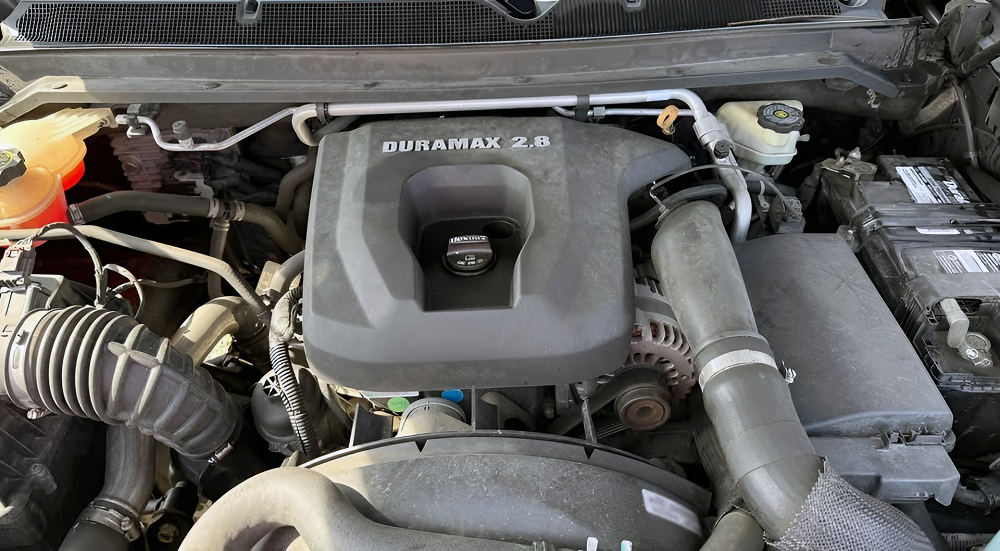
1. The 2.8L Duramax has a strong backbone wrapped in high-stakes hardware
The long block holds up under real diesel load
Run 7,000 pounds up a grade and the bottom end doesn’t flinch. The LWN uses a gray cast-iron block, forged steel crank, forged rods, and aluminum pistons with deep bowls built for high cylinder pressure.
Combustion pressure stays controlled, and bearing failures remain rare in stock form. Most engines that see clean oil and fuel clear 200,000 miles without touching the rotating assembly.
Output lands at 181 to 186 hp and 369 lb-ft. Peak torque hits around 2,000 rpm, right where towing lives. The variable-geometry turbo builds boost early and feeds the engine clean torque instead of high-rpm drama. Hard mechanical failures inside the block are uncommon below 250,000 miles.
Timing uses a belt, not a chain. GM set the service interval at 150,000 miles, though early trucks triggered premature 100,000-mile warnings under Service Update 17466. Belt failure risks piston-to-valve contact because this is an interference design. Ignore that interval and you risk the head.
Refinement hardware raises the cost of mistakes
GM wanted this diesel quiet. The oil pan carries a bonded steel plate to damp resonance. A metal timing cover cuts belt noise. The torque converter houses a centrifugal pendulum vibration absorber to smooth torsional pulses.
That CPVA works. It also ties engine feel tightly to transmission behavior. If the converter clutch slips or chatters, the truck feels broken even when combustion is clean. NVH tuning pushed calibration toward steady-state slip logic inside the 6L50 and 8L45.
The engine bay packaging stays tight. Emissions plumbing wraps the exhaust side. Charge-air pipes snake around heat sources. Access to rear-mounted components adds labor fast. Packaging, not metallurgy, drives many $2,000 to $3,500 repair quotes.
Core engine versus high-failure systems
| Area | Mechanically durable | Common failure exposure |
|---|---|---|
| Bottom end | Cast iron block, forged crank, diesel torque capacity | Rare internal failure under stock power |
| Timing drive | 150,000-mile belt interval | Belt neglect risks full valve contact |
| Turbo system | Strong low-rpm torque, exhaust brake function | Vane soot, hose leaks, boost-control codes |
| Emissions hardware | EPA Tier 2 Bin 5 compliance | DPF clogging, EGR fouling, DEF heater faults |
| Transmission pairing | Tow-friendly gearing | TCC shudder under 18-NA-355 |
The pattern stays consistent. Major engine castings survive. Peripheral systems fail first, often between 80,000 and 150,000 miles.
2. Emissions hardware is where the real fights start
Soot loads the DPF faster than most owners expect
Stack short trips and idle time, and soot climbs fast. The DPF needs sustained exhaust heat near 600°F to 1,100°F to burn clean. City driving rarely holds that temperature long enough. Soot mass rises past threshold and the ECM flags P2463 or P2459.
Reduced power follows. The truck limits torque to protect the filter from excess backpressure. Forced regens require a scan tool and steady high temp. Dealers often charge $300 to $500 for a static regen.
Ignore it long enough and the filter clogs solid. Replacement DPF units run $1,200 to $2,800 for the part alone, plus labor.
EGR soot turns into rough idle and coolant loss
Hot exhaust routes back through the intake under EGR command. Soot and oil mist coat the valve and intake runners. The valve sticks, airflow skews, and idle turns uneven. Fuel economy drops and throttle response dulls.
EGR coolers add another risk. Internal cracks let coolant leak into the exhaust stream. Drivers report white smoke and steady coolant loss with no puddle. Cooler replacement can exceed $1,500 in parts and labor.
DEF heaters and NOx sensors can sideline a healthy engine
Cold weather stresses the DEF tank and heater circuits. When heaters fail, the cluster warns of limited restarts. Codes like P20EE, P2BAA, P144E, and P144F follow. The engine may run fine while the SCR system refuses compliance.
NOx sensors sit in harsh heat and moisture. Soot and condensation skew readings. False “Incorrect DEF Quality” messages trigger countdown logic. A single NOx sensor often costs $300 to $600 before labor.
Emissions failure patterns that hit first
| System | Common trigger | Driver symptom | Typical repair range |
|---|---|---|---|
| DPF | Short trips, interrupted regens | Limp mode, P2463 | $300 regen to $3,500 full replacement |
| EGR valve | Carbon buildup | Rough idle, hesitation | $400 to $900 cleaning or replacement |
| EGR cooler | Internal crack | Coolant loss, white smoke | $1,200 to $2,000 |
| DEF heater | Electrical failure | Restart countdown | $800 to $1,500 |
| NOx sensor | Soot, moisture | MIL, DEF warnings | $300 to $600 each |
Most emissions failures surface between 80,000 and 150,000 miles.
3. Transmission shudder can make a healthy diesel feel wrecked
Feel the rumble strip at 45 mph and blame the torque converter
Cruise at light throttle and it shivers like you hit road grooves. That’s torque converter clutch slip inside the 6L50 or 8L45. The TCM commands controlled slip for fuel economy. Old Dexron VI fluid absorbed moisture and changed friction behavior.
The clutch cycles between grab and release. Heat builds. Friction material sheds into the fluid. The chatter grows worse between 25 and 80 mph.
GM addressed it under 18-NA-355. The fix calls for a triple flush using blue-label Mobil 1 Synthetic LV ATF HP. Fluid and labor usually run $350 to $600 at an independent shop, though dealer quotes for the full TSB procedure often reach $700 to $1,000.
Catch it early or pay for hard parts
Mild shudder often clears after the updated fluid. GM notes improvement may take up to 200 miles and two full heat cycles. No metal in the pan usually means the converter survived. Many trucks recover at this stage.
Let it chatter for months and damage spreads. Converter lining delaminates. Debris contaminates valve body passages. Shift quality degrades and engagement delays appear.
At that point the flush won’t save it. Converter replacement runs $1,500 to $2,500. Dealer quotes for full transmission replacement can exceed $7,000.
Shudder stage versus repair path
| Stage | Driving feel | Likely repair | Financial exposure |
|---|---|---|---|
| Early | Light vibration at steady throttle | LV ATF HP triple flush per 18-NA-355 | $350 to $600 independent, $700 to $1,000 dealer |
| Moderate | Repeat chatter, harsher shifts | Flush plus converter inspection | $600 to $1,500 |
| Late | Persistent shake, delayed engagement | Torque converter or full rebuild | $2,000 to $7,000 |
Metal contamination inside the 8L45 can push a rebuild past $5,000.
4. Turbo and intake faults steal power before they damage parts
Carbon locks the VGT vanes and scrambles boost control
Lean on the throttle and feel power surge, then fall flat. The variable-geometry turbo uses movable vanes to control exhaust flow. Soot and heat bake onto those vanes over time. Movement slows, then sticks.
Boost control codes follow. Common flags include P0046 and P0299 for underboost. The truck may enter reduced power without obvious turbo noise. Exhaust brake function weakens when vane travel gets restricted.
Complete turbo failure costs real money. Replacement units run $1,000 to $1,700 for parts. Labor adds 6 to 10 hours. Full job totals often land between $2,000 and $3,000.
Charge-air leaks fake bigger engine trouble
Hear a hiss under load and watch boost drop early. Oil mist from the crankcase ventilation system softens intercooler hoses. Couplers swell and split near clamps. Boost escapes before it reaches the intake.
GM bulletin 17-NA-194 ties P0299, P2002, P2459, P2463, and P20EE to induction leaks. A torn hose can trigger DPF and SCR complaints. Techs who skip smoke testing chase the wrong system. Reinforced hose kits run $150 to $300.
Untreated leaks raise soot output. Richer combustion pushes more particulate into the DPF. That shortens regen intervals and accelerates filter loading.
MAP sensor sludge corrupts the engine’s boost math
Pull the MAP sensor at 60,000 miles and expect black sludge. EGR soot mixes with oil vapor in the intake manifold. The sensor tip cakes over and reads low pressure. Fueling and turbo control drift off target.
Symptoms feel subtle at first. Throttle response dulls. Fuel economy slips 1 to 3 mpg. Regens occur more often than normal.
Cleaning costs almost nothing. A can of electrical cleaner and 15 minutes can restore accurate boost data. Ignore it and performance degrades long before a hard code appears.
5. Fuel system failures turn small contamination into big bills
High rail pressure leaves zero room for dirty diesel
Run low on fuel and suck in water, then listen for knock. The LWN uses a Denso common-rail system pushing nearly 29,000 psi. Diesel lubricates the high-pressure fuel pump and injectors. Water or low lubricity removes that film fast.
HPFP damage sends metal through the rail. Fine shavings travel into all four injectors and return lines. Once contamination spreads, the entire system must be cleaned or replaced. Full fuel-system repairs can cross $4,000 to $7,000.
Fuel filter neglect shortens that timeline. Factory intervals stretch to 30,000 miles in light use. Many diesel techs cut that in half. A $50 filter prevents a multi-thousand-dollar cascade.
Injectors fail quietly before they fail loud
Feel a rough idle at a stop and smell fuel in the oil. Injector wear can leak fuel past the needle seat. That washes cylinder walls and dilutes crankcase oil. Oil level rises while viscosity drops.
Overfueling creates hot spots in the piston bowl. Long-term imbalance risks piston cracking under load. GM issued injector flow-rate updates for certain 2016 to 2018 trucks to correct calibration drift. Misfire codes may never show before damage builds.
Single injector replacement runs $400 to $700 each. A full set plus labor can exceed $2,500.
Harness chafing mimics injector death
Hit a bump and watch the truck stumble. Injector wiring runs close to metal edges and plastic brackets. Vibration wears through insulation at known rub points. Codes P0201 through P0204 follow.
Intermittent shorts create random misfires. Techs who skip harness inspection swap injectors first. Repair often means loom wrap or connector repair, not new injectors. Ignored chafing can burn a driver circuit inside the ECM.
6. A $50 crank wheel can trigger a $3,000 teardown
Lose crank signal and the engine stops on the spot
Cruise steady, then the tach drops to zero. The starter cranks strong, but it won’t fire. Codes P0335 or P0336 appear even after a new sensor. That points past the sensor and toward the crank reluctor wheel.
The reluctor mounts at the rear of the crankshaft. Early 2016 to 2017 trucks saw bonding or attachment failures. The wheel slips or delaminates and the CKP signal loses sync. Injection timing stops and the engine shuts down immediately.
Fuel and spark aren’t the issue here. The ECM refuses to fire injectors without a stable crank reference. No signal means no combustion event.
Access is the real cost driver
The part itself costs under $100. Reaching it requires removing the transmission. Shops often quote 14 to 18 labor hours. Exhaust, crossmembers, and sometimes engine mounts come loose.
Dealer bills commonly land between $2,800 and $3,500. Independent shops may shave that to $1,800 to $2,500 with experience. Labor, not parts, drives the invoice.
Ignore early stall warnings and it will leave the truck unable to move. There’s no limp mode fallback once the crank signal drops.
7. Cooling faults confuse the ECM before they overheat the block
Watch the temp gauge drop and the fan roar
See the gauge fall to zero while the fan screams. That often points to a stuck thermostat. Code P0128 appears when the engine fails to reach 210°F. A stuck-open unit keeps the engine too cool for proper emissions control.
Fuel economy drops and regens trigger more often. Cold coolant delays closed-loop operation and raises soot output. A stuck-closed thermostat swings the other way and spikes temperature fast. Overheat events can warp the aluminum head.
Thermostat replacement is labor-heavy on this layout. Access runs behind intake plumbing and coolant lines. Repair estimates commonly range from $883 to $1,157.
Coolant loss can blur into EGR trouble
Notice steady coolant loss with no drip on the ground. White smoke from the tailpipe adds suspicion. That symptom overlaps with EGR cooler leaks discussed earlier. Both routes feed coolant into the exhaust path.
Misdiagnosis wastes money quickly. Shops may replace thermostats when the cooler is cracked. Pressure testing and exhaust gas checks narrow it down. EGR cooler replacement often exceeds $1,500.
Cooling logic ties directly into emissions health. Run too cold and the DPF loads faster. Run too hot and head gasket risk rises. Sustained overheating above 240°F risks permanent head distortion.
8. Long life depends on heat, clean fuel, and earlier service
Pull hard and cruise long to keep the DPF alive
Run steady highway miles and watch soot mass stay stable. The DPF needs sustained exhaust heat to complete passive regen. Thirty to forty-five minutes at highway speed helps finish the burn cycle. Short hops stack soot and trigger frequent active regens.
Monitor oil level and fuel dilution. Frequent regens inject extra fuel late in the cycle. Some of that fuel washes past the rings. Rising oil level signals dilution.
Highway duty reduces forced regen visits. DPF replacement can exceed $3,000 installed.
Shorten service intervals before wear accelerates
Change oil every 5,000 miles with Dexos2 5W-30. Low-ash oil limits DPF ash loading. Stretching to 7,500 miles increases soot suspension in the crankcase. Turbo bearings depend on clean oil film at high heat.
Swap the fuel filter every 15,000 miles. Modern ULSD carries lower lubricity than older diesel. Fresh filtration protects the HPFP and injectors. A $50 filter guards a $4,000 fuel system.
Service transmission fluid early if shudder appears. Waiting until 90,000 miles invites converter damage. Fluid exchange at 45,000 miles costs far less than a rebuild.
Preventive tasks versus factory intervals
| Task | Factory interval | Proactive interval | Financial impact |
|---|---|---|---|
| Oil change | Up to 7,500 miles | 5,000 miles | Protects turbo, limits soot |
| Fuel filter | 30,000 miles | 15,000 miles | Shields HPFP and injectors |
| Transmission fluid | 90,000 miles | 45,000 miles | Reduces TCC wear |
| Timing belt | 150,000 miles | Inspect by 100,000 miles | Prevents valve contact |
| MAP cleaning | Not listed | 30,000 miles | Restores boost accuracy |
Neglect stacks costs fast. DPF, converter, or fuel-system repairs can each exceed $3,000 once damage spreads.
Sources & References
- 2.8L Duramax LWN Engine Guide – Reliability, Performance, Specs
- For Just Six Years, The Cheapest Diesel Pickup Truck In America Was A Small Chevy That Got 31 MPG – The Autopian
- 2016 Colorado/Canyon Duramax® Diesel New Model Features – nhtsa
- 2017 Chevrolet Colorado ZR2 New Model Features – nhtsa
- Chevy/GMC 2.8 Duramax Issues: Common Problems Explained
- Advice on 2017 Chevy Colorado 2.8L Duramax : r/Diesel – Reddit
- DPF / Service Fees : r/Duramax – Reddit
- Cost To Replace A DPF – Mobile Diesel Service
- How much does it cost to remove a DPF? – SPELAB
- Turbo Diesel Problems: Common Issues Explained
- Technical Service Bulletins – Old World Industries
- The dreaded torque converter Shudder – an update? : r/chevycolorado – Reddit
- Service Bulletin TECHNICAL – nhtsa
- 2020 Canyon 2.8 Duramax – transmission shudder during acceleration. Dealer wants $8,800 for a full replacement. Anyone had luck with GM on this? : r/gmc – Reddit
- Service Bulletin TECHNICAL – nhtsa
- 2020 Canyon 2.8 Duramax – transmission shudder during acceleration. Dealer wants $8800 for a full replacement. Anyone had luck with GM on this? – Reddit
- Get that shudder fixed! : r/chevycolorado – Reddit
- How much did a transmission flush cost for you? : r/chevycolorado – Reddit
- Diesel Tuner’s Blog | 2.8L – DuramaxTuner.com
- Expected Cost for a full turbo replacement : r/Duramax – Reddit
- Diesel Turbo Replacement Cost: What to Expect & How to Save …
- Common Duramax Diesel Problems & Fixes: LB7 to L5P – DPP – Diesel Power Products
- HPFP Failure : r/tdi – Reddit
- Bad High Pressure Fuel Pump Symptoms: HPFP Failure Signs – YouTube
- HIGH PRESSURE FUEL PUMP FAILURE SYMPTOMS – YouTube
- Emission Recall N232415860 Fuel Injector Flow Rate … – nhtsa
- The Best Place to Troubleshoot Injector Harness Chafing in a GMC Duramax in Jeffersonville – Diesel Pickup Pros
- MC-10234176-0001.pdf – nhtsa
- $50 part, $2800 bill : r/chevycolorado – Reddit
- GM 2.8 Duramax Crank No Start FIX | Reluctor / Exciter Ring Replacement – YouTube
- Car Thermostat Replacement Costs | Kelley Blue Book
- Chevrolet Colorado Thermostat Replacement Cost Estimate – RepairPal
- Shop By Category – Cooling System – Thermostats – Merchant Automotive
- Thermostat issue? : r/chevycolorado – Reddit
- Thermostat replacement : r/chevycolorado – Reddit
- Hold Your Horses – A Look At The Updated DuraMax Fuel-Injection-Related Transmission Issues – Gears Magazine
- Can a Bad MAP Sensor Affect Fuel Economy?