
A rising transmission whine can sour a used C-HR deal before the test drive even ends. Certain 2018–2019 U.S. gasoline models are covered by Toyota’s Customer Support Program 26TE06 for a verified abnormal CVT whine.
Toyota says the condition may result from premature wear and may lead to early CVT failure. A car that still pulls well deserves a careful diagnosis if it makes that sound.
Those two model years deserve the closest scrutiny when shopping for a U.S. gasoline C-HR. This guide weighs them against 2020–2022 models and explains which repair records matter before you buy. Overseas hybrids and the battery-electric 2026 C-HR need separate checks because their drivetrains differ.
Toyota’s August 2026 Customer Support Program changes who may pay for a qualifying CVT repair. Certain 2018–2019 cars qualify for covered repairs through September 30, 2027, regardless of mileage.
A Toyota dealer must confirm both the vehicle’s eligibility and the covered condition. Before buying a noisy example, get the diagnosis and coverage decision in writing.
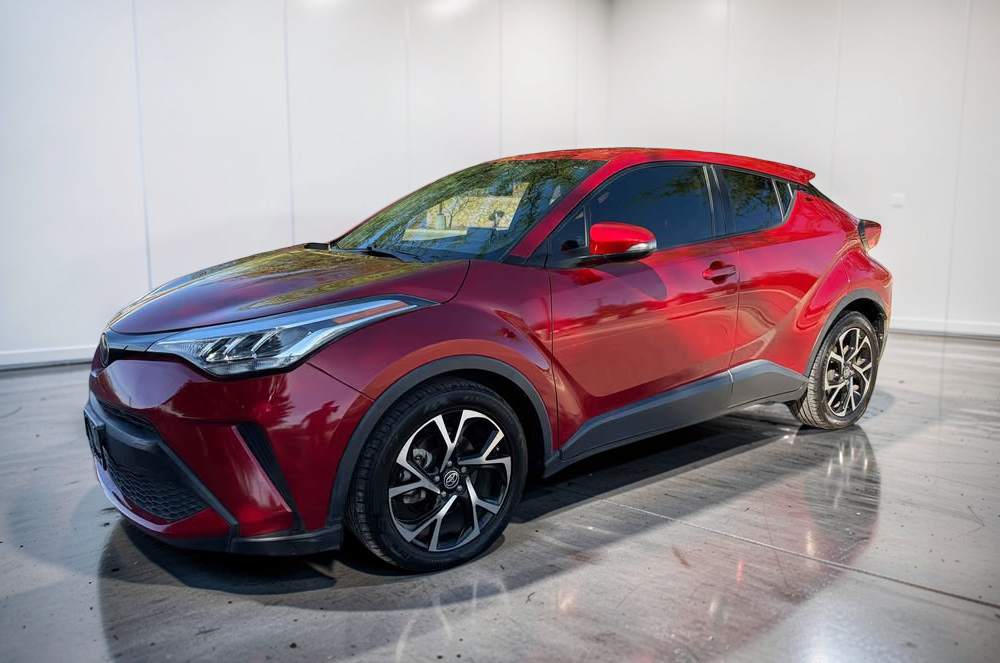
1. Why 2018–2019 C-HRs need a closer look
A noisy 2018 needs a diagnosis before a deal
Pass on a noisy 2018 gasoline C-HR until a qualified shop identifies the cause and you know who will pay. Toyota’s related service information and Customer Support Program 26TE06 address certain 2018–2019 cars with an abnormal CVT whine. Toyota says the noise is more noticeable between 15 and 30 mph. A normal-feeling acceleration run does not rule out the covered condition.
A past transmission repair changes what you need to check. Ask for the invoice showing the replacement unit, mileage at installation, and repair warranty. “Transmission replaced” leaves too much unknown. A used unit and a new or remanufactured unit need different scrutiny.
Match that invoice to the car’s VIN and current mileage. Then have a shop check any noise that remains. Toyota’s repair path depends on the vehicle, the installed transmission, and verification of the covered condition, so model year alone will not establish coverage.
The 2019 cabin upgrade didn’t settle the CVT concern
The 2019 C-HR gained a standard 8-inch touchscreen with Apple CarPlay across U.S. grades. That makes phone use easier, but it says nothing about transmission wear. Certain 2019 cars still fall within Toyota’s CVT support program. Do not assume the second model year eliminated the concern in every car.
Missing repair records leave the cause of any drivetrain noise open. A seller’s claim that it is “just tire noise” needs a shop’s backing. A technician should rule out tires, wheel bearings, and other sources before attributing the sound to the transaxle.
Complaint totals can’t price your risk
Raw complaint counts do not show how often a transmission fails. More sales, higher mileage, and longer time on the road can raise those totals. Reporting habits also affect the record. A useful failure rate needs a known vehicle population and a clear way to count failures.
Recalls, service bulletins, and customer-support programs serve different jobs. A safety recall addresses a safety defect or failure to meet a safety standard. A service bulletin guides diagnosis or repair; it does not automatically make that repair free. A customer-support program sets coverage terms for a stated fault.
Under 26TE06, an eligible car must show the covered CVT condition before Toyota authorizes replacement. The program does not offer a new transmission simply because a car falls within the listed model years. If diagnosis finds an uncovered fault, you may owe the diagnostic charge and any repair bill you authorize.
2. What that CVT whine can tell you
Match the noise to the right transmission
The U.S. gasoline C-HR uses a 2.0-liter engine and a continuously variable transmission. Service records may identify the engine or transmission with codes such as 3ZR-FAE and K114; match those codes to the vehicle rather than assuming that every C-HR in every market uses the same hardware. Overseas hybrids use a different drivetrain, so their repair histories do not establish how the U.S. gasoline CVT will hold up.
Toyota calls the assembly a transaxle, which combines the transmission and differential in one housing. Internal noise can warrant repair while the car still accelerates without slipping. Waiting for a loss of drive can let a fault progress beyond its first clear warning.
The key noise occurs at 15–30 mph
Toyota’s August 2026 support notice says premature wear in certain 2018–2019 C-HR CVTs may produce an abnormal whine that is more noticeable between 15 and 30 mph. The related technical procedure provides the dealer with the diagnostic conditions and identification checks needed to determine whether the vehicle qualifies.
Speed alone will not identify the failed part. A technician must trace the sound to the transaxle and rule out tires, wheel bearings, and other sources. The dealer may also need the transmission’s identification information to determine whether the installed unit falls within the applicable production limits.
A matching model year does not replace that evidence. If the sound or transmission identification falls outside the support program, diagnosis continues under the normal repair information and warranty terms.
A whine doesn’t name the failed bearing
Bearing failures appear in owner reports, but those reports do not prove that every noisy C-HR has the same internal damage. The law firm Ahdoot & Wolfson lists a class-action investigation involving 2018–2022 C-HRs. An investigation does not establish a failure rate, a court finding, or a right to compensation.
Toyota’s support notice links premature CVT wear with abnormal whine and possible early failure. It does not set a universal 60,000–100,000-mile failure window. Mileage alone cannot show how long a noisy unit will last.
A confirmed transaxle noise still does not identify which internal bearing has failed. Toyota’s repair procedure calls for CVT replacement when the covered condition is verified. After repair, a road test should confirm that the whine or grinding has stopped.
3. Toyota’s CVT coverage can change who pays
The first deadline has no mileage cap
Toyota’s Customer Support Program 26TE06 covers a verified abnormal CVT whine in certain 2018–2019 C-HRs. A dealer must confirm that the vehicle and fault qualify. Coverage applies to work performed at an authorized Toyota dealer.
| Coverage provision | Published terms |
|---|---|
| Primary coverage | Through September 30, 2027, regardless of mileage |
| Secondary coverage afterward | 10 years or 120,000 miles from first use, whichever comes first |
| Covered repair | New or remanufactured CVT after confirmation of the covered condition |
| Repair location | Authorized Toyota dealer |
| Previously paid repairs | The owner letter provides instructions for reimbursement consideration |
The 10-year clock starts when the car first enters service, not when you buy it used. Toyota does not offer preventive replacement for a transmission that has not shown the covered fault. Damage from abuse, an accident, theft, or vandalism falls outside the program’s stated terms.
Toyota replaces the CVT assembly
The program materials list a CVT and torque-converter kit, fresh CVT fluid, and related gaskets. The listed labor allowance is 6.5 hours; that is not a promise of same-day service. The dealer must still confirm the condition, order the applicable parts, and complete the repair process.
Toyota’s replacement route does not prove that every independent bearing repair is impossible. For an uncovered car, ask each shop to name the unit it plans to install. Used, rebuilt, remanufactured, and new transmissions can carry different warranties. The estimate should state the parts, labor, fluid, and any added work.
An $8,000–$10,000 figure should not stand in for a current written quote. Ask whether the warranty covers both the replacement unit and labor if the unit fails again. A parts-only warranty can leave you paying to remove and install the transmission twice.
Settle the repair bill before the sale
A low asking price means little while payment for an existing CVT fault remains unresolved. Have the seller obtain a written diagnosis and Toyota’s coverage decision before you agree on a price. If Toyota approves the repair, ask for the completed invoice before taking the car.
Keep receipts if you have already paid to fix the covered condition. Toyota provides a route for reimbursement consideration, but that does not guarantee payment for every past repair. If the dealer finds an uncovered fault, you may owe diagnostic fees and any repairs you authorize.
4. Safety recalls that can change the buying decision
Match the recall to the failed part
| Affected C-HR years | Campaign | Defect and risk | Required repair |
|---|---|---|---|
| Certain 2018 | 17V717 / H0W | The electronic parking brake may fail to apply or release. If it cannot apply, a rollaway is possible, particularly on a slope. | Reprogram the skid-control ECU. |
| Certain 2019 | 18V710 / J0Y | Insufficiently tightened rear hub-bearing bolts can damage brake components or allow a rear wheel to detach. NHTSA identified 681 potentially involved vehicles. | Inspect the bolts. If a bolt is loose or detached, replace the specified hub-bearing and carrier assemblies. |
| Certain 2019 | 19V244 / 19R1 | Load-capacity label text can wear away, leaving the driver without the correct vehicle limit and increasing overload risk. | Apply a corrected load-capacity modification label. |
| Certain 2019–2020 | 19V877 / 19TA22 | A rear-center-seat-belt locking mechanism may fail, reducing restraint in certain crashes. | Inspect the belt assembly and replace it if affected. |
| Certain 2021 | 22V107 / 22TA02 | Incorrect radar initialization can leave pre-collision assistance inactive without a fault warning. | Inspect and initialize the radar sensor as required. |
A recall count won’t tell you what remains broken
Recall lists name model years, but each campaign covers a specific group of vehicles. Have Toyota check the VIN and confirm which repairs remain open. Ask for records showing the campaign number, completion date, and work performed.
A completed label repair carries little weight when judging transmission life. An open wheel-retention recall poses a separate, direct safety risk. Counting both as equal marks against a model year hides what can actually fail.
The 2021 radar recall needs more than a glance at the dash. The fault can leave pre-collision assistance inactive without showing a malfunction warning. A normal-looking instrument panel cannot confirm that the radar has been initialized correctly.
For the seat-belt recall, the affected position is the rear center seat. Until the recall repair is complete, follow Toyota’s safety instructions and avoid using that seat if the campaign notice says to do so.
5. A fresh battery can hide an old drain
A jump-start doesn’t explain the flat battery
Slow cranking, repeated jump-starts, and overnight discharge need a diagnosis before you blame the C-HR’s wiring. A worn battery may no longer hold enough charge. A sound battery can also run flat during storage or from a load that remains on.
Toyota’s battery guidance names storage time, temperature, electrical loads, and parasitic drain as factors that can shorten battery life. Bulletin T-SB-0035-20 covers several 2021 Toyota models, including the C-HR. It gives dealers battery-care instructions before delivery; it does not establish a drain defect across early C-HRs.
A jump-start only shows that extra power helped the engine start. It does not prove the battery has failed or that the alternator works correctly. Nor does it establish damage to an engine computer.
The test results matter more than the replacement date
A useful repair record shows battery age, type, rated cold-cranking amps, and test results. The tester must use the correct battery type and rating. Toyota’s instructions call for charging and retesting when the first result requires it. Testing an undercharged battery can give a misleading result.
Cable connections need attention before another battery goes in. Toyota notes that a “replace battery” result can stem from a poor connection. Its procedure calls for an out-of-vehicle retest before replacement in that situation.
For repeated discharge, ask for charging-test results and a measured current draw with the car parked. The shop should let the car’s electronics enter sleep mode before judging that draw. A reading taken while control units remain awake can send the repair in the wrong direction.
A recent battery invoice should explain why the old one failed. If the battery and charging tests pass, unexplained overnight discharge still needs tracing. A battery health test cannot identify which circuit keeps drawing power after shutdown.
6. A cracked windshield can add a calibration bill
An edge crack doesn’t prove a body defect
A crack near the windshield’s edge needs a close look at the glass and its repair history. Look for an impact mark, signs of past replacement, and leaks around the seal. An edge crack alone does not prove that body flex caused the damage.
Owner reports can flag a concern, but they do not establish which C-HR year cracks glass most often. Claims that Toyota’s TNGA body structure causes these cracks need engineering evidence. Without that evidence, judge the damaged glass and installation on the car in front of you.
A replaced windshield also needs paperwork. Ask when the shop fitted it, which glass it used, and whether leaks followed. Water stains near the headliner or pillars warrant a seal inspection before purchase.
The camera sits behind the glass, the radar doesn’t
The C-HR’s forward camera sits near the top of the windshield. Its radar sits behind the front grille. Toyota’s owner documentation identifies these as separate sensors that support driver-assistance features.
Replacing the windshield makes camera calibration part of the repair discussion. Toyota’s owner documentation says the front camera must be recalibrated after windshield replacement, and glass-service providers may offer that service. Ask for a written quote covering the correct windshield, fitting materials, labor, and required camera calibration.
For a previous replacement, request the calibration report with the glass invoice. It should identify the car, date, and result. A receipt for glass alone does not establish that the shop completed calibration.
Front-end damage needs a separate sensor check. Windshield-camera calibration does not establish that the grille-mounted radar escaped damage.
7. Why 2020–2022 belong on your shortlist
Later production gives you a firmer starting point
For a used U.S. gasoline C-HR, 2020–2022 are reasonable years to include in your search. Toyota’s CVT support program names certain 2018–2019 cars, while the later model years are not named in that program. That gives buyers a documented distinction when comparing early and later production.
It does not establish that every later transmission will stay trouble-free, or that a 2022 car will outlast a well-maintained 2021. A newer badge does not prove stronger bearings or better assembly quality. You still need a quiet road test, service records, and an inspection of the car itself.
The useful upgrades arrived in different years
| Model year | Verified U.S. equipment | What changes for you |
|---|---|---|
| 2020 | Revised exterior styling, standard Android Auto, and Toyota Safety Sense P. | Adds Android phone integration but keeps the earlier driver-assistance package. |
| 2021 | Toyota Safety Sense 2.5 becomes standard, with enhanced pedestrian and bicyclist detection and intersection support. | Brings the key driver-assistance upgrade. Check completion of any applicable radar recall. |
| 2022 | Retains TSS 2.5, smartphone integration, a 2.0-liter gasoline engine, and a CVT. | Compare its condition, mileage, and price with a similar 2021. The year alone does not prove longer transmission life. |
A 2022 badge doesn’t prove a longer service life
Fewer complaints can reflect fewer years on the road and less mileage. Raw totals do not account for those differences or the number of cars sold. An unclear reliability score cannot establish that a 2022 transmission will outlast a well-kept 2021.
Compare cars with similar mileage and documented upkeep before paying more for the newer year. A replacement transmission needs an invoice showing the unit installed and its warranty. A car with no past transmission work still needs a road test that checks for whine and grinding.
The 26TE06 support program names certain 2018–2019 C-HRs. Its terms do not extend to 2020–2022 models. On a later car, another valid warranty or coverage agreement must pay, or the repair falls to you.
8. Hybrid C-HRs need a different set of checks
The hybrid badge changes the transmission
Overseas C-HRs include 1.8-liter and 2.0-liter hybrids, separate from the U.S. gasoline model. Toyota Europe’s 2020 update added the 2.0-liter hybrid alongside the existing 1.8-liter version. Both use Toyota’s hybrid e-CVT system, whose design differs from the gasoline car’s conventional belt-and-pulley CVT.
Toyota’s hybrid system uses an engine, motor-generators, and a planetary power-split device to blend engine and electric power. It does not use the same belt running between variable-width pulleys used by a conventional belt-type CVT.
That hardware difference matters when reading failure reports. A K114 bearing complaint does not establish the same fault in a hybrid transaxle. The hybrid transaxle still contains mechanical and electrical parts that can fail, so it needs its own inspection history.
A new 12-volt battery says little about hybrid health
The high-voltage traction battery stores energy for electric drive. A separate 12-volt battery powers control systems and helps bring the hybrid into its ready state. Replacing that small battery does not establish the condition of the traction battery.
Ask for hybrid inspection records, stored fault findings, and details of any battery or inverter repairs. Match service records to the engine, model year, and country where Toyota sold the car. A generic “hybrid checked” note leaves the test results unknown.
Toyota’s UK approved-used inspection includes a Hybrid Health Check alongside engine, battery, and mechanical checks. Request the dated results when weighing a used example. A passing result records condition at the test; it does not guarantee how many years the traction battery has left.
An MOT pass leaves the gearbox untested
U.K. MOT records can reveal worn tires, brake faults, failed lights, and suspension defects. Repeated advisories help show whether an owner dealt with wear or left it for another year. Match those entries to repair invoices, especially when the same defect returns.
MOT pass rates do not measure engine or transmission life. They also cannot prove that hybrid drivetrains last longer than gasoline versions. Official MOT guidance excludes the condition of the engine, clutch, and gearbox from the test.
9. The 2026 electric C-HR brings a different risk
Battery-control software can shut down drive power
The U.S. 2026 C-HR is battery-electric, uses two electric motors, and has standard all-wheel drive. It has no gasoline engine or K114 transmission. Its repair record needs separate scrutiny from the earlier gasoline and overseas hybrid models.
Recall 26V570 / Toyota 26TA17 covers 8,521 U.S. vehicles with faulty battery-control software. The error can allow the drive battery to become overcharged when its state of charge is high and regenerative braking continues under certain conditions, including sustained downhill operation and low temperatures.
If overcharging triggers a shutdown, warning lights and a buzzer may appear. The car can lose motive power while traveling at speed. All recalled vehicles contain the affected software, but that does not mean every vehicle has experienced a shutdown.
Confirm the software repair before buying
The remedy is a free dealer software update to the battery-electric vehicle control unit. As of September 28, 2026, NHTSA listed owner letters as planned to begin mailing October 18, 2026. Have Toyota check the VIN, confirm remedy availability, and document completion before purchase.
NHTSA’s filing identifies affected production from February 6 through July 10, 2026. Those cars have not accumulated years of battery aging, winter use, or high-mileage wear, so the model’s short service history cannot support a firm long-term reliability ranking.
A completed recall closes this specific software fault. It does not establish future battery life or motor durability. Until repaired, the affected software can permit overcharging during sustained regeneration and shut down the electric drive.
Sources & References
- Toyota Customer Support Program 26TE06
- Toyota C-HR Gets Tech and Styling Upgrades for 2019
- Toyota C-HR Updates for 2020
- 2021 Toyota C-HR and Toyota Safety Sense 2.5
- Toyota Europe: The New Toyota C-HR
- NHTSA Recall 17V-717
- NHTSA Recall 18V-710
- Toyota VIN Recall and Service-Campaign Lookup
- Toyota T-SB-0035-20 Battery Maintenance Bulletin
- 2022 Toyota C-HR Driving-Support Systems Owner-Manual Excerpt
- GOV.UK: How the MOT test works
- Toyota Debuts the 2026 C-HR Battery-Electric Vehicle
- NHTSA Recall 26V-570 / Toyota 26TA17
- CVT Bearing Investigation: Ahdoot & Wolfson