
Sunlight hits the Solara’s sticky dash, and glare spreads across the windshield. Heat and humidity can break down the surface, leaving cracks and a tacky shine. On 2004–2008 models, that damage can spoil your view before the test drive starts.
The engine can hide a bigger bill. Certain 2002–2006 four-cylinder models suffer damaged head-bolt threads, which can let coolant escape. The 2007–2008 four-cylinders need close checks for excess oil use. Choosing a V6 avoids those specific faults, but adds timing-belt service to the records you need.
A clean body won’t settle the rest. The gearbox can hesitate, and loose rear glass can let rain soak a convertible’s carpet. This guide maps the Solara years, engines, and repair records to check before you buy.
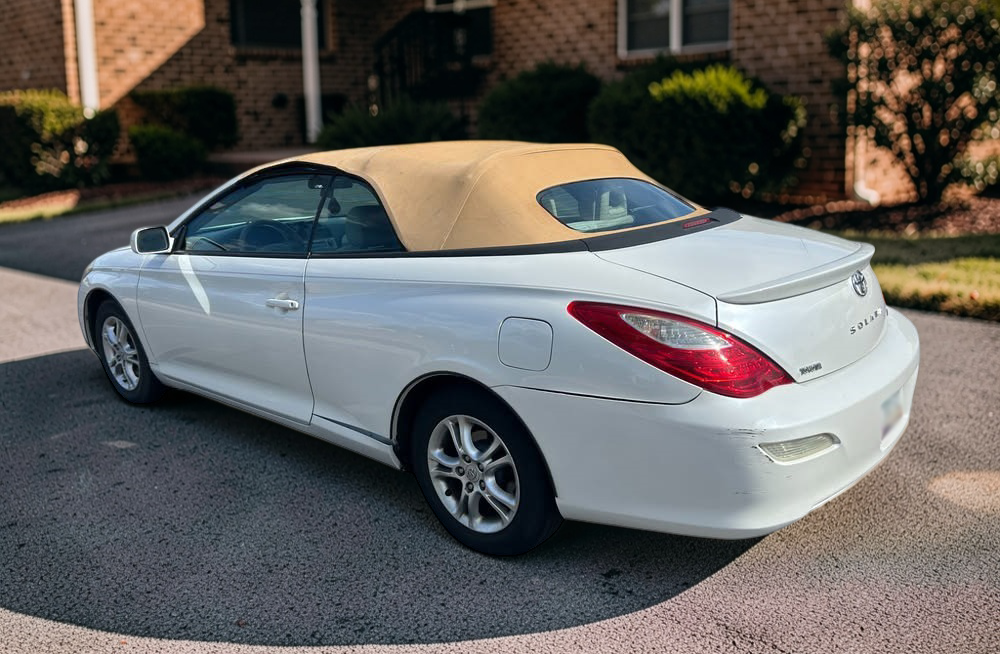
1. Check the engine before trusting the year
The same badge hides different repair risks
The first Solara generation covers U.S. model years 1999–2003. The convertible began in 2000. The second generation runs from 2004–2008 in the U.S. Both generations offer four-cylinder and V6 engines, with different faults and service needs.
| Model years and engine | Timing drive | Main checks before purchase |
|---|---|---|
| 1999–2001 2.2-liter four-cylinder, 5S-FE | Belt-and-gear drive | Oil-change records, sludge history, and timing-belt service |
| 1999–2003 3.0-liter V6, 1MZ-FE | Belt-and-gear drive | Belt records and oil history, including the earlier oil-gelling concern |
| 2002–2008 2.4-liter four-cylinder, 2AZ-FE | Chain | Head-bolt thread history on applicable 2002–2006 vehicles; oil-use history on applicable 2007–2008 vehicles |
| 2004–2008 3.3-liter V6, 3MZ-FE | Belt-and-gear drive | Belt service, applicable recalls, shifting behavior, and dashboard condition |
The 2AZ-FE risk discussion below uses Toyota’s documented 2002–2006 head-bolt bulletin and 2007–2008 oil-consumption bulletin. Neither bulletin means that every car in the stated model years has the problem.
Low complaint counts won’t clear a 2003 or 2005
A 2003 four-cylinder falls within the applicability range of Toyota’s T-SB-0015-11, provided it has the listed 2AZ engine and applicable vehicle configuration. The bulletin addresses damaged cylinder-head-bolt threads in the aluminum engine block. If the threads fail, a head bolt can lose its grip and compromise clamping. Coolant leakage can result, but coolant loss alone does not diagnose this defect.
A 2005 V6 avoids the 2AZ-FE’s specific head-bolt and oil-consumption concerns. Its automatic transmission still needs a careful road test. Toyota issued a calibration bulletin for some 2004–2005 V6 Solaras with the five-speed automatic to reduce downshift lag and gear hunting. Applicable recalls also need separate checks.
Complaint totals count reports, not the share of cars that fail. Sales volume, engine choice, and body style affect those totals. Maintenance and past repairs also change what you’re buying. A year-wide ranking can hide those differences.
A V6 coupe removes the folding-roof repair bill
A well-kept V6 coupe deserves consideration alongside any four-cylinder with unresolved coolant loss or oil use. The fixed roof removes the folding mechanism and fabric-to-glass bond from the inspection. It also avoids the convertible’s roof seals and related leak repairs.
Keep 2001–2003 and 2005–2008 V6 coupes on the candidate list. Earlier cars need strong oil-service records; later cars still need dashboard and shift checks. Ask for invoices that identify any major engine work, with dates and mileage.
For the later 3.3-liter V6, Toyota’s maintenance guide specifies timing-belt replacement at 90,000 miles or 108 months, whichever comes first. An invoice needs both the service date and mileage. Low mileage does not extend that calendar limit. Check the applicable maintenance guide before applying the interval to an earlier 3.0-liter V6; Toyota’s earlier material lists a shorter calendar interval for that engine.
2. On 2002–2006 four-cylinders, a head gasket may hide damaged threads
The bolts can lose their grip inside the block
Toyota’s T-SB-0015-11 covers certain 2AZ-equipped 2002–2006 Solaras. The threads sit inside the aluminum engine block. They anchor the bolts that clamp the cylinder head against the gasket.
When the threads pull loose, the affected bolts can lose clamping force. The condition can contribute to head-gasket or external coolant leakage. Replacing the gasket alone does not repair damaged threads underneath.
Toyota’s documented repair procedure uses Time Sert M11×1.5 thread inserts for the eligible bolt holes. The bulletin calls for inspection of all relevant holes; specified holes that cannot receive inserts require block replacement if damaged. The procedure does not make every insert brand or repair method Toyota-approved.
Dried coolant starts the search, not the diagnosis
Falling coolant levels deserve attention even when the driveway stays dry. Look for dried residue along the head-to-block joint, especially beneath the intake side. Ask whether the temperature gauge has climbed or the engine has overheated.
Residue alone won’t prove that head-bolt threads have failed. A hose or water pump can leak and leave coolant on nearby surfaces. A technician should pressure-test the cooling system and trace the leak to its starting point.
Repeated top-ups leave the cause unresolved. Continued coolant loss can lead to overheating and further engine damage. Don’t accept a full reservoir as proof that someone fixed the leak.
“New head gasket” leaves an expensive question unanswered
A repair invoice should identify any block-thread work and the repair method used. It should also record the cylinder-head inspection, gasket replacement, and post-repair testing. A vague “head gasket replaced” entry doesn’t establish whether the threads needed repair.
Past overheating adds another concern: cylinder-head distortion. Ask whether the shop checked the head for warping and cracks. Thread inserts restore bolt grip, but they don’t correct a warped or cracked head.
A documented repair can keep an affected car worth considering. Fresh coolant loss or another overheating episode calls for a new diagnosis. Before buying, require the shop to locate the leak and quote the work in writing.
3. On 2007–2008 four-cylinders, a full dipstick can hide oil loss
Toyota’s repair reaches the pistons and rings
Toyota’s T-SB-0030-15 includes certain 2007–2008 Solaras with the 2AZ engine. It addresses excessive oil consumption and identifies a revised piston assembly. The related oil-consumption inspection measures oil use over approximately 1,100–1,300 miles. If the test confirms the condition, the repair calls for piston-and-ring replacement.
The oil-control rings help keep excess oil off the cylinder walls. Poor oil control lets oil enter the combustion chamber and burn. This repair tackles a different fault from the earlier head-bolt thread damage.
The bulletin doesn’t mean every 2007–2008 four-cylinder burns excess oil. Nor does it set one mileage when the trouble starts. You need that engine’s oil-use history and test results.
A short test drive won’t measure consumption
A seller can top up the oil just before you arrive. The dipstick then shows the current level, with no record of what disappeared between changes. A short road test won’t establish how much oil the engine uses.
Ask how much oil the owner adds and over how many miles. Oil receipts, mileage logs, and past consumption-test results can support the answer. Without those records, “it hardly uses any” remains an unmeasured claim.
Blue exhaust smoke needs investigation, but no visible smoke doesn’t clear the engine. External leaks can also lower the oil level. A measured consumption test and leak inspection help separate those causes.
The old warranty won’t automatically cover a new purchase
Toyota addressed this concern through Warranty Enhancement Program ZE7 for certain VIN-eligible 2007–2008 Camry Solaras. Its primary coverage ran through October 31, 2016. Secondary coverage lasted 10 years from first use or 150,000 miles, whichever came first. Ordinary 2007–2008 Solaras have generally aged beyond that secondary window, although mileage and qualifying pre-expiry dealer records can affect an individual case.
A seller’s promise that Toyota will fix it free carries no weight without written coverage confirmation. Ask instead for the completed repair invoice. It should identify the piston-and-ring work, repair date, and mileage.
A replacement engine needs its own paper trail
“Engine replaced” can describe several different jobs. Revised pistons in the original engine differ from a replacement short block or a complete used engine. An unidentified used engine may bring the same oil-use concern.
Request the replacement’s identity, installation mileage, and parts records. For a short block, ask which piston specification it contains. For a used engine, request its donor details and subsequent oil-use history.
Even a detailed installation invoice leaves current consumption unanswered. Look for measured oil use after the repair, with miles and top-up amounts recorded. A full dipstick at the viewing can’t supply that missing rate.
4. A V6 needs proof of belt service
Low miles won’t stop the belt from aging
Both Solara V6 engines use timing belts. Toyota’s maintenance material lists the earlier 1MZ-FE service at approximately 90,000 miles or 72 months, while the 3MZ-FE guide lists 90,000 miles or 108 months, whichever comes first. Calendar limits still apply to cars that spend most days parked.
Ask for an invoice showing the replacement date and mileage. A service sticker offers a clue, but rarely identifies the full job. Without dated records, you can’t establish how much service life remains.
Find out what the belt job included
The water pump, tensioner, and idler pulleys deserve attention when pricing belt service. The tensioner controls belt tension, while the idlers guide its path. Worn bearings or a leaking pump can require more work in the same area.
Shared labor can make related repairs sensible while the belt is off. Ask the shop to inspect accessible seals and identify any leaks. Toyota’s belt interval doesn’t automatically require a new water pump at every replacement.
An invoice for “timing service” may leave those parts unspecified. Request the parts list before treating it as a complete belt job. Don’t budget on the assumption that a broken belt will leave the engine unharmed.
Earlier engines need more than a clean oil cap
Toyota’s historical oil-gelling program covered specified vehicles with the 2.2-liter four-cylinder and 3.0-liter V6. For Solaras, the stated program scope generally corresponds to 1999–2001 2.2-liter cars and 1999–2002 3.0-liter cars, subject to the program’s terms. A 2003 Solara was outside that stated scope.
Look for consistent oil-change records across the car’s life. Heavy sludge can restrict oil flow to parts that need steady lubrication. A recent oil change won’t reveal what accumulated during years of neglected service.
Deposits beneath the filler cap alone can’t establish the engine’s internal condition. Have a qualified technician investigate suspected sludge and decide whether deeper inspection is needed. Missing service records leave that maintenance history unproven.
Certain 2004–2005 V6s need a separate pulley check
Recall 11V-539, Toyota campaign B0M, covers certain 2004–2005 Camry Solara V6 vehicles built approximately June 1, 2004 through March 31, 2005. The affected engines are the 1MZ-FE and 3MZ-FE; four-cylinder Solaras use a different pulley and are not covered by this recall.
The adhesive between the pulley’s inner damper and outer ring may be inadequate. The outer ring can become misaligned or begin to separate, and an accessory belt can slip or detach. The result can include loss of power-steering assistance, increased steering effort, and reduced alternator charging.
Timing-belt replacement doesn’t establish whether the recall work took place. Have Toyota check the VIN and confirm completion of the prescribed inspection or replacement.
5. A glossy dashboard can spoil the view on 2004–2008 models
Cracks and tackiness deserve a daylight inspection
A failing upper dashboard can feel sticky and show cracks across its surface. Some develop a strong shine that reflects onto the windshield. In direct sun, that reflection may make the road harder to see.
Toyota’s ZE6 program covered certain 2004–2008 Solaras with dashboards that cracked or became sticky or melted from heat or humidity. It was a VIN-eligible warranty enhancement, not a blanket rule for every car in those model years.
Toyota’s dashboard program had a time limit
Toyota’s Warranty Enhancement Program ZE6 covered the specified dashboard condition as a voluntary warranty extension, not a safety recall. Primary coverage ran through May 31, 2017. Secondary coverage lasted 10 years from first use, subject to VIN eligibility, condition verification, and the program’s other terms.
Ordinary new claims have generally aged beyond those windows. A seller who mentions ZE6 still needs proof of completed replacement or a qualifying pre-expiry dealer record. The program’s existence doesn’t establish that Toyota repaired this car.
A dash mat can hide the surface underneath
Inspect the panel in daylight, including the areas near the windshield and passenger airbag. With the seller’s permission, lift removable covers to view the surface beneath. Don’t scrape, press hard, or apply solvents to test the material.
Those tests can mark a weakened surface. Look instead for cracks, uneven gloss, and visible deterioration. If the seller claims a replacement, request an invoice identifying the panel and installation date.
A mat blocks your view of the original surface. A coating can also conceal cracks or change how the dashboard feels. Neither proves that someone replaced the damaged panel.
Price the panel, cover, or refinishing job separately
Replacing the dashboard panel, fitting a cosmetic cover, and refinishing the surface involve different work. A replacement removes the old panel; a cover leaves it underneath. Refinishing treats the existing surface, so its condition limits the repair.
Ask a shop to confirm parts availability and quote the exact work before agreeing on the car. The estimate should address fit, finish, and the passenger-airbag area. Any proposed cover or coating must preserve the airbag’s deployment path.
6. Shift lag and highway shake need separate diagnoses
The 2004–2005 V6 can hesitate before a downshift
On some 2004–2005 V6 Solaras with the five-speed automatic, Toyota bulletin TC006-05 addressed an ECM calibration intended to reduce downshift lag during acceleration at 10–20 mph, reduce gear hunting at 20–30 mph while the driver modulates the accelerator, and improve response during heavy acceleration from a stop.
Have a technician check which calibration the car currently uses. An old invoice for an update helps establish repair history. The road test still needs to show how the transmission behaves now. The bulletin is not a recall and does not prove that every car has the symptom.
Rising revs without matching speed need a closer look
A pause before a downshift differs from slipping during a shift. With shift flare, engine speed rises before the next gear takes hold. Persistent flare, slipping, or loss of engagement needs mechanical diagnosis.
Test the transmission cold and again after it reaches full operating temperature. Review its service records and scan for stored faults. Note whether trouble occurs when selecting Drive or Reverse, during shifts, or under steady load.
Reprogramming can’t repair worn internal parts. Fresh fluid also won’t establish that the clutches hold properly. Reports of failed 2008 transmissions warrant inspection, but don’t prove every final-year gearbox has the same defect.
Steering-wheel flutter has its own bulletin
Toyota’s T-SB-0106-08 addresses highway vibration or steering-wheel flutter on applicable 2007–2008 Solaras. The reported speed range is approximately 65–75 mph. Drivers may feel the shake through the steering wheel, floor, or seats.
Tire imbalance, wheel damage, axle problems, and worn or loose suspension parts need checks before anyone approves bulletin-specific parts. Toyota’s procedure requires confirmation and normal diagnosis first; front-hub replacement is conditional if the vibration remains after those checks.
Use a smooth road and stay within posted limits during the test drive. Note the speed where the shake starts and whether it changes under braking. If traffic or speed limits prevent a useful test, leave it for the shop.
A calibration update for shift lag won’t correct tire or wheel vibration. Before approving updated parts, require the technician to document which checks support the bulletin’s repair.
7. A leaking convertible roof can outweigh the model year
Loose rear glass affects more than 2008 models
Look where the roof fabric meets the heated rear glass. Lifting edges, visible gaps, and old adhesive patches deserve close inspection. Owner reports document rear-window separation on both first- and second-generation Solaras.
Those reports show that examples exist across generations. They don’t measure how often the problem occurs, prove a design defect, or establish that 2008 fares worst. Judge the actual fabric, glass bond, and past repairs on the car in front of you.
Wet carpet won’t tell you where rain entered
Water may enter through the glass bond, windshield-header seal, side-window seals, or drainage areas. It can travel behind trim before collecting on the floor. A wet rear footwell doesn’t identify the entry point.
Have a top specialist perform a controlled water test. Check the rear footwells, accessible trunk areas, and nearby trim for dampness or water stains. Ask the specialist to trace each leak before quoting a complete roof.
Existing water damage needs its own assessment. Dry carpet at the viewing won’t establish that the padding underneath stayed dry. Include wet padding and any corrosion in the repair estimate.
Watch both sides move and the windows meet the seals
Operate the roof through a full cycle with the seller. Both sides should move evenly, and the front edge should meet the windshield header correctly. The latches should engage without excessive force.
Check where each side window contacts the weatherstrip after the roof closes. Gaps or uneven contact can leave a path for rain. A roof that opens smoothly may still seal poorly when closed.
Don’t force a binding roof or push against loose rear glass. Uneven movement needs a specialist’s assessment before further operation. Forcing the latches won’t correct poor alignment.
Fresh glue can’t restore shrunken fabric
A local bond repair, replacement rear-window section, and complete top replacement are different jobs. Some early-generation roofs have aftermarket replacement rear-window sections available. The specialist needs to identify the roof’s construction and parts availability before choosing the repair.
Fabric shrinkage, brittle material, split seams, and old adhesive repairs may limit what remains usable. Shrunken fabric can pull against a fresh glass bond. New adhesive won’t restore the fabric’s original dimensions.
Request an itemized estimate covering the top material, glass section, seals, labor, and existing water damage. Confirm which parts the quoted repair retains. A glass-bond repair won’t stop a separate leak at the windshield-header seal.
Sources & References
- Toyota T-SB-0015-11: Cylinder Head Bolt Threads Damaged
- Toyota T-SB-0030-15 Rev. 1: 2AZ Engine Oil Consumption Repair Procedure
- Toyota ZE7 Warranty Enhancement Program
- Toyota maintenance guide: 2002
- Toyota maintenance guide: 2003
- Toyota ZE6 dashboard program notice
- Toyota ZE6 FAQ
- Toyota ZE6 policy bulletin
- NHTSA recall 11V-539 decision
- NHTSA recall 11V-539 manufacturer notice
- Toyota T-SB-0106-08
- Toyota 2002 Solara owner’s manual
- NHTSA historical sludge record
- Toyota Solara convertible leak guide