
The engine revs, the transmission slips, and that cheap Envoy starts looking expensive. Worn clutches or lost hydraulic pressure can turn a short test drive into a rebuild quote. On some models, a separate headlamp fault can knock out both low beams.
The 2002–2009 GMC Envoy needs a closer look than its asking price suggests. Engine faults, electrical recalls, and past repairs change the risk from one truck to another. The earlier Jimmy-based Envoy has different engines and crash protection, so it needs a separate assessment.
This guide identifies the years that deserve caution, explains their costly faults, and compares later models with better safety equipment.
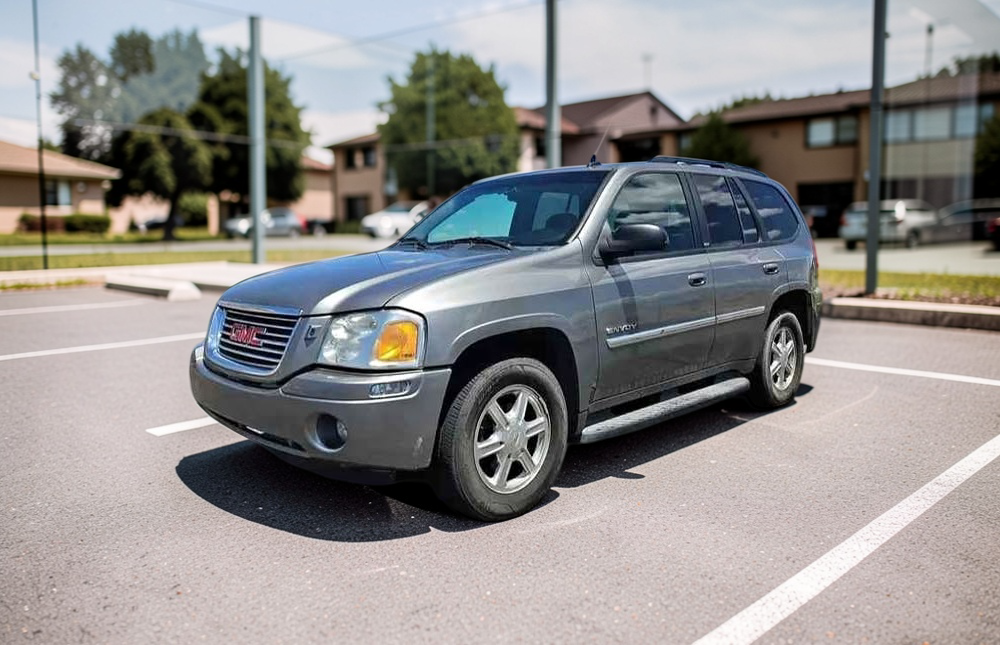
1. Which Envoy years can turn a bargain into a repair bill?
Start with 2002 and unrepaired 2005–2007 models
Put 2002 and unrepaired 2005–2007 Envoys under the closest scrutiny. GM documented engine, fuel-sender, and electrical defects across parts of this group. The faults differ by year, engine, and equipment. Repair records can change whether a specific truck deserves a place on your list.
The 2004–2005 XUV needs separate scrutiny when its rear roof, glass, or tailgate won’t work. Those linked functions add faults that a basic engine scan won’t explain. Before buying a faulty XUV, get a diagnosis and confirm that repair parts are available.
| Model year or version | Buying position | What drives the risk |
|---|---|---|
| 2002 | Avoid unexplained engine noise, poor compression, or unresolved stalling. | Certain 4.2L engines in affected builds fall under GM’s cracked cylinder-liner policy. Some air-suspension models had a separate electrical stall recall. |
| 2003–2004 standard Envoy and XL | Consider selectively after checking condition and repairs. | Both years retain the earlier frontal crash rating. Applicable trucks also fall within the rear-lamp recall population. |
| 2004–2005 XUV | Avoid neglected examples with roof or tailgate faults. | The retractable roof, rear glass, and tailgate require a full function test and fault diagnosis. |
| 2005 | Check fuel-gauge repairs and identify the engine. | Fuel-sender coverage includes this year. The 5.3L V8 gained cylinder deactivation. Don’t broadly assign later door-switch fire recalls to 2005. |
| 2006–2007 | Verify applicable safety repairs before purchase. | Door-module and headlamp campaigns overlap with fuel-sender faults. The XL ended after 2006. |
| 2008–2009 | Start here for later safety equipment, then assess condition. | Curtain airbags became standard for 2008. Headlamp special coverage still includes certain trucks from both years. |
A newer badge won’t save a worn-out truck
In 2026, these Envoys sit roughly 17–24 model years behind new vehicles. Rust can weaken frame rails and suspension mounts regardless of the year badge. Oil neglect can leave engine wear that a fresh oil change won’t reveal.
Complaint totals alone can’t establish which year fails most often. Sales volume, years in service, and reporting habits affect those counts. A low count for 2009 doesn’t prove that its engine or transmission will last longer.
A documented earlier Envoy may make more sense than a neglected 2008–2009 truck. Ask for invoices that identify the repaired fault and the parts installed. A claim of “rebuilt transmission” leaves the repair scope unknown without that paperwork.
Test the transmission after it reaches normal operating temperature. Engine speed that rises during a shift without matching acceleration points to slip that needs diagnosis. Reject a truck with frame perforation or weakened suspension mounts, even if the engine runs cleanly.
2. The 4.2L engine faults that can change the deal
A knocking 2002 needs more than a seller’s guess
Certain 2002 Envoys with the 4.2L inline-six fall under GM’s cylinder-liner policy 03019. The affected population is limited to specific builds, including vehicles produced during calendar year 2001, not every 2002 Envoy. The liner forms the surface the piston travels against. GM’s repair guidance calls for engine replacement when an affected engine has a confirmed cracked liner.
That defect doesn’t establish that every 2002 engine has a bad block. Knocking, poor running, or low compression need diagnosis before you price the truck. A compression test can reveal a weak cylinder, but it won’t prove a cracked liner by itself.
If the seller claims an engine replacement, ask for the invoice and the installed engine’s identity. Check whether the shop fitted a used engine or a replacement with a documented repair history. Without those records, you can’t establish which engine now sits under the hood.
Cam-timing codes can reach deeper than a solenoid
Codes P0014 and P0017 flag exhaust-cam timing or crankshaft-to-camshaft alignment faults on applicable 4.2L engines. You may feel the engine shake at idle. Neither code proves that a new sensor will fix it.
For applicable 2004–2011 Envoys, GM bulletin PIP3694F links these codes and rough idle to actuator-solenoid screen faults or excessive crankshaft end play. The bulletin does not establish that the same diagnosis applies to 2002 Envoys. The solenoid meters oil to the cam actuator, which adjusts exhaust-cam timing. Damaged or displaced screens require inspection, while excess end play means the crankshaft moves too far lengthwise.
Start with the oil level and condition, then inspect the actuator solenoid and its screens. A technician should compare commanded cam timing with actual movement and follow the bulletin’s diagnostic steps. Confirmed excess crankshaft end play requires mechanical diagnosis beyond replacing the solenoid.
Weak cabin heat needs a temperature check
A stuck-open thermostat can cause slow warm-up, weak cabin heat, and code P0128. Coolant reaches the radiator too soon, delaying engine warm-up. The code means coolant temperature stayed below the expected regulating range under the monitored conditions.
A faulty coolant-temperature signal can also mislead the diagnosis. GM’s diagnostic guidance includes sensor-circuit checks, so the dashboard gauge alone won’t settle it. A technician should compare scan-tool temperature readings with a cold engine and track them during warm-up.
Keep cold running separate from coolant loss or overheating. A stuck-open thermostat alone doesn’t prove internal engine damage or a ruined catalytic converter. Falling coolant levels or rising engine temperature require separate cooling-system tests.
3. The 5.3L V8 needs a different set of checks
The early V8 skips the cylinder-deactivation hardware
The Envoy XL offered a 5.3L V8 for 2003, before the Denali arrived. Those early engines used the LM4 designation and ran on all 8 cylinders. The later LH6 brought different hardware and repair risks.
For 2005, the Envoy’s 5.3L gained Displacement on Demand, later called Active Fuel Management, or AFM. Under light loads, special lifters deactivate valves on 4 cylinders while the engine cuts their fuel. When power demand rises, those cylinders return to work.
The early LM4 avoids AFM lifters, but age and poor upkeep can still leave expensive engine wear. Confirm the engine through factory build records and any replacement invoices. A Denali badge or a seller’s “5.3 V8” description won’t establish which engine now powers the truck.
A steady tick can mean more than worn spark plugs
Persistent ticking, misfires, and reduced compression warrant a close look at the valvetrain. GM bulletin PIP4568N specifically includes 2006–2009 V8 Envoys and addresses AFM lifter faults. It identifies cylinders 1, 4, 6, and 7, the cylinders used for deactivation.
A failed AFM lifter can prevent a valve from opening as intended. You may hear a steady tick and feel the engine shake as that cylinder misfires. Code P0300 can appear, but it doesn’t distinguish a lifter fault from ignition, fuel, or other mechanical faults.
Don’t price a ticking V8 around the seller’s claim that it needs plugs. Diagnosis should check compression and valve movement before the shop commits to replacing lifters. Confirmed lifter failure requires substantial labor, and inspection may reveal camshaft damage that expands the repair.
Ask for invoices when the seller claims an AFM repair or modification. The paperwork should identify the failed parts and any camshaft work. Software that disables cylinder deactivation cannot restore a damaged lifter or worn cam lobe.
Low oil needs a measured cause
A low dipstick reading doesn’t identify where the oil went. Ask how much oil the engine uses and over how many miles. Check for external leaks and records of top-ups between changes.
AFM hardware alone doesn’t prove that the engine needs rings, lifters, or a replacement. GM notes that certain full-size-truck AFM oil-pan remedies don’t fit LH6 midsize SUVs. A Silverado repair procedure cannot establish the correct repair for an Envoy.
Have the shop document the starting oil level, mileage, and oil added during a consumption test. Repair visible leaks before assigning the loss to oil burning inside the engine. Without measured use and a confirmed cause, a low reading cannot justify a piston-ring repair.
4. A slipping transmission can wipe out the savings
Trouble may start after the fluid warms up
A short drive around the block can miss faults in the Envoy’s four-speed automatic. Its 4L60-E-family transmission may shift well cold, then slip or slam into gear once warm. Hotter, thinner fluid can expose internal leaks that reduce clutch pressure.
Check Drive and Reverse engagement, then assess each shift at normal operating temperature. Watch for engine speed rising without a matching gain in road speed. The Envoy’s weight alone doesn’t prove transmission failure, and no fixed mileage marks the end of every unit.
| Symptom | Possible fault | What the repair must address |
|---|---|---|
| Second gear, fourth gear, and Reverse disappear together | A damaged reaction shell can interrupt the geartrain’s mechanical connection. | Internal inspection and repair of broken parts. Fresh fluid cannot restore a stripped connection. |
| Engine speed flares during the 2–3 shift, or third and fourth slip under load | Worn 3–4 clutch friction plates or hydraulic leaks can prevent firm clutch engagement. | Damaged clutches and the cause of lost apply pressure. |
| Shifts turn harsh when hot, sometimes with converter-slip faults | Converter-clutch control faults, valve-body wear, or hydraulic pressure faults need diagnosis. | Scan data and pressure tests must establish why shift pressure or converter operation changed. |
“Rebuilt” needs an invoice behind it
A rebuild invoice should name the failed parts and explain what the shop repaired. New friction plates alone don’t prove a lasting fix. Sonnax documents several causes of 3–4 clutch failure, including faults that let clutch apply pressure escape.
Ask how the shop handled debris and checked the cooler and fluid lines. Material left in the fluid circuit can contaminate a replacement transmission. The invoice should also show whether the repair included the torque converter and valve-body work.
A used transmission needs its donor mileage, identity, and warranty in writing. Confirm the installed unit before ordering parts or accepting a replacement quote. A seller’s claim that it “came from a low-mileage truck” leaves its condition unproven.
Compare the asking price plus a written repair estimate with the cost of a functioning Envoy. Include any converter, cooler, and hydraulic work the diagnosis requires. If third or fourth slips under load, don’t accept a fluid change as proof of repair.
5. Door-switch fires and headlights that cut out
A working window switch doesn’t clear the fire risk
Certain 2006–2007 Envoys and 2006 Envoy XLs fall within driver-door module fire campaigns. Moisture can cause corrosion inside the module that controls the windows and door locks. Electrical shorts can then overheat the module, melt nearby plastic, or start a fire.
Erratic window operation can warn of damage, but normal operation doesn’t prove the module is safe. The defect can cause a fire while the SUV sits parked with its key removed. GM instructed owners of affected vehicles awaiting repair to park outdoors.
The recall history runs through 12V406, 13V248, 14V404, and 15V599. Early repairs used protective coating on some modules, but that remedy proved insufficient. Later records also showed that some repairs marked as module replacements hadn’t included replacement.
Ask a GM dealer to verify the applicable final repair against the VIN and campaign history. An invoice for an early coating treatment doesn’t establish completion of a later replacement campaign. Where records leave doubt, the dealer may need to identify the installed module.
Both low beams can fail while high beams still work
An overheating headlamp driver module can cut power to both low beams and the daytime running lamps. The lights may return after an outage, making the fault hard to reproduce during an inspection. High beams can remain available because they use a separate circuit.
Recalls 14V755 and 15V519 fall under GM campaign 14291. NHTSA’s investigation examined a broader vehicle population than the initial recall group. A model year outside that first group doesn’t rule out the same headlamp fault.
GM also issued special coverage 17138/N172091910 for certain 2006–2009 Envoys. Its historical limit was 12 years or 150,000 miles, whichever came first. Those terms don’t establish free repair eligibility in 2026.
Check which replacement the repair invoice documents. An interim relay replacement doesn’t necessarily satisfy the final recall remedy. The dealer’s campaign record must show completion of the applicable final repair.
A clean VIN search can miss an old recall
Recall 04V527 covers applicable 2002–2004 Envoy and Envoy XL rear lamps. Heat and vibration could loosen bulb contact in the tail and stop lamps. Check both rear lamp assemblies with the running lights on and the brake pedal pressed.
A working lamp today doesn’t establish that the recall repair took place. Ask for the repair record as well as testing the lights. Intermittent contact can let a bulb work during one test and fail later.
NHTSA’s public VIN search may omit recalls more than 15 years old, completed recalls, and non-safety campaigns. That limits its value on an Envoy this old. Obtain GM’s campaign history and repair invoices before treating a blank search result as proof of completed repairs.
6. The fuel gauge can leave you stuck
A full tank can show empty
On affected Envoys, the fuel gauge may drop to empty just after a fill-up. It can later recover or show more fuel than the tank holds. Premature wear at the fuel-level sensor’s electrical contacts disrupts the signal used to calculate the reading.
GM special coverage 10054E includes certain 2005–2007 Envoys, 2005–2006 XLs, and 2005 XUVs. The sensor sits inside the tank and tracks fuel level through a float arm. Worn contacts can interrupt that reading even while the fuel pump supplies the engine normally.
A technician should compare sender data with gauge response and inspect the wiring before choosing parts. An instrument-cluster fault or damaged wire can also produce a false reading. Replacing the sender won’t fix a fault elsewhere in that circuit.
Don’t trust the displayed range when the fuel-level signal is wrong. That estimate depends on knowing how much fuel remains. A gauge that overstates the level can leave the engine without fuel before the needle reaches empty.
A failed sender doesn’t condemn the fuel pump
GM’s prescribed repair used a revised fuel-level sensor. The sender measures fuel; the pump delivers it under pressure. A false gauge reading alone doesn’t prove the pump has failed.
The repair choice depends on the pump module’s condition and the diagnostic findings. Ask the shop to explain any recommendation for a complete module rather than the sensor alone. A separate fuel-pressure fault needs its own test results.
The coverage originally required some owners to pay half the repair cost. GM’s 2013 revision removed that contribution for eligible repairs. The program’s limit remained 10 years or 120,000 miles from the vehicle’s original in-service date, whichever came first, so those historical terms don’t promise free repairs in 2026.
7. Rear sag, steering leaks, and rust beneath the frame
A sagging rear end can wear out the compressor
On air-suspension models, a rear end that sinks overnight points toward an air leak. Aging rubber air springs can crack and lose pressure while the Envoy sits. The compressor then runs more often to restore ride height, adding heat and wear.
Check the air springs, lines, connections, and controls before replacing the compressor. A weak compressor may be the result of a leak that nobody repaired. Leaving that leak in place forces the replacement to keep chasing lost pressure.
Certain 2002 Envoys with electronically controlled air suspension also faced a separate electrical defect. Recall 04V289 addressed a voltage spike that could disrupt the engine controller and stall the engine. GM specified an added wiring harness, so replacing leaking air springs doesn’t complete that recall repair.
A steering-hose leak can reach hot engine parts
Recall 05V455, GM campaign 05086, includes certain 2006 Envoy and Envoy XL models. A defective power-steering hose could fracture and release fluid. The resulting pressure loss could remove steering assist, while fluid reaching hot engine parts could start a fire.
Losing assist makes the wheel much harder to turn, especially at low speeds. Check the hose for leaks and damage, then verify the campaign repair through GM records. Don’t try to reproduce the defect with forceful, full-lock steering.
The wider recall also includes 2005 vehicles from other GM model lines. That doesn’t extend the Envoy’s affected range to 2005. For the Envoy and XL, this campaign identifies certain 2006 vehicles.
Fresh undercoating can hide a weak frame
Have an independent shop inspect the frame rails, suspension mounts, body mounts, and brake lines on a lift. Light surface rust differs from deep scaling or holes through the steel. Thick flakes and swollen seams warrant closer inspection of the metal beneath them.
Fresh black undercoating proves little about the frame’s condition. It can cover corrosion, patches, or welds that need further assessment. Undocumented welding near suspension mounts leaves the strength and quality of the repair unknown.
Brake-line corrosion creates a separate risk even when the frame remains sound. A badly corroded line can rupture under braking pressure and release fluid. Frame perforation or weakened suspension mounts are grounds to reject the truck, regardless of model year.
8. Extra seats, a sliding roof, and four-wheel-drive repair risks
The XL’s third row comes with a longer repair history to check
The 2002–2006 Envoy XL adds a third row and a longer wheelbase. Its added size doesn’t prove that the transmission will fail. Past towing loads, fluid service, and current shift behavior matter more than body length alone.
Verify the tow rating for the engine, axle ratio, and drivetrain fitted to that truck. Passengers and cargo also affect how much trailer weight it can safely handle. A rating from a different Envoy configuration can leave you working from the wrong limit.
A hitch alone doesn’t prove hard use. Look for repair records and have the shop assess the brakes, transmission, and cooling system. The factory tow rating cannot establish what worn brakes or a slipping transmission can handle today.
An XUV roof fault needs a parts quote before purchase
The 2004–2005 Envoy XUV combines a retractable rear roof with linked rear-glass and tailgate functions. A fault in one part can prevent another from completing its movement. A tailgate that works in one mode doesn’t prove every function works.
Have the seller demonstrate each function through a full cycle using the owner’s manual procedures. Watch for stalled movement, warning messages, and glass that won’t reach its required position. Inspect the seals and rear cargo area for water entry.
If a function fails, get a diagnosis and confirm parts availability before agreeing on a price. A reset that restores movement once doesn’t establish a lasting repair. The estimate needs to identify the failed motor, switch, wiring, or mechanism before you can price the work.
A flashing selector light doesn’t prove four-wheel drive engaged
Selectable four-wheel drive adds a transfer case and front driveline parts that need their own inspection. Ask for records showing fluid service with the specified lubricants. An engine oil-change history won’t establish that the transfer case received service.
Have the shop verify each available mode using the owner’s manual shifting procedure and suitable road surfaces. Some shifts require specific vehicle speeds or transmission positions. Testing locked four-wheel-drive modes on dry pavement can cause driveline binding.
Watch whether the selector light settles into the requested mode. Continued flashing doesn’t confirm completed engagement, and a service warning needs diagnosis. Until the fault is resolved, don’t price the truck as having fully working four-wheel drive.
9. Why 2008–2009 deserve a look, with safety limits
The upgrades arrived in 3 separate steps
GM revised the Envoy’s frontal structure and restraints for 2005. StabiliTrak electronic stability control became standard for 2006, helping control skids through braking and engine-power adjustments. Standard curtain airbags followed for 2008, adding head protection along the side windows.
Those changes make a sound 2008–2009 inline-six Envoy a reasonable starting point. You get the later safety equipment without the 5.3L V8’s AFM lifters. The 4.2L still needs checks for cam-timing faults, oil neglect, and engine wear.
This preference rests on equipment and engine configuration, not proof of lower failure rates. A late-model truck can still have a slipping transmission or an unresolved headlamp fault. On earlier Envoys, confirm the actual airbag equipment rather than assuming every trim has curtain airbags.
Curtain airbags don’t erase the crash-test weaknesses
IIHS rated the 2002–2004 Envoy Marginal in its original moderate-overlap frontal test. The 2005–2009 models earned Acceptable in that test after the structural and restraint changes. Acceptable sits below the institute’s top rating of Good.
The 2008–2009 Envoy earned Marginal in the original IIHS side test, despite its standard curtain airbags. Head protection alone doesn’t determine the result. The test also assesses other injury measures and how well the structure protects occupants.
For 2008–2009, IIHS also rated the head restraints and seats Poor for rear-impact protection. Curtain airbags don’t correct that weakness. These results come from historical test protocols, not today’s updated frontal and side tests.
Sources & References
- NHTSA Special Policy 03019 record
- GM Special Policy 03019 production scope and remedy excerpt
- GM PIP3694F cam timing diagnosis
- GM PIP4568N AFM lifter diagnosis
- GM bulletin 10-06-01-008F on oil consumption
- 2005 GMC Envoy Owner’s Manual
- GM Hydra-Matic 4L60-E Technician’s Guide
- Sonnax technical note on 3–4 clutch apply-pressure loss
- GM Safety Recall 12V406 driver-door module
- NHTSA recall record 13V248 driver-door module
- GM and NHTSA owner notice for recall 14V404
- NHTSA Part 573 report for recall 15V599
- NHTSA Part 573 report for headlamp recall 15V519
- NHTSA headlamp investigation and GM campaign 14291 materials
- GM Recall 04087 for rear lamps
- NHTSA recall lookup
- GM Special Coverage Bulletin 10054E for fuel-level sensors
- GM Special Coverage Bulletin 10054B for fuel-level sensors
- GM Recall 04048 for electronically controlled air suspension
- GM Recall 05086A for power-steering hoses
- 2004 GMC Envoy XUV Owner’s Manual
- 2008 GMC Envoy Owner’s Manual
- 2008 GM Fleet and Tow Guide
- 2003 GMC Envoy specifications
- IIHS 2003 GMC Envoy historical safety ratings
- IIHS 2008 GMC Envoy historical safety ratings
- IIHS original moderate-overlap frontal test protocol
- IIHS original side-impact test protocol
- J.D. Power GMC Envoy XL model history
- Consumer Guide history of the GMC Envoy XUV