
Smoke rises from the engine bay after shutdown. The smell is hot plastic. That moment kicked off a long recall chain tied to BMW’s PCV heater.
Three campaigns followed, 17V-683, 19V-273, and 22V-119. Investigators traced several engine-bay fires to a heated elbow in the crankcase vent system on N51 and N52 engines.
Those straight-sixes powered many BMWs from 2005 through the early 2010s. The list includes E90 3 Series, E60 5 Series, early X3 and X5, and several Z4 models. By the final recall, more than 900,000 vehicles were involved.
The failure sits in the heater circuit. The elbow heater runs on a shared 30-amp line with other components. When the heater shorts, plastic can melt without blowing the fuse.
This guide explains how the PCV heater works, why it fails, and how the final recall fixed the circuit.
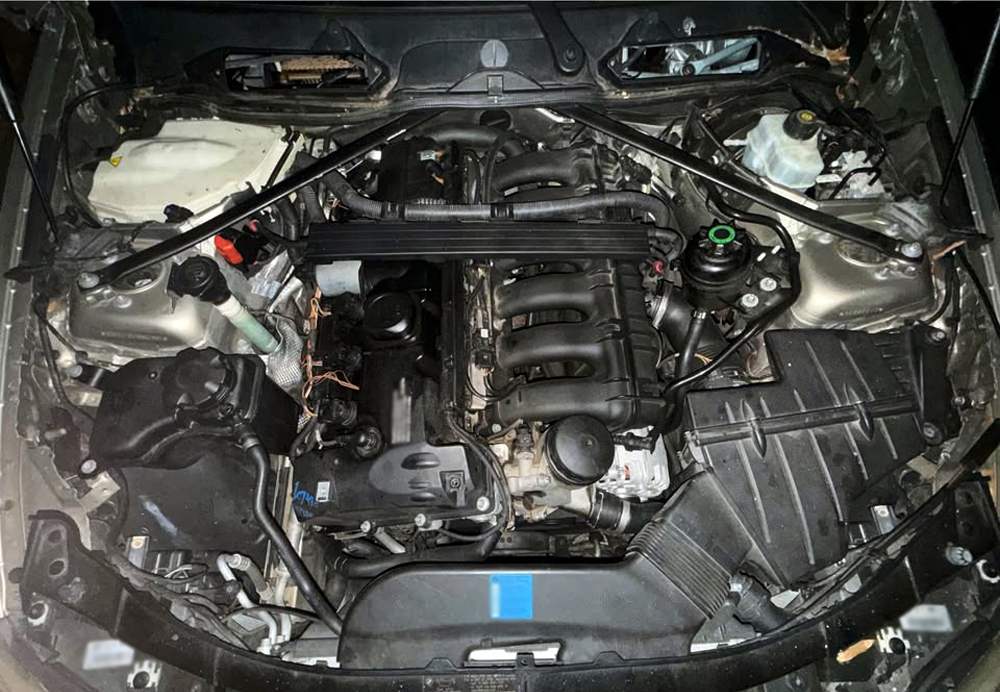
1. How BMW’s PCV system and heater work on N51 and N52 engines
Blow-by pressure, sludge, and the reason heaters exist
Combustion gases slip past the piston rings every time the engine fires. That mix carries fuel vapor, oil mist, and water vapor. Left trapped, pressure climbs inside the crankcase and pushes oil past seals.
BMW routes those gases back into the intake through the PCV system. The intake vacuum pulls vapors out of the crankcase and burns them in the cylinders. Pressure stays stable and emissions stay within federal limits.
Cold climates create a second problem. Water vapor mixes with oil and forms a thick beige sludge inside the vent hoses. Temperatures below about 14°F can freeze that sludge and block the vent path.
A blocked vent line spikes crankcase pressure fast. Oil then leaks from valve cover gaskets, front seals, and rear main seals. Early N52 engines recorded seal failures during winter operation in northern markets.
BMW added electric heaters to the vent plumbing to prevent those blockages. The critical component sits at the intake manifold. BMW calls it the blow-by heater angle connector.
That plastic elbow contains a small heating element inside a copper sleeve. The element warms the vent passage and keeps moisture from freezing. Normal current draw stays under 5 amps during steady operation.
External PCV hardware versus integrated valve cover systems
Early N52 engines used a magnesium valve cover and a fully external PCV system. The crankcase vent valve sat outside the cover. Multiple hoses carried blow-by gases between the crankcase and intake.
Several of those hoses included heaters. A relay controlled them using ambient temperature data from the DME. The heaters ran only in cold conditions.
Later engines switched to a plastic valve cover. BMW moved the PCV valve inside the cover casting. Hose routing became simpler and fewer heated parts remained.
The heated angle connector stayed in the system. That elbow sits at the intake manifold entry point. Vapors pass through it before entering the intake runners.
The electrical behavior changed as well. The heater receives full battery voltage whenever the ignition sits in ACC or ON. The circuit stays live even when the engine is not running.
| Engine generation | Valve cover material | PCV layout | Heated components | Heater control logic |
|---|---|---|---|---|
| Early N52 | Magnesium | External PCV valve and hoses | Heated suction hose, oil return hose, elbow | Relay and temperature control |
| N51 / N52N | Plastic | PCV valve integrated in cover | Heated intake elbow only | Ignition powered, always active |
Continuous power increases operating hours for the heater element. Many units remain energized during accessory mode diagnostics and key-on service work. The heater sits on a shared 30-amp circuit that also feeds oxygen sensor heaters.
2. The electrical flaw that lets the PCV heater ignite
Inside the heater element and the 30-amp circuit feeding it
Current flows into the blow-by heater through a shared high-load circuit. That line also feeds the oxygen-sensor heaters. The fuse protecting the circuit is rated around 30 amps.
The elbow heater itself uses a PTC resistor inside a copper sleeve. PTC elements increase resistance as temperature rises. Normal draw stays near 4–6 amps during steady operation.
Trouble begins when the internal resistor cracks or shorts. Current rises above normal but often stays under the 30-amp fuse limit. Heat builds inside the plastic elbow while the fuse remains intact.
Several field reports logged heater circuits pulling 15–20 amps before failure. That load stays far below the fuse rating. The plastic housing begins to soften around 230°F.
Moisture intrusion and surface tracking inside the connector
Water vapor moves through the vent hose every time the engine runs. Condensation collects inside the heater elbow during short trips. Over time the plastic housing absorbs moisture.
Some recalled parts lacked heat-stabilized plastic. That material breaks down faster under temperature cycling. Surface cracks allow conductive residue to build on the plastic shell.
Electrical current then migrates across the damp surface. Engineers call that tracking. The current creeps along the housing and creates localized heat spots.
Temperatures climb slowly instead of spiking. No fuse trips. Plastic carbonizes and becomes conductive, which feeds more current into the same hot zone.
What drivers and technicians actually see before a fire
First sign often comes from smell. Burnt plastic odor drifts from the left rear of the engine bay. The heater elbow sits near the intake manifold behind cylinder six.
Some vehicles log oxygen-sensor heater faults. Codes like P0030, P0050, or related heater-circuit faults appear in the DME. Those codes occur when the shared fuse finally blows.
Other cases show melted wiring near the elbow connector. The intake manifold may discolor or warp from heat. Repair invoices sometimes include intake replacement and harness repair exceeding $2,000.
Several documented events occurred while the vehicle sat parked with the ignition in accessory mode. The heater still receives 12-volt power in that state.
3. Recall 17V-683 begins the PCV heater fire campaign
Field fires force BMW to open a safety investigation
Reports of engine-bay fires began surfacing in North America around 2016. Investigations traced several cases to the crankcase vent heater elbow. The failures occurred on cars parked after short drives.
BMW filed the first safety campaign in late 2017. The recall carried the NHTSA identifier 17V-683. Internal reports cited moisture intrusion and heater short circuits.
The campaign covered roughly 740,000 vehicles in the United States. Production years ranged from early 2006 through late 2011. All used N51 or N52 family straight-six engines.
Most incidents began with a burning plastic odor. Heat damage appeared around the intake elbow and nearby wiring harness. Several vehicles required intake manifold replacement after the fire source melted surrounding components.
Vehicles pulled into the first recall wave
| Series / body style | Platform codes | Engine family | Production window | Notes |
|---|---|---|---|---|
| 1 Series coupe / convertible | E82, E88 | N52, N52K | Feb 2006–Dec 2011 | Mostly 128i models |
| 3 Series sedan / coupe / wagon / convertible | E90, E91, E92, E93 | N51, N52, N52K | Feb 2006–Dec 2011 | Largest affected population |
| 5 Series sedan / wagon | E60, E61, early F10 | N52, N52K | Feb 2006–Dec 2011 | 525i, 528i, 530i |
| X3 and X5 SAV | E83, F25, E70 | N52K | Feb 2006–Dec 2011 | xDrive30i models |
| Z4 roadster / coupe | E85, E86, E89 | N52, N52K | Feb 2006–Dec 2011 | Shared heater elbow design |
The heater elbow sat near the rear of the intake manifold on every listed engine. That location exposed the plastic connector to exhaust heat and moisture.
Dealer repair procedure under the first campaign
Technicians replaced the blow-by heater elbow with an updated part. The service bulletin listed part 11 61 2 458 830 for many applications. Wiring around the elbow received inspection for melting or carbon marks.
The repair also required replacing aluminum alternator bolts. Those bolts stretch during installation and cannot be reused. BMW specified new fasteners under part 12 31 2 458 831.
Owners received the first notification letters in December 2017. Parts shortages delayed many repairs until mid-2018. During the waiting period BMW advised drivers to watch for smoke or burning plastic odors.
The repair assumed defective heater batches caused the fires. The circuit design stayed unchanged, and the heater still drew power from the same 30-amp shared fuse.
4. Recall 19V-273 expands the problem after repaired cars burn again
Post-recall failures reopen the investigation
Field reports continued after the first recall repairs. Several vehicles serviced under 17V-683 later suffered the same heater meltdown. Some incidents produced smoke while the cars sat parked.
BMW reopened the engineering review in early 2019. Engineers examined failed heater elbows returned from the field. Lab tests confirmed material degradation in the plastic housing.
The plastic lacked heat-stabilized additives used in higher-temperature components. Repeated heating cycles caused micro-cracks in the connector shell. Moisture collected inside those cracks and formed a conductive film.
Current traveled across the damp plastic surface. Tracking created hot spots inside the elbow housing. Some failed units reached temperatures exceeding 392°F during bench testing.
Production ranges widened across several models
| Model family | Added production window | Estimated units | Reason for inclusion |
|---|---|---|---|
| 3 Series sedan | Early 2005–2006 N52 builds | Part of ~305,000 total portfolio | Early heater material batch |
| 5 Series wagon 530xi | Feb 2006–Feb 2007 | ~1,400 | Limited production run |
| X5 xDrive30i | Aug 2006–Sep 2011 | ~68,700 | Broader E70 range |
| Z4 roadster and coupe | May 2006–Mar 2010 | ~18,300 | Same heater connector design |
Many of these vehicles had never received the first heater replacement. Others had been repaired once and failed again. The second recall confirmed the heater material degraded faster under heat and moisture exposure.
Why replacing the elbow still left a fire path
The revised heater used improved plastic composition. BMW required dealers to install the new elbow and inspect surrounding wiring. The circuit feeding the heater remained unchanged.
The heater still drew power from the shared 30-amp oxygen-sensor circuit. A moderate short could raise current without blowing the fuse. Heat then concentrated inside the elbow housing.
Vehicles repaired under the earlier recall still carried the same electrical architecture. A heater pulling 18 amps could cook the plastic connector for minutes without tripping the fuse.
5. Recall 22V-119 adds a fuse and finally fixes the circuit
Fires on repaired cars force a third recall
Fire reports continued after the first two recalls. Several vehicles repaired under 17V-683 or 19V-273 later suffered heater failures again. Investigators documented at least six confirmed engine-bay fires between 2019 and 2021.
BMW engineers revisited the circuit design. The heater element sat on a shared high-current line. The fuse protected the entire circuit, not the heater itself.
A heater short drawing 15–20 amps stayed under the fuse rating. The plastic elbow heated slowly while the fuse stayed intact. Engineers concluded the circuit lacked localized protection.
BMW filed a new safety campaign in March 2022. The recall carried the identifier 22V-119 and covered about 917,000 vehicles.
The inline fuse retrofit that stops the thermal chain
The repair strategy shifted from part replacement to circuit protection. Technicians install a new wiring harness containing a 7.5-amp inline fuse. That fuse isolates the heater from the main 30-amp circuit.
The heater now sits behind its own low-current protection. A short or resistor failure immediately blows the fuse. Current stops before the plastic elbow overheats.
The heater may still fail electrically. The fuse interrupts power within milliseconds. A blown 7.5-amp fuse leaves the heater disabled but prevents thermal runaway.
What technicians replace during the final repair
Dealer inspection begins at the intake elbow. Technicians check for melted plastic, wiring damage, or char marks around the heater connector. Vehicles without heat damage receive the fuse harness retrofit.
Units with heat damage require additional parts. The heater elbow, intake manifold, and sections of wiring harness may be replaced. Aluminum alternator bolts are replaced again during reassembly.
| Model group | Chassis codes | Engines | Production range |
|---|---|---|---|
| 1 Series | E82, E88 | N51, N52K | Nov 2007–Oct 2013 |
| 3 Series | E90, E91, E92, E93 | N51, N52, N52K | Feb 2005–Oct 2013 |
| 5 Series | E60, E61 | N52, N52K | Jan 2005–Dec 2009 |
| X3 SAV | E83 | N52K | Apr 2006–Aug 2010 |
| X5 SAV | E70 | N52K | May 2006–Mar 2010 |
| Z4 | E85, E86, E89 | N52, N52K | Apr 2005–Aug 2011 |
The retrofit leaves the heater functional but protected by a dedicated fuse. The new circuit limits heater current to 7.5 amps.
6. Don’t confuse it with the newer BMW starter fire recalls
Different engines, different hardware, different decade
The PCV heater recalls target older E-series BMWs. Those cars use naturally aspirated N51 and N52 inline-six engines. Production spans roughly 2005 through 2013.
Starter fire recalls hit a different generation. Those cases involve newer G-series and late F-series vehicles. Engines include the turbocharged B48 four-cylinder and B58 inline-six.
The failure point also changes location. PCV heater fires begin near the intake manifold. Starter failures occur at the bellhousing where the starter motor mounts.
Warning behavior drivers actually report
PCV heater failures usually begin with a plastic smell. Smoke appears from the rear of the engine bay near cylinder six. Oxygen sensor heater codes sometimes follow when the shared fuse fails.
Starter recall cases behave differently. Drivers report intermittent no-start conditions. The starter may crank slowly or stay energized after the engine fires.
Heat builds near the starter housing. Smoke appears under the vehicle near the transmission tunnel. Some failures damaged wiring and starter relays.
| Feature | PCV heater recall 22V-119 | Starter recall campaigns |
|---|---|---|
| Main component | Blow-by heater elbow | Starter motor and relay |
| Engine families | N51, N52, N52K | B48, B58 |
| Model years affected | ~2005–2013 | ~2019–2025 |
| Typical warning signs | Burning plastic, intake smoke | No-start, hot starter |
| Primary repair | Inline fuse harness | Starter and relay replacement |
Both recall groups carry the same safety warning. Park the vehicle outside until repairs occur. The two failures originate in separate electrical systems.
7. What actually happens in the workshop during the recall repair
Checking recall history before touching the engine
Technicians start with the VIN in BMW’s AIR system. The database lists open campaigns and prior recall work. Codes for 17V-683, 19V-273, and 22V-119 appear together for many vehicles.
Next comes a physical inspection. Mechanics check the alternator mounting bolts. Earlier recall repairs replaced the original bolts with aluminum stretch bolts marked with blue paint.
Unpainted bolts signal the engine likely never received the earlier repair. Painted bolts confirm prior recall work. The heater elbow and nearby wiring still require inspection.
Old plastic parts breaking during access
Most N52 engines now exceed 10 years of service. Heat cycles harden plastic intake boots and vacuum fittings. Removal of the intake duct often cracks aged hoses.
Vacuum leaks show up after reassembly. Rough idle and lean mixture faults appear within minutes. DME codes like P0171 and P0174 are common when a hose splits.
Smoke testing the intake system usually finds the leak. The test fills the intake with low-pressure vapor. Any crack reveals itself within seconds.
Labor time and parts technicians deal with
BMW assigns the recall repair flat-rate codes. Operation 00 65 790 applies when the vehicle arrives for recall only. The repair takes about 8 to 12 FRU depending on model.
Some vehicles need extra parts if heat damage exists. Intake manifolds and wiring harness sections raise repair costs quickly. A damaged intake on an N52 often adds $600 to $900 in parts alone.
Mobile service programs handled some earlier recall waves. BMW reimbursed mobile repairs at 150 percent of standard FRU time. The heater elbow sits behind the intake manifold near cylinder six.
8. Safety rules, emissions law, and what owners must do now
Federal recall law and dealer restrictions
Federal safety law blocks dealers from selling cars with open recalls. The rule sits under the National Traffic and Motor Vehicle Safety Act. Violations can trigger civil penalties per vehicle.
Private sales often bypass this rule. Used BMWs change hands with open recalls still active. Buyers then inherit the fire risk tied to the heater circuit.
BMW dealers must complete the recall free of charge. Parts and labor fall under the safety campaign. That policy remains active regardless of vehicle age or mileage.
Emissions compliance and registration limits
Some states treat the PCV heater as an emissions component. California enforces that rule through the Air Resources Board. Dealers must provide proof of correction after the recall repair.
The certificate uses form SD92-084. The document confirms the emission recall work was completed. Missing paperwork can delay registration renewal.
The PCV system routes blow-by gases back into the intake stream. Any blocked or disabled system raises hydrocarbon emissions. Emissions violations can trigger a failed smog inspection.
The real risk of ignoring the recall
Heater failures often begin with a blown oxygen sensor heater fuse. The shared circuit powers multiple O2 heaters. When the fuse blows, the DME logs heater faults across several sensors.
Codes often include P0030, P0050, or similar heater-circuit faults. Drivers sometimes replace sensors without tracing the PCV heater short. The real failure remains in the heater elbow.
A heater short that avoids blowing the fuse can melt surrounding parts. Intake manifolds and engine wiring harnesses sit inches from the heater connector. Harness replacement on an N52 can exceed $3,000.
Sources & References
- BMW 22V-119 Recall: Stop Your BMW N52 Engine From Catching Fire | FCP Euro
- Part 573 Safety Recall Report 22V-119 | NHTSA
- BMW PCV Valve Recall Includes More Than 917,000 Vehicles …
- BMW Recall 22V-xxx: Positive Crankcase Ventilation (PCV) Valve Heater – nhtsa
- RECALL 17V-683: POSITIVE CRANKCASE VENTILATION … – nhtsa
- Recall Quarterly Report 22V-119 – nhtsa
- Consumer Alert: Important BMW Park Outside Recall for Fire Risk | NHTSA
- Part 573 Safety Recall Report 19V-273 | NHTSA
- 22V-119 PCV Heater Recall – What’s the fix? : r/BmwTech – Reddit
- BMW Recall: PCV Valve Heater Shorts Causing Fire Hazard – RepairPal
- RECALL 17V-683: POSITIVE CRANKCASE VENTILATION (PCV) VALVE HEATER – nhtsa
- Part 573 Safety Recall Report 17V-683 | NHTSA
- RECALL 17V-683: POSITIVE CRANKCASE VENTILATION (PCV) VALVE HEATER – nhtsa
- Recall 17V-683: Positive Crankcase Ventilation (PCV) Valve Heater BMW AG is conducting a Voluntar – nhtsa
- Nearly 200,000 BMW Cars Recalled For Potential Fire Risk – Men’s Journal
- BMW Recalls Nearly 1 Million Cars For Valve Heater That Could Catch Fire – TFLcar
- Safety Recall – Positive Crankcase Ventilation (pcv) Valve Heater – M5POST – BMW M5 Forum – F90 – Bimmerpost
- All 2025 BMW Recalls By Model – CarBuzz
- BMW Recalls 87,394 U.S. Cars Over Starter Overheating Fire Risk
- Recall alert: NHTSA says park 200K BMWs outside due to fire risk – HITS 96.5
- Another 87,000 BMWs Recalled Over Engine Starters That Can Catch Fire – Autoblog
- BMW recalls nearly 90000 vehicles over engine starter fire risk – Fox Business
- What is the PCV valve heater recall? – BMW 3-Series (E90 E92) Forum – Bimmerpost
- New PCV Recall!! for e90 n52 – BMW 3-Series (E90 E92) Forum – Bimmerpost
- Recall 22V-119 – XBimmers.com | BMW X6 Forum X5 Forum – Bimmerpost
Was This Article Helpful?