
Smoke trails from the tailpipe. Coolant vanishes. Misfires kick in. The Fusion stumbles like it’s lost compression, then throws a random misfire code. Mechanics chase hoses, sensors, thermostats, anything but the block itself.
The real failure sits lower. Ford’s open-deck EcoBoost engines, especially the 1.5L and 2.0L, warp under heat and hammer coolant straight into the cylinders. Cracked bridges, crushed gaskets, and coolant intrusion wreck engines before 100,000 miles.
This guide breaks it down. Which Fusions are hit hardest. What 17S09, 19B37, 21N12, 22-2134, and 25SA4 actually cover. How Ford responds, when they pay, when they stall. And what steps still exist if your engine’s already circling the drain.
1. Why the Fusion leaks from inside the block, not outside the hoses
Open-deck blocks, slitted bridges, and how they crush the gasket
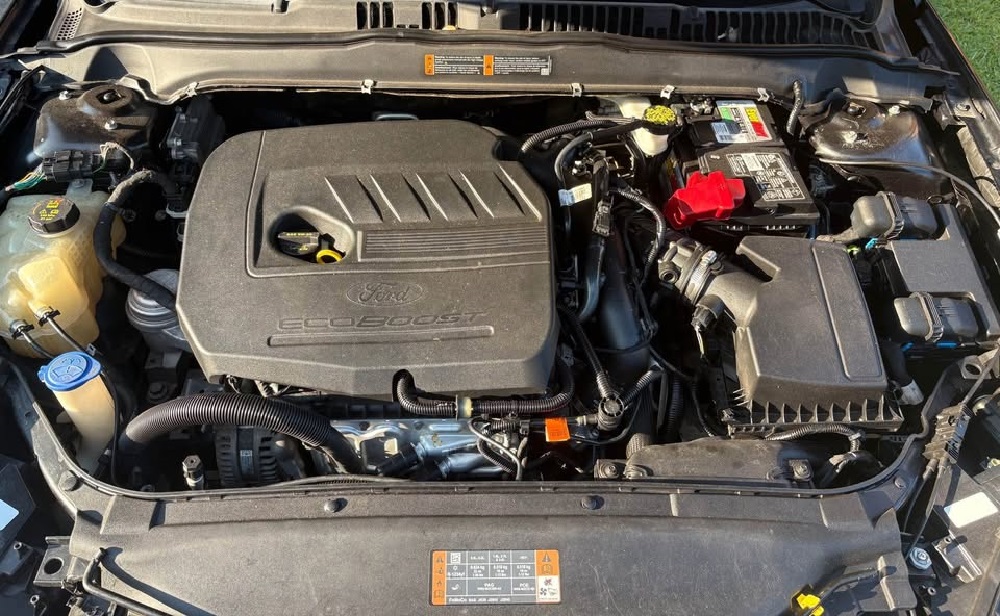
The 1.5L and 2.0L EcoBoost engines in the Fusion came with an open-deck aluminum block. Instead of thick solid material around the cylinders, Ford machined thin bridges between the bores, then added slits across those bridges to improve cooling. That design turned out fragile under boost.
Cylinder pressures climb fast in turbocharged engines. Add GDI combustion heat and thermal cycling from daily shutdowns, and those slitted bridges start flexing.
Over time, that flex crushes the fire ring in the head gasket. Once the seal breaks, coolant doesn’t just seep, it gets forced straight into the combustion chamber.
Later versions switched to a closed-bridge casting. But early Fusion builds ran slitted decks for years, especially in the 2014–2019 range. That’s the weak spot: thin aluminum that warps under stress and opens a direct coolant path into the cylinder.
What owners see: misfires, steam, and missing coolant
Internal coolant loss leaves no puddle. Most owners don’t notice until the coolant tank runs low for the second or third time. First signs show up at startup. Cold misfire. Damp white smoke out the tailpipe. Engine smooths out after warmup. That’s early-stage coolant intrusion burning off pooled fluid from the night before.
It escalates fast. Once a cylinder takes on too much, it starts misfiring under load. The car may stall, trigger a limp mode, or flash P0300–P0304 codes. Shops chase sensors, coils, or injectors, because there’s no obvious leak. Meanwhile, the real damage spreads inside the block.
This pattern fools both owners and techs. External leaks like a bad water pump or cracked reservoir leave a trail. Internal intrusion leaves guesswork until compression drops or the coolant boils off completely.
The 1.6L fire setup and how Recall 17S09 rewired the warning system
The 1.6L EcoBoost in early Fusions took a different path. That engine didn’t just misfire, it caught fire. The head would overheat in one corner, crack under pressure, and push oil onto the red-hot exhaust manifold. Fires broke out while driving or after shutdown.
Ford’s answer was Recall 17S09. It didn’t involve structural fixes. Dealers added a new coolant level sensor, updated the PCM and cluster software, and built in an “overheat strategy” that cut power and flashed messages if coolant ran low.
No new head. No stronger block. Just more warnings. While programs like 17S09 and 21N12 focused on detection and mitigation, CSP 19B37 introduced a proactive preventive measure.
By reprogramming the PCM to run the electric water pump and cooling fans after shutdown, Ford aimed to eliminate the ‘heat soak’ that causes thermal stress on the slitted bridges, directly addressing the issue of gasket degradation before failure occurs.
2. Which Fusion engines qualify and which got left out
Where each EcoBoost sits and which ones drop coolant first
Ford split the Fusion lineup across several engines. The base models ran the 2.5L Duratec, which isn’t part of the coolant crisis. Everything below is EcoBoost.
The 1.6L launched first, found in 2013–2014 models, mostly SE trim. It’s the only one with an official safety recall, but for fires, not engine failure.
The 1.5L took over in 2014 and ran through 2019. Most SE and mid-trim cars got this engine. These blocks carried the slitted-deck flaw that triggered widespread coolant intrusion. They saw multiple CSPs and TSBs, but no safety recall.
The 2.0L was paired with Titanium and Sport trims, running from 2013 to 2020. It shares the same open-deck design and intrusion failures as the 1.5L, but never received a CSP, only TSBs, leaving owners stuck with warranty limits or full-price repairs.
The 2.3L, used briefly in later models and shared with the Mustang/Lincoln MKC, got swept into a separate recall for block heater fire risk. These were tied to external leaks, not gasket failure.
Only the 2020 2.0L closed-bridge block is considered structurally improved. Anything earlier runs the risk.
What Ford offered by engine, year, and VIN range
| Engine & MY range | Primary failure pattern | Ford action type | Program / ID | Typical remedy |
|---|---|---|---|---|
| 1.6L EcoBoost 2013–2014 | Head overheat, cracking, oil on exhaust, fires | Safety recall | 17S09 / 17V209 | Coolant level sensor, PCM & cluster update |
| 1.5L EcoBoost 2014–2016 | Coolant intrusion, white smoke, misfire, stall | CSP + TSB | 19B37, 21N12, 19-2139 | PCM reflash, short-block replacement if intrusion proven |
| 1.5L EcoBoost 2017–2019 | Same as above with later build blocks | CSP (narrow VIN/time) | 19B37, 21N12 | PCM reflash, revised short block under time/mileage cap |
| 2.0L EcoBoost 2013–2018 | Coolant intrusion, white smoke, no-start/stall | TSB only (no CSP) | 19-2346, 22-2134 | Long-block replacement if under powertrain/ESP coverage |
| 2.0L/2.3L 2019–2020 w/ block heater | External heater leak, under-hood fire while parked | Safety recall | 25SA4 / 25V685000 | Heater element & cord replacement, stop-use instruction |
| 2.0L EcoBoost 2020 revised block | Structurally improved deck, much lower risk | Standard warranty only | Later design (no special program) | Normal repairs; no known structural coolant-intrusion fix needed |
Why VIN filters matter more than model year
Ford didn’t always apply coverage across an entire model year. Both 19B37 and 21N12 filter by VIN build date and powertrain warranty start, not just calendar year. Some 2017–2019 1.5L Fusions were excluded despite showing textbook intrusion signs.
The 2.0L fared worse. TSBs are only honored inside warranty. If your Fusion’s powertrain clock ran out, Ford won’t cover the long block, even with identical failure symptoms.
No VIN lookup, no help. Owners who bought used or missed Ford mailers often found out too late, usually after the engine gave up.
3. How Ford’s coolant-leak fixes actually work (and when they don’t)
What Recall 17S09 really fixed and what it didn’t touch
17S09 was triggered by fire risk in the 1.6L EcoBoost, not gasket failure. Ford didn’t redesign the head or improve cooling flow. Instead, they added a coolant level sensor to catch low volume early and rewrote the PCM to force limp mode before the head cracked.
A jumper harness tied the sensor into the dash cluster. Software updates brought new warnings, reduced throttle response, and overheat failsafe logic. That combo gave drivers more time to pull over, but if coolant loss still went unchecked, the damage continued.
Engines that had already overheated or cracked before the recall weren’t covered for repairs. Ford’s position was clear: the recall added protection moving forward. Any past damage was on the owner.
CSP 19B37 and the shutdown heat it tried to bleed off
The 1.5L EcoBoost was prone to “heat soak” after shutdown. When the key turned off, coolant stopped moving, but heat in the head kept climbing. That spiked temps near the gasket’s sealing surfaces, especially around the slitted bridges.
CSP 19B37 changed that. Ford reprogrammed the PCM to run the electric water pump and cooling fans for several minutes after engine shutdown. That post-run bleed dropped deck temps and slowed down the gasket crush cycle.
But it was only preventive. If a block had already started warping or showed signs of coolant loss, this update didn’t fix anything. No parts changed. No gasket replaced. No deck reinforced.
CSP 21N12: the narrow window for a free short block
21N12 came two years later. It extended coverage for 1.5L engines to 7 years or 84,000 miles from warranty start. If coolant intrusion was confirmed, Ford paid for a short block, once.
But there were catches. Owners had to complete 19B37 first. If the car missed that update or the software wasn’t showing as done in Ford’s system, 21N12 wouldn’t trigger. That blocked secondhand buyers, late claimants, and anyone who ignored the 19B37 notice.
Miss the mileage limit by 100 miles or the deadline by one week, and the claim was denied, regardless of failure severity.
2.0L TSBs: long blocks only if you’re still under warranty
Ford never gave 2.0L Fusion owners a CSP or extended warranty. Only TSBs, specifically 19-2346 and 22-2134, outlined how to handle coolant intrusion. The fix was a complete long block, not just a short block.
If the car was under the 5-year/60,000-mile powertrain limit or an active Extended Service Plan, Ford would approve the swap. But if the car was outside that window, the owner got the bill.
Dealers followed a VIN-triggered protocol. No warning letter. No goodwill exception. No override if the TSB matched the failure but the coverage expired.
Here’s how Ford split the repairs by engine and program:
| Engine / issue | Ford program type | ID(s) | Hardware/software action | Extra warranty? |
|---|---|---|---|---|
| 1.6L overheat/fire | Safety recall | 17S09 / 17V209 | Add coolant sensor, reflash PCM/cluster | Recall is time-unlimited |
| 1.5L intrusion | CSP + TSB | 19B37, 21N12, 19-2139 | PCM overheat logic, short-block replacement | 7 yrs / 84k (21N12) |
| 2.0L intrusion | TSB only | 19-2346, 22-2134 | Long-block replacement if under warranty | No special extension |
| 2.0L/2.3L block heater | Safety recall | 25SA4 / 25V685000 | Heater/cord replacement, no-use advisory | Recall is time-unlimited |
Why 2.0L owners feel boxed out
The 2.0L shares the same slitted-deck flaw and failure pattern as the 1.5L, but Ford treated it differently. No CSP. No warranty bump. Only a technical bulletin.
That gap left thousands of Fusion Titanium and Sport owners stuck with $7,000–$11,000 engine quotes, even when Ford’s own bulletins called the failure pattern “known.”
Dealers followed protocol. If the warranty had lapsed, the answer was no. No override, no escalation. Just a dead car and a repair bill that exceeded its Blue Book value.
4. Catching coolant intrusion before the engine gives up
DTCs that flag coolant in the cylinders
Coolant intrusion doesn’t hide forever. It starts with light misfires that clear up after warm-up, then shows up as full-on stumble under load. When the PCM flags a problem, these are the codes Fusion techs see the most:
| DTC | Meaning | How it ties to coolant intrusion |
|---|---|---|
| P0300 | Random misfire | Multiple cylinders intermittently wet with coolant |
| P0301–P0304 | Misfire cylinder 1–4 | Points to the worst-affected bore |
| P0316 | Misfire on startup (first 1,000 revolutions) | Coolant pooling in cylinder overnight, burned off at start |
| P0217 | Engine overtemperature condition | Coolant volume low from ongoing loss |
| P1285/P1299 | Cylinder head overtemperature / overheat | PCM using CHT sensor to trigger failsafe strategy |
Relative compression tests show imbalance on wet cylinders after sitting overnight. Misfire counters spike in the first 30 seconds, then drop off once the coolant burns out. Scans with IDS or ForScan help flag which bores are dropping power before the block fully lets go.
How pressure tests and borescopes confirm the failure
Cold pressure testing tells more than a hot drive cycle. Techs pressurize the cooling system to 15–20 psi, then wait. No visible drip? Doesn’t matter. If pressure drops and the reservoir empties without a trace, it’s time for a borescope.
Pull the spark plugs. The cylinder that’s steam-cleaned will look like polished aluminum, no carbon, no oil film, just a silver piston top. That’s where the coolant’s coming in.
One clean piston and a cold misfire code is usually enough for Ford warranty review or CSP approval. Even without a puddle, that’s direct proof of intrusion.
Why these blocks rarely get rebuilt
Once the head comes off, the failure shows up fast. Bridges between the cylinders are often cracked. Gasket fire rings are blown out sideways or heat-cycled into failure. In some cases, coolant paths eroded into the bore wall.
Shops rarely try to salvage the block. Ford doesn’t spec machining or repair for slitted-deck engines. The only fix is a factory short block or long block, and that’s if you catch it in time. Miss the warranty or CSP cutoff, and it’s full price with reused turbos, sensors, and emission gear unless you pay to swap it all.
Skip any reuse step, and the new engine may inherit the same problems that ended the last one.
5. External heater recalls and the parked-fire threat
How coolant in the cord sparked fires before the engine even started
Recall 25SA4 (NHTSA ID 25V685000) was officially issued in October 2025 after reports of parked fires.
This safety recall affects 2019–2020 2.0L and 2.3L EcoBoost models, specifically addressing the risk of short circuits in the engine block heater when the vehicle is plugged in. The issue originated from block heaters on certain 2019–2020 2.0L and 2.3L EcoBoost models.
The heater element could crack, leaking coolant into the power cord socket. Once coolant reached the pins, it shorted across the terminals, overheated the connector, and ignited surrounding wiring. Fires didn’t need the engine running, just a live outlet and a cracked heater core.
Drivers often spotted burn marks near the lower grille, puddles with a chemical sheen under the bumper, or smelled scorched plastic and coolant after unplugging the car.
Ford’s fix replaced both the element and the cord. No changes were made to the engine, but the recall was logged as a full safety risk. As with 17S09, this one doesn’t expire and doesn’t depend on mileage.
Why Ford recalls some cooling failures and sidelines others
Internal coolant leaks cause stalls and misfires. External heater leaks start fires while the car’s off. That split matters.
Regulators only require a safety recall when there’s a direct risk of injury or fire. The 1.5L and 2.0L head gasket failures didn’t meet that threshold, at least on paper. They stalled engines. They ruined blocks. But they didn’t light cars on fire in dealer lots.
So Ford gave the block heater leak full recall status and left the gasket problems under CSP or TSB handling. The same cooling system, two very different risk labels.
The result? Heater recalls cover late-model Fusions with no mileage cap. Gasket CSPs get denied after 84,000 miles, even with identical techs doing the teardown.
6. Lawsuits, pressure, and why Ford’s strategy may backfire
Miller v. Ford claims recalls were too little, too late
The class-action lawsuit Miller et al. v. Ford Motor Company argues that Ford knew the slitted open-deck blocks were fatally flawed years before any program launched.
Plaintiffs say Ford chose low-cost software patches and narrow CSPs over redesigns or full safety recalls, leaving most owners exposed when their engines failed outside coverage.
The suit points to stalling, limp mode, and loss of power as safety defects, not durability problems. It also highlights Ford’s internal data trails: tech bulletins, service patterns, and warranty denials that suggest long-term awareness of the failure rate.
The case is headed to a jury trial set for June 15, 2026. If successful, Ford could be forced into expanded warranty terms, reimbursement for past repairs, and compensation for diminished resale value on affected Fusions.
Fusion owners looped into wider EcoBoost litigation
The Miller case isn’t the only fight. Multiple suits have pulled in Fusion, Escape, Edge, MKC, and Mustang owners who share the same EcoBoost engine architecture.
Some focus on the 1.5L and 2.0L, others on the 2.3L, which uses the same slitted-deck layout. Claims include breach of warranty, concealment of material defects, and violations of consumer protection laws.
These suits borrow tactics from earlier engine defect settlements like the Hyundai/Kia Theta II and GM 2.4L Ecotec cases, both of which led to court-ordered buybacks, extended warranties, and large cash payouts.
Owners tracking their repairs, parts invoices, and denied claims may have a better shot at future settlement relief if those lawsuits expand.
How these programs shape Fusion resale and trade value
Fusion values took a hit. Dealers and auctions flag coolant-intrusion history. Any car with white smoke, startup misfires, or an open CSP code gets low-balled, or passed over entirely.
But not all coverage claims drag value down. A Fusion with a completed 21N12 short block or a dealer-installed 2.0L long block often fetches more than a low-mile original-engine car. Buyers know the fix is done and the risk is buried.
Cars with denied coverage or partial repairs, 19B37 done but no engine, are the worst hit. Many get dumped at wholesale, flipped at small lots, or unloaded with vague ads claiming “just needs head gasket.” Most don’t. They need a full engine.
7. What to know if you’re keeping, or buying, a Fusion post-failure
Owning a high-risk Fusion with no coverage left
If your 2013–2018 Fusion still runs and you’re out of warranty, coolant checks need to become routine. Check the reservoir with every fuel fill. Don’t wait for the light, by then, the gasket’s likely gone.
Pressure test anytime the level drops without a clear leak. Shorten oil intervals. The EcoBoost runs hot, and once the coolant breaks down, thermal cycling gets worse. Don’t run extended drain intervals on a block already known for head gasket crush.
Avoid towing and steep high-speed grades if possible. And never shut the engine off immediately after a hard drive in hot weather, heat soak starts the minute coolant flow stops.
After the engine swap: what’s changed and what hasn’t
Ford’s revised blocks dropped the slitted-deck bridges. The updated 1.5L and 2.0L replacements use thicker, closed-bridge castings with drilled coolant channels. Gasket clamp strength is higher, and warp risk is lower. That’s the good part.
What didn’t change: GDI still carbon loads the valves. Turbo heat still cooks oil. And coolant still matters more than most owners think. Miss one reservoir check or stretch one oil change too far, and you can still lose a new engine to heat damage or turbo failure.
Even post-replacement, it’s smart to borescope every 30,000 miles, run annual pressure tests, and flush coolant early, not late.
Which used Fusions are safe to buy and which to avoid
| Fusion profile | Coolant-risk rating | Why it lands in that tier |
|---|---|---|
| 2020 2.0L with documented revised closed-bridge block | Low | Newest casting, no widespread intrusion pattern, normal warranty |
| 2017–2019 1.5L with 19B37 + 21N12 short block completed | Lower-medium | Revised short block, but same basic EcoBoost stress environment |
| 2013–2018 2.0L with documented long-block TSB replacement | Medium | Fresh long block, but no extra warranty; still turbo GDI heat |
| 2014–2018 1.5L with 19B37 done but no 21N12 engine yet | High | Software-only protection, original slitted block still in service |
| Any 2013–2019 EcoBoost Fusion with white smoke / misfires | Very high | Classic coolant-intrusion symptoms; likely needs a full engine |
Start with the VIN. Check owner.ford.com or NHTSA.gov/recalls. Ask for OASIS printouts. Scan the car for P0300, P0316, and coolant temp codes. Look for white smoke at startup and fresh coolant on the dipstick.
If a seller says ‘just needs a thermostat,’ walk. If they say ‘head gasket’s an easy fix,’ run. If there’s no record of 19B37 or 21N12 on a 1.5L, you’re likely buying someone else’s imminent engine failure.
Sources & References
- Ford Fusion Coolant Leak Recall: Essential Facts and Actions – Lemon Law Firm
- Consumer Class Action Lawsuit Against Ford
- Ford Ecoboost Engine Coolant Leaks – Lieff Cabraser
- Ford Facing Another Lawsuit For Alleged Engine Problems – CarBuzz
- Ford 1.5 & 2.0 EcoBoost Engine Problems – YouTube
- Recall Information – Ford Recalls | Ford Owner Support
- Recall – Ford
- Ford Recall: Engine Cylinder Head Overheats And Leaks Oil – RepairPal
- 17S09 – Coolant Level Sensor System Installation – 2013-2015 Ford – Ford | PDF – Scribd
- Ford Fusion Engine Coolant System Recall – Asbury Automotive Group
- Ford Coolant Engine Defective Class Action Lawsuit | Sacramento Attorney
- Ford Owners Sue for Overheating Engine Issues | The Truth About Cars
- technical service bulletin – Opinion corp
- What build date or model year did the 2.0L Ecoboost change to the coolant intrusion engines? – Reddit
- 2.0 ecoboost engine. How to know if you have the revised block from the outside? : r/fordfusion – Reddit
- Ford coolant class action lawsuit : r/fordescape – Reddit
- 2019 Escape SE 1.5L White Smoke out of Exhaust on Startup : r/fordescape
- This is Why the Ford 1.5L 1.6L 2.0L and 2.3L Ecoboost Engines are Gulping Coolant!
- Customer Satisfaction Program 21N12 Certain 2017-2019 Model Year Fu – NHTSA
- TECHNICAL SERVICE BULLETIN 1.5L EcoBoost – Low Coolant, White Exhaust Smoke And/Or Illuminated MIL – Built On Or Before 10-Jun-2019 20-2100 – NHTSA
- TECHNICAL SERVICE BULLETIN 2.0L EcoBoost – Coolant … – NHTSA
- Customer Satisfaction Program 19B37 – Supplement #4 – NHTSA
- Customer Satisfaction Program 19B37 – Supplement #3 – NHTSA
- Screwed by Ford for coolant intrusion : r/fordescape – Reddit
- Coolant intrusion 2018 : r/fordescape – Reddit
- Coolant intrusion opinions wanted : r/fordescape – Reddit
- Customer Satisfaction Program 19B37 – Supplement #2 – NHTSA
- Struggling with Ford Denying Help for Known 1.5L EcoBoost Engine Coolant Intrusion — Need Advice – Reddit
- Customer Satisfaction Program 21N12 : r/fordescape – Reddit
- Anyone have a 2.0L Ecoboost with coolant intrusion? : r/fordfusion – Reddit
- 2017 Fusion, 2.0L Coolant Intrusion : r/fordfusion – Reddit
- TECHNICAL SERVICE BULLETIN 2.0L EcoBoost – Coolant In Cylinders, White Exhaust Smoke And/Or Illuminated MIL 19-2346 – NHTSA
- Engine failure at 44k miles on 2018 Escape due to known coolant intrusion issue : r/fordescape – Reddit
- Bought 1 week ago, found out it has coolant intrusion : r/fordfusion – Reddit
- 2015 Ford Fusion coolant intrusion, Suggestions : r/fordfusion – Reddit
- What years had the coolant intrusion issue on the 2.0 EcoBoost? : r/FordEdge – Reddit
- Ecoboost Coolant Intrusion – Page 2 – Ford Motor Company Discussion Forum
- ORDER signed by District Judge Dale A. Drozd on 09/04/25 GRANTING 37 Motion to Dismiss IN PART AND DENYING IN PART – Justia
- Find Existing Ford Fusion Car Recalls – Dealer Rater
- Recall of some 2019-2020 Fusion models.”The engine block heater may crack and develop a coolant leak…” – Reddit
- 59,000 Fords, Lincolns Recalled for Underhood Fire Risk – Cars.com
- Ford Recalls 59,000 Vehicles For Fire Risk Due To Short Circuit – CarBuzz
- Ford Recalls 60,000 Vehicles for Fire Risk Linked to Block Heater – Autoguide.com
- Fords Recalled Due to Fires – Fixed Ops – Auto Dealer Today
- Ford Recalls Check By VIN
- TECHNICAL SERVICE BULLETIN 1.5L EcoBoost – Low Coolant, White Exhaust Smoke And/Or Illuminated MIL – Built On Or Before 06-Apr-2019 19-2139 – NHTSA
Was This Article Helpful?