
Fire it up, hear that uneven five-cylinder thrum, then the idle stumbles and the light pops. That’s how the GM 3.7 starts to go.
From 2007 to 2012, the LLR Vortec 3700 made 242 hp and 242 lb-ft in the Colorado, Canyon, H3, and i-370. Bigger bore than the 3.5, same long stroke, chain-driven cams with exhaust VVT. Good torque on paper.
In real use, timing chains stretch, heads leak oil pressure, valve seats lose seal, and P0017 keeps coming back. Same code, different issue.
This guide calls out what fails, what the codes really mean, and when repair makes sense.
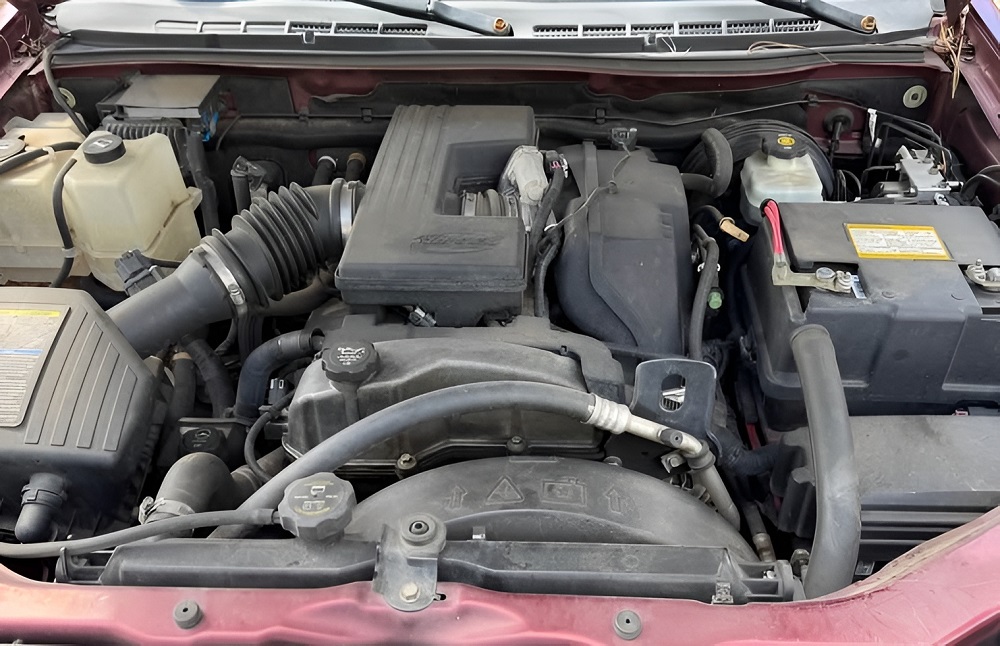
1. The LLR architecture and why this inline-5 was a built-in compromise
Bigger bore, same long stroke, higher load on the head
Bore grew to 95.5 mm. Stroke stayed at 102 mm. Displacement landed at 3.7 liters, 3,654 cc, with a 10.0:1 compression ratio.
The block and head use A356 aluminum. Dual overhead cams run off a primary timing chain. Exhaust cam carries variable valve timing.
Power peaks at 242 hp at 5,600 rpm. Torque hits 242 lb-ft at 4,600 rpm. Oil capacity is 6.0 quarts of 5W-30, and the VVT system depends on clean flow through small control passages.
That longer stroke raises piston speed and side loading. Higher thermal load follows, especially in slow, heavy use.
Same engine, different stress in a 4,700 lb H3
Colorado curb weight sits around 3,900 to 4,200 lb. H3 pushes near 4,700 lb before gear. Add larger tires and lower aero efficiency, and the engine works harder at every throttle tip-in.
Tow ratings reach 6,000 lb in some trims. Sustained load keeps coolant temps near 210–220°F. Oil temps climb higher under towing or sand use.
High-load duty shortens timing-chain life. It also magnifies head sealing and valvetrain oil-pressure problems. Heat and vibration stack up fast in the heavier platform.
| Spec | Value | Mechanical impact |
|---|---|---|
| Displacement | 3.7 L (3,654 cc) | Higher piston speed at same rpm |
| Bore x Stroke | 95.5 mm x 102.0 mm | Long stroke increases rod angle stress |
| Compression | 10.0:1 | Tight knock margin under heat |
| Output | 242 hp / 242 lb-ft | Adequate in Colorado, strained in H3 |
| Oil capacity | 6.0 qt 5W-30 | Critical for VVT and chain tensioners |
Atlas modularity shared parts with 2.9L and 4.2L variants. That kept costs down. It also meant the 5-cylinder carried balance shafts, long chains, and more rotating mass than a basic truck V6.
2. Cylinder head failures that end compression and oil pressure
Porous castings and lifters that collapse at idle
Cast the head at Castech and porosity becomes the wild card. Microscopic voids form in oil drain and valvetrain rail areas. Pressurized oil leaks internally instead of feeding the hydraulic lash adjusters.
Hot idle oil pressure drops. Lifters tick from the top end. Leave it long enough and valve lift falls off, which triggers P0300 random misfire at idle.
Technicians confirm with a stethoscope and a manual lash adjuster check. A soft lifter compresses by hand when oil pressure has leaked away through the casting.
Valve seat recession and idle misfire traps
Watch idle shake at 650 rpm while cruise feels smooth. That pattern points toward intake valve sealing loss. The seat recedes into the aluminum head and the valve fails to close fully.
Leak-down testing confirms the fault before parts get ordered. Once the head comes off, machine inspection decides the path forward. Most full cylinder head jobs on an LLR land between $2,000 and $4,000 after labor, gaskets, torque-to-yield bolts, and machining are included.
Bent valves after head work
Install the head without locking cam timing and valves meet pistons. The Atlas setup requires precise cam flat alignment at TDC. Miss that and the engine starts with a dead hole.
A fresh head can show the same misfire as the old one. Compression stays low because a valve stem bent during install never seals. Cylinder head bolts torque to 22 lb-ft plus 155 degrees, and skipping angle torque risks clamp failure.
| Symptom | Mechanical fault | DTC pattern |
|---|---|---|
| Ticking at hot idle | Lash adjuster oil leak | None or P0300 |
| Idle-only misfire | Intake valve seat recession | P0300 |
| Low compression after head job | Bent valve from timing error | P0300, single cylinder |
| Coolant loss with no leak | Porous head casting | Overheat, misfire |
Run a low-pressure leak-down test before replacing coils. Cylinder sealing determines whether the problem lives in aluminum or ignition parts.
3. Timing chain stretch and the P0017 code that defines this engine
Long chain, heavy load, slow drift out of sync
Run the LLR past 100,000 miles under load and chain wear shows up. The primary chain drives both cams. A secondary chain spins the balance shafts.
Chain pitch grows as pins and bushings wear. Cam timing retards a few degrees at a time. The PCM flags P0017 when crank and cam signals drift more than 16.31 degrees out of correlation.
Cold starts rattle for one to two seconds. Idle hunts at 650 rpm. Left alone, the chain can jump a tooth and end compression instantly.
Early warning signs before hard failure
Watch for intermittent P0017 with no clear engine complaint. Some trucks run fine at highway speed and only stumble at stoplights. The code may clear and return over weeks.
Scan data shows cam desired vs. actual angle drifting apart. Exhaust cam may lag several degrees at idle. Oil pressure often reads normal, which misleads diagnosis.
Once rattle starts on every cold start, wear is advanced. Full timing service runs $1,500–$2,500 depending on labor and parts quality.
Sensor swaps that waste money
Replace crank or cam sensors first and the code often comes back. P0017 signals mechanical correlation loss more often than electrical failure. Sensor faults throw P0335 or P0340, not persistent correlation errors.
Proper check sets cylinder #1 at TDC. Cam flats must align within spec using a straightedge. If flats sit off plane, the chain has stretched beyond tolerance.
| Code | Primary trigger | Mechanical risk |
|---|---|---|
| P0017 | Crank/cam correlation error | Chain stretch or tooth jump |
| P0014 | Exhaust cam over-advanced | Stuck phaser or oil control fault |
| P0340 | Cam sensor circuit fault | Electrical or harness issue |
| P0335 | Crank sensor circuit fault | Stall or no-start |
Ignore repeated P0017 and piston-to-valve contact becomes possible if the chain skips under load.
4. VVT solenoid clogging and cam phaser control failure
Dirty oil slows the exhaust cam and sets hard codes
Feed this engine dirty 5W-30 and the VVT system reacts first. The exhaust cam phaser uses pressurized oil to advance or retard timing. Oil flows through a fine mesh screen in the actuator solenoid.
Sludge blocks that screen. Cam response lags behind PCM commands. The result shows up as P0014 or repeat P0017 at idle and light throttle.
Scan data reveals desired cam angle moving while actual angle sticks. Solenoid bolts torque to 89 lb-in, and overtightening can crack the housing.
Sticking phaser that mimics chain stretch
Hear a brief rattle at startup and assume chain wear. A worn or sticking cam phaser makes the same noise. Oil drains out overnight and the rotor slaps until pressure builds.
Low-end torque feels weak below 2,000 rpm. Idle may dip to 550 rpm and surge. Replace the solenoid first if screens show debris.
If phaser internals wear, full timing service becomes necessary. Parts and labor often cross $2,000 when chains, guides, and phaser all get replaced.
| Symptom | Likely VVT fault | Typical DTC |
|---|---|---|
| Rough idle with no chain noise | Restricted solenoid screen | P0014 |
| Startup rattle, clears warm | Phaser rotor wear | P0017 |
| Sluggish throttle under load | Delayed cam advance | P0014 |
| Code returns after sensor swap | Mechanical cam control issue | P0017 |
Oil change intervals beyond 7,500 miles under towing accelerate screen blockage and phaser wear.
5. Sensor dropouts and ground faults that fake mechanical failure
Crank sensor failures that feel like a jumped chain
Lose crank signal for a split second and the engine dies. The CKP sensor feeds RPM data to the PCM. No signal means no spark and no injector pulse.
Stalls often happen hot, after 20 to 30 minutes of driving. Restart may require a cool-down period. P0335 may store, but some dropouts leave no code.
Scan data shows RPM falling to zero while the engine still spins. A failing CKP costs $50 to $150 in parts, but misdiagnosis can lead to unnecessary timing work.
Cam sensor noise and limp behavior
Cam sensor errors throw P0340. The PCM struggles to confirm cylinder phase. Fuel sync shifts and idle goes rough.
Under load, power drops and throttle response slows. The PCM may default to a backup strategy with fixed cam timing. That limits torque and raises exhaust temps.
Heat-soaked harnesses near the exhaust manifold cause intermittent faults. Resistance checks and harness inspection matter before replacing hard parts.
Corroded ground combs and phantom codes
Factory ground combs on early Colorado and H3 models corrode. Poor contact injects electrical noise into sensor circuits. The PCM reads unstable cam or crank signals.
Rough idle and false P0017 can follow. Voltage drop across ground points should stay under 0.1 volts during cranking. Higher readings point to poor chassis bonding.
Replace the comb with individual eyelets and clean metal contact. Ignore it and random codes return no matter how many sensors get replaced.
| Symptom | Mechanical suspect | Electrical suspect |
|---|---|---|
| Sudden stall, no restart | Chain jump | CKP dropout |
| Idle surge with timing code | Chain stretch | Cam sensor noise |
| No-start after hot soak | Severe mechanical failure | CKP thermal failure |
| Repeating random codes | Timing misalignment | Corroded grounds |
Chasing sensors without testing grounds wastes hours and pushes repair bills past $1,000 before the real fault gets touched.
6. Balance shafts, harmonics, and vibration that damages the rest of the engine
Inline-5 rocking couple and why GM added twin shafts
Spin an inline-5 and it rocks end to end. The firing order creates a primary rocking couple. Vertical second-order forces ride along at higher rpm.
GM installed two counter-rotating balance shafts inside the block. They spin at twice crank speed. At 6,000 rpm engine speed, shafts approach 12,000 rpm.
Those shafts ride on dedicated bearings fed from the main oil gallery. Wear there leaks oil pressure and adds deep lower-end rattle.
Balance shaft bearing wear and oil pressure loss
Hear a dull knock low in the block at hot idle. Oil pressure dips below 15 psi at 650 rpm. The dash light may flicker after long highway runs.
Worn balance shaft bearings leak oil internally. That reduces supply to cam phasers and chain tensioners. VVT response slows and timing codes follow.
Replacing shafts requires full teardown. Labor alone often exceeds 15 hours, pushing total repair above $2,500.
Harmonic balancer failure and timing stress
Inspect the front harmonic balancer after 120,000 miles. The rubber isolator cracks and separates. Torsional vibration increases as damping fades.
Excess vibration stresses the timing chain and guides. Sensor signals can show noise spikes at certain rpm bands. Replace the balancer before rubber separation throws the outer ring off center.
A new balancer runs $150 to $300 in parts. Ignore it and chain wear accelerates under sustained load.
| Component | Failure mode | Resulting symptom |
|---|---|---|
| Balance shaft bearing | Excess clearance | Low hot idle oil pressure |
| Balance shaft delete | Increased vibration | Mount and accessory wear |
| Harmonic balancer | Rubber separation | Chain and sensor stress |
| Shaft chain tensioner | Wear or slack | Rattle at low rpm |
Run the engine with failing balance hardware and vibration loads transfer straight into the timing system and engine mounts.
7. Cooling system weak points that warp heads fast
Plastic radiator tanks that split under heat
Run an H3 in traffic at 95°F and watch coolant temps hover near 220°F. The factory radiator uses plastic end tanks crimped to an aluminum core. After 80,000 to 120,000 miles, those tanks crack at the seams.
Coolant loss starts slow. A sweet smell shows up after shutdown. Low coolant triggers hot spots around exhaust valve seats.
Overheat this aluminum head once and it can warp beyond spec. Head flatness tolerance sits around 0.004 inches across the surface.
Thermostat failures that spike temperature fast
The thermostat targets roughly 190–203°F. When it sticks closed, temp climbs past 240°F in minutes. The dash gauge may lag while the head soaks heat.
Aluminum expands faster than iron. Head gasket clamping load drops as temperature rises. Combustion gases enter the cooling system and push coolant out.
A thermostat costs under $50. Ignore overheating and a head job runs $2,500 to $4,000.
Heavy platform heat load in H3 use
The H3 weighs near 4,700 lb before cargo. Larger tires raise effective gearing and engine load. Sustained throttle keeps coolant and oil temps elevated.
Fan clutch wear reduces airflow at low speed. Electric fan controls can lag during stop-and-go traffic. Heat cycles fatigue the head casting over time.
| Symptom | Likely cooling fault | Mechanical consequence |
|---|---|---|
| Slow coolant loss | Radiator tank crack | Head hot spots |
| Rapid temp spike | Stuck thermostat | Warped aluminum head |
| Bubbling reservoir | Combustion gas intrusion | Head gasket failure |
| Overheat under load | Weak fan clutch | Valve seat distortion |
Run the LLR past 250°F even once and permanent head distortion becomes likely.
8. Recalls, platform defects, and which years age better
Fuel module water intrusion and sudden stalls
Check 2009 build trucks for fuel system recall history. NHTSA campaign 09V154000 covers a porous RTV seal at the fuel pump control module. Water enters the module and shorts the circuit board.
Hard start shows up first. Then random stall at idle or cruise. In some cases, the engine cranks but never fires.
The fix replaces or reseals the module. Ignore it and stall risk stays live in wet climates.
Shift cable recall that mimics engine failure
Review 2011 trucks for recall 11V337000. The transmission shift cable clip can misadjust. The key may release while the transmission sits out of Park.
The truck may roll. Owners sometimes blame the engine when it refuses to restart. The issue sits in the shifter linkage, not the LLR itself.
Repair involves cable inspection and clip replacement. No engine parts fix that condition.
Which years age better in the real world
Scan owner data and service history from 2007 forward. Early 2007–2008 trucks generated more head and timing complaints in the field. By 2009–2012, early casting failures show up less often in shop records.
Component revisions happened during the Atlas run. Exact material changes aren’t always documented in public records. Timing chains, phasers, and cooling parts still age the same across all years.
Service history outweighs badge year. Oil change gaps and overheating events matter more than build date.
| Year range | Field pattern | Risk at 120,000+ miles |
|---|---|---|
| 2007–2008 | Higher early head and timing complaints | Elevated if no head or chain work |
| 2009 | Fuel module recall exposure | Moderate if recall completed |
| 2010–2012 | Fewer early casting reports | Timing wear still common |
Any LLR past 150,000 miles without documented timing service carries increased risk for chain elongation and phaser failure.
9. Maintenance strategy that keeps an LLR alive past 150,000 miles
Short oil intervals protect chains and phasers
Run 5W-30 and keep it clean. The oil life monitor often stretches changes to 7,500 miles. In towing, idling, or short-trip use, cut that to 3,000–5,000 miles.
Dirty oil clogs VVT solenoid screens. Sludge slows chain tensioners and raises startup rattle. Cam timing drift begins long before a hard P0017 sets.
Six quarts cost less than a phaser. Full timing service runs $1,500 to $2,500.
Proactive timing inspection before codes stack
Inspect cam correlation data by 100,000 miles. Watch desired versus actual cam angle at hot idle. A steady 2–4 degree lag signals wear starting.
Listen for cold-start rattle longer than two seconds. Check for guide debris in the oil pan during service. Replace chains, guides, and tensioners before a tooth jump.
Wait for a hard fault and valve-to-piston contact becomes possible. A skipped chain can turn a running engine into a full rebuild in one event.
Cooling system refresh before heat warps aluminum
Replace radiator and thermostat by 100,000–120,000 miles in heavy use. Flush coolant every 50,000 miles under severe duty. Inspect fan clutch engagement at operating temp.
Monitor for reservoir bubbling under throttle. Test for combustion gases if overheating occurred. Aluminum heads tolerate little abuse past 240°F.
Ignore cooling maintenance and head replacement costs climb to $3,000 or more.
| Service item | Conservative interval | Failure risk if ignored |
|---|---|---|
| Engine oil & filter | 3,000–5,000 miles severe duty | Chain and phaser wear |
| Timing inspection | 100,000 miles | P0017, chain jump |
| Radiator & thermostat | 100,000–120,000 miles | Head warp |
| Coolant flush | 50,000 miles severe duty | Corrosion, hot spots |
An LLR with documented oil, timing, and cooling work can clear 200,000 miles. One that misses those windows often faces a $4,000 repair before 160,000.
Sources & References
- 3.7-Liter Engines | GM, GMC, Isuzu & Chevrolet Motors For Sale
- Remanufactured Chevrolet Engines – Page 10 of 38 – Powertrain Company
- Chevy Colorado: The Last Inline-Five Pickup Truck – CarBuzz
- Turbo Kit T3/T4 Charger for L52 LLR 3.5/3.7 04-12 Colorado Canyon H3 I350 I370 L | eBay
- 2007 HUMMER H3 Review & Ratings – Edmunds
- Why is the inline-5 unpopular with manufacturers? (When compared to the v6) – Reddit
- Balance shaft – Wikipedia
- КОДЫ ОШИБОК OBD 2 ===расшифровка и решение проблем=== – Chevrolet TrailBlazer & Chevrolet Tahoe Club
- Fits: 2007-2010 HUMMER H3 3.7L 3700 L5 LLR VORTEC ENGINE RE-RING REBUILD KIT
- CHEVY COLORADO – Auto-Brochures
- 2007 Chevrolet COLORADO (3.7L 5 -cyl Engine Code [E] E) Motor Oil, Filters and Lubricants – AMSOIL
- 2012 Chevrolet Colorado Oil Change
- 2009 HUMMER H3T Review & Ratings – Edmunds
- Your Guide To 5 Engine Problems In The 2009 Chevy Colorado …
- Hummer H3 Reliability and Common Problems – In The Garage with …
- Service Bulletin INFORMATION – nhtsa
- What do I owe if mechanic did $2300 of repairs and didn’t fix the problem? – Reddit
- GM Issues Fix for Ticking Noise in 2025 Chevrolet and GMC Trucks – Autoblog
- Exactly how reliable are the first gen colorados/GMC Canyons? : r/chevycolorado – Reddit
- History of the Hummer H3 | Ultimate Rides
- Condition/Concern Recommendation/Instructions – nhtsa
- Condition/Concern Recommendation/Instructions – nhtsa
- 11 OBDG07 Engine Diagnostics
- Chevy P0017 CAM/Crankshaft Position Correlation – Denlors Auto Blog
- P0340 Code: Camshaft Position Sensor “A” Circuit Malfunction – In The Garage with CarParts.com
- Symptoms of a Bad Crankshaft Position Sensor – Auto Parts at AutoZone
- Balance Shaft Caution on 2004-2012 GM 3.5 & 3.7L DOHC Engines
- Timing Chain Kit Water Oil Pump For Chevrolet GMC Hummer Isuzu 2.9L 3.7L 07-11 – eBay
- Timing Chain Kit Water Oil Pump For 07-11 Chevrolet GMC Hummer Isuzu 2.9L 3.7L | eBay
- 2007 Hummer H3 – Schwarttzy.com
- Balancer Shaft Design for Twin Cylinder Engine | PDF | Gear | Stress (Mechanics) – Scribd
- Atlas 4/5cyl Balance Shaft Delete Kit 2.8/2.9/3.5/3.7L 2004-12 | Badland Industries
- Temporary Fix for Crankshaft Position Sensor (Most Complete Guide in 2025) – CFSensor
- HOW TO TEST CRANKSHAFT POSITION SENSOR WITH A MULTIMETER – YouTube
- Chevy Colorado Maintenance Schedule | Sid Dillon Chevrolet-blair Inc
- World’s Best Oils & Filters for 2009 Chevrolet Trucks Colorado – AMSOIL Synthetic Oil
- Recall Bulletin
- 2010 Chevrolet Colorado Owner Manual M – Experience GM
- 2011 GM Light Commercial Body Application Guide 10-18-2010 – Scribd
- Why do people prefer V6 engines over turbocharged 4 cylinders? : r/whatcarshouldIbuy
- NPR 2013noacatalogforprintout | PDF | Cylinder (Engine)
- NOA YEAR 2012 CATALOG: Index – NPR OF AMERICA, INC.