
The dash flickers, relays click, and the Jeep Compass refuses to start. Even a new main battery may not fix it. A weak auxiliary battery can disrupt starting, trigger multiple warnings, and leave you stuck.
The trouble is that a failing battery, a normal stop/start restriction, and a charging fault can show similar signs. Replacing parts without testing both batteries can waste hundreds of dollars.
This guide explains what causes these problems, how to spot a failing auxiliary battery, what repairs cost, and how to prevent another no-start.
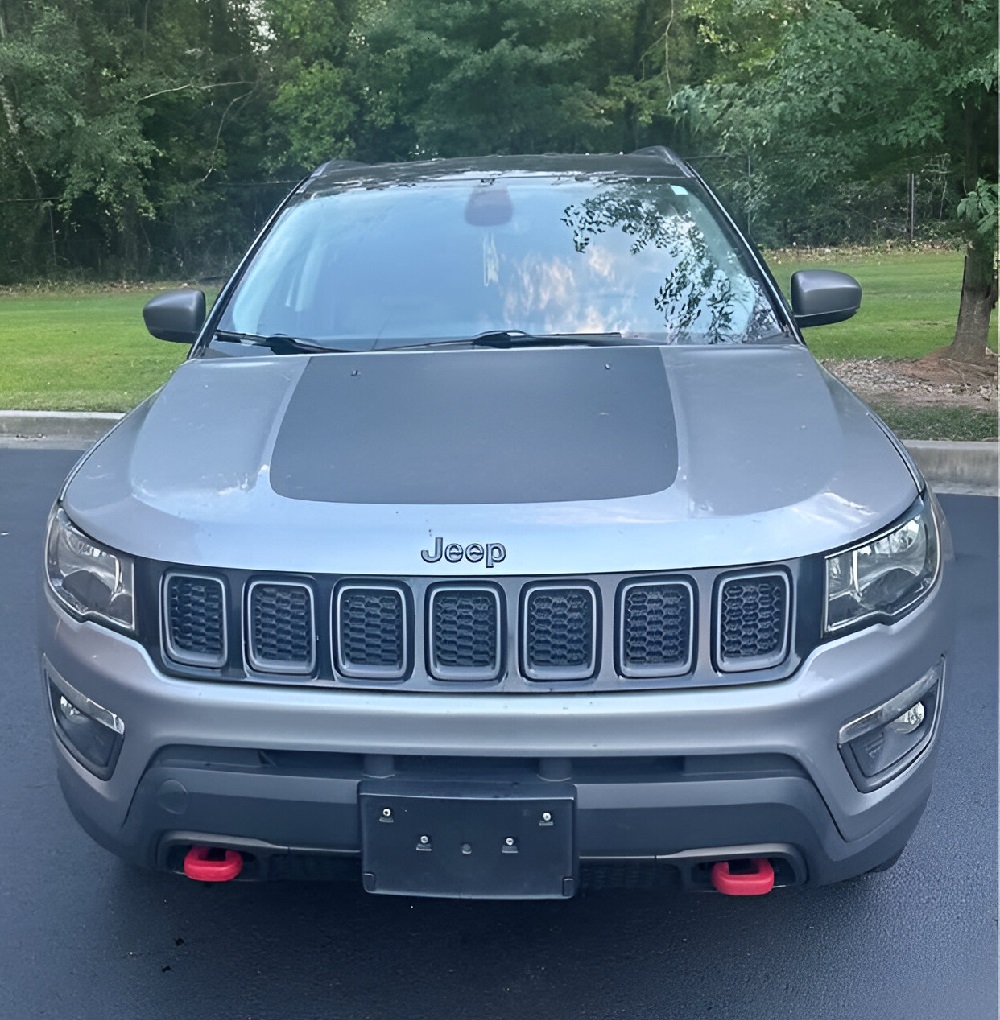
1. Know Which Compass Battery Setup You’re Dealing With
Not Every Compass Has the Same Two-Battery Layout
The dual-battery setup applies to second-generation Jeep Compass models equipped with Engine Stop/Start (ESS). It starts with the redesigned 2017 Compass and extends through applicable 2026 models. The older Compass, also sold during 2017, uses a different electrical layout.
On the MP-generation Compass, the main 12-volt battery sits under the hood, behind the left headlamp. A smaller auxiliary battery sits below or beside the main battery assembly. Access often requires removing the main battery and nearby mounting hardware.
Battery size also varies by configuration. Earlier ESS models commonly use H5/Group 47 AGM main batteries, while some applications take H6/Group 48. Check the VIN, engine, and original battery labels before ordering replacements.
The Small Battery Has a Bigger Job Than It Looks
The main battery supplies the heavy current needed to crank the engine. The auxiliary battery helps maintain power to control modules during certain starting and stop/start events. Both use 12-volt AGM construction, but their capacities differ sharply.
A Power Control Relay (PCR) connects or separates the batteries when commanded. During starting checks and ESS restarts, it can isolate the main battery from the auxiliary supply. Stellantis uses that separation to evaluate the auxiliary battery on its own, because a healthy main battery would otherwise mask a weak auxiliary.
The auxiliary battery therefore matters even when automatic engine stops are disabled. If its voltage collapses during a starting check, the Powertrain Control Module (PCM) can lose power and reset. Stellantis documents this behavior under P00FD, the Battery B state-of-charge performance fault.
An Intelligent Battery Sensor (IBS) monitors battery current, voltage, and temperature. Mounted at the negative battery connection, it helps the vehicle estimate charge and decide when ESS can operate.
The IBS measures battery condition but doesn’t switch the batteries. That job belongs to the PCR, making the relay, battery cables, and auxiliary supply separate points to test.
2. When Stop/Start Warnings Signal Real Battery Trouble
A Battery Charging Message Doesn’t Always Mean Failure
“Stop/Start Not Ready” or “Battery Charging” can appear while your Compass starts and runs normally. The message often means the Engine Stop/Start (ESS) feature hasn’t met its operating conditions.
Low battery charge can block automatic stops. So can extreme battery temperatures, heavy air conditioning, full defrost, or an open hood. Stellantis service guidance lists battery charge, battery temperature, air conditioning demand, defrost, and an open hood among the conditions that keep automatic stops from happening.
Battery charge requirements also change with temperature. Stellantis guidance S1408000384 Rev. J, released in March 2026, gives these examples: roughly 65% charge at 77°F and up to 80% at 32°F. These aren’t fixed limits for every Compass calibration.
A charging message alone doesn’t prove the auxiliary battery is defective. If the engine starts normally, check battery charge and ESS conditions before replacing parts.
Clicking Relays and Flickering Displays Are More Serious
Trouble becomes harder to ignore when the starter clicks and the dashboard begins resetting. Interior lights may flicker, the engine may crank slowly, or the Compass may refuse to start.
Several warnings can appear together, including “Service Stop/Start, ” “Service Shifter, ” and stability-control messages. Low voltage can disrupt multiple control modules during startup. Those warnings don’t automatically mean each module has failed.
Stellantis documented this pattern in S2008000075, released June 25, 2020. The case covers no-start conditions following jump-starts or limited driving that left both batteries undercharged.
The bulletin also identifies P00FD, a Battery B state-of-charge performance fault. During certain starting checks, auxiliary supply voltage near 8 volts can reset the Powertrain Control Module (PCM). The PCM then disables ESS.
A red battery charging warning that stays illuminated while the engine runs needs separate attention. It can signal inadequate charging from the alternator or related wiring. Safely stop and arrange service rather than assuming the auxiliary battery caused it.
A Jump-Start Can Get You Moving Without Fixing the Fault
A dead Compass may restart with an external 12-volt power source. That proves outside power helped the starting circuit. It doesn’t identify which battery failed.
Jeep’s 2021 Compass manual specifies a 12-volt source and an engine-ground connection away from the discharged battery. Follow the exact jump-start procedure for your model year. Never jump-start a frozen battery because its case could rupture or explode.
Once the engine starts, the alternator may begin charging both batteries. However, a short drive might leave them undercharged, especially after a deep discharge. A damaged battery may also fail to hold the charge it receives.
Repeated jump-starts call for separate tests of the main and auxiliary batteries. The charging circuit also needs checking if either battery keeps going flat. A successful restart doesn’t establish that either battery can hold enough charge overnight.
3. How One Weak Battery Can Leave Both Batteries Dead
A Damaged Auxiliary Battery Can Pull Down the Main Battery
The Jeep Compass connects its 2 batteries through the Power Control Relay (PCR). When connected, they share electrical power. A badly damaged auxiliary battery can draw current from the healthier main battery.
A shorted cell creates a stronger drain than a battery that has simply lost capacity. The faulty cell can pull the shared voltage down while the Compass sits parked. By morning, the main battery may lack enough power to crank the engine. Stellantis doesn’t describe overnight drain as a routine failure mode, but it does list a faulty auxiliary battery among the causes of P00FD.
Still, an aging auxiliary battery doesn’t always drain the main battery. Both can lose charge from short trips, long parking periods, or electrical loads that remain active. Repeated deep discharge also promotes sulfation, which reduces the battery’s ability to accept and hold charge.
A battery with severe sulfation may remain weak even after extended charging. Testing each battery separately helps distinguish lost capacity from an internal fault. If both pass, the shop needs to check charging performance and current draw while parked.
Turning Off Stop/Start Won’t Protect a Failing Battery
Pressing the ESS OFF button stops automatic engine shutdowns during that drive. It doesn’t disconnect the auxiliary battery or change the factory wiring.
The main and auxiliary batteries remain part of the vehicle’s electrical circuit. A shorted auxiliary cell can still draw power whenever the batteries are connected. Turning off ESS won’t repair that cell or restore lost battery capacity.
The factory stop/start setting also returns after the next ignition cycle. Drivers who dislike automatic stops must normally press the button again after restarting.
Disabling ESS may reduce automatic restart events, but that doesn’t establish longer battery life. If your Compass keeps going flat with ESS disabled, both batteries still need separate testing. A measured overnight current draw can then reveal whether power is leaving the batteries while the vehicle is parked.
4. Test Both Batteries Before Spending Money on Repairs
Test Each Battery Alone or Risk a False Result
The Jeep Compass has 2 batteries that can affect each other’s test readings. A healthy main battery may hide a weak auxiliary battery while both remain connected. Testing them together can miss the actual fault.
Stellantis service case S2008000075 calls for disconnecting both negative cables when testing the auxiliary battery. For the main battery, the auxiliary ground must be isolated. If equipped with an Intelligent Battery Sensor (IBS), disconnect its electrical connector before removing the negative cable.
Each battery needs a separate test with the correct AGM setting. The report should show its rated cold-cranking amps (CCA), measured performance, and final test result. Poor contact at the tester clamps can also produce a false failure reading.
A result of “Charge and Retest” means the battery needs charging before a final decision. Replacing it immediately could waste money. A battery that fails again after proper charging has a stronger case for replacement.
Why 12 Volts Doesn’t Prove a Battery Is Healthy
A fully charged AGM battery typically reads around 12.6-12.8 volts after resting. Temperature, battery design, and recent charging can change that reading.
A worn battery can show normal voltage with no load. Once the starter draws heavy current, its voltage may collapse. A voltmeter alone won’t reveal how much cranking power the battery has left.
Voltage also drops during normal engine cranking. Seeing less than 12 volts during a start doesn’t automatically mean failure. The technician needs a load test and voltage readings captured during the fault.
Running voltage needs careful interpretation, too. The Compass uses controlled charging, so one alternator voltage reading cannot prove a charging fault. The shop must check the specified charging conditions and power delivery to both batteries.
These Fault Codes Point to Different Repairs
| Fault code | What it means | What to check first |
|---|---|---|
| P00FD | Battery B state-of-charge performance | Auxiliary battery, fused supply, cables, and PCR |
| B2193 | IBS internal fault | Reset the IBS and check whether the code stays active |
| U113E | Lost communication with IBS | Sensor power, fuse, connector, and LIN wiring |
| P2AF5 / P2AF6 | Starter Relay 3 stuck on or off, shown as Starter Relay C on some scan tools | Auxiliary charge, battery connections, and relay circuit |
A basic OBD-II reader may miss Body Control Module (BCM) faults and battery charge data. A scan tool with access to those readings can separate battery faults from sensor communication failures.
For B2193, Stellantis advises resetting the IBS through its 2-way connector. After restarting, the technician checks whether the fault remains active after about 30 seconds. A persistent active code can justify replacing the sensor.
U113E requires a different check. A loose connector, blown IBS fuse, or damaged LIN wire can interrupt communication. Stellantis specifies checking sensor power and LIN activity before condemning the IBS.
The latest warning concerns unnecessary relay and power-distribution repairs. Stellantis communication 9100652 Rev. 1, dated October 14, 2026, covers 2024-2026 Compass models. It warns that a depleted auxiliary battery can trigger misleading P2AF5 and P2AF6 faults.
The referenced procedure, S2508000031 Rev. A, calls for checking auxiliary battery charge and secure connections before replacing hardware. Like other Stellantis service documents, neither publication authorizes automatic warranty replacement.
A weak AUX14 battery can therefore lead to an unnecessary power-distribution center replacement. Its charge and cable connections need verification before the shop condemns the relay circuit.
5. Replace the Right Battery Without Wasting Money
Match the AGM Battery Before Ordering a Replacement
The Jeep Compass auxiliary battery commonly uses the AUX14 size. It’s a 12-volt AGM battery with roughly 12 to 14 amp-hours (Ah) of capacity, depending on the supplier. Many replacements carry a 200 cold-cranking amp (CCA) application rating.
Battery size alone doesn’t guarantee a proper fit. The replacement must match the terminal layout, mounting points, and electrical requirements. A similar-looking motorcycle battery may have the wrong terminals or capacity.
The main battery needs the same care. Several earlier ESS-equipped Compass models use an H5/Group 47 AGM battery. Other configurations require H6/Group 48 or different specifications.
Check the VIN and factory battery requirements before buying. Replacing an AGM battery with a standard flooded battery can leave the charging setup mismatched to the required battery type.
Replacing Both Batteries Isn’t Always Necessary
A dead auxiliary battery doesn’t automatically mean the main battery needs replacement. If the main battery is recent, holds a full charge, and passes testing, keeping it makes sense.
Replacing both becomes more reasonable when they fail separate load tests. The same applies when both have suffered repeated deep discharge. An older main battery with marginal cranking performance may also be nearing replacement.
A battery that merely needs charging deserves another test before being condemned. One with a shorted cell or failed capacity test needs replacement.
Ask the shop for separate test results showing each battery’s measured performance. The repair order should identify which battery failed and which was only discharged. Replacing a healthy $280 main battery adds cost without fixing the original fault.
What Jeep Compass Battery Replacement Actually Costs
Interstate’s listed U.S. prices provide a useful comparison as of November 2026.
| Battery | Listed parts price | Coverage |
|---|---|---|
| Interstate MTX-AUX14 | $174.95 | Auxiliary AGM battery |
| Interstate MTX-47/H5 | $279.95 | Main AGM battery, where specified |
| Both batteries | $454.90 | Combined parts cost |
These prices exclude labor, testing, taxes, and any applicable core charges. They also don’t establish fitment for every Compass model year.
Access adds labor because the auxiliary battery sits beneath or beside the main battery assembly. Removing the main battery and surrounding hardware takes more work than a typical battery swap.
Corroded terminals, loose grounds, damaged cables, or a faulty Power Control Relay (PCR) can raise the bill further. Those faults require separate testing and repair.
An itemized quote should separate battery replacement from electrical diagnosis. The $454.90 example covers only the 2 batteries, with no installation or fault diagnosis included.
6. Why Stop/Start May Stay Disabled After New Batteries
The Battery Sensor Needs Time to Learn the New Charge Level
A fresh battery doesn’t always clear the “Stop/Start Not Ready” message immediately. The Intelligent Battery Sensor (IBS) must update its estimate of battery charge.
Stellantis guidance S1408000384 Rev. J, released in March 2026, explains this learning period. For combustion-engine vehicles without external charging, the procedure calls for 1 engine start followed by 2-4 hours of undisturbed sleep.
After external charging, charge-state learning can take up to 2 days. During this time, ESS may remain disabled even when the engine starts normally.
The learning period doesn’t recharge a weak battery. If the starter still cranks slowly, both batteries need testing. Clearing fault codes also won’t restore lost battery capacity.
Charging Through the Wrong Connection Can Confuse the Sensor
The IBS measures current flowing through the main battery’s negative connection. That information helps the vehicle estimate how much charge enters or leaves the battery.
Connecting a charger directly to the negative battery post can bypass this measurement. The battery may receive a charge that the sensor doesn’t fully account for.
Use the specified vehicle ground connection when charging. The charger’s positive lead goes to the approved positive connection, following the model-year instructions.
A new battery doesn’t automatically require a new IBS or a paid battery-registration procedure. The sensor should be replaced only when testing confirms a fault.
If ESS remains unavailable after the learning period, check for active sensor and communication faults. A persistent B2193 or U113E requires diagnosis of the IBS, its power supply, connector, and LIN wiring.
7. Why Fresh Batteries Can Still Leave Your Compass Stuck
A Bad Charging Circuit Can Drain New Batteries
New batteries can temporarily hide a charging fault. Once their stored power runs low, the Compass may refuse to crank again. Replacing them a second time won’t fix poor charge delivery.
The technician should verify charging at both batteries while the engine runs. The test must account for the vehicle’s controlled alternator output and current electrical load. A voltage-drop test can reveal resistance in the positive cables and ground connections.
Loose terminals, damaged battery cables, and poor grounds can restrict charging current. High-current fuses and their connections also need inspection. A terminal can look clean while corrosion or a loose joint creates resistance underneath.
The Power Control Relay (PCR) and its connections deserve attention if one battery charges while the other remains low. Fuse locations and ratings vary by model year. Don’t replace the alternator until testing confirms inadequate charging output.
Overnight Battery Drain Needs a Different Test
A Compass that starts normally after charging but dies overnight may have an unwanted electrical draw. This becomes more likely when both batteries pass their load tests.
Modern vehicles draw some current while parked. Control modules need time to shut down after the ignition turns off. Opening a door or waking the vehicle during testing can give a false reading.
The technician should measure current after the vehicle enters its sleep state. If the draw remains excessive, circuit testing can help locate the source. Aftermarket accessories, faulty relays, and modules that stay awake are possible causes.
Short trips can also leave the batteries undercharged without any abnormal overnight draw. For a Compass driven infrequently, an AGM-compatible smart maintainer can help preserve battery charge. Connect it through the approved charging points so the IBS can track charging current.
A maintainer cannot repair a shorted battery cell or stop unwanted electrical loads. If a fully charged Compass keeps going flat while parked, the shop needs a measured sleep-state current draw and the circuit responsible.
Sources & References
- STAR Case S2008000075: No Start, Start Stop Inoperative, Cluster Messages to Service Shifter
- STAR Case S1408000384 Rev. J: IBS State of Charge Inaccurate, Battery Charging Message
- Service Communication 9100652 Rev. 1: False P2AF5 and P2AF6 Fails, 2024-2026 Jeep Compass
- STAR Case S2508000031 Rev. A: No Crank, No Start, Start Stop Inoperative
- 2026 Jeep Compass Owner Handbook – Mopar
- P2AF5 Code Meaning: Starter Relay C Stuck On
- Interstate MTX-AUX14 AGM Auxiliary Battery, 12 Ah
- Interstate MTX-47/H5 AGM Automotive Battery, Group H5, 650 CCA
- 2018 Jeep Compass Battery Replacement – Shop by Group Size and Type
- NAPA The Legend Premium AGM Battery, BCI No. 400, 200 CCA
- Installing New Aux and Main Battery, 2017.5-2023 Jeep Compass
- How to Disable Auto Start/Stop on Any Jeep