
Flares off the line, shudders mid-throttle, then locks into limp mode with no warning. That’s the pattern. Mitsubishi’s Jatco CVTs may hit fuel targets, but heat, slip, and old fluid tear them down fast.
Most failures start quiet, light surging, soft ratio errors, and end with pressure loss or belt scoring that ends drive entirely.
This guide cuts through dealer doublespeak and parts-cannon guesses. Which Outlander years are trouble. What the codes mean. Where the 6-speed and PHEV setups hold up. And how the Outlander really compares when pushed past 100,000 miles.
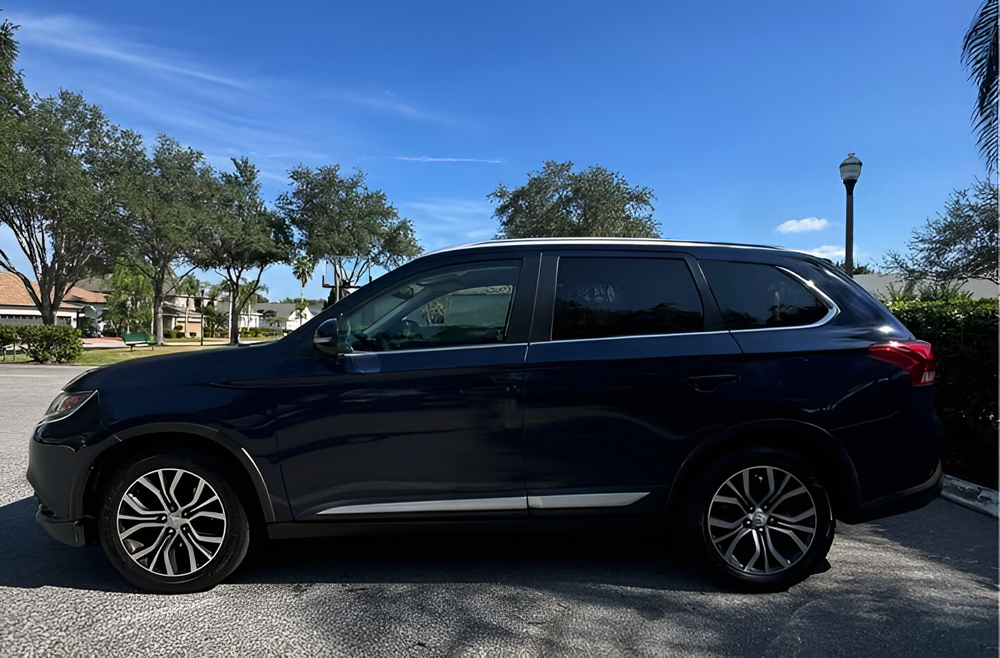
1. How the Outlander’s transmission lineup shifted across four generations
Gen 1: Overbuilt boxes, minimal drama (2001–2006)
The first-gen Outlander, originally badged Airtrek in Japan, came with drivetrains that rarely flinched. Base trims used a 5-speed manual. Automatics ran Mitsubishi’s INVECS-II 4-speed and, later, a 5-speed. Both were old-school hydraulic torque-converter setups with adaptive shift logic, not CVTs, not high risk.
These transmissions weren’t refined, but they could take a beating. The 4G64 and 4G69 engines topped out under 165 hp, far below the hardware’s failure ceiling.
Most issues today are age-based: gasket seep, solenoid delays, or line pressure loss from worn valves. Nothing like the belt-and-pulley failures that came later.
Gen 2: Two engines, two very different outcomes (2007–2013)
Starting in 2007, the second-gen Outlander split its transmission future in half. Stick with the 2.4L inline-4 and you got the INVECS-III CVT, Mitsubishi’s badge for a Jatco unit.
Step up to the 3.0L V6 in XLS or GT trims and the transmission changed entirely: a 6-speed torque-converter automatic from Aisin or Mitsubishi.
That split defined the long-term repair curve. The V6 6-speed holds up with basic care, fluid, filter, and no overheating. The CVT, though, showed early signs of wear even back then. Light shudder, soft surge, and flare under throttle were common by 60,000 miles. Some units survived. Plenty didn’t.
Gen 3: CVT-8 dominates, and starts slipping early (2014–2020)
By the third generation, Mitsubishi went all-in on Jatco. The 2.4L models now ran the CVT-8, model codes F1CJC (FWD) and W1CJC (AWD). The V6 trims kept their 6-speed, but the volume was shifting fast toward 4-cylinder CVTs.
The complaints ramped up just as fast. Belt slip under load, hard lockup into limp mode, or random RPM jumps during highway cruising. Jatco claimed wider ratio spread and lower weight.
Real-world data showed abrasion wear, heat soak, and oil shearing that made the transmission unpredictable past 80,000 miles. TSBs trickled in, but the failure stayed mechanical.
Gen 4: Rogue genes, newer CVT, same risk (2022–present)
The current-gen Outlander rides on the Renault-Nissan-Mitsubishi CMF-CD platform. That means Nissan’s 2.5L engine and the Jatco CVT-X, a new variant with simulated step logic and a wider ratio spread than CVT-8.
Early reviewers praised smoother takeoff and better throttle response. But the hardware still leans on pulleys and a steel belt. Nissan’s Rogue uses the same setup, and long-term reports there show the same core failure risks: fluid oxidation, pressure loss, and abrupt limp mode when the belt slips or the ratio doesn’t track.
The PHEV: eDrive system skips the CVT entirely
Plug-in hybrid Outlanders avoid the entire Jatco CVT chain. Instead, they use a GKN-sourced multi-mode eDrive, with no stepped gears and no belt-pulley setup. The drivetrain relies on twin electric motors, fixed gear reduction, and a hydraulic clutch to couple engine power above 40–45 mph.
That change dodges nearly every classic CVT failure mode. No flare, no belt dust, no pressure solenoids to chase. But the eDrive has its own weak spots, mainly inverter faults, battery codes, and rare clutch judder at high mileage. Electrically complex, yes. Mechanically, far more robust.
Outlander generations, transmission types, and baseline risk profile
| Generation / years | Main engines | Transmission types | Supplier / architecture | Failure tendency |
|---|---|---|---|---|
| Gen 1 (’01–’06) | 2.0–2.4 I4 | 5-MT, INVECS-II 4/5-AT | Mitsubishi hydraulic | Low, mostly age-related |
| Gen 2 (’07–’13) | 2.4 I4, 3.0 V6 | INVECS-III CVT, 6-AT | Jatco CVT, Aisin/Mitsu AT | CVT issues on 4-cyl |
| Gen 3 (’14–’20) | 2.4 I4, 3.0 V6, PHEV | Jatco CVT-8, 6-AT, GKN eDrive (PHEV) | Jatco + GKN | High CVT risk, PHEV low |
| Gen 4 (’22–present) | 2.5 I4, PHEV | Jatco CVT-X, GKN eDrive | Alliance CVT + GKN | CVT long-term unknown, PHEV low |
2. Inside the Jatco CVT: how it slips, scorches, and seizes
The pulley squeeze that simulates gears, and shreds belts
Jatco CVTs don’t shift. They squeeze. Two variable-diameter pulleys pinch a high-tensile steel belt and adjust their spacing to change ratios. Tighten one, widen the other, and the belt rides a different diameter. That’s how the system moves from “low gear” to “high.”
The belt never locks into teeth. It holds by friction alone. Under ideal pressure, the drive feels smooth, until it doesn’t. A slight delay off the line, revs hanging without speed, fake steps in Sport mode that mask a slipping belt. Every slip leaves a mark.
Slipping belt dusts the inside, fouls the valve body
When that belt slips, it grinds. Microscopic metal dust, abrasion powder, gets shaved off and dumped into the CVT fluid. There’s no fine filter. The powder circulates through solenoids and valve body bores, cutting flow and throwing off line pressure.
Weak pressure means more slip. Slip creates more dust. It’s a loop that feeds itself until sensors go out of range or the belt starts notching the pulleys. Codes pop. TCMs log mismatches. But by the time the warning hits, the valve body’s already scored and clutches inside the torque converter start to drag.
Heat thins the fluid, throws pressure off, and triggers limp mode
Mitsubishi specs Dia Queen J1 or J4 fluid, depending on year. Both degrade fast under heat. Long hills, heavy throttle, or stop-and-go in summer spikes internal temps. Once the fluid darkens or smells burnt, it’s already lost film strength. Pressure drops follow.
The CVT doesn’t tolerate heat creep. If temps hit the limit or RPM and speed don’t align, the TCM slams it into limp mode, low gear only, rev-limited, reduced power. Sometimes it clears on restart. Other times the failure sticks.
No-move conditions often trace to cooked fluid and soft pulley walls that let the belt slip no matter how tight the solenoid fires.
CVT stressors vs long-term damage on Outlander
| Stress factor | What the driver does | Short-term symptom | Long-term hardware outcome |
|---|---|---|---|
| Low fluid, old J1/J4 | Stretch intervals, no checks | Occasional flare, minor shudder | Belt/pulley scoring, solenoid sludge |
| Sustained heat (towing, hills) | Long climbs, heavy loads | Hot smell, delayed response | Oxidized fluid, limp mode events |
| Contamination (abrasion powder) | Ignore early shudder | Random surges, harsh engagement | Valve body wear, no-move condition |
3. Outlander transmission symptoms owners actually see
CVT shake, flare, and throttle that feels like mush
The early warnings don’t always feel like failure. You roll into the throttle at 25–40 mph, and the engine revs before the car responds. That’s belt slip, not lag. At steady cruise, the cabin buzzes. It’s not road noise, it’s shudder from the pulleys hunting for ratio.
It gets worse uphill or after a long drive. Light throttle feels unstable. Press harder, and the RPM climbs without pulling. Owners describe it as “rubber-band” or “slipping clutch,” especially in CVT-8 units on 2.4L trims. Sport mode masks some of it, but the hardware behind the shift logic hasn’t changed.
Power dropouts, stuck-in-low limp mode, and full shutdown
As internal pressure fades or temps spike, the software steps in. The TCM starts limiting RPM. Then comes the flashing check light, stuck ratios, or full limp mode with barely any throttle response. You’re locked in a single gear with revs capped around 3,000.
Some units recover after a shutdown cycle. Others don’t move again until the pulley face gets inspected, or replaced. If belt scoring’s visible, the whole box is done. Most failures land between 60,000 and 120,000 miles, depending on heat, fluid age, and how long the early shudder was ignored.
V6 6-speeds feel different, firmer shifts, fewer breakdowns
The 3.0L trims don’t use a CVT. Their 6-speed automatic is a conventional torque-converter box with true gear sets. Failures here come later and follow classic wear paths: delayed engagement, torque converter clutch shudder, or hard downshifts as valve body pressure control breaks down.
These units usually give more warning. Fluid smells burnt. Shifts get rougher. But they don’t hit limp mode as fast, and most can be rebuilt instead of replaced. That alone cuts repair costs by half compared to a CVT.
4. Codes, bulletins, and how dealers actually diagnose these failures
CVT codes that signal real damage, not a bad sensor
When a scan pulls P0776, pressure isn’t holding. That means the solenoid can’t clamp the belt hard enough, usually from valve body wear or fluid contamination.
P0730 shows the input and output speeds drifting apart, which only happens when the belt slips against the pulleys. By the time that code sticks, the damage is already physical.
Codes like P084A, P0969, and P2719 sit one step earlier in the chain. They point to pressure sensors or solenoid control falling outside range. Some clear with fresh fluid and stable temps. Others come back fast, especially once abrasion powder starts clogging the hydraulic circuit.
What the TSBs change, and what they don’t touch
Mitsubishi issued multiple CVT bulletins, including 20-23-001REV4, aimed at shudder and surge complaints. Most focus on fluid condition checks, TCM reprogramming, and confirmation road tests. Software updates smooth throttle mapping and delay ratio changes, which can quiet symptoms for a while.
What they don’t do is repair worn pulley faces or a belt that’s already slipping. Reflashes reduce how often the system reports a fault. They don’t restore clamp pressure once the metal’s been scored. That’s why some owners cycle through updates before the transmission finally fails outright.
A real diagnostic session versus a quick in-and-out visit
A proper workup starts with a full scan using Mitsubishi’s factory tool, MUT-III, logging live pressure data, ratio targets, and temperature under load. A road test follows, watching for flare or speed mismatch as the CVT heats up. If high-risk codes show, the next step is physical inspection.
Mitsubishi Motors specifies borescope inspection of the belt and pulley faces when pressure-related DTCs appear. Scoring or discoloration ends the discussion.
The official fix becomes belt, pulley, and valve body replacement, often quoted between $5,000 and $8,000. Shortcut visits skip that step and send drivers back out with a software update, even though the wear is already there.
Outlander CVT DTCs and likely next steps
| DTC | What it means in plain terms | Likely internal state | Typical dealer move |
|---|---|---|---|
| P0776 | Pressure solenoid not holding properly | Belt clamp pressure unstable | Fluid check, valve body focus |
| P0730 | Input/output speeds don’t line up | Confirmed belt slip | Internal failure diagnosis |
| P084A | Fluid pressure sensor out of range | Sensor fault or real drop | Sensor test, then internal inspection |
| P0969 | Solenoid “A” control issue | Valve wear or control fault | Electrical checks, valve body evaluation |
| P2719 | Secondary pressure control problem | Advanced hydraulic wear | Often leads to CVT replacement quote |
5. Why the Outlander PHEV dodges most transmission failures
No pulleys, no belt, just motors, gears, and one clutch
The PHEV Outlander runs a GKN eDrive system, not a Jatco CVT. Most of the time, it drives as a series hybrid: the gas engine spins a generator, the motors move the wheels. Below highway speed, there’s no mechanical connection between engine and axle.
Above 40–45 mph, a hydraulic clutch locks in and routes engine torque straight through a fixed reduction gear. That’s the only mechanical drive path. No ratios to shift. No pulleys to slip. Nothing to clamp or flare. It’s a hard-coupled drivetrain when it needs to be, and a pure EV the rest of the time.
Drivetrain warnings that feel like transmission trouble
When a PHEV throws a fault, it’s usually electrical. “System Fault” lights trace to the inverter, the battery, or the high-voltage control modules, not the motor or gears.
A small subset of owners report judder during clutch engagement in high-speed mode, usually around 70,000+ miles. That comes from clutch wear, not belt degradation.
These issues confuse diagnostics because they mimic CVT surge or hesitation. But there’s no belt to slip, and no fluid pressure system to fail. The fault logic points to voltage, current, or actuator timing, not traditional transmission parts.
Long-term risk shifts from mechanical to electrical
The mechanical side of the PHEV drivetrain holds up. No belt dust. No shudder from heat. No fluid shear events that trigger limp mode. But the system’s reliability depends on sensors, software, and thermal limits in the power electronics.
Owners who rack up mileage on steady commutes, low load, frequent regen braking, see fewer failures. Those who hammer the battery, climb grades, or tow push the inverter and clutch harder.
That’s where judder, code stacks, and cooling faults start creeping in. High voltage fixes don’t come cheap, but they’re rare compared to what happens to the Jatco-equipped 2.4L models.
6. Maintenance and add-ons that actually move the needle
J1 vs J4 fluid and why 30,000 miles matters
Mitsubishi started with Dia Queen J1, then shifted to J4 for later CVT-8 and CVT-X units. J4 holds pressure better, resists oxidation longer, and cuts shudder risk. But neither lasts forever, especially under heat.
The factory interval says 60,000 miles, sometimes longer. That’s too late. Once the fluid darkens or smells burnt, pressure drops start, and metal dust has already begun cutting up solenoids. Specialists recommend 30,000-mile changes, no exceptions. Fluid’s cheap. Valve bodies aren’t.
External filters, coolers, and how to keep the belt clamped
Behind the heat exchanger sits a cartridge filter Mitsubishi barely mentions. It catches abrasion powder, the fine metal grit that factory screens miss. Most owners never change it. They should. Every fluid service should include a fresh cartridge.
Add a stacked-plate cooler up front, and you drop temps by 30–50°F. That keeps fluid film strong, especially under load or in hot weather. The stock radiator cooler can’t handle towing or long climbs. When coolant hits 210°F, it bakes the transmission fluid, not cools it.
Maintenance strategy vs expected transmission lifespan
| Approach | Fluid interval | Cooler / filter changes | Likely outcome by 150,000 miles |
|---|---|---|---|
| Follow OEM “lifetime” | 60k+ or never | Rarely touched | High CVT failure odds, big repair |
| Moderate care | 45k–60k | Filter occasionally, no cooler | Mixed, some units survive, some fail |
| Aggressive prevention | 30k | Filter every time + aux cooler | Best chance of CVT making 200k+ |
Real numbers, what prevention costs versus a blown CVT
A factory CVT replacement runs $6,000 to $8,000 installed. Used units cut that to $3,500, but come with risk. A proper rebuild, done right, not just resealed, costs about $4,500 from a specialist.
By comparison: J4 fluid, filter, and labor every 30k runs about $350–$450 per service. Add a cooler kit for $250–$400. Over 150,000 miles, that’s $1,500–$2,000 total. Less than half the cost of a failure, and it buys you pressure stability, clean solenoids, and a shot at pushing the original transmission past 200k.
7. Warranty, class actions, and owner leverage
The 10-year coverage dealers don’t always honor
Mitsubishi advertises a 10-year/100,000-mile powertrain warranty. But that only applies to the first owner. Second owners drop to 5 years, 60,000 miles. Even under full coverage, dealers deny repairs if fluid’s dirty, maintenance is undocumented, or the problem’s brushed off as “normal CVT behavior.”
Some owners make multiple visits before anything’s logged. Others get software updates instead of a real inspection. The belt keeps slipping, the valve body keeps degrading, and the clock keeps ticking. Once the warranty ends, so does leverage.
The Hardy lawsuit and what it exposed
In 2021, a class action suit, Hardy et al. v. Mitsubishi Motors North America, hit over widespread CVT failures. Plaintiffs claimed the Jatco units were unsafe, slipped under throttle, and left drivers stuck in limp mode while Mitsubishi blamed driving style.
The suit argued Mitsubishi knew from warranty records and internal data that these transmissions failed early. TSBs were issued. Software patches rolled out.
But hardware didn’t change, and the CVT kept wearing out the same way. No formal recall followed, but the lawsuit opened the door to extended claims and settlements for some owners.
When a CVT problem qualifies for a buyback or lemon claim
Lemon law varies by state, but repeat failures and excessive downtime build a strong case. If the CVT’s been in the shop multiple times for shudder, loss of power, or limp mode, and the fix never holds, it’s no longer a drive complaint. It’s grounds for replacement or repurchase.
The key is documentation. Not vague “hesitation” notes, actual fault codes, service orders, and TSB references. Dealers may argue the problem wasn’t reproduced.
That doesn’t matter if it’s been logged, verified, and unresolved through warranty. The cleaner the paper trail, the stronger the leverage when it’s time to file.
8. How Outlander transmission reliability compares to RAV4, CR-V, and Rogue
Toyota’s launch gear CVT avoids belt strain from the start
Toyota’s Direct Shift CVT drops a physical 1st gear in front of the belt system. That gear handles the heaviest torque, dead-stop launches, before the CVT ever takes over. Once rolling, the pulleys step in.
That simple change buys belt life. No heat from standing starts. Less initial slip. Far fewer reports of high-mileage failures. RAV4 drivers still service the fluid, but the hardware doesn’t self-destruct under normal load. The result: fewer rebuilds, fewer limp modes, fewer $6,000 surprises.
Honda’s CVTs hold line pressure and tune smarter
Honda builds its CVTs in-house. The G-Design Shift units in CR-Vs run higher-pressure pumps and tighter software control. Instead of faking gear shifts, they prioritize smooth, linear pull, less hunting, less heat, fewer surges.
Failures do happen, mostly from bearing noise or internal clutch wear. But they don’t slip like Jatco boxes. And when they do go down, it’s slower, more warning, more rebuildable cases. CR-Vs with 150,000+ miles and original CVTs are common, especially with regular fluid changes.
Rogue and Outlander share the same CVT, so does the risk
Since 2022, the Outlander and Nissan Rogue run on the same CMF-CD platform, using the same 2.5L engine and Jatco CVT-X. Nissan’s tuning differs slightly, but the core unit matches.
Rogue CVTs have a long history of failure, belt slip, ratio errors, and limp mode events before 100,000 miles. Nissan extended warranties, faced multiple lawsuits, and still battles complaints.
Outlander owners with the same box should expect similar outcomes unless Mitsubishi reworks the fluid spec, cooling, or shift logic.
Sources & References
- Mitsubishi Outlander – Model Years, Generations & News | Cars.com
- Mitsubishi Outlander – Wikipedia
- Mitsubishi Outlander Generations: All Model Years | CarBuzz
- GKN Driveline Multi-Mode eTransmission On The Mitsubishi Outlander PHEV
- Mitsubishi Outlander CVT Problems: Expert Insights and Solutions …
- Mitsubishi Outlander Transmission Problems & Your Options …
- Mitsubishi Outlander Generations | CarsDirect
- 2022 Mitsubishi Outlander: Better than a Nissan Rogue? [First Drive]
- 2021 Toyota RAV4 Hybrid vs 2022 Mitsubishi Outlander – CarGurus
- 2022 Outlander and 2021 Nissan Rogue comparison. : r/mitsubishi – Reddit
- 2016 outlander gt v6 : r/MitsubishiOutlander – Reddit
- 2022 Honda CR-V vs. 2022 Mitsubishi Outlander – iSeeCars.com
- MITSUBISHI ASX / RVR / Outlander Sport – All Models by Year (2010-Present) – autoevolution
- POTENTIAL TRANSMISSION SHUDDER/SURGE WITH … – nhtsa
- 2022 Mitsubishi Outlander vs Old Mitsubishi Outlander : r/mitsubishi – Reddit
- Mitsubishi and CVT : r/mitsubishi – Reddit
- How to Diagnose a Failing Outlander Transmission | FactoryMitsubishiParts.com
- Nissan Transmission Problems: Common Issues with Rogue CVT
- CVT issues? : r/MitsubishiOutlander – Reddit
- Understanding Mitsubishi Outlander CVT Transmission Problems: Expert Solutions and Services – Cleveland Auto Repair
- The Mitsubishi Outlander PHEV System Fault: What Is It?
- SERVICE CAMPAIGN BULLETIN – nhtsa
- Charged EVs | Outlander PHEV showcases new GKN Multi-Mode eTransmission
- Outlander PHEV CVT issues? : r/mitsubishi – Reddit
- Outlander PHEV transmission? : r/electricvehicles – Reddit
Was This Article Helpful?