
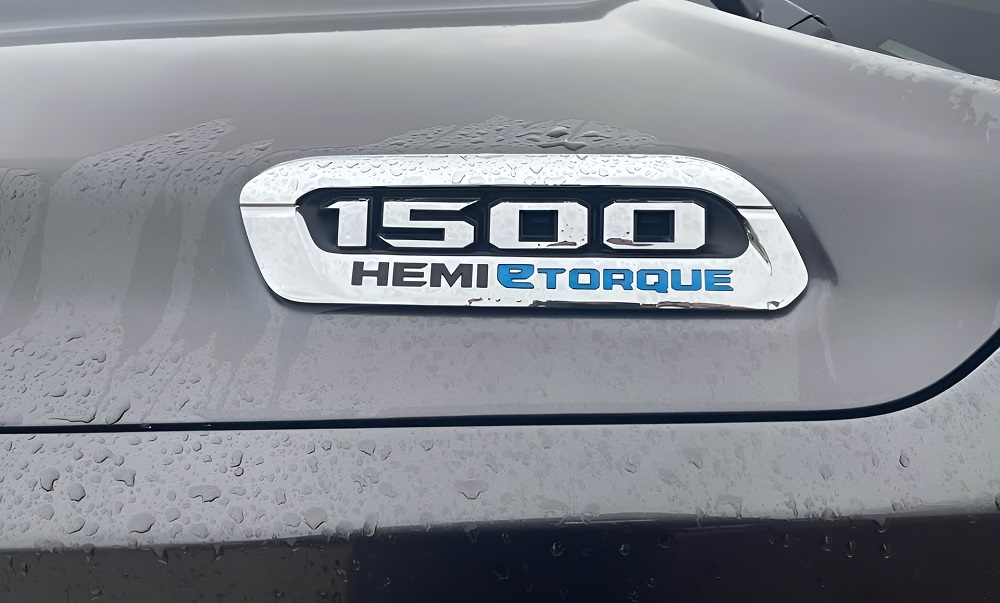
Pull from a light. Hear a whine up front. See stop/start shut off. That’s how many Ram eTorque problems start. Since 2019, Ram has used eTorque on some 1500 V6 and V8 trucks. It adds a belt-driven motor, a 48-volt battery, and a converter that feeds the 12-volt side.
Most trouble starts in 3 places. The motor can whine. The 48-volt battery side can throw faults. The software can trip warnings or kill charging.
One case went past a warning light. Recall 23V-265 hit certain 2021 Ram 1500 trucks with the 5.7L eTorque because PCM software could shut the engine off while driving. Some years just act fussy. Some can leave the whole truck dead in the road.
1. Fix the map first, or the diagnosis goes sideways
Start with what eTorque actually does
eTorque is a mild-hybrid system. The truck still moves on gasoline power. The electric side helps with launch, captures energy under braking, restarts the engine fast, and feeds the 12-volt system through a DC-DC converter.
That layout matters because one fault can fake 3 others. A weak 48-volt side can show up as a dead 12-volt battery. A converter fault can look like an alternator problem. A bad restart event can make people blame the starter when the belt-driven motor is the real actor.
The V6 and V8 don’t carry the same hardware load
Ram sells eTorque with both the 3.6L Pentastar V6 and the 5.7L HEMI V8. The 2026 Ram 1500 rates the V6 at 305 hp and 269 lb-ft. The 5.7L eTorque V8 makes 395 hp and 410 lb-ft.
The assist hardware changes too. The V6 uses a liquid-cooled Continental MGU mounted at the front in a tighter package. The V8 uses an air-cooled Magneti Marelli MGU mounted higher on the engine. That split matters when heat, belt load, and bearing noise enter the story.
The hard parts sit in different places, but the electrical spine stays the same
| Item | 3.6L Pentastar V6 eTorque | 5.7L HEMI V8 eTorque |
|---|---|---|
| Engine output | 305 hp / 269 lb-ft | 395 hp / 410 lb-ft |
| MGU cooling | Liquid-cooled | Air-cooled |
| MGU layout | Front-mounted | Upper engine area |
| Initial torque assist | Up to 90 lb-ft | Up to 130 lb-ft |
| Battery pack | 430 Wh lithium-ion | 430 Wh lithium-ion |
| DC-DC converter | 3.0 kW | 3.0 kW |
Both engines still depend on the same 48-volt battery pack and the same 12V-to-48V handshake. When that link fails, the truck can lose charging support, throw stop/start faults, and drain the 12-volt side even if the gas engine itself is still sound.
P0E55 points at the DC-DC converter current-sensor side. P0AD4 points at battery airflow or thermal trouble.
2. The MGU is where smooth hybrid theory turns into real repair bills
The whine usually starts in the bearing, not in the battery
The MGU is the belt-driven motor-generator on the front drive. It charges the 48-volt pack when the engine runs. It also pushes torque back into the crank during launch, shifts, and restart events.
The most common hardware complaint is bearing wear inside that unit. Owners hear a high whine, a grind, or a growl that rises with engine speed. The noise often shows up first at idle, then gets sharper with light throttle.
Belt load is a big reason. eTorque needs far more belt tension than a normal alternator setup because restart events hit hard and fast. Ram engineered the system for restart times around 70 milliseconds, and that repeated shock load pounds the drive-end bearing over time.
Front-end noise can fool the diagnosis fast
Not every whine means the MGU itself is shot. The belt path also works the tensioner and idler harder than a standard accessory drive. Those parts can chirp, grind, or rumble and sound close enough to send a shop after the wrong fix.
That matters because the pattern can overlap. A bad idler may scream on cold start. A worn MGU bearing may stay noisy hot or cold and change pitch with rpm. A tensioner can add a rough flutter at idle when belt load swings during stop/start events.
Once the bearing gets loose, the sound usually stops being subtle. The front of the engine takes on a steady electric whine. Some owners report it long before a warning light shows up. Others keep driving until charging support falls off and the truck starts leaning on the 12-volt battery.
The repair gets expensive because the unit is treated as a whole assembly
Dealer service usually does not open the MGU and replace one bearing. The normal path is full unit replacement. That turns a small internal wear point into a major parts-and-labor job.
Reported MGU replacement cost often lands around $1,500 to $2,100. Parts alone commonly fall in the $1,000 to $2,000 range before labor, fees, and any core charge. When the unit is backordered, the truck can sit for months because a failed MGU can stop 12-volt charging and leave the truck unable to restart.
3. The 48-volt side can make the truck act dead before the engine has any real problem
Warning lights usually show up before the truck quits
Many eTorque faults start with messages, not noise. Common ones include “Stop/Start Unavailable” and eTorque service warnings. The truck may still run, but charging support gets shaky and the 12-volt side starts carrying more load than it should.
That’s when the complaints get messy. Screens may flicker. Power steering assist can act odd. Owners also report phantom alarms, weak cranking, and random low-voltage behavior that feels like a bad 12-volt battery alone.
The converter is a major choke point
The DC-DC converter bridges the 48-volt pack to the 12-volt system. When it fails, the truck can keep running only until the 12-volt battery drains down. Once that reserve is gone, the engine can stall and fail to restart.
One of the key fault paths here is P0E55. That code points to the DC-DC converter current-sensor side and fits the pattern of a truck that suddenly stops charging the 12-volt system correctly.
The result can look like a simple battery failure when the real fault sits upstream in the converter or battery-control logic.
Battery heat and airflow faults have their own trail
The 48-volt pack uses internal air cooling. If fan flow drops or the intake path gets blocked, pack temperature rises under load. Towing, hot weather, and stop-and-go traffic hit this system hardest because electrical assist demand stays high while heat keeps building.
P0AD4 is one of the important codes in that lane. It ties to battery airflow or thermal-management trouble. When that happens, the hybrid side can shut down to protect the pack, and the driver feels a sudden loss of assist and regenerative braking support.
Stellantis had to issue a battery-control software update for 2023 trucks
Bulletin 08-034-24 covers certain 2023 Ram 1500 trucks with both the 3.6L V6 eTorque and 5.7L V8 eTorque. It calls for a Battery Pack Control Module software update. The bulletin lists codes such as P0AC0, P1A29, P0DE7, P0ABA, P0B3D, P0B3E, U3017, P0E55, P0DAF, and P0AD4.
| Symptom or code | Likely fault lane |
|---|---|
| “Stop/Start Unavailable” | Low 48-volt state, pack fault, airflow fault, or converter trouble |
| P0E55 | DC-DC converter current-sensor side |
| P0AD4 | Battery airflow or thermal-management fault |
| P0AC0 / P1A29 / P0DE7 | Battery pack control and management faults |
| Strange 12-volt behavior | Converter fault or bad 48V-to-12V handshake |
A weak 12-volt battery can push the whole system harder than it should
The 12-volt battery still matters on an eTorque truck. When that battery gets weak, the DC-DC converter can run near full effort to keep up. That extra load adds heat to the 48-volt electronics and can speed converter wear.
The failure can also run the other way. Bad 48-volt charging logic can drain the 12-volt battery fast, which is why some trucks come in with low-voltage chaos even though the main issue lives in the hybrid side.
Typical 12-volt battery replacement runs about $288 to $377. A high-voltage battery replacement estimate runs about $2,494 to $2,608.
4. Software turned this from a nuisance into a real stall risk
The recall year needs a hard line around it
Recall 23V-265 covered about 131,700 Ram 1500 trucks from model year 2021. The scope was narrow. It applied to trucks with the 5.7L HEMI eTorque engine, not every eTorque Ram on the road.
The defect sat in PCM software. Under certain conditions, that calibration could command an over-rich fuel mixture. The engine could then shut down while the truck was moving, with loss of motive power and reduced brake and steering assist.
This was not a parts recall
The remedy was a PCM reflash. Stellantis did not call for a new MGU, a new battery pack, or a new converter. The labor time listed in the recall communication was about 0.3 hour.
That matters when owners read the wrong story into it. A truck with recall 23V-265 history may still have separate hardware risk in the MGU or 48-volt system. The recall fixed one software stall path. It did not rewrite the whole eTorque reliability record.
The complaint trail showed this was more than a one-off glitch
Federal records show FCA had already logged 206 customer assistance records before launch. The company also cited 636 warranty claims, 53 field reports, and 1 accident tied to the issue. Those counts are why this section belongs in the safety lane, not the annoyance lane.
ODI later noted complaints on newer trucks too, including allegations of sudden stalls and trouble restarting when the rich-condition fault was present.
That does not expand 23V-265 beyond 2021 HEMI eTorque trucks. It does show why any stall complaint in an eTorque-era Ram deserves a VIN check before deeper parts chasing starts.
5. Cold weather and towing load expose weak parts fast
Winter removes margin out of the battery side
Cold weather hits lithium-ion performance first. The 48-volt pack charges slower, delivers less punch, and drops stop/start more often when temperatures fall hard. A truck with a weak cell may act normal in mild weather, then start throwing warnings once winter shows up.
That pattern matters in diagnosis. A battery pack can look healthy in the shop, then fail on the first deep-cold start the next morning. Owners often notice the stop/start system staying offline, slow recovery in charging behavior, or repeat warning messages before a full failure.
Heat and trailer load pound the assist hardware
eTorque helps a loaded Ram leave a stop with less lag. That same job adds heat to the MGU and the battery side. Long grades, towing, and hot traffic put steady demand on the assist system while airflow and cooling margin shrink.
The V8’s air-cooled MGU has less thermal cushion than the V6’s liquid-cooled unit. In hard use, internal heat soak can force the system to pull back assist. The driver may feel that as a hiccup in acceleration or a soft loss of shove while merging or climbing.
Weak parts show themselves under stress, not always in easy driving
A marginal MGU bearing may stay quiet on short trips, then sing after long belt load. A tired 12-volt battery may scrape by in town, then sink voltage once the converter works harder in cold weather. A restricted battery cooling path may never show itself until stop-and-go heat or towing drives pack temperature up.
That’s why many eTorque complaints sound inconsistent at first. The system can pass through light commuting, then drop stop/start, cut assist, or throw voltage faults only under real demand. One blocked cooling path or one weak cell can change the truck’s behavior without changing the engine’s mechanical health.
6. Year split matters more than mileage bragging
The first trucks built the bad reputation
The 2019 and 2020 trucks sit in the early-risk lane. Those years picked up the most chatter around MGU bearing noise, charging oddities, and low-voltage gremlins. The hardware concept was already in place, but the field record turned ugly once real miles and real stop/start cycles stacked up.
A quiet 2020 can still be a better buy than a noisy 2023. Mileage alone will not sort these trucks. A 40,000-mile truck with front-drive whine and weak charging logic can be a worse bet than a 90,000-mile truck with a solid repair trail.
The 2021 model year carries the recall stain
The 2021 Ram 1500 with the 5.7L eTorque sits in its own bucket because of recall 23V-265. That truck has the official stall paper trail. The risk there is not just owner complaint volume, but a documented PCM fault that could shut the engine off in motion.
That makes 2021 a VIN-check year first. A buyer or owner needs recall status before any deeper guesswork. If the truck still stalls, bucks, or drops motive power after the reflash, the problem has already moved outside the clean recall path.
The 2023 trucks need a battery-control check before parts get thrown at them
A 2023 truck with stop/start warnings, charging faults, or 48-volt codes should push the BPCM update to the top of the list.
Bulletin 08-034-24 covers both the 3.6L V6 eTorque and 5.7L V8 eTorque on the 2023 Ram 1500. Codes named in that bulletin include P0AC0, P1A29, P0DE7, P0ABA, P0B3D, P0B3E, U3017, P0E55, P0DAF, and P0AD4.
That matters because a truck can look like it needs a battery pack, converter, or MGU when the control side still has an open software path. Skipping that step can waste money fast. One wrong parts-cannon move on this system can put a shop bill deep into 4 figures before the main issue even changes.
Later complaints can wear the wrong badge
Not every 2025 complaint belongs in the eTorque pile. Bulletin 21-015-25 covers 2025 Ram 1500 trucks with the 3.0L Hurricane engine for bump or jerk complaints during engine stop/start and downshift events. That is an ESS and transmission calibration story, not an eTorque hardware story.
The lineup split matters even more in 2026. Ram still sells the 3.6L Pentastar with eTorque and the 5.7L HEMI with eTorque, while also selling Hurricane six-cylinder trucks in the same 1500 family.
A stop/start complaint on a 2026 Ram means nothing until the engine is identified first. The 2026 5.7L eTorque is rated at 395 hp and 410 lb-ft. The 2026 3.6L eTorque is rated at 305 hp and 269 lb-ft.
7. The truck can go dead even when the engine is still healthy
The helper system can become the gatekeeper
A Ram can have a sound HEMI or Pentastar and still end up dead. If the MGU stops charging, the converter quits, or the 48-volt side drops out, the truck can burn through the 12-volt battery and lose restart ability.
That’s why some owners end up towing a truck with no rod knock, no spun bearing, and no core engine failure.
That changes the math. A bad phaser or lifter makes engine noise and keeps the diagnosis in one lane. eTorque faults can bounce between charging, stop/start, warning lights, and low-voltage chaos before the truck finally goes dark.
The small battery bill and the big battery bill live in different worlds
A normal 12-volt battery on a Ram 1500 averages about $288 to $377. Labor usually runs about $37 to $54 of that total. That’s annoying money, not leave-you money.
The hybrid high-voltage battery is a different hit. RepairPal puts Ram 1500 hybrid high-voltage battery replacement at about $2,494 to $2,608. Labor runs about $244 to $358, with parts near $2,250.
The MGU turns a bearing problem into a major bill
The MGU often gets replaced as a full assembly. Dealer repair paths usually do not break it down to a simple bearing swap. That pushes the cost far past what the failed internal part would suggest.
When the unit is available, reported MGU replacement commonly lands around $1,500 to $2,100. When it is not, the truck can sit for months waiting on parts while the charging system stays compromised.
That means one failed eTorque unit can stack towing, downtime, rental cost, and a 4-figure repair on top of a still-healthy gas engine.
Sources & References
- E-Torque MGU : r/ram_trucks – Reddit
- Ram 1500 ETorque Whine – idler pulley is culprit : r/ram_trucks – Reddit
- 2019-2026 RAM 1500 5.7L eTorque MGU Repair – Circuit Board Medics
- Etorque repair saga : r/ram_trucks – Reddit
- 2020-2024 Ram 1500 eTorque Problems: Battery Pack Faults, Stop/Start Issues and Power Loss
- etorque battery issue? : r/ram_trucks – Reddit
- Technical Service Bulletin (TSB) – Battery Pack Control Module (BPCM) Software Update – nhtsa
- Ram eTorque Issues in 2019-2023 Models – The Barry Law Firm
- Ram eTorque Problems | Lemon Law 123
- Technical Service Bulletin (TSB) – Flash: Transmission Control Module (TCM) Updates – nhtsa
- 2026 RAM 1500 – Stellantis Fleet
- Ram 1500 Hybrid High Voltage Battery Replacement Cost Estimate – RepairPal
- Ram 1500 Battery Replacement Cost Estimate – RepairPal