
Merge hard in an Outback XT or Ascent and the turbo hits like it should, until it doesn’t. Boost drops. A light flashes. Power dies. That’s when every story about Subaru’s 2.4 turbo floods back.
The FA24F powers Subaru’s top trims, Outback XT, Legacy XT, Ascent, WRX, and overseas Foresters. On paper, it’s the perfect downsized replacement for the old 3.6 flat-six. More torque, better mileage, modern emissions. But under load, it shows its limits.
This guide cuts through it. RTV chunks clog oil flow. Carbon chokes valves. TCV shorts scramble sensors. PCV fails. Oil vanishes. And the CVT takes the fall when power fades.
Treat it right, and the 2.4 turbo holds strong. Slip up, and it fails harder and faster than any old-school NA flat-four.
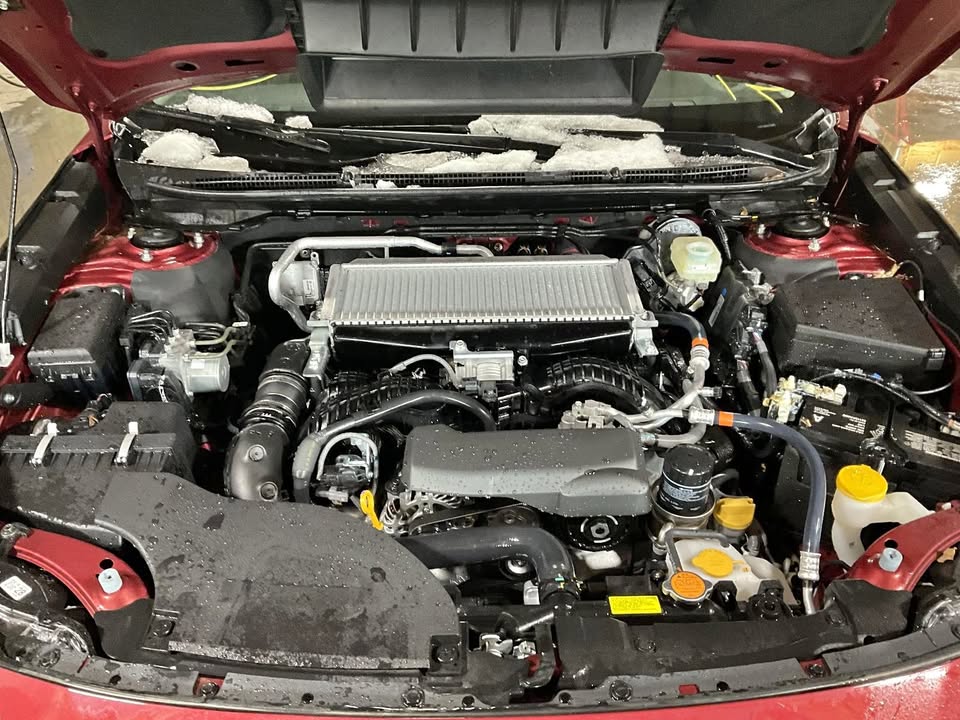
1. What the Subaru 2.4 turbo actually is and where it’s working hardest
FA24F architecture in one glance
The FA24F is a 2.4L oversquare flat-four, punching out up to 271 hp and 277 lb-ft using a twin-scroll turbo and direct injection. Bore is 94 mm, stroke 86 mm, same layout as the naturally aspirated FA24D in the BRZ and GR86, but tuned here for torque, not revs.
Compression sits at 10.6:1, high for a turbo engine, but knock risk is controlled by DI cooling and smart timing logic. It runs 87 AKI in the Ascent and Outback, 91+ in the WRX. Heads and block are aluminum, with beefed-up rods and semi-closed deck support for the cylinders. No timing belt, chains only.
Where the old FA20DIT hit hard in the upper band, the FA24F’s torque peaks early and stays flat, built for weight. The turbo mounts low and forward for quicker spool and tighter emissions control.
FA24F vs FA24D vs FA20DIT basics
| Parameter | FA24F 2.4 Turbo | FA24D 2.4 NA | FA20DIT 2.0 Turbo |
|---|---|---|---|
| Displacement | 2,387 cc | 2,387 cc | 1,998 cc |
| Bore × stroke | 94 × 86 mm | 94 × 86 mm | 86 × 86 mm |
| Induction | Twin-scroll turbo, DI | NA, port + DI (D-4S) | Twin-scroll turbo, DI |
| Typical output | ~260–271 hp / 277 lb-ft | ~228–234 hp / 184 lb-ft | ~268 hp / 258 lb-ft |
| Recommended fuel | 87 AKI in SUVs, 91+ in WRX | 91/93 AKI | 91/93 AKI |
Vehicle applications and duty cycles that stress the 2.4 turbo
The FA24F shows up in the Ascent, Outback XT, Legacy XT, and 2022+ WRX. Overseas, it’s also used in high-output Foresters and Levorgs. Every version runs the same block and head architecture, but ECU tuning and torque targets vary by model.
Loads shift with use. Ascent drivers tow up to 5,000 lb in summer heat, pushing oil and coolant temps. WRX owners push boost and RPM, stressing the bearings and valvetrain.
Short-trip commuters never heat-cycle the oil, letting RTV buildup and moisture settle in. All paths lead to the same failure points, but at different speeds.
The engine’s strengths, tight packaging, fast spool, early torque, become weaknesses when heat, load, and wear stack up faster than maintenance can keep pace.
2. Lubrication weak spots that issue bearings and motors
RTV chunks in the oil system starve the bottom end
Subaru ditched full gaskets on critical joints, lower pan, upper pan, timing cover, cam carriers, and sealed them with RTV. Factory assembly often lays it on thick. As torque is applied, the extra sealant squeezes into the oil-side of the joint. When that bead cures, it becomes shrapnel.
Those cured slivers break off, float downstream, and collect on the five-sided oil pickup screen. The screen isn’t just a filter. It’s a choke point.
Get a few thick strands across it, and the oil pump starts pulling air under G-load. You won’t see it at idle, but pull hard through an onramp and you’re already losing the film between crank and rod.
WRX and track builds show it early, high RPM, high oil demand. But Ascent owners towing in heat can hit the same failure mode with a family trailer and an uphill climb.
Real failure scenarios that spin bearings and eat blocks
| Scenario | Driver sees/feels | What’s happening internally |
|---|---|---|
| Brief low-oil-pressure flicker on hard cornering | Light flashes on long cloverleaf, then clears | Pickup screen partially blocked, pump cavitating on high G |
| Sudden loud knock after highway pull | Strong pull, then deep metallic rattle | Rod bearing momentarily lost oil film |
| Track day “lunches the motor” | High RPM laps, then catastrophic knock | Severe restriction, bearings overheated and smeared |
Early failures hit tuned WRXs and road-course builds. But stock motors with partial clogs can survive months of soft use, until one event pushes them over. By the time the oil light stays on, the bearing’s already gone.
What a proper fix costs, and how to avoid repeat failure
| Service | What the shop actually does | Typical result/cost range (USD) |
|---|---|---|
| Oil filter “autopsy” | Cut filter, check for RTV bits/metal in pleats | Cheap diagnostic; flags bigger issues |
| Lower pan drop & screen clean | Remove pan, clean pickup, flush debris | Often $400–$800 at independents |
| Full reseal with proper RTV | Strip old sealant, hand-scrape, thin bead, 24-hr cure | $800–$1,500+, depends how deep they go |
| Rebuild/long block after failure | Replace or rebuild short block, clean system fully | Several thousand, varies by model |
Cure time matters. Rebuilding a blown short block and slapping on fresh RTV before it’s set can restart the same failure loop. So does bead thickness. Too thick, and you’re right back to clogging the pickup. Too thin, and it leaks before it cures.
3. Gasketless sealing that leaves FA24F engines sweating oil
Where seepage starts and why it shows up early
The FA24F doesn’t use cut gaskets at key joints. Subaru sealed the cam carriers, timing cover, and oil pans with RTV. It saves weight and space, but doesn’t always hold up. Heat cycles stretch aluminum, flex corners, and stress the sealant. Sooner or later, it thins out. That’s when the oil starts creeping.
Most owners catch it after shutdown. Burnt oil rises up from the belly pan. The undertray’s damp. The dipstick dips between oil changes, not enough to throw a light, just enough to throw you off. Subaru’s bulletins keep circling the same weak points: cam carrier seams and the upper oil pan joint.
Sorting seepage from consumption without guessing
Shops don’t throw parts. First step is a clean-down and a hot run. Then they check the seams for fresh wetting. Dye works when leaks hide under boost. Oil in the intercooler points to PCV or turbo return issues, not a leaky case.
If the engine stays dry but the oil keeps disappearing, the hunt moves inward.
Where FA24F leaks and how hard they are to fix
| Location | Access level | Typical repair scope |
|---|---|---|
| Lower oil pan | Under-car, exhaust nearby | Drop pan, reseal; easier end of spectrum |
| Upper pan/block seam | Requires exhaust, subframe work | Significant labor, may support engine |
| Timing chain cover | Front dress removal | Long job; careful RTV work needed |
| Cam carrier to head | Valve covers, timing, cams off | Among the most invasive on this engine |
When it’s a watch item and when it’s a teardown
Light seepage can ride for a while, just track it and wipe it down. But if it hits the exhaust, leaves visible pools, or drains the dipstick between fill-ups, the job can’t wait.
Upper pan and cam carrier reseals aren’t casual work. It’s hours deep with zero room for error. Rush the prep or miss a sealing edge, and the next leak shows up sooner, and worse.
4. Thermo Control Valve failures that trigger limp mode and chaos codes
How Subaru swapped thermostats for a coolant control grenade
The FA24F ditches the old wax thermostat for an electronic Thermo Control Valve (TCV), a plastic-bodied unit that reroutes coolant to the radiator, heater core, block, and turbo oil cooler based on sensor data. It’s precise, fast, and lightweight.
It also shares a 5V reference line with sensors like the MAP, throttle body, and TGV actuators. When the housing leaks internally, coolant hits the circuit. Short that 5V feed, and the car doesn’t just run hot, it runs blind.
Most failures trace back to TCVs built before mid-2021, where the shaft would fracture or coolant would breach the case and arc the control board.
When the TCV quits and the whole network stumbles
| Failure mode | Common DTCs (examples) | Driver symptoms |
|---|---|---|
| Shaft/housing fracture | P2682, P26A3 | Overheating warnings, reduced power, fans running hard |
| Coolant intrusion/short on 5V | P26A5, P26A6 plus other sensor codes | Dash lit up, limp mode, harsh shifting, stalling |
| Stuck in “cold” position | No heat, slow warm-up, poor MPG | Heater weak, temp gauge sluggish |
When the 5V rail shorts, the car doesn’t isolate the fault, it drops everything on the line. Suddenly the MAP sensor, throttle position, and evap controls vanish from the ECU’s view. Expect hard shifts, weak throttle, or a no-start if the short lingers.
Warranty cover, part revisions, and repair that doesn’t backfire
Subaru issued a 15-year/150,000-mile TCV warranty extension for many 2019–2021 models, including Outback, Legacy, and Forester. The updated valve swaps the fragile resin shaft for a stainless rod, and better seals stop coolant from hitting the circuit.
Replacement means draining and refilling coolant, bleeding the system fully, and clearing memory from any stored throttle or evap faults. Skip burping, and you risk a hot spot near the turbo or a false overheat warning as bubbles hit the sensor neck.
5. Direct injection carbon that suffocates cold starts and issues MPG
Why this motor bakes carbon faster than most
The FA24F runs pure direct injection, fuel never touches the back of the intake valves. Add a flat-four layout, constant turbo boost, and PCV vapors loaded with oil mist. Now feed that through EGR on cold starts. It cakes fast.
By 30,000–60,000 miles, many owners notice cold start stumble, soft off-idle throttle, and a steady MPG drop. Valves don’t seat clean. Airflow swirls. Random misfires creep in, often on cylinders 2 and 4 where oil pooling hits hardest.
Short-trip commuters see it first. Long freeway drivers stretch it out. Tuned WRXs just build it hotter and faster.
What works, and what wastes your time
| Method | Where it cleans | Best use case | Limitations |
|---|---|---|---|
| Tank P.E.A. additive | Injectors, chambers | Ongoing preventative measure | Barely touches intake valves |
| Induction P.E.A. service | Intake runners, light valve film | Mild to moderate buildup | Can’t fully remove heavy crust |
| Walnut blasting | Directly on valves/ports | Heavy buildup, misfire complaints | Requires manifold removal, more cost |
When cold starts go rough and idle trims drift, shops usually skip to walnut blasting. It’s fast, complete, and hits only closed valves, no chamber risk. Expect $500–$900 depending on labor, higher at dealers or if paired with other service.
How to keep the FA24F breathing past 60,000 miles
Catch cans or Air-Oil Separators (AOS) cut vapor load and slow down buildup. They won’t stop it, but they buy time. P.E.A. additives help more at the injector and piston crown level than the valves themselves.
If the car’s tuned, tracked, or idled a lot, blasting around 50,000 miles isn’t excessive. On stock power with good highway cycles, 70,000–80,000 miles may still run clean. Cold starts are the canary, when they stumble, carbon’s already stacked up.
6. PCV failures that flood cylinders and mask deeper oil loss
When the valve cracks and the engine drinks its own oil
Early FA24F models used a press-fit plastic PCV valve that could separate under heat and vibration. When it popped, oil got sucked straight into the intake runners. Some drivers caught it as a blue smoke bomb in the rearview. Others didn’t notice until the oil light came on.
The worst failures dumped enough oil to foul plugs, poison cats, or trigger a low-oil shutdown within a few hundred miles. Subaru issued a recall on affected units, if the valve was intact, it got replaced with a steel-bodied version. If it broke, the engine came out for internal cleaning and fragment retrieval.
PCV failure vs “normal” turbo oil use
| Pattern | Typical mileage window | What you see | Risk level |
|---|---|---|---|
| PCV separation | Low to mid mileage | Sudden heavy smoke, big oil drop in few trips | High – stop driving, recall applies |
| RTV/return restriction | Any, often mid-life | Gradual increase in oil use, oil in intercooler | Medium – needs investigation |
| Mild turbo/DI oil use | Varies, 3–5k intervals | 0.25–0.5 qt between changes, no smoke | Usually manageable if monitored |
When oil use isn’t a recall, but still a warning sign
Even without a broken valve, FA24Fs lose oil. Some burn it slowly through the DI/turbo path. Others pool it from clogged return paths in the heads. If RTV chunks block the drains, oil backs up, mist gets pulled into the intake, and consumption jumps.
The factory says some use is normal, but if you’re topping up every 1,000 miles, something’s off. Burning plus knock, tick, or rattle? Now you’re in rod-bearing or oil starvation territory.
Habits that prevent a dry crankcase and a dead turbo
Start with the dipstick. Low-oil warnings come late. On hard-driven or tuned cars, check every tank of gas. On stock ones, every 1,000 miles minimum.
Use high-quality synthetic oil, OEM filters, and tight drain intervals. Don’t rely on the factory monitor. Go 3,000–5,000 miles max if you’re towing, idling, or chasing boost. On a flat-four turbo, the oil system isn’t forgiving, it’s the first thing that fails and the last thing most owners check.
7. Cold-start clatter and cam phasers that won’t park
When the rattle’s harmless, and when it’s not
The FA24F uses hydraulic cam phasers with internal lock pins that hold position during shutdown. If oil pressure bleeds off before they lock, they rattle on cold start, 1 to 3 seconds of sharp clack before the pressure builds and stabilizes the sprockets.
Subaru calls it normal. It usually is. But when the lock pin sticks or the sprocket wears, the rattle lingers. Add cam-position codes or delayed throttle response and the phaser’s no longer just noisy, it’s late or out of phase entirely.
Injectors and direct injection pulse can also tick under load. They’re loud but harmless. But deep knocks, rising with RPM or after hot restarts, usually trace to rod bearings, not valvetrain.
Common 2.4 turbo noises and what they usually mean
| Noise description | When it happens | Likely source | Typical severity |
|---|---|---|---|
| 1–3 second light rattle on cold start | First start of the day | Cam phaser lock pin/sprocket | Usually benign, monitor |
| Persistent tick matching RPM | Hot or cold, always there | Injector tick, DI clatter | Often normal for DI engines |
| Deep knock that worsens warm | Under load, after warm-up | Rod bearing distress | Serious – park and inspect |
| Metallic grind with timing codes | Startup and driving | Damaged sprocket/chain issue | Needs teardown and repair |
When phasers need replacement, and what the bill looks like
A single phaser runs about $320 in parts. The labor to reach it isn’t light. Front dress has to come off, and chain alignment has to be dead on when it goes back in.
If RTV bits have already clogged the oil circuit or the engine’s had pressure issues, the timing system won’t last long, new sprockets won’t save a dry head.
Some techs replace all four sprockets preventively once they’re in there. But if the rattle’s brief, clean, and doesn’t trigger timing faults, most shops monitor. Once it shows up warm or trips a cam correlation code, it’s teardown time.
8. CVT shudder and WRX shock loads blamed on the engine
TR690 quirks that feel like misfires but aren’t
The FA24F pairs with Subaru’s TR690 high-torque CVT in the Ascent, Outback XT, and Legacy XT. On paper, it handles the engine’s 277 lb-ft.
On pavement, it hesitates, judders, and flares. Light throttle in traffic? It shudders. Climb a hill? RPM jumps before the torque hits. Launch from a stop? You get a jerk, then lag, then go.
Drivers often chase engine issues, plugs, sensors, fuel trims, when the real issue is inside the transmission. A slipping CVT chain or flaky torque converter clutch mimics engine stumble, but the fix isn’t under the hood.
Engine vs CVT symptoms many owners confuse
| Complaint | Feels like… | Often actually is… |
|---|---|---|
| Low-RPM shudder in traffic | “Engine misfire or bad tune” | CVT chain slip / torque converter clutch issue |
| Sudden RPM flare on climb | “Turbo lag” | CVT ratio change/flare |
| Jerky launch after stop | “Turbo stumble” | Converter or software logic |
| Hard stalling after warning lights | “Engine dying” | TCV or shared 5V fault taking out sensors and CVT logic |
Subaru issued multiple TCM updates to adjust pressure curves and lock-up behavior. Some cases require full converter or CVT replacement. If you’re chasing a misfire with no codes, and the engine checks out, suspect the TR690.
WRX drivetrain weak points when boost goes up
Manual WRX models skip the CVT and use a 6-speed. It’s direct, responsive, and not built for high torque loads. Once power climbs past 350 whp, clutch slip, synchro wear, and differential chatter show up fast.
The engine gets blamed when the car bucks or pops out of gear. In reality, driveline shock loads hit the transmission first, then echo back into the crank through the flywheel.
Tuned WRXs with stock clutches and diffs chew through components that never troubled the older EJ cars. And if you’ve got binding on decel or cracked mount ears, the block’s already starting to pay for it.
9. Oil, intervals, and the fine line between survival and failure
When 0W-20 cuts it, and when it doesn’t
Subaru calls for 0W-20 synthetic across most FA24F platforms to hit EPA targets. But tuners, track shops, and even Japanese manuals point elsewhere. Under boost, towing, or heat, 0W-20 shears down fast. Bearings ride thinner film. Failures follow.
Step up to 5W-30, and the film strength holds better at temp. WRX and Ascent owners running harder see longer bearing life, steadier oil pressure, and cleaner top ends with no noticeable fuel economy drop. Use the dipstick, not the spec sheet.
Oil viscosity trade-offs for the FA24F
| Viscosity | Official stance (NA market) | Real-world pros | Real-world cons |
|---|---|---|---|
| 0W-20 | Factory recommendation for MPG | Better cold flow, meets EPA targets | Thinner film under heavy load/heat |
| 5W-30 | Often recommended in JDM docs and by tuners | Stronger film, better bearing protection towing/track | Slight MPG drop, off-book in some regions |
The intervals that change outcomes, not just oil
Factory schedules say 6,000 miles. Real-world shops call that optimistic. For any FA24F under load, tuned, or short-tripped, 3,000–5,000 miles is the ceiling. And that’s with quality oil and OEM filters.
CVT fluid? Subaru calls it lifetime. Failures say otherwise. Drop and fill every 30,000–50,000 miles, especially on the TR690. Spark plugs every 40,000–60,000, PCV every 30,000, and walnut blasting once deposits stack up past 50,000.
Let any of these stretch too far, and the chain reaction begins, carbon buildup, oil loss, or limp mode sensors.
What’s fixed on later builds, and what’s still on you
By 2025, Subaru tightened RTV application, hardened TCV designs, and dialed in ECU logic. Newer Outbacks and WRXs see fewer early failures. But nothing mechanical changed under the core parts.
The FA24F can handle power. It can tow. It can cruise. But it won’t babysit. Treat it like a naturally aspirated FB or EJ and you’ll wreck it. Miss oil. Miss pressure. Miss heat. That’s where it breaks.
Sources & References
- Subaru FA engine – Wikipedia
- Meet Subaru’s New FA24 Boxer Engine – The Drive
- Comparing Subaru’s EJ and FA Engines: A Detailed Guide – IAG Performance
- Technical data of vehicle Subaru WRX (VB) II – Automoli
- FA24 vs EJ25 : r/subaru – Reddit
- Is the FA engine more reliable than the EJ? : r/WRX – Reddit
- Subaru OEM Timing Chain Kit – FA24 (22+ WRX, 22+ BRZ) – Flatirons Tuning!
- Why Toyota’s New Turbocharged Engine Is The Future Of The GR86 – CarBuzz
- So this happened. Another bad PCV valve? 2024 Limited with 12000 miles. : r/wrx_vb – Reddit
- Subaru 2.4 Turbo Engine Problems – CoPilot
- SERVICE BULLETIN – nhtsa
- Oil Seepage Diagnosis And Repair Procedures – 2012-2021 Subaru
- Subaru Oil Seepage Repair Guide | PDF | Leak | Screw – Scribd
- TSB Thursday: 09-80-21R: DTC # P2682 & P26Ax** / Thermo Control Valve – Design Change : r/subaru – Reddit
- Lawsuit Says Subaru Thermo Control Valve Defect Can Cause Engine Overheating, Failure
- SERVICE BULLETIN – nhtsa
- Thermo Control Valve Warranty Extension – nhtsa
- 6 Subaru 2.4 Turbo Engine Problems & How to Fix Them – The …
- Carbon build up – how to avoid? : r/subaru – Reddit
- Evidence catch cans/AOSs are needed on these cars? : r/wrx_vb – Reddit
- Subaru Dealership and Walnut Blasting : r/WRX – Reddit
- PSA on Carbon build up with FA20’s : r/WRX – Reddit
- Carbon build up. : r/WRX – Reddit
- WRX AOS or Catch Can – Brewed Motorsports
- SERVICE BULLETIN – nhtsa
- Ways to mitigate the need for walnut blasting in the future? : r/wrx_vb – Reddit
- Forester XT- frequency of removing carbon buildup? : r/SubaruForester – Reddit
- Timing Chain / Camshaft Sprocket Installation-Procedure Information – nhtsa
- Subaru Engine Start Up Rattle, Sound? – Try This Quick DIY Fix – YouTube
- Repaired Engine Rattling noise on Subaru XV, Impreza, Forester, Outback at Cold Start.
- Subaru Right Side Intake Cam Sprocket For 2022-25 Subaru WRX FA24F, 22-25 BRZ
- SERVICE BULLETIN – OEMDTC
- SERVICE BULLETIN – nhtsa
- Poll: FA vs EJ : r/WRX – Reddit
- PRODUCT CAMPAIGN BULLETIN – nhtsa
- Recommended maintenance schedule and oil type — for Subaru Forester 2025 – Reddit
- Subaru EJ vs FA Engine SMACKDOWN! Which one is better? : r/wrx_vb – Reddit
- The Benefits of a Subaru Closed Deck Engine Block – IAG Performance
- Our Blogs Technical Articles Subaru Closed Deck vs Open Deck blocks – Possum Bourne Motorsport
- Subaru Closed Deck Engines – All Drive Subaroo
- IAG 1000 FA24 Subaru Closed Deck Short Block for 2022-24 WRX – 1000 BHP
- Closed Deck vs Semi Closed Deck vs Open Deck Blocks – BMW 3-Series (E90 E92) Forum – Bimmerpost
- A/O separator vs. Catch can : r/WRX – Reddit
- Air Oil Separator vs. Catch Can: Choosing the Right Solution for Your Turbocharged Subaru
- How vital is an AOS for these cars? : r/WRX – Reddit
- The Best Oil For Your New Subaru Engine And How To Get The Longest Life – Torque News
- Subaru Outback Oil Type: All Model Years
- 5w-30 it is as confirmed by Subaru : r/wrx_vb – Reddit
- Subaru Dealer recommends 5W30 but manual says 0W20 : r/Subaru_Outback – Reddit
- Subaru Maintenance Schedule
- Hey all.. I’m not in the Subaru family YET, I’m heavily considering the 2025 Outback Wilderness. Just wondering on everyone’s opinion on the reliability of the Turbo, the 2.4 engine and the CVT along with them all mated together? – Reddit
- Is there any reason I shouldn’t just do the exact maintenance schedule in the Subaru Maintenance and Warranty booklet? – Reddit
- How often should you walnut blast with the Fa’s : r/WRX – Reddit
- New 2026 Subaru Outback Model Research
- What Are the Changes for the 2026 Subaru Outback? A Deep Dive Into Subaru’s Bold New Direction
- Updates for 2026 Subaru Outback | SoCal
- 2026 Subaru Outback Release Date & Redesign Preview
- Reprogramming Files / DTC P04AE: EVAP (System Purge Control Valve “B” Performance / Stuck Open) – nhtsa
- 2026 Subaru Outback Trims Explained: Which One is the Best Buy? – Autoblog
- Subaru Outback 2.4 Turbo Engine performance : r/Subaru_Outback – Reddit
- Meet Subaru’s New FA24 Boxer Engine : r/cars – Reddit
Was This Article Helpful?