
The light turns red. The Legacy shudders, then stalls. On some 2010–2012 2.5-liter CVT models, torque-converter wear keeps the lockup clutch from releasing. The engine struggles against the transmission as the car stops. Subaru documented the fault in bulletin 16-90-13R, but that symptom still needs a diagnosis.
Oil loss raises a separate concern on 2013–2014 2.5-liter manuals and certain early 2013 CVT cars. A full dipstick at the sale won’t show how much oil burns between changes. Without test results or clear repair records, you could inherit an engine repair along with the keys.
This guide breaks down the Subaru Legacy years to approach with caution, the repairs that matter, and better alternatives.
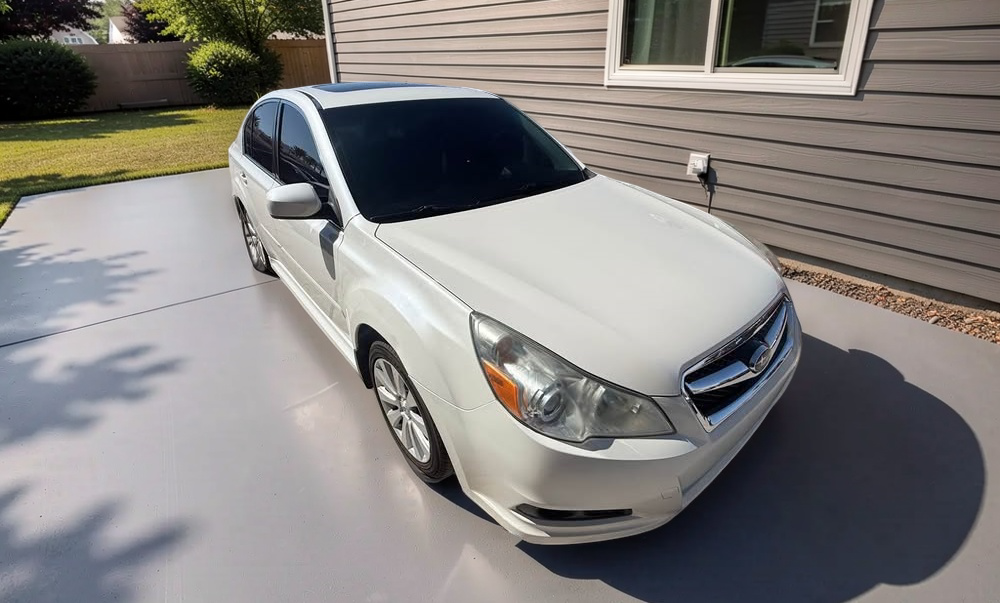
1. Which Legacy years can hide the biggest repair bills?
The engine and gearbox change the risk
A 2012 Legacy 2.5i CVT and a 2012 3.6R use different engines and transmissions. The manual 2.5i adds another choice. Each needs a different inspection, even when the asking prices match.
| Model years and powertrain | Main buying concern | Evidence to demand |
|---|---|---|
| 2005–2009 2.5i and GT | Engine leaks and cooling-system condition; oil-feed checks on applicable GT turbo models | Leak diagnosis, cooling-system condition, and oil-service records |
| 2010–2012 2.5i CVT | Torque-converter wear linked to low rpm or stalling at stops | Diagnosis of any stopping-related shudder and records of the applicable converter repair |
| 2013–2014 2.5i manual; affected early 2013 2.5i CVT | Excess oil consumption within Subaru’s listed production group | Production details, measured oil use, and any short-block repair records |
| 2015–2019 | Head-unit faults, battery drain, and year-specific recalls | Working audio and phone functions, drain diagnosis, and completed recall repairs |
| 2020–2022 2.5-liter or XT | Thermo control valve coverage on qualifying cars; chain-slip recalls on certain 2.4-liter turbo models | Valve repair history or the applicable CVT campaign’s inspection and repair results |
| 2023–2025 | Less long-term evidence; check applicable service programs, including WRB-26 for certain 2023–2024 cars | Maintenance history, current condition, and VIN-specific program and coverage status |
The 2013 change splits the early cars
For 2013, Subaru replaced the non-turbo 2.5-liter EJ engine with the FB-series engine. It also introduced a second-generation CVT. That change separates the earlier converter concern from the later oil-consumption production group.
Subaru’s bulletin 02-157-14R lists all 2013–2014 Legacy 2.5-liter manuals within its affected production table. For 2013 CVTs, it lists cars with VINs before D*048086 and engine numbers below 151602. The asterisk forms part of Subaru’s VIN notation; a dealer should confirm the car’s production details.
That table doesn’t extend the same group to every 2014 CVT. Nor does exclusion prove an engine won’t burn oil. A single dipstick reading shows the oil level at that moment, not its loss over distance.
The 3.6R kept its 5-speed automatic through 2014. It therefore avoids the early four-cylinder CVT hardware and the FB25 oil-consumption concern described above. Its separate powertrain still needs checks for leaks, cooling faults, and transmission wear.
Complaint totals can flag symptoms worth testing. They can’t establish failure rates without knowing vehicle numbers, age, mileage, and reporting patterns. Subaru’s production changes confirm different hardware, but they don’t prove which version lasts longer.
For a 2010–2012 CVT that stalls at stops, bulletin 16-90-13R calls for diagnosis before converter replacement. That includes checking stored fault codes and testing line pressure. A brief road test can’t rule out other hydraulic faults.
2. Older engines can hide more than a gasket leak
Trace the leak before pricing the repair
Coolant crust along a cylinder-head seam deserves a closer look on an older 2.5-liter Legacy. Subaru’s WWP-99 customer-service campaign addressed possible external cylinder-head-gasket coolant leaks on certain 2000–2002 Legacy and Outback models by prescribing cooling-system conditioner. That limited campaign scope does not establish the same defect across every 2005–2012 engine.
An external leak lets coolant escape outside the engine. A combustion leak lets cylinder pressure enter the cooling passages. The two faults need different tests, even when both leave the coolant level low.
Have a shop pressure-test the cooling circuit and trace visible seepage. Suspected combustion leakage calls for further testing, such as checking for combustion gases in the coolant. Oil around the engine also needs tracing before anyone blames a head gasket.
A past overheat makes the repair history more important. Excess heat can warp a cylinder head and compromise its sealing surface. A gasket invoice should show what the shop inspected, measured, and repaired.
“Upgraded gaskets” tells you little about that work. New gaskets can’t correct a warped head or an unresolved cooling fault. Without those checks, the engine can leak again.
A replacement engine needs its own history
Complaints about knocking or engine replacement are leads to investigate, not proof of a common defect or a fixed failure mileage. They also do not establish which model year has the highest failure rate.
Knock alone won’t tell you why an engine failed. Low oil, lost oil pressure, and bearing damage require separate investigation. The original diagnosis matters because a replacement engine may inherit an unresolved fault.
Ask where the replacement came from and when the shop installed it. A used engine’s mileage before installation matters as much as its mileage since the swap. An invoice that says only “engine replaced” leaves its condition and repair scope unclear.
The rest of the car still needs inspection. Structural corrosion can make an engine replacement poor value. A coolant leak or failing radiator can also overheat the replacement engine.
A new GT turbo won’t fix a blocked oil feed
On applicable Legacy GT turbo hardware, a small mesh screen sits inside the oil-supply banjo bolt. Subaru bulletin 02-103-07R warns that clogging or restriction can reduce or cut off turbo oil supply and cause turbo failure. It also calls for checking the oil-supply pipe for blockage.
That oil feeds the turbo’s bearings. Restricted flow leaves them without enough lubrication as the shaft spins. Replacing the turbo without addressing the restriction leaves the replacement exposed to the same fault.
A turbo invoice should show whether the shop checked the screen and supply pipe. Missing oil-change records leave another gap in the engine’s history. Repeated turbo replacements or unexplained modifications warrant a Subaru specialist’s inspection.
A new turbo proves nothing about crankshaft bearings, cylinder sealing, or oil pressure elsewhere in the engine. If restricted lubrication caused the failure, the repair must restore oil flow before the replacement turbo runs.
3. The 2010–2012 CVT can drag the engine to a stop
The lockup clutch can stay applied too long
The engine warms up, the car slows, and rpm drops sharply near a stop. You may feel a shudder before the engine stalls. On affected 2010–2012 Legacy CVTs, wear inside the torque converter can keep its lockup clutch applied.
Subaru bulletin 16-90-13R identifies wear at the converter’s thrust washer. That wear can restrict the oil passage that releases lockup pressure. The clutch then releases late or stays applied as road speed falls.
The effect resembles stopping a manual car without pressing the clutch pedal. The transmission keeps loading the engine when it needs to idle. Subaru’s revised converter replaces the earlier thrust-washer arrangement with a needle bearing.
A stall alone doesn’t prove this fault. Subaru calls for checking stored trouble codes and testing line pressure before replacing the converter. In rare cases, continued symptoms after converter replacement also require a valve body.
During a purchase inspection, include normal driving from cold through full operating temperature. Pay attention to rpm and shudder during ordinary stops. If symptoms appear, have a shop with Subaru diagnostic tools test the transmission.
A converter fault doesn’t condemn the whole CVT
A torque converter, valve body, and complete CVT represent different repair scopes. The estimate should name the failed part and explain the test results. Evidence of internal damage or fluid contamination can change which repair makes sense.
Subaru’s service guidance allows specified repairs to individual CVT parts. A converter diagnosis therefore doesn’t automatically justify replacing the entire transmission. Ask why a complete assembly is necessary if that’s the proposed repair.
For a replacement CVT, confirm whether the unit is new, remanufactured, rebuilt, or used. Those descriptions affect what work it received and what remains unknown. Compare labor, included parts, and the written warranty alongside the price.
Fluid service must follow the guidance for that model year and its operating conditions. Fresh fluid can’t reverse thrust-washer wear. A drain-and-fill receipt doesn’t establish that the converter fault has been repaired.
The old warranty letter won’t cover most cars now
Subaru extended qualifying CVT coverage to 10 years or 100,000 miles, whichever came first. The program included 2010–2015 Legacy 2.5-liter CVTs and the 2015 3.6-liter CVT. The time limit runs from the original warranty start date.
For 2010–2012 cars, that protection has generally expired by October 2026. Low mileage alone doesn’t preserve coverage once the age limit passes. Have Subaru confirm any remaining coverage before counting it toward the purchase.
A past transmission replacement needs its own paperwork. Subaru states that remanufactured CVTs dated December 31, 2013, or later include the revised converter. An invoice without the replacement unit’s details doesn’t establish which converter it contains.
4. A full dipstick can hide the 2013–2014 oil problem
The transmission narrows the affected group
Subaru’s oil-consumption bulletin 02-157-14R identifies specific Legacy production groups. Its table includes all 2013–2014 2.5-liter manuals. For 2013 CVTs, it lists cars with VINs before D*048086 and engine numbers below 151602.
The asterisk belongs to Subaru’s VIN notation. Have a dealer check the production details against both listed cutoffs. A model year alone won’t confirm whether an early 2013 CVT falls within that group.
The table doesn’t include every 2014 CVT under the same production criteria. An engine outside those limits can still consume oil for other reasons. Wear, external leaks, and crankcase-ventilation faults still need investigation.
Measure what disappears between top-ups
A seller can top up the oil minutes before an inspection. The dipstick then shows a full sump, even if the engine needs frequent refills. Dated mileage and oil-addition records reveal what that single reading can’t.
Subaru’s procedure calls for addressing external leaks and crankcase-ventilation concerns before measuring consumption. Its repair threshold was more than one-third quart over 1,200 miles under the prescribed test. That threshold applied to the bulletin’s qualifying vehicles and conditions.
A low-oil warning doesn’t establish the amount consumed or its cause. Subaru also addressed premature warning-light operation in the bulletin. Oil inside a spark-plug well points toward a sealing leak there, not proof of worn piston rings.
Check the miles after a short-block repair
For qualifying cases, Subaru specified replacement of the engine short block. That assembly contains the block, crankshaft, connecting rods, and pistons. The repair doesn’t mean the shop replaced every engine part.
Ask for the installation mileage and oil-use records after the repair. A short-block invoice establishes the work performed, but not the engine’s current consumption. Continued top-ups need measured amounts and distances, even after replacement.
The historical warranty extension lasted 8 years or 100,000 miles, whichever came first. Coverage generally has expired for these cars by October 2026. A car below 100,000 miles still falls outside the extension once its 8-year limit passes.
5. A frozen screen and a dead battery need different fixes
The screen’s model year sets the coverage
A Legacy’s display may freeze, reboot, go blank, or stop responding to touch. Visible screen damage can accompany some failures. Test phone pairing, audio, and touch controls through a normal drive, not just at startup.
Subaru uses separate warranty programs for different head units and telematics modules. The data communication module, or DCM, handles connected services and can cause battery drain. A head-unit replacement doesn’t establish that the DCM works correctly.
| Legacy hardware | Published warranty extension | Limit that matters |
|---|---|---|
| 2018 Harman Gen 3.0, bulletin 15-263-20 | 5 years/100,000 miles | Normally expired by October 2026; confirm the unit and VIN |
| 2019 Harman Gen 3.1 and 2020–2022 CP1, bulletin 15-322-25R | 8 years/150,000 miles | Covers qualifying failures; replacement under the program is one-time |
| 2016–2018 DCM, bulletin 15-317-24R | 8 years/100,000 miles | Covers the specified telematics-related drain; temporary unrestricted coverage has ended |
| 2019 DCM, bulletin 15-318-24R | 8 years/150,000 miles | Requires diagnosis linking excessive standby current to the DCM |
The age and mileage limits apply whichever comes first. A dealer must check the original warranty start date and prior program repairs. A previous covered replacement can affect eligibility for another head unit.
Head-unit coverage doesn’t automatically include speakers, amplifiers, wiring, or physical damage. Where the program requires software updates first, the shop must follow that repair path. An unresponsive screen alone doesn’t establish eligibility for replacement.
Another battery can leave the drain untouched
A new battery can start the engine while leaving an overnight drain unresolved. On affected 2016–2018 cars, the DCM can repeatedly try to reach the discontinued 3G network. Subaru documents this behavior when the relevant update hasn’t been completed.
The shop needs to separate a worn battery from a charging fault or excessive standby draw. Current testing must follow Subaru’s prescribed conditions and allow the car to enter its sleep state. Measuring too soon can mistake normal activity for a fault.
The 2019 DCM program addresses a different cause involving internal memory corruption. That fault can leave the module drawing excessive current after shutdown. The repair record should identify the module as the cause, rather than simply note a discharged battery.
The 2019 repair changed when parts returned
Subaru revised its 2019 DCM repair guidance in 2025 after replacement stock became available. Qualifying repairs returned to DCM replacement. The earlier bypass-box installation stopped being a covered repair measure under that program.
If a seller reports a past bypass repair, obtain the dated invoice. It identifies which repair the shop performed under the guidance then in effect. For a car that still loses charge, the shop must measure standby draw again after the prescribed sleep period.
6. A windshield crack can bring an EyeSight calibration bill
Two glass programs cover different years
A crack across the windshield doesn’t establish whether Subaru will pay for replacement. The model year, glass, damage pattern, and repair history affect eligibility. Subaru’s programs cover separate groups with different limits.
For certain qualifying 2015–2016 Legacys, Subaru extended coverage for an applicable factory-installed windshield to 8 years with unlimited mileage and allowed a one-time replacement. By October 2026, that protection has generally expired.
The 2020–2022 program uses bulletin 12-257-25R and a different limit. It allows one qualifying replacement within 8 years or 100,000 miles, whichever comes first. Genuine Subaru glass and the program’s damage criteria matter.
Covered damage can involve a small chip followed by continued stress cracking. An impact mark therefore doesn’t automatically rule out coverage. Have the dealer assess the crack before authorizing an out-of-pocket replacement.
The glass invoice needs to include calibration
On an EyeSight-equipped Legacy, the cameras look through the windshield. Replacement glass and its installation affect that viewing path. The repair must follow the applicable camera-calibration procedure.
An out-of-pocket estimate should include glass, moldings, installation charges, and required EyeSight calibration. A glass-only quote leaves part of the repair unpriced. Subaru’s later windshield program includes EyeSight calibration in its repair provisions.
For a car with replacement glass, ask for the installation and calibration records. Check that the shop completed the procedures required for that model. A dashboard without an EyeSight warning doesn’t prove the cameras passed calibration.
7. The 2020–2022 engine choice changes what can fail
The thermo control valve can trigger fault codes
Qualifying 2020–2022 Legacys use an electronic thermo control valve, or TCV, to manage coolant flow. Subaru says coolant-vapor intrusion into the valve’s sensor can trigger P2682 and/or P26A-series codes.
Subaru bulletin 09-119-24 extends qualifying TCV coverage to 15 years or 150,000 miles, whichever comes first. This is a warranty extension, so the dealer must confirm eligibility and diagnose the fault. A stored code alone doesn’t establish that every cooling repair qualifies.
The replacement part number matters. 21319AA040 already incorporates the redesign, while 21319AA010 spans versions that require production-date checks. Subaru introduced the revised valve into production on June 7, 2021.
Subaru says technicians can’t read the valve’s date code while it remains installed. A repair invoice can therefore tell you more than a quick underhood inspection. Ask which part the shop fitted and at what mileage.
Certain turbo models need more than a software receipt
The 2.4-liter turbo has a separate CVT recall history. 21V955 / WRK-21 covers certain 2020 Legacy turbo models. 22V485 / WRK-22 covers an additional group of 2020–2021 turbo cars.
An incorrect transmission-control-module program can allow the CVT drive chain to slip. The chain guide may break, and continued operation can eventually break the drive chain and cause loss of motive power.
The recall repair includes reprogramming, analysis of stored transmission data, and chain-guide inspection. Specified findings require transmission replacement. A receipt that lists only a software update doesn’t show the inspection results.
Ask for the campaign repair order showing what the dealer found. If the shop replaced the CVT, the record should identify the replacement assembly. Recall completion doesn’t resolve a new slip, shudder, or loss of drive that develops afterward.
The newer CVT extension has a firm mileage limit
Subaru’s 2025 bulletin 16-155-25R extends coverage for two specific Legacy configurations. It covers qualifying 2019 2.5-liter and 2020 2.4-liter CVTs. The limit is 10 years or 100,000 miles, whichever comes first.
The program briefly allowed coverage regardless of mileage or the original warranty start date. That temporary period ended June 30, 2026. By October 2026, buyers must use the regular age and mileage limits when assessing coverage.
The bulletin excludes salvage-yard CVTs, rebuilt salvage vehicles, and CVTs overhauled, remanufactured, or rebuilt by parties not approved by Subaru. Confirm eligibility through Subaru’s Vehicle Coverage Inquiry and retain any available records identifying the installed CVT. A qualifying car with more than 100,000 miles now falls outside this extension’s standard mileage limit.
8. An open steering recall can stop the test drive
Match the recall to the VIN
A recall’s model-year range doesn’t mean every Legacy in that range needs repair. Production dates and affected parts narrow the group. Check the VIN, then obtain the dealer’s record of the completed work.
| Recall campaign | Affected Legacy group | Failure and required repair evidence |
|---|---|---|
| 16V292 / WTD-65 | Certain 2016–2017 cars | Incorrectly machined steering shafts can fail to transmit steering-wheel movement. Verify inspection and replacement where required. |
| 20V218 / WRD-20 and 21V587 / WRG-21 | Certain 2019 cars under the first campaign; certain 2018–2020 cars under the later campaign | A deformed low-pressure fuel-pump impeller can stop the pump and stall the engine. Verify the applicable pump replacement. |
| 24V227 / WRA-24 | Certain 2020–2022 cars | Faulty occupant-detection sensors can prevent passenger-airbag deployment. Verify replacement of the affected passenger-seat sensors. |
| 23V755 / WRQ-23 | Certain 2021–2023 cars | Water entering the inhibitor switch can disable the reverse lights and rear-camera image. Verify switch replacement. |
| 23V647 / WRN-23 | Certain 2023 cars | Paint on propeller-shaft center-support brace mounting surfaces can prevent the bolts from retaining specified tightness. Verify that the surfaces were cleaned and new bolts installed. |
The steering campaign comes before a road test
Subaru instructed owners of affected WTD-65 vehicles not to drive until inspection and any required repair. A normal steering feel doesn’t establish that the shaft meets specification. Arrange the recall inspection before taking an affected, unrepaired car onto the road.
For other candidates, compare the current VIN lookup with dated repair orders. The records should identify the campaign and the work performed. A general service invoice or “all recalls done” statement leaves those details unconfirmed.
A closed campaign records completion of its specified remedy. It doesn’t explain a fresh stall, warning light, or transmission fault. An engine that still cuts out after a fuel-pump recall repair needs a separate diagnosis.
9. Better Legacy choices still come with limits
The 3.6R badge hides two transmission choices
The 2010–2014 Legacy 3.6R pairs its 3.6-liter flat-six with a 5-speed automatic. That combination avoids the four-cylinder’s early CVT converter hardware and the FB25 oil-consumption concern. Age still leaves room for coolant leaks, worn seals, and transmission wear.
A clean service history matters more than the badge. Have a shop inspect the engine for leaks and test the cooling system. The automatic also needs a road test from cold through full operating temperature.
The 2015–2019 3.6R uses a high-torque CVT instead of the 5-speed automatic. Its transmission differs from the four-cylinder unit, but “high torque” doesn’t establish a lower failure rate. Repair history and present condition still determine how much risk you’re buying.
The six-cylinder also brings higher fuel use than comparable 2.5-liter versions. Compare fuel costs alongside the purchase price and any pending repairs. A 2015–2019 3.6R still exposes you to CVT repair costs.
A 2019 still needs its electronics checked
The 2019 Legacy came near the end of its generation, making it worth considering with documented maintenance. Its age gives buyers more service history to examine than newer cars. That history needs to cover the transmission, head unit, and battery drain.
Check the applicable fuel-pump recall and any DCM repairs. Test the Harman head unit through a normal drive. For a 2.5-liter car, have Subaru confirm eligibility under the newer CVT extension.
That extension doesn’t apply to the 2019 3.6R under the same bulletin. Nor does a working screen today establish unused replacement coverage. Prior repairs and the original warranty start date affect what remains available.
Newer cars have less wear, but less history
The 2023–2025 Legacys offer younger alternatives with less accumulated age. They also have fewer years of long-term evidence. Lower complaint totals alone can’t establish how they’ll hold up at high mileage.
Certain 2023–2024 cars fall under Subaru service program WRB-26, dated February 2026. Incorrect FOTA software-version linking can leave telematics functions unavailable; dealers check the DCM, replace an affected DCM, and initialize the CCU.
WRB-26 is a service program, so a safety-recall search alone may miss it. Ask Subaru to check both recalls and service programs against the VIN. The repair record should show which work the dealer completed.
2025 was the final Legacy model year. Before setting an offer price, obtain an inspection from a shop with Subaru diagnostic tools. Require written, VIN-specific details of outstanding repairs and remaining component coverage.
Sources & References
- Subaru 2013 Legacy press kit: FB engine and second-generation CVT
- Subaru TSB 02-157-14R: engine oil consumption
- Subaru 2014 Legacy press kit: 3.6R transmission
- Subaru TSB 16-90-13R: torque-converter design change
- Contemporaneous WWP-99 campaign announcement reproduction
- Subaru 2024 Warranty and Maintenance Booklet
- Subaru TSB 02-103-07R: turbocharger oil-supply mesh screen (reproduced)
- Subaru TSB 16-107-17R: CVT warranty extension
- Subaru TSB 15-263-20: 2018 Harman Gen 3.0 head-unit extension
- Subaru TSB 15-322-25: CP1 and Gen 3.1 head-unit extension
- Subaru TSB 15-317-24R: 2016–2018 DCM warranty extension
- Subaru TSB 15-318-24R: 2019 DCM warranty extension and revised repair
- Subaru 2015–2016 Legacy/Outback windshield extension notice
- Subaru TSB 12-257-25R: windshield extension and inspection
- Subaru TSB 09-119-24: thermo control valve warranty extension
- Subaru TSB 09-80-21R: thermo control valve design change
- Subaru WRK-21/22R: CVT chain-guide safety recall
- Subaru TSB 16-155-25R: CVT warranty extension
- Subaru WTD-65 / NHTSA 16V-292: steering recall owner notice
- NHTSA 20V-218 / Subaru WRD-20: fuel-pump recall
- Subaru WRG-21 / NHTSA 21V-587: fuel-pump recall
- NHTSA 24V-227 / Subaru WRA-24: occupant-detection recall
- NHTSA 23V-755 / Subaru WRQ-23: inhibitor-switch recall
- Subaru WRN-23 / NHTSA 23V-647: propeller-shaft recall owner notice
- Subaru WRB-26 service-program bulletin copy
- Subaru announcement: Legacy production ends after the 2025 model year
- Subaru 2015 Legacy introduction: 3.6R high-torque CVT