
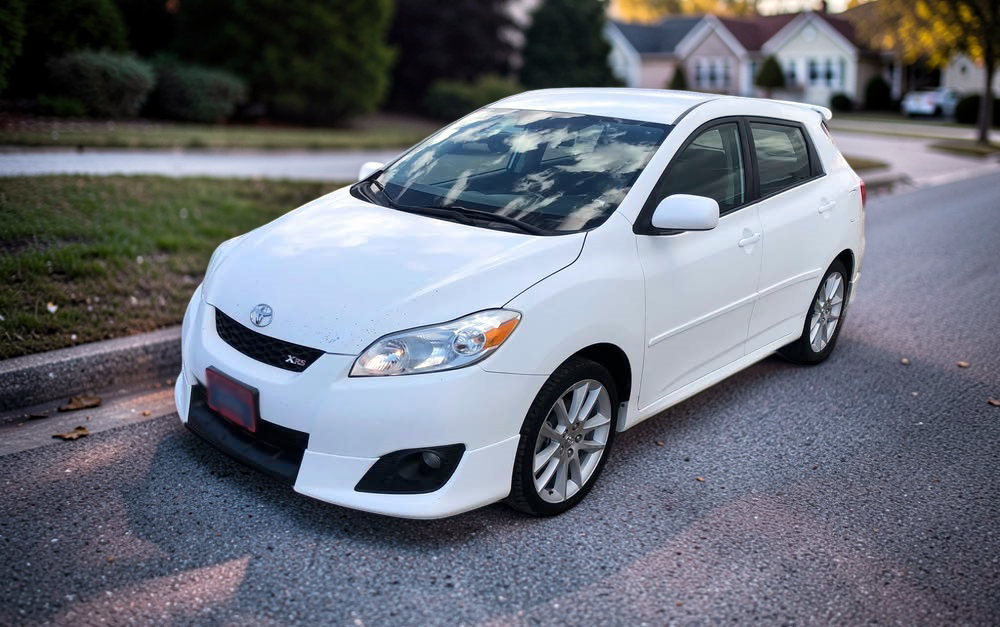
A dry dipstick stops the walkaround before that cheap Matrix even starts. Some 2.4-liter engines let oil slip past the piston rings and burn. Miss enough top-ups, and low oil can damage the bearings.
The 2009–2013 2.4-liter models deserve close checks for oil use. Toyota’s piston repair bulletin includes that full span. Buying a later year will not settle the concern.
Older cars bring other repair risks. Early five-speed manuals need careful gearbox checks. Certain 2005–2008 front-wheel-drive models also have recalled engine computers that can cause starting, stalling, or performance problems. Recall coverage depends on the VIN and fitted equipment, not just the badge on the hatch.
Here’s which Toyota Matrix years and engines need caution, where rust hides, and which repairs matter before you buy.
1. Check the engine before trusting the year
The same badge hides different engines
A used listing that says “1.8-liter Matrix” leaves out a key detail. Toyota used three different 1.8-liter engine families across the model’s U.S. run. Each needs its own checks.
Trim names also changed by year and market. Match the VIN-based build record to the engine fitted. An engine swap can leave the original sales details out of date.
| Model years and version | Engine | What matters before buying |
|---|---|---|
| 2003–2008 standard models, including XR | 1ZZ-FE, 1.8-liter | Check the five-speed manual separately from the automatic. Some earlier cars also offered AWD. |
| 2003–2006 XRS | 2ZZ-GE, 1.8-liter | This performance engine uses a six-speed manual. Do not apply the standard five-speed diagnosis to it. |
| 2009–2013 base/L models | 2ZR-FE, 1.8-liter | These use a five-speed manual or four-speed automatic. This engine is outside the 2AZ oil-consumption bulletin. |
| 2009–2013 versions with the larger engine | 2AZ-FE, 2.4-liter | U.S. S and some XRS versions use this engine. Second-generation AWD versions also use the 2.4-liter and a four-speed automatic. |
A 2013 badge doesn’t clear the pistons
Toyota’s oil-consumption repair bulletin T-SB-0030-15 includes qualifying 2009–2013 Matrix models with the 2AZ engine. It calls for revised piston assemblies and rings to reduce oil use. The listed years extend beyond 2009 and 2010.
A late registration date does not prove that the engine has those revised parts. A receipt for piston and ring replacement gives you stronger evidence. A receipt that says “engine replaced” leaves the replacement’s internal parts unknown.
Oil-use records after the repair matter, too. Fresh oil at the full mark shows only the level during that check. A short test drive cannot measure how much oil the engine burns between top-ups.
2. A noisy five-speed can swallow the savings
Listen for bearing noise in 2003–2008 manuals
Standard first-generation manual models use the C59 five-speed gearbox. Give early cars close attention for growling, hard shifts, or gears that jump out. Later 2006–2008 examples still need the same checks.
Some transmission rebuilders identify output-shaft bearing wear as a recurring C59 service issue. That supports careful inspection, but it does not establish a failure rate for every model year. Do not treat a known repair pattern as proof that every C59 will fail.
The clutch pedal gives clues, not a diagnosis
A growl at idle in neutral may change when you press the clutch. Pressing the pedal changes the load and speed of parts inside the gearbox, which can change bearing noise.
That change alone does not identify the failed bearing. Clutch-release parts and other gearbox bearings can make overlapping sounds. A technician needs to compare noise with pedal position, engine speed, and road speed.
Grinding during shifts points toward a different set of checks. Worn synchronizers can struggle to match gear speeds, while a dragging clutch can keep the input shaft turning. Clutch slip instead lets engine speed rise without a matching gain in road speed.
A gear that jumps out during normal driving needs separate diagnosis. Worn engagement teeth, shift parts, or excess shaft movement can cause it. A new clutch will not repair damaged teeth or worn gearbox bearings.
The replacement price starts before labor
One supplier lists a rebuilt 2003–2008 C59 at $1,699. That buys the gearbox, not the complete installed repair. Installation, shipping, fluids, and any core charge can add to the bill. It is one supplier’s parts price, not a national installed estimate.
A used gearbox needs an exact model match, a condition check, and clear warranty terms. An invoice saying “transmission replaced” does not show whether anyone replaced worn bearings. Ask for the rebuild parts list or the used unit’s mileage and warranty.
Core refunds also have limits. A supplier may require the correct, complete gearbox with no external case damage and no broken gears. A cracked housing can cost you the core refund on top of the repair.
3. A bad engine computer can mimic transmission damage
The stalling recall covers specific 2005–2008 cars
Recall 10V384 covers certain 2005–2008 Corolla and Matrix vehicles. Cracks can develop at solder joints or protective components inside the engine computer. Those faults can disrupt its operation and may lead to starting, stalling, or performance problems.
The recall is configuration- and VIN-specific. Do not assume that every 2005–2008 Matrix is covered, or that an AWD or XRS car has the same computer as a front-wheel-drive 1ZZ-FE model. Toyota’s VIN campaign history should control the buying decision.
P2716 needs testing before a gearbox quote
Code P2716 indicates a fault involving pressure-control solenoid D. That solenoid helps control hydraulic pressure inside the automatic transmission. A fault in its control circuit can produce hard shifts without proving internal gearbox damage.
Toyota bulletin TC015-07 addresses harsh shifts with this code on certain 2005–2007 front-wheel-drive automatics with the 1ZZ-FE engine. The diagnostic process can lead to engine-computer replacement, but the code alone does not identify which electrical part failed. Wiring, connections, the solenoid, and the computer need the proper checks.
Continued harsh shifts after a confirmed computer repair require further diagnosis. Do not approve a complete gearbox replacement based on the code alone.
A cleared warning light proves little
Ask Toyota for the VIN-specific campaign history and the invoice showing what the dealer did. The record should identify the inspection or computer replacement. If the paperwork conflicts with the fitted computer, have Toyota check its identity.
A documented repair and normal starting and shifting change the buying assessment. Scan for stored and pending faults alongside the road test. Check emissions readiness, too, since clearing codes or disconnecting the battery can reset those monitors.
Incomplete monitors do not prove the seller hid a fault. They do show that some self-checks have not finished. A blank fault screen immediately after a reset cannot establish that the repair worked.
4. Oil burning can turn a 2.4-liter bargain into engine work
The trouble starts at the piston rings
Oil-control rings scrape excess oil from the cylinder walls as the pistons move. When those rings stick or stop controlling oil, more oil reaches the combustion chamber. The engine burns it, and the level drops between changes.
Oil loss can leave bearings short of lubrication if you do not replenish it. No single mileage marks when every 2AZ-FE starts burning oil. No fixed amount of remaining oil defines when damage begins. Maintenance history and actual measured consumption matter more than the odometer alone.
Toyota’s T-SB-0030-15 calls for revised piston assemblies and rings to reduce consumption. The repair requires opening the engine and replacing those parts.
Fresh oil can hide the rate of loss
A seller can fill the sump before you arrive. A full dipstick will not show how much oil disappeared last week. A low reading could reflect burning, leaks, or missed maintenance.
Oil-addition records give you mileage and volume to compare. Check for external leaks, too, since oil escaping past a gasket also lowers the level. Heavy tailpipe deposits or fouled spark plugs justify more testing, but neither proves failed oil-control rings.
A short road test will not measure consumption over hundreds of miles. Ask for earlier test results and records since any piston repair. An old passing result does not establish the engine’s current oil use.
Toyota’s test measured loss over 1,100–1,300 miles
Toyota’s oil-consumption procedure describes a controlled test. Technicians set the starting level and use inspection seals to help detect tampering. Owners then return after approximately 1,100–1,300 miles.
The follow-up check uses a measured oil addition. If the level still falls below full after the prescribed checks, the procedure directs technicians toward the applicable repair. The test must follow Toyota’s mileage and inspection requirements to be meaningful.
That threshold served Toyota’s repair assessment. Passing it could still leave you adding oil between changes. For a used-car purchase, measured loss over time matters more than a seller’s claim that consumption meets a factory limit.
A used engine can bring the same pistons
An invoice listing revised pistons and rings identifies work aimed at the oil-burning fault. “Used engine installed” leaves those parts unknown. The replacement could retain the original piston design.
Ask which parts the shop fitted and how oil use changed afterward. A repair date alone will not show whether consumption improved. Bearing damage or scored cylinder walls can also require work beyond the piston repair.
Toyota lists 14.2 labor hours for front-wheel-drive Matrix piston repairs and 14.7 hours for AWD. Those figures show the job’s scale, but they do not set a retail labor quote. Parts, shop rates, and added engine damage change the bill.
ZE7 coverage had firm limits
Toyota’s Warranty Enhancement Program ZE7 covered qualifying oil-consumption repairs under specific terms. Primary coverage ended October 31, 2016, regardless of mileage. Secondary coverage lasted 10 years from first use or 150,000 miles, whichever came first, subject to the program’s conditions.
By 2026, buyers should normally expect those terms to have expired. Confirm any claim of remaining coverage or goodwill assistance with Toyota using the VIN. A service bulletin alone does not entitle you to a free piston repair.
5. An airbag recall can stop the test drive
Certain 2003–2004 cars must stay parked
NHTSA’s current Takata warning includes certain 2003–2004 Corollas, including Matrix models. Their recalled inflators can rupture during deployment and throw metal fragments into the cabin.
Heat, humidity, and age can degrade the inflator’s propellant. A rupture can cause severe injury or death. A clean interior and normal engine operation reveal nothing about that risk.
Check the VIN before arranging a test drive. An affected, unrepaired car should receive recall service before it moves under its own power. Ask Toyota about mobile repair, vehicle pickup, or towing instead of driving it to the dealer.
Later models still need an airbag check
Toyota’s Takata recall information includes Matrix model years from 2003 through 2013, but the specific campaign depends on the VIN and repair history. Choosing a later 1.8-liter car does not remove the need for this check.
An old airbag invoice records one repair at one point in time. It does not establish that the car has completed every later campaign. Have Toyota match that invoice’s campaign number against the car’s current recall record.
A blank VIN search leaves gaps
NHTSA’s VIN search does not display recalls that have already been repaired. It can also omit recalls more than 15 years old, unless the manufacturer supplies broader coverage. That limit matters for older Matrix campaigns, including some engine-computer and airbag campaigns.
Ask a Toyota dealer for the VIN-specific campaign history and match it to repair invoices. Check which campaigns applied, what work the dealer recorded, and whether any remain open. “No open recalls shown” does not prove that every recalled part received its required repair.
6. Pedal, brake, and window recalls hit different years
The accelerator-pedal recall covers certain 2009–2010 cars
The Matrix accelerator-pedal recall includes certain 2009–2010 models. Friction inside the affected pedal assembly can make the pedal harder to depress, return slowly, or remain partly depressed. The campaign is VIN-specific, so verify the repair rather than relying on the model year.
Floor-mat entrapment involved a separate recall campaign. A loose or wrong-size mat can trap the pedal even when its internal mechanism works. Individual acceleration complaints do not establish which defect caused an event.
Match the repair record to the failed part
| Potentially affected Matrix vehicles | Campaign and fault | Required repair or proof |
|---|---|---|
| Certain 2003–2004 cars with power windows | 08V162. Front door-glass bolts can loosen, allowing glass to separate from the regulator. | Confirm replacement of the specified glass bolts. A window that moves normally does not prove completion. |
| Certain 2009–2010 cars | 10V017. The accelerator pedal assembly can become harder to operate or return slowly. | Verify the campaign repair using the VIN and dealer record. |
| Certain 2009–2010 1.8-liter cars | 09V338. In extreme cold, frozen condensation can block the brake-vacuum port. Reduced brake assist can increase stopping distance. | Confirm the revised intake-air connector. U.S. coverage included specific cold-weather states and sales or registration conditions. |
| Certain 2009–2011 cars | 15V689. The power-window master switch can short, overheat, and melt. | Confirm switch inspection and the specified repair or replacement where required. |
The campaign number is only the starting point. Match it to the car’s VIN, market, production details, and repair history.
7. Which Matrix belongs on the shortlist?
A repaired 2007–2008 automatic deserves a look
A 2007–2008 1.8-liter automatic can be a reasonable first-generation candidate with sound maintenance and completed recall work. Its automatic gearbox removes the C59 manual-bearing concern from the purchase. Check oil use and rust separately, since neither follows transmission type.
A rough cold idle needs its own diagnosis. Toyota bulletin EG045-07 covers intake-gasket leaks on certain 2003–2008 1ZZ-FE cars after a subfreezing cold soak. Air entering past the gasket can leave the fuel mixture too lean.
Codes can include P0171, P0300–P0304, and P0133. These point to lean running, misfires, or slow oxygen-sensor response, but they do not prove the gasket leaks. Toyota’s repair calls for confirming the leak and fitting the revised intake-manifold gasket.
Start with a 2011–2013 1.8-liter for simpler experience
The 2011–2013 base/L models are sensible starting points if you want to avoid the specific 2AZ oil-consumption program. Their 2ZR-FE engine falls outside that bulletin. That distinction supports the choice, but it does not establish the lowest overall failure rate.
A well-kept 2009–2010 1.8-liter can also earn a place after applicable recall repairs. Toyota made stability and traction control standard for the 2010 U.S. Matrix. Check the fitted equipment on a 2009 car rather than assuming it has both.
Stability control can brake individual wheels to help correct a skid. Traction control limits wheelspin under power. Neither can restore grip that worn tires have lost.
More power and AWD come with the 2.4-liter
Toyota rated the later 1.8-liter at 132 hp, compared with 158 hp for the 2.4-liter. The larger engine gives you 26 more horsepower. Second-generation AWD models also require that engine, so they need the same oil-use checks.
A Canadian listing for a 2014 Matrix can be correct. Toyota continued selling the model there after U.S. sales ended. Confirm its Canadian specification and campaign history, since trim names and equipment differ by market.
The second-generation AWD version pairs its 2.4-liter engine with a four-speed automatic. Toyota did not offer that AWD setup with the 1.8-liter.
8. Hidden rust can rule out a good engine
Look behind the plastic rocker trim
Plastic rocker trim can hide rust along the steel beneath the doors. Clean paint above it tells you little about that metal. Have a shop inspect behind the trim and beneath the car on a lift.
The inspection should cover rocker panels, pinch welds, floor edges, subframes, and suspension mounting points. Light surface rust differs from deep scaling, holes, or metal that has lost strength. Thick undercoating can obscure those defects rather than repair them.
Salt exposure, trapped moisture, and past body repairs matter across both Matrix generations. The evidence does not support treating 2006 as the only year at risk. Suspected structural rust needs a body specialist’s assessment, especially where suspension mounts attach to the shell.
Lift the cargo floor before agreeing on price
Lift the cargo floor and inspect the spare-wheel well. Standing water, rust stains, or musty trim justify tracing a leak. Remove the spare so it does not hide damage around its mount.
Taillight seals, hatch seals, and body seams are possible entry points. Water can travel along panels before collecting in the lowest part of the floor. A wet spare-wheel well alone does not identify the failed seal.
A controlled water test should trace the entry path before anyone replaces parts. The shop must also assess the floor once it is dry and exposed. Sealing the leak will not restore steel that corrosion has eaten through.
Sources & References
- Toyota T-SB-0030-15, 2AZ Engine Oil Consumption Repair Procedure
- Toyota Warranty Enhancement Program ZE7
- NHTSA Takata Air Bag Recall: Do Not Drive Vehicles
- Toyota Takata Airbag Safety Recall
- NHTSA Check for Recalls: VIN search limitations
- NHTSA campaign 10V017, accelerator pedal assembly
- Toyota/NHTSA campaign 08V162, door-glass bolts
- NHTSA campaign 09V338, Corolla/Corolla Matrix brake-vacuum port
- Toyota Matrix recall listings
- Toyota Safety Recalls and Service Campaigns VIN Lookup
- Toyota Matrix 2010 powertrains and standard VSC/TRAC
- Toyota Canada 2014 Matrix Specifications