
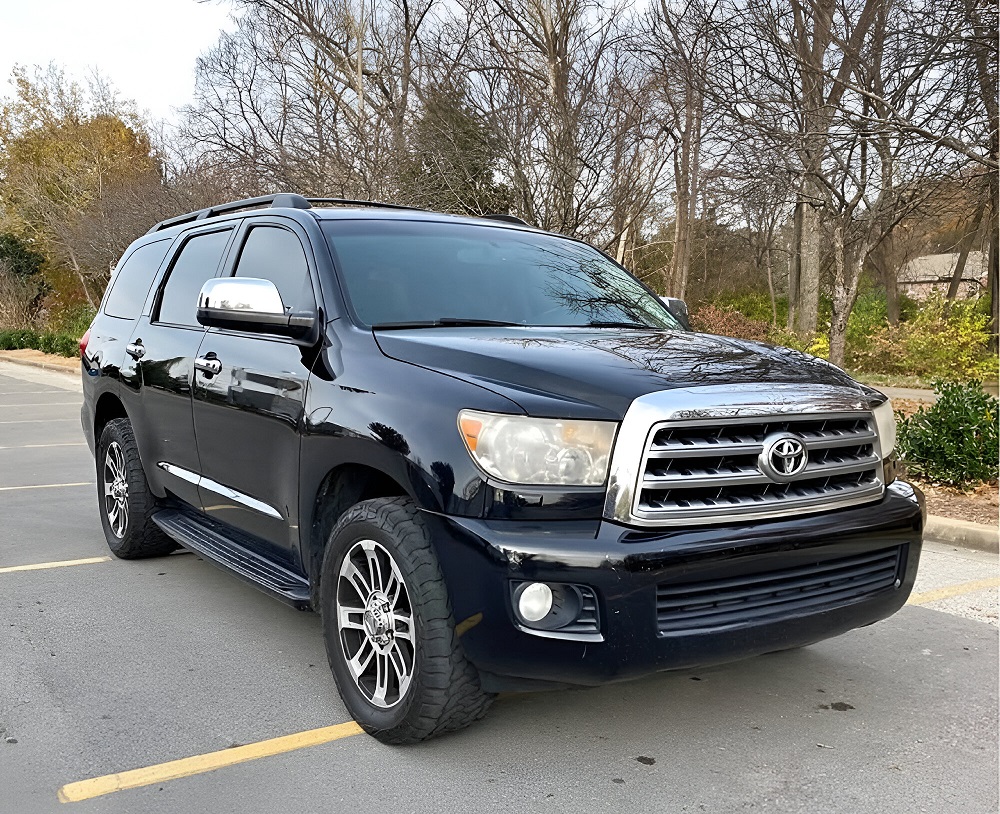
1. Which Sequoia years deserve a closer look
| Model years | Documented concerns or considerations | What to check before buying |
|---|---|---|
| 2001–2004 | NHTSA investigated reported yaw-rate-sensor behavior on certain 2001–2002 Sequoias. Separate recalls covered certain 2002–2004 lower-ball-joint applications and certain 2003 vehicle-stability-control systems. | Check the VIN for completed recalls. Have a mechanic inspect the ball joints, steering, brakes, and any recurring stability-control warnings. |
| 2005–2007 | Toyota’s ZH8 frame program covered certain vehicles whose corrosion met the program’s inspection criteria. Certain vehicles were also covered by lower-ball-joint recalls. | Inspect the frame rails, crossmembers, suspension mounts, and ball joints. Do not assume that every vehicle in these model years qualified for frame coverage. |
| 2008 | The redesign introduced two different V8 powertrains. Certain vehicles were covered by Toyota’s ZH9 frame program, while selected vehicles also require attention to timing-belt maintenance and air-injection systems. | Identify the engine, verify timing-belt history on 4.7-liter models, inspect the frame, and diagnose emissions faults before approving repairs. |
| 2009–2012 | Engine choice affects maintenance requirements. Certain 4.6-liter and 5.7-liter vehicles appear in Toyota air-injection warranty enhancements or technical guidance. | Confirm the engine and service history. Treat codes such as P2440 or P2442 as starting points for diagnosis, not automatic proof that the air pump needs replacement. |
| 2013–2020 | Later V8 Sequoias may offer desirable equipment, but owner reports, complaint totals, and campaign records do not establish an objective reliability ranking by year. Certain 2018–2020 vehicles may be affected by Toyota fuel-pump campaign 20TA02. | Use the vehicle’s condition, maintenance records, equipment, and VIN-specific campaign status to set the price. Verify 20TA02 eligibility and completion directly with Toyota. |
| 2021–2022 | These are among the final V8 Sequoias and may appeal to buyers seeking newer equipment, but their age and model year do not prove a lower failure rate. | Check the VIN, service records, frame condition, engine leaks, tires, brakes, and overdue maintenance. Compare the asking price with likely costs of owning the vehicle. |
| 2023–2025 | Selected hybrid Sequoias are covered by recalls involving transmission-control software, tow-hitch covers, or rearview-camera software. | Check the VIN for open and completed recalls. Match completed remedies to repair invoices, and have continuing shifting, warning-light, or stalling concerns diagnosed separately. |
The concern changes with the vehicle’s age
Older Sequoias deserve a system-by-system inspection rather than a blanket rejection. On 2001–2002 vehicles, NHTSA investigated reports involving yaw-rate-sensor malfunctions and unexpected stability-control or braking behavior. The investigation, PE16-006, closed in December 2016 without a safety recall. That closure means NHTSA did not require a recall based on its testing and findings; it does not make a recurring warning or steering-pull complaint irrelevant.
Certain 2003 Sequoias were covered by recall 10V-176 for a vehicle-stability-control software problem that could activate near 9 mph. Certain 2002–2004 and certain 2004–early 2007 Sequoias were also covered by lower-ball-joint recalls. The word ‘certain’ matters: production and VIN eligibility determine whether a truck was included.
For certain 2005–2007 vehicles, Toyota’s ZH8 frame program offered frame replacement when corrosion met the program’s inspection standard. A separate ZH9 program addressed certain 2008 vehicles. These were conditional programs, not blanket recalls for every Sequoia in those model years.
Complaint counts do not establish reliability
Raw complaint totals cannot show how likely a Sequoia is to fail. Sales volume, vehicle age, mileage, reporting habits, and surviving vehicle condition all affect the count. A small number of online reports can identify a possible issue, but it cannot establish a failure rate.
For a purchase decision, give more weight to the inspection, service records, diagnostic evidence, and confirmed recall status. If a seller cites a completed campaign, ask for the repair order or have Toyota verify the VIN.
2. Early Sequoias: brake-control warnings and worn joints
The yaw-rate-sensor investigation was not a recall
NHTSA’s PE16-006 investigation examined reported yaw-rate-sensor malfunctions in 2001–2002 Sequoias. The documented concern involved unexpected stability-control or braking behavior, along with warning indications. NHTSA closed the investigation without requiring a recall.
If a truck shows recurring VSC warnings, a warning buzzer, or a steering pull, have a qualified technician diagnose it before purchase. Do not assume that a particular diagnostic code or a suspected sensor explains every stability-control symptom; the applicable service information and vehicle testing should identify the cause.
Certain 2003 trucks can activate VSC near 9 mph
Recall 10V-176 covers certain 2003 Sequoias whose VSC control unit could store an incorrect steering-angle reference. Under the condition described in the recall, VSC could activate near 9 mph after the vehicle pulled away from a stop. Toyota’s remedy was a software update, with control-unit replacement when the unit could not accept the update.
This campaign does not cover every early Sequoia. Confirm eligibility and completion using the VIN. A VSC warning on a different model year does not establish that the 10V-176 condition is present.
Ball-joint recalls deserve a current inspection
Recall 05V-225 covers certain 2002–2004 Sequoias with lower-ball-joint defects that could cause premature wear or looseness. In the affected vehicles, separation could lead to loss of steering control. Recall 07V-013 covers certain 2004–early 2007 Sequoias and calls for replacement of affected lower ball joints. ‘Early 2007’ refers to production eligibility, not every 2007 vehicle.
A completed recall is not a lifetime condition report. Ask what parts were replaced and when, then have a mechanic check the joints and surrounding suspension for current wear.
3. Frame rust can determine whether an older Sequoia is worth buying
Toyota’s frame programs were conditional and time-limited
Toyota’s ZH8 program covered certain 2005–2007 Sequoias, while ZH9 covered certain 2008 Sequoias. Where corrosion met the program’s inspection criteria, the remedy could include frame replacement. Eligibility depended on the vehicle and program terms; it was not automatic for every truck in those years.
Toyota also offered a separate H0F corrosion-coating program for eligible vehicles in specified cold-climate states. That program ended on May 21, 2019. The programs had deadlines and time limits, so do not assume a free frame replacement remains available in 2026. Ask Toyota to check the VIN and confirm the applicable terms before counting on coverage.
Surface rust is not the same as structural corrosion
A thin layer of surface rust does not by itself prove that a frame has lost strength. Deep pitting, peeling layers, perforation, or weakened steel around frame rails, crossmembers, and suspension mounts require professional assessment. This is inspection guidance, not a quantified reliability finding.
Fresh undercoating can hide corrosion. An old inspection receipt records only the condition on that date, and a replacement frame still needs an inspection for later rust. Have the frame assessed before agreeing on a price or paying a deposit. Walk away from an unrepaired vehicle with structural rust holes or weakened suspension mounts.
4. The 2008 redesign has two very different V8s
Identify the engine before pricing maintenance
The 2008 Sequoia offered a 4.7-liter 2UZ-FE V8 with a five-speed automatic and an available 5.7-liter 3UR-FE V8 with a six-speed automatic. The engine changes the maintenance work you should expect.
The 4.7-liter uses a timing belt. The 5.7-liter uses timing chains and does not share the 4.7-liter belt schedule. Confirm the engine through the VIN, factory specifications, or the vehicle itself before applying repair advice.
The 4.7-liter timing-belt interval is time-based
Toyota’s 2008 maintenance guide specifies timing-belt replacement for the 4.7-liter engine at 90,000 miles or 108 months, whichever comes first. The time limit is nine years, so low mileage does not eliminate the need for service.
Ask for an invoice showing the replacement date and mileage. An invoice for an external drive belt does not prove that the timing belt was replaced. If the record is missing, include the service in the purchase budget.
The smaller V8 changed in 2010
Toyota replaced the 4.7-liter option with a 4.6-liter V8 for 2010 while retaining the 5.7-liter. Do not apply the 4.7-liter timing-belt schedule to the 4.6-liter or 5.7-liter engines.
Some buying guides describe the 5.7-liter as standard across the lineup from 2013. Treat that as a model-year equipment claim to verify against Toyota’s factory specifications for the vehicle you are considering, not as proof that 2013–2017 trucks are objectively more reliable.
5. Air-injection faults require diagnosis, not automatic parts replacement
Warranty enhancements and bulletins have specific coverage
Secondary-air-injection pumps and switching valves can trigger an emissions warning. Toyota warranty enhancements identified in the source material as ZTQ and ZG6 covered specified Sequoias under stated model-year, engine, production, and start-date rules for up to 10 years or 150,000 miles, whichever came first. Verify the original Toyota documents and VIN before treating either program as applicable. A ten-year term that began at first use would generally have expired by 2026, but the exact vehicle and program terms control.
Toyota technical guidance also addressed certain valve conditions on later 5.7-liter vehicles. A bulletin or warranty enhancement is not evidence that every Sequoia with the same engine will develop the problem.
P2440 and P2442 do not identify the failed part by themselves
Diagnostic trouble codes P2440 and P2442 indicate that the engine computer detected a switching-valve condition. Neither code alone proves that the air pump must be replaced. A technician should follow the applicable Toyota diagnostic procedure and distinguish a software-related condition from a valve or pump damaged by water, debris, or freezing weather.
Ask the shop which test supports each proposed part. Separate software work from valve or pump replacement in the estimate, and confirm that the recommended repair matches the latest instructions for that VIN.
6. Oil and coolant leaks can change a 5.7-liter Sequoia’s price
Diagnose the leak before negotiating the repair
Oil on the side of a 5.7-liter V8 does not prove a cam-carrier leak. A valve-cover gasket, timing-cover seal, or another source can allow oil to travel before it drips. Have a mechanic clean and trace the leak to its starting point.
CarComplaints lists two 2008 Sequoia cam-tower leak reports and displays a $3,000 repair figure. That is a small owner-report sample and a listed figure, not a controlled failure rate or a current local price. Treat it as anecdotal context only.
A 2014 owner reported roughly $2,000 for a valley-plate repair in a forum post. That is one owner-reported amount, not a universal price or evidence of prevalence. A cooling-system pressure test should identify the source before any valley-plate work is approved.
Written diagnosis matters more than a model-year label
Ask the shop to identify the leaking joint, affected bank, and work included in the estimate. An online estimate for a camshaft seal is not a price for a full cam-carrier reseal. Similarly, a falling coolant reservoir can involve the water pump, radiator, hoses, or valley area. Do not negotiate from a guessed repair.
7. Newer hybrids need VIN-specific recall checks
The 2023 powertrain is different from the V8
For 2023, Toyota replaced the V8 with a standard twin-turbo V6 i-FORCE MAX hybrid. The motor-generator sits between the engine and transmission, and the powertrain uses a 10-speed automatic. This is a different vehicle generation with different recall and service questions.
Check the exact recall campaign and repair status
Recall 24V-125 concerns certain 2023–2024 Sequoia hybrids that may move in Neutral; the remedy uses transmission-control software. Recall 24V-640 concerns certain 2023–2024 Sequoia hybrids whose tow-hitch covers may detach; the remedy includes a replacement cover and a rear-bumper modification.
Recall 25V-657 concerns certain 2023–2025 Sequoias for a software condition that can prevent the rearview image from appearing in Reverse. The broader related campaign coverage should be read from the NHTSA or Toyota filing rather than inferred from a headline; do not use the Sequoia model-year list to imply that every 2022 vehicle is categorically outside all related campaigns.
Recall eligibility follows the individual VIN, equipment, and build date. Have Toyota confirm open campaigns and match completed work to repair invoices. An appointment notice does not prove that the remedy was completed.
Related engine campaigns do not establish Sequoia coverage
The V35A bearing campaigns cited in the original article list other Toyota and Lexus vehicles and should be checked against the current NHTSA filings for exact scope and filing date. Exclusion from a campaign does not prove that a similar engine cannot fail, while inclusion of another model does not create Sequoia eligibility for a free engine replacement. Ask for the actual campaign number and invoice when a seller claims recall work.
8. Which Sequoias belong on a shortlist?
Consider 2013–2017 V8s for condition and equipment
A well-maintained 2013–2017 Sequoia may be worth considering, but these years should not be described as objectively safer or more reliable without normalized failure data or a reliability study. Their appeal is a combination of age, equipment, engine configuration, condition, and price.
Review air-injection repairs, oil-leak diagnoses, cooling-system history, frame condition, tires, brakes, and overdue maintenance. A clean inspection and complete records matter more than the year badge.
Consider 2018–2020 models for equipment, not a reliability guarantee
Toyota made Safety Sense P standard for 2018, and Apple CarPlay and Android Auto became factory equipment for 2020 according to the model-year information cited in the original article. Verify equipment on the specific vehicle because trim and market can matter. These features do not establish reliability.
Certain 2018–2020 Sequoias may be affected by Toyota fuel-pump campaign 20TA02. Campaign number, production range, model-year scope, and completion status must be verified against Toyota’s campaign document and the VIN. If applicable, ask for an invoice showing the remedy.
Final V8 years involve a fuel-economy cost
The 2021–2022 models appeal to buyers who want the final V8 generation and newer equipment. That is a preference based on age and features, not proof of a lower failure rate. Compare the asking price with the cost of tires, brakes, leaks, and overdue service.
Toyota and EPA figures cited in the original article list the 2022 Sequoia at 15 mpg combined with 2WD and 14 mpg with 4WD. At 14 mpg, 12,000 miles requires about 857 gallons. Verify the exact rating for the vehicle’s drivetrain and configuration using an official Toyota or fueleconomy.gov entry.
Sources & References
This article uses recall, manufacturer, maintenance, owner-report, and fuel-economy sources. Recall status and campaign scope are time-sensitive; verify them against the current VIN record before purchase.
- NHTSA, PE16-006 investigation document
- NHTSA recall 10V-176
- NHTSA recall 05V-225
- Toyota warranty enhancement program ZH8
- Toyota 2008 Sequoia launch information
- Toyota 2008 Scheduled Maintenance Guide
- Toyota 2010 Sequoia powertrain announcement
- Toyota 2023 Sequoia launch information
- NHTSA recall 24V-125
- NHTSA recall 24V-381
- Toyota 2018 Sequoia model-year information
- Toyota campaign 20TB02 / fuel-pump information
- CarComplaints 2008 cam-tower reports
- IH8MUD 2014 Sequoia owner report
- NHTSA recall database
- EPA fueleconomy.gov