
During a road test, listen for transmission noise, but treat a whine as a symptom rather than proof of a defect. On certain 2017–2018 Siennas, a washer-tab assembly condition can allow an internal nut to loosen and damage a UA80 8-speed. Have Toyota verify the condition before you settle on a price.
Older vans warrant checks for cracked door mounts and leaking oil lines. A repaired van can make sense when records and inspection support the price. Replacing an oil pipe may stop the leak, but it cannot by itself reverse internal crankshaft-bearing damage.
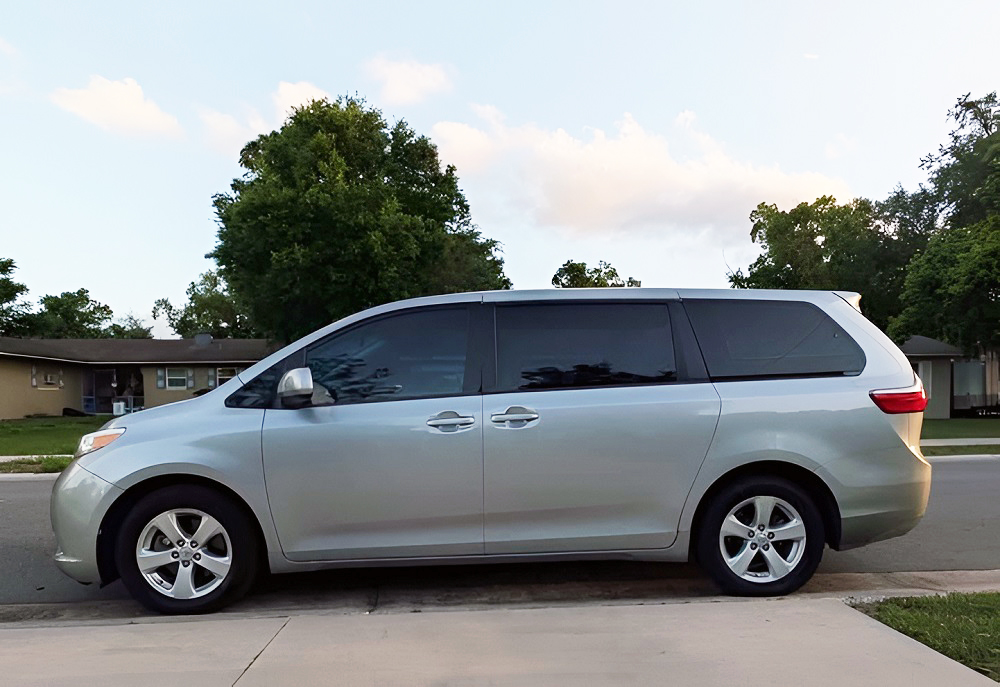
1. Which Sienna years deserve the hardest look?
Repair history can change the buying decision
Put 2004–2005, 2007–2008, 2011, and 2017–2018 under close review for the documented conditions discussed below. These are buying judgments, not measured failure probabilities or universal worst-year rankings. Rust, maintenance, and repair quality can change the choice.
Keep 2006 in the early-generation inspection window. It may share door-related inspection concerns with nearby years. Its 3.3-liter V6 also has scheduled timing-belt service.
Treat 2021 as a conditional purchase. Its recalls identify specific faults and do not establish widespread engine or hybrid-transmission failure. Repeated no-starts, brake warnings, or loss of drive still require a clear diagnosis.
What would make each year worth buying?
| Sienna years | Main buying concern | Evidence that strengthens the case |
|---|---|---|
| 2004–2005 | Front-door check mounting damage, powered-door faults, aging parts | Sound mounting metal, working doors, detailed repair records |
| 2006 | Door condition and overdue timing-belt service | Belt invoice with date and mileage; clean door inspection |
| 2007–2008 | Applicable VVT-i oil hoses and oil-cooler pipes; drivetrain condition | Records naming the repaired circuit and installed parts; checks for past oil-loss damage |
| 2009–2010 | Oil-cooler pipes on equipped vans, door wear, rust | Confirmed pipe hardware, sound bodywork, working doors |
| 2011 | Applicable powered-door recall, V6 oil-cooler pipes, unresolved AWD noise | VIN-specific repair records, equipment checks, diagnosis of any rear hum |
| 2017–2018 | Specified internal damage in certain UA80 transmissions | Toyota eligibility check, diagnosis, records identifying any transaxle replacement |
| 2021 | Applicable recalls and unresolved starting, braking, or propulsion faults | Completed remedies, reliable READY operation, normal braking and power delivery |
Complaint counts won’t establish a van’s condition
A larger vehicle population can produce more raw complaints even when the complaint rate is unchanged. Older vans may have more accumulated mileage or age-related wear, but the individual vehicle’s odometer, maintenance, inspection, and use history control. Reporting habits vary, so raw totals do not establish the share that failed.
A safety recall addresses a safety defect or safety-related noncompliance in a defined vehicle population. A service bulletin gives technicians manufacturer information about a condition, diagnosis, inspection, or repair; it is not automatically a recall or free repair. Warranty enhancements and customer-support programs carry their own eligibility and coverage terms.
Check the VIN through Toyota’s recall and service-campaign lookup and NHTSA’s recall search. Applicability can depend on production date, engine, drivetrain, equipment, market, or sale and registration history. Ask Toyota for campaign-completion records and relevant warranty-program history.
NHTSA’s VIN/plate search reports unrepaired safety recalls within its displayed scope. It does not show completed safety recalls or manufacturer customer-service and other non-safety campaigns, and it generally does not display safety recalls more than 15 years old except where a manufacturer offers more coverage. This is a display limitation, not recall expiration. A clear result does not establish that an older van received every required repair, service-campaign remedy, or maintenance item.
2. A cheap 2004–2006 Sienna can need costly door repairs
A front-door pop can come from cracked mounting metal
Open either front door slowly and watch the door-check mount. This short arm limits the door’s swing. Failed spot welds or cracked mounting metal can let the panel flex and pop.
Toyota’s NV003-07 procedure addresses this condition on certain 2004–2006 Siennas produced before specified VIN cutoffs; a later POL07-04 customer-support program covered certain 2004–2007 vehicles. The repair involves MIG welding or door replacement, depending on the damage. A body shop should inspect cracked paint, split metal, and movement around the mount. Replacing the check arm alone will not repair a damaged mounting panel.
A dragging door needs a diagnosis before a motor
Toyota’s historical ZTS program recognized separate sliding-door cable and latch conditions on certain older Siennas. The program’s vehicle ranges and terms differ by component. A past cable repair does not by itself document that the latch was inspected or repaired.
Cable, roller, track, and latch faults are possible inspection targets when a door drags or jams, but these are diagnostic possibilities rather than proof of a documented model-wide defect. The symptom alone will not identify the failed part. A technician should trace the fault before quoting a motor or cable assembly.
Trouble during travel calls for different checks than failure during the final pull shut. A door that reaches the opening but won’t close fully needs latch and closing-mechanism checks. Neither symptom establishes a particular failed motor.
Toyota’s ZE6 program addressed verified dashboard cracks and sticky or melting surfaces caused by heat or humidity on certain 2004–2010 Siennas under historical warranty terms. Check the surface and any windshield glare from the driver’s seat. The published terms were time-limited and do not promise free dashboard replacement today; confirm any current eligibility by VIN.
Separate the rollaway recalls from the spare-tire repairs
Recall 13V429000 covers certain 2004–2005 and 2007–2009 Siennas. A damaged shift-lock solenoid can let the lever leave Park without brake-pedal pressure. The van can roll if the parking brake doesn’t hold it. Toyota’s remedy replaces the solenoid.
Recall 17V657000 covers a different group of certain 2005–2007 and 2009–2010 vans. Grease inside the shifter can migrate and disrupt the shift lock. Toyota’s remedy replaces the solenoid and corrects the grease application.
The original 14V273000 notice named certain 2011 2WD Siennas with spare tires. Its scope depended on sale or registration history in specified severe-cold areas. Toyota’s later E0S action also revisited certain 2004–2010 2WD vans from A9E/10V160000. That follow-up required an improved remedy for affected earlier vehicles.
An earlier campaign visit may not document completion of the revised action. Toyota determined that the original A9E procedure might not have been adequate and issued E0S with an improved remedy. Have Toyota confirm the VIN’s remedy history. A broken carrier cable can allow the spare to separate and become a road hazard.
Missing belt records leave a service bill
The 2004–2006 3.3-liter V6 uses a timing belt. Toyota’s 2006 maintenance schedule calls for replacement at 90,000 miles or 72 months, as applicable. An invoice should name the belt and show the service date and mileage. “Engine serviced” may describe only an oil change.
The 1998–2003 3.0-liter V6 also uses a belt. The 3.5-liter V6 introduced for 2007 uses a chain. That chain still depends on proper lubrication and maintenance; this does not mean it is maintenance-free or requires scheduled replacement without a manual-based service requirement or diagnosis.
Without proof of required belt service, consider including replacement in the purchase budget. Age, rust, and neglected work can outweigh an older van’s model-year reputation. A broken timing belt can stop the engine, and internal damage depends on the engine and failure mode.
3. The 2007 V6 makes oil-line history worth checking
Oil hose replaced leaves two circuits to sort out
Toyota fitted the 3.5-liter 2GR-FE V6 to the Sienna for 2007. The VVT-i oil-supply hose serves the variable valve-timing system. A separate circuit carries engine oil through an oil cooler on equipped vans.
An invoice for one circuit does not establish the condition of the other. Check the engine, cooler equipment, VIN, and actual installed parts against the repair history.
Ask which line leaked and which replacement part the shop installed. A mechanic should inspect the relevant connections and pipes for fresh oil. Both circuits carry engine oil, but they use different components and repair procedures.
The cooler-pipe program reaches through 2011
Toyota’s ZE2 warranty enhancement addressed verified leaking or seeping engine-oil-cooler pipes on certain 2007–2011 Siennas. It can therefore include certain equipped 2009–2010 vans. Model year alone will not establish which pipes remain on the engine or whether the vehicle is eligible.
Secondary coverage lasted 10 years or 150,000 miles, whichever came first. Toyota counted the time from the vehicle’s first-use date. For 2007–2011 vehicles, that time limit would generally have expired by 2026, subject to Toyota’s individual records and any separate coverage.
Have Toyota confirm any coverage against the individual vehicle’s records. The historical program requires a verified leak or seep and repair through an authorized Toyota dealer. A bulletin describing the fault doesn’t guarantee payment for a repair today.
A fresh pipe won’t reveal how long the engine ran dry
Fresh oil beneath the engine and a falling dipstick level need diagnosis. Continued oil loss can reduce lubrication and may cause internal engine damage, including bearing damage, depending on severity and duration. If the oil-pressure warning comes on, pull off safely and shut down. That light reports pressure; the dipstick checks oil level.
Ask how long the engine ran after the leak started. Request any oil-pressure test results and follow-up noise findings. A replacement-line invoice can’t establish how much internal wear occurred.
Transmission trouble needs its own diagnosis. Rising engine speed without matching road speed during a shift can signal slipping. That symptom alone won’t establish worn clutches, and an engine oil-line repair won’t resolve it.
A deep knock after oil loss warrants further engine checks. Noise, pressure readings, and signs of metal contamination may help assess the damage, but this is diagnostic guidance rather than a Toyota-defined test protocol. A knock alone does not prove the engine needs a rebuild. Restored oil pressure may stop further oil-loss risk but does not by itself reverse or rule out internal bearing damage.
4. A 2011 Sienna needs more than a short test drive
A blown fuse can leave the sliding door unlatched
Recall 16V858000, Toyota campaign G04, covers certain 2011–2016 Siennas with power sliding doors. Ice or another obstruction can stop a door while its motor keeps trying to move it. The stalled motor can draw enough current to blow the fuse. If the latch remains released, the door can open while driving.
Toyota’s Phase 1 remedy replaces the junction block and rear sliding-door wire harnesses and installs two connecting sub-harnesses. Phase 2 covers certain side-entry wheelchair conversions and has separate handling. Toyota must confirm the VIN, conversion status, and applicable remedy for the specific van.
After checking the repair record, run both doors through their full travel only if the vehicle is safe to operate. Grinding, dragging, or incomplete closing is an inspection target, not proof of a particular mechanical failure. The electrical repair does not renew worn cables, rollers, or latches.
Locate an AWD growl before pricing a differential
A rear hum on an AWD van can have several causes. Tires, wheel bearings, and rear-driveline parts are possible inspection targets, but this is general diagnostic advice rather than proof of a 2011-specific defect. Noise can travel through the body and mislead the driver.
Changes with pavement, gentle turns, or throttle may give the shop clues, but they do not identify a failed bearing or differential by themselves. The shop should locate the source before quoting a complete rear unit.
Confirm the drivetrain before applying AWD repair advice. A front-wheel-drive Sienna does not have the Sienna’s AWD rear-drive or coupling assembly.
An alignment can’t tighten a worn steering joint
Steering slack, knocks over bumps, and uneven tread can have several causes. A mechanic should locate actual play in the linkage, joints, and steering gear. A worn tie-rod joint can let the wheel’s toe angle change.
New tires remove earlier tread-wear clues. Fresh rubber therefore leaves the steering and suspension condition unproven. An alignment adjusts wheel angles; it can’t remove play from a worn joint.
Confirm the engine before applying V6 repair advice to a 2011 van. Toyota offered a 2.7-liter 4-cylinder and a 3.5-liter V6; AWD versions use the V6. The oil-cooler pipe concern applies to relevant equipped vehicles.
Repair loose steering parts before the final alignment. If an actual tie-rod separation occurs, steering control can be severely compromised; this is a conditional safety warning, not evidence of a documented 2011 Sienna tie-rod defect.
5. A 2017–2018 transmission whine can signal internal damage
One washer tab can let a nut work loose
Toyota introduced the UA80 8-speed automatic to the Sienna for 2017. Its ZJC notice says a washer tab may not have bent far enough during assembly. The nut it locks can then loosen and damage the transaxle.
Symptoms can include a whine, harsh shifts, reduced power, or warning lights. None proves this internal fault alone. Diagnosis includes transmission serial-number checks and Toyota’s applicable diagnostic procedure.
Verified damage determines the repair
ZJC names certain 2017–2018 Siennas built from late July 2016 through mid-February 2018. Secondary coverage runs 10 years from first use, with unlimited mileage. VIN eligibility, verified damage, authorized-dealer work, and program exclusions still control coverage.
Once a dealer verifies the specified mechanical condition, Toyota’s prescribed repair replaces the transaxle. Software compatibility must be checked, and reprogramming may be required if the replacement combination is mismatched. Software work does not replace the prescribed transaxle replacement when the mechanical condition is verified.
Ask Toyota to confirm the first-use date and remaining coverage. For a claimed replacement, request the repair date, mileage, and installed unit’s details. A fluid-service invoice doesn’t establish a hardware replacement.
The fuel pump carries a separate stall risk
Recall 20V682000, Toyota campaign 20TA02, includes certain 2017–2020 Siennas. The low-pressure pump inside the tank can stop and cut fuel delivery. The engine may run roughly, show warnings, or stall. Toyota’s remedy replaces the pump with an improved unit.
Confirm this repair separately from any transmission work. The affected population includes certain 2020 vans, beyond ZJC’s stated model years. A failed pump can leave the engine unable to restart.
6. Does the 2021 hybrid deserve an avoid label?
Steady engine revs can be normal
The 2021 Sienna replaced the V6 and conventional automatic with a 2.5-liter hybrid drivetrain. Toyota specifies an electronically controlled continuously variable transmission with electric traction motors rather than a conventional belt-and-variable-pulley CVT. The UA80 loose-nut condition concerns certain earlier Siennas equipped with that conventional automatic.
Electric drive and engine shutdown can reduce fuel use in traffic. Regenerative braking recovers some energy as the van slows. Under hard acceleration, engine speed may stay relatively steady while road speed rises, although engine speed also varies with load, battery state, grade, and speed.
That sound alone won’t establish transmission slipping. A loss of drive, warning lights, or failure to gain speed needs diagnosis. Normal hybrid sounds and automatic engine starts and stops are described in the owner’s manual. Unexplained loss of propulsion should not be dismissed as normal and requires diagnosis.
The stability-control and airbag recalls address different faults
Recall 22V239000, Toyota campaign 22TA03, affects certain 2021–2022 Siennas. After specific driver inputs, software can leave Vehicle Stability Control off at the next restart. Toyota updates the skid-control computer to correct that behavior.
Recall 23V865000 concerns front-passenger occupant-classification sensors on certain 2021 Siennas. A capacitor fault in a sensor’s circuit board can disrupt occupant detection. Warning lights may appear, and the passenger airbag may fail to deploy when needed. Toyota inspects the sensors and replaces affected units.
Seat bolts and rail welds affect separate vehicle groups
Recall 25V086000, Toyota campaign 25TA05, covers certain 2021–2025 Siennas with under-tightened third-row seatback bolts. These bolts secure the seatbacks to their recliner plates. Low clamping force can reduce seatback protection in a crash. Toyota’s remedy tightens the bolts to specification.
Recall 25V668000 separately concerns second-row seat-rail welds on certain 2025 Siennas. A 2022 van falls outside that specific population, though it may fall within the third-row bolt campaign. Insufficient weld penetration can weaken the second-row rail assembly in a crash.
A failed start doesn’t establish a traction-battery fault
A weak or discharged 12-volt battery can prevent the hybrid from entering READY mode. The 12-volt system supplies low-voltage control electronics needed to start or enable the hybrid system; it is separate from the high-voltage traction battery. A failed start alone does not diagnose traction-battery damage.
Repeated trouble warrants battery tests, connection checks, and investigation of possible electrical drain. The technician may also need hybrid-system fault codes. A jump-start can restore READY without finding the cause of the discharge.
Brake warnings, an unexpected pedal drop, or weak stopping force need immediate diagnosis. Owner complaints describe symptoms without establishing a defect across every 2021 Sienna. Do not drive or road-test a van with unresolved weak braking, pedal drop, or a brake warning; have it inspected and, if necessary, transported to a qualified repair facility.
7. Which Sienna years make better used buys?
2009–2010 can fit a tight budget
The 2009–2010 Siennas can suit a small budget when bodywork and maintenance records support the price. At this age, rust and deferred repairs can erase any model-year advantage. Low mileage won’t establish the condition of the doors or oil pipes.
Some equipped vans fall within the historical ZE2 oil-cooler pipe population. Include diagnosed repairs in the purchase budget. Active oil loss needs repair before regular driving.
2015–2016 offer the V6 with a 6-speed
Consider 2015–2016 if you want a conventional V6 and the inspection supports the asking price. These vans pair the 3.5-liter engine with a 6-speed automatic. That configuration falls outside the specific UA80 assembly condition.
Certain vans from both years still fall within the G04 sliding-door recall population. Age also warrants general checks for coolant loss, worn door parts, and neglected fluids. Dried coolant around the water pump or hose joints may indicate leakage and needs diagnosis; this is not presented as a unique model-year defect.
2019–2020 use a later V6 powertrain
The 2019–2020 Siennas fall outside ZJC’s stated 2017–2018 model-year window. That distinction separates them from that specific program, but it does not establish lifetime transmission durability or freedom from other faults.
Certain vans from both years still need the fuel-pump recall remedy. Confirm completion against the VIN, then assess transmission behavior from cold through full operating temperature. Delayed engagement, repeated harsh shifts, or a persistent whine still need diagnosis.
Price the hybrid premium against actual fuel use
Consider 2022–2024 hybrids only after comparing the actual purchase premium with annual mileage, real-world fuel use, fuel prices, financing, and maintenance. The 2022 Sienna carries EPA combined ratings of 36 mpg FWD and 35 mpg AWD. Actual mileage varies with driving conditions and use.
Check applicable recalls and remaining battery coverage against the first-use date and mileage. Toyota’s original U.S. hybrid-battery warranty runs 10 years or 150,000 miles, whichever comes first. The remaining coverage transfers with transfer. Buying used doesn’t restart the clock.
Fuel savings depend on annual miles, real mpg, and local pump prices. Financing and maintenance add separate costs. As an example only, a $5,000 premium would take 5 years to repay at $1,000 in annual fuel savings; use the actual price difference and buyer-specific assumptions.
Sources & References
- The Toyota Sienna’s Best And Worst Model Years For Reliability
- Toyota Sienna: The Best Years To Buy (And The Ones You Should
- Here Are The Toyota Sienna Years To Avoid – CoPilot
- These Are the Toyota Sienna Years to Avoid – MotorBiscuit
- 2004-2010 Toyota Sienna Engine Problems & Reliability | TWD
- Best & Worst Years of Toyota Sienna – Graphs & Owner Surveys – FIXD
- Are there any particular years of Toyota Sienna to avoid? – Reddit
- Which model years to avoid? : r/ToyotaSienna – Reddit
- Toyota Sienna Repair: Service and Maintenance Cost – RepairPal
- 2004-’05 and 2007-’09 Toyota Sienna Minivans Recalled … – Edmunds
- 2011-2020 Toyota Sienna Reliability: Sliding Door Problems
- Toyota Sienna Reliability and Common Problems – CarParts.com
- Certain 2017 to 2018 Model Year Toyota Sienna – nhtsa
- Toyota Fuel Pump Recall
- 2021 Toyota Sienna | CarComplaints.com
- I went through all 49,801 complaints NHTSA received in 2026. If you
- Toyota Sienna – CarComplaints.com
- 2004 Toyota Sienna Recalls | Cars.com
- Toyota Transmission Failure Getting Worse — Don’t Let … – YouTube
- A 50-Cent Fuel Pump Part Has Been Stalling Toyotas for Six Years
- Denso fuel pump recall – Engines – Transmissions – Drive Train
- Part 573 Safety Recall Report 16V-858 – nhtsa
- 2014 Toyota Sienna Recall 16V858000 – STRUCTURE:BODY:DOOR
- 2017 Toyota Sienna Repair & Maintenance Costs – RepairPal
- 2004 Toyota Sienna Repair & Maintenance Costs – RepairPal
- Toyota Sienna Buying Guide: Cost, Reliability, and the Best Years to
- I pulled 20 years of NHTSA complaints to find which used cars are
- Car Complaint Index 2026 – MotiveGrid
- 2016 Toyota Sienna: Door may open or fail to latch – FixCatalogue
- Part 573 Safety Recall Report 20V-012 | NHTSA
- 2004-2010 Toyota Sienna Buying Guide Part 1 – YouTube