
Metal chips slip past the wash bay. Oil carries them to the mains. Then the knock starts. That’s how some 2022–2024 Tundras lose a V35A-FTS before 40,000 miles.
Toyota ditched the 5.7 V8 for a 3.4-liter twin-turbo V6 built for torque and emissions. It runs an 85.5 mm bore, 100 mm stroke, tight clearances, and 0W-20 oil under heavy load. When debris hits those main bearings, the oil film collapses and the crank can seize.
NHTSA recalls 24V-381 and 25V-767 now cover over 200,000 trucks and SUVs. Some get full engine replacements. Others wait while failures stack up. This guide shows what fails, who’s covered, and what the fix really means.
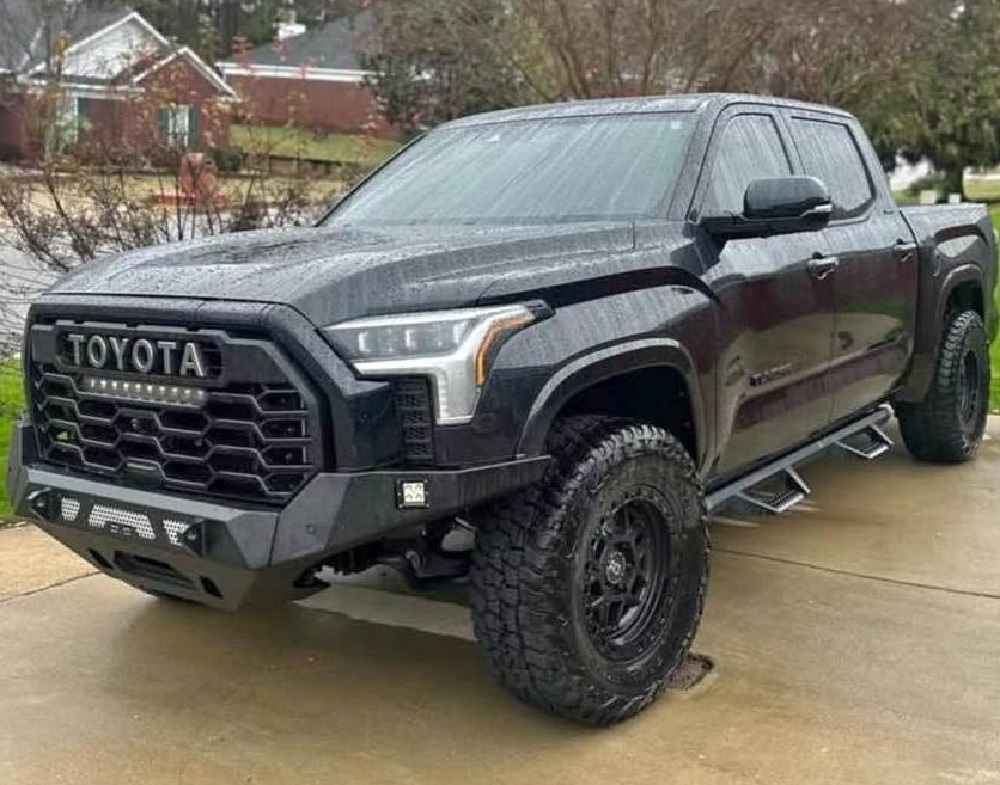
1. From overbuilt V8 to high-strung twin turbo V6
How the V35A-FTS loads the bottom end harder than the old 5.7
Scrap the 3UR-FE 5.7 V8. Drop in a 3.4-liter twin-turbo V35A-FTS built under TNGA rules. Bore measures 85.5 mm. Stroke stretches to 100 mm. That long stroke builds torque early and hammers the crank at low rpm.
Factory rating hits 389 hp and 479 lb-ft in gas Tundra trim. Peak torque lands around 2,400 rpm. Tow at 1,800 to 2,500 rpm on a long grade and cylinder pressure spikes stay high for minutes, not seconds. Main bearings carry that load every combustion event.
Clearances run in the micron range. Oil spec calls for 0W-20 to cut drag and meet fuel targets. Thin oil plus high BMEP means the hydrodynamic film has little margin when contamination enters the system.
The old 5.7 V8 ran thicker oil, lower specific output, and wider bearing surfaces. Field data shows many 3UR-FE engines clearing 300,000 miles with basic service. The V35A works closer to the edge by design.
Where torque and boost squeeze the main bearings
Twin turbos feed direct and port injection through D-4ST. Boost builds fast under load. High cylinder pressure pushes straight down the rod and into the crank journals.
Main bearings support the crank’s vertical load. They also absorb bending forces from adjacent firing cylinders. Under heavy tow, oil temps can push past 230°F. Film strength drops as temperature rises.
Teardowns show wiped #1 to #3 main shells in multiple failures. Rod bearings often keep factory crosshatch marks. That pattern points to load concentration at the mains before rods ever starve.
Journal width on the mains spreads load, but surface pressure still climbs with high torque at low rpm. Once debris disrupts the oil wedge, localized heat spikes can exceed 400°F at the bearing surface. Bearing overlay smears. Oil pressure falls fast.
How competitors handle similar torque stress
Ford’s 3.5 EcoBoost in the F-150 also runs high boost and early torque. Early models fought timing chain stretch and cam phaser noise. Bottom-end bearing seizures stayed rare compared to chain complaints.
GM’s 6.2-liter L87 keeps displacement high and boost absent. It has lifter failures and AFM issues, but widespread main bearing seizures haven’t defined the platform. The 3.0 Duramax diesel runs high cylinder pressure, yet uses heavier oil and a different bearing strategy.
Nissan’s VK56VD V8 in the Titan sticks with natural aspiration. Specific output stays lower. Bearing failures rarely headline that engine’s problem list.
Toyota built its brand on conservative bottom ends. The V35A recall under 24V-381 and 25V-767 centers on main bearing seizure leading to stall and loss of motive power. Over 200,000 units sit inside those campaigns.
2. Inside the bearing wipe that ends the V35A-FTS
Metal swarf in the oil and the first mains to go
Drill oil galleries. Hone cylinders. Cut crank saddles. Those steps create metallic swarf measured in microns.
Wash systems should clear it. Field reports and recall filings show some debris stayed in certain build windows. Once the engine fires, oil flow carries that grit straight to the mains.
The oil pump feeds the main gallery first. #1 through #3 mains see contamination before rods. A single shard can score the bearing overlay and collapse the oil wedge at 2,000 rpm under load.
Clearance runs tight. Oil film thickness measures in microns. Disrupt that film and surface temps spike past 400°F in seconds. Bearing material wipes. Oil pressure drops below spec and the crank starts to bind.
Why the mains smear while rods still look fresh
Teardowns show a pattern. Main bearings turn blue and smear. Rod bearings often keep their factory patterning.
The crank’s vertical load transfers into the mains first. They also absorb bending force from adjacent firing cylinders. Rods ride downstream in the oil path.
Oil routing matters. Contaminated oil hits the mains before reaching rod journals. By the time debris travels further, the damage at the mains has already started.
Some engines fail under 40,000 miles. A few reports show failures under 5,000 miles. Main shells spin in their saddles, block oil feed holes, and starve the rest of the bottom end.
What drivers hear before the crank locks
Cold start brings a light knock that fades warm. Tow up a grade and a deep rumble shows up under load. Metallic glitter appears in the drain pan.
Oil pressure warnings may flash. DTCs can include low oil pressure or misfire codes as the crank slows. Then the engine can stall without restart.
Some failures give almost no warning. A brief knock at highway speed, dash lights, then silence. A seized main can lock the crank instantly and cut motive power.
What it feels like versus what’s breaking
| Stage | What the driver feels | What’s happening inside | Risk level |
|---|---|---|---|
| Early distress | Faint knock at idle, rumble under load | Localized wipe on main bearing overlay | Damage accumulating |
| Progressive wear | Strong knock, oil light flicker, power loss | Bearing smear, journal scoring, oil flow reduced | Imminent seizure |
| Catastrophic failure | Loud bang, sudden stall, no restart | Bearing spins, oil feed blocked, crank locks | Total engine loss |
A spun main can block the oil feed hole in its saddle. Oil pressure can fall below 5 psi at hot idle. At that point, the bottom end is done and the repair path runs $18,000 to $25,000 for a full engine replacement.
3. NHTSA recalls 24V-381 and 25V-767, who actually gets a new engine
Phase 1, 24V-381 and the first wave of seized engines
File ODI reports. Log stalled trucks. Count bearing failures. That trail led to NHTSA recall 24V-381, Toyota code 24TA07.
The campaign launched May 30, 2024. It covered about 102,000 vehicles. Models included 2022–2023 Tundra and Lexus LX 600 with the non-hybrid i-FORCE engine.
Build dates ran from November 2021 through February 2023 for many Tundras. The defect description lists main bearing failure, engine knock, rough running, no-start, and loss of motive power. Remedy called for complete engine assembly replacement.
Dealers were directed to install a new long block built under revised manufacturing controls. No in-bay bearing polish. No partial teardown. Full engine swap.
Phase 2, 25V-767 expands the blast radius
Field failures kept coming. Complaint volume rose after the first cutoff window. That triggered recall 25V-767, Toyota codes 25TA14 and 25LA07.
Announced November 6, 2025, the expansion added about 126,691 vehicles. Coverage stretched into 2024 model year Tundra and LX 600. The 2024 Lexus GX 550 joined the list.
Production sources now included both Alabama and Tahara plants. Toyota cited increased field failure allegations beyond the original window. Some units listed remedy as under development at launch.
| Metric | 24V-381 | 25V-767 |
|---|---|---|
| Announcement date | May 30, 2024 | November 6, 2025 |
| Approx. units | 102,092 | 126,691 |
| Model years | 2022–2023 | 2022–2024 |
| Models | Tundra, LX 600 (gas) | Tundra, LX 600, GX 550 (gas) |
| Production source | Alabama | Alabama and Tahara |
| Remedy status at launch | Engine replacement available | Staged / remedy developing |
Combined coverage crosses 228,000 vehicles. Engine seizure under these campaigns qualifies as a safety defect due to loss of motive power at speed. Outside those VIN ranges, the same failure can leave an owner facing a $20,000-plus repair bill.
4. Alabama vs. Tahara, how two plants fed the same failure
Huntsville machining, swarf counts, and the fabric swatch data
Machine the block in Huntsville at TMMAL. Drill oil galleries. Bore mains. Flush the casting in a high-pressure wash cell.
Toyota used fabric swatches to measure residual debris after washing. Internal analysis later showed oversized metallic particles in certain 2023–2024 engines. Particle counts exceeded the tighter thresholds adopted after early failures.
Those engines shipped into trucks that later spun mains under load. The recall expansion under 25V-767 tracks with these contamination findings. Production windows widened because field data did not flatten after the first cutoff.
Revised wash protocols moved to multi-stage high-pressure filtration. Particle size limits tightened. Engines built before those changes remain at risk once debris circulates through the oil system.
Tahara engines and the myth of geographic immunity
Point at Japan and assume it’s safe. Early owner chatter pushed that theory. Teardown evidence undercut it.
Tahara-built engines in LX 600 and GX 550 showed similar debris signatures. Material analysis found larger metallic fragments in units produced between the first recall and mid-2024 bearing updates. The issue tracked process control, not nationality.
Both plants feed the global V35A line. TNGA strategy spreads one engine across Tundra, Sequoia, Land Cruiser 300, LX 600, and GX 550. A process miss at scale multiplies across nameplates fast.
Bearing cradle revisions and new part numbers in 2024
Redesign the #1 main bearing cradle. Increase tolerance for particulate load. Phase in updated bearing sets during early to mid-2024.
Updated main bearing part numbers include 11071-70040-03 and 11701-70041-02. Implementation dates cluster around February to April 2024 builds. Wash systems also upgraded in late 2022 and refined again in early 2024.
| Component | Original example | Updated example | Implementation window |
|---|---|---|---|
| Main bearing set | 11071-70040 | 11071-70040-03 | April 2024 |
| Bearing cradle | Standard design | Revised robust design | Mid-2024 |
| Wash protocol | Standard filtration | Multi-stage high pressure | Dec 2022 / Early 2024 |
These revisions improve debris tolerance and bearing stability. They do not remove contamination from engines already in service. Once a main wipes and spins, the only approved repair under recall is full engine replacement.
5. Hybrid exclusion and the fight over “motive power”
Same long block, different regulatory math
Bolt the electric motor between the engine and the 10-speed. That’s the i-FORCE MAX layout. Under the hood sits the same V35A-FTS long block used in gas trucks.
When a gas Tundra spins a main, the truck can stall at highway speed. Regulators classify that as loss of motive power. That triggers safety recall action under federal law.
In the hybrid, the motor can move the truck short distances on battery alone. Toyota argued that limited electric propulsion reduces crash risk during engine failure. Regulators accepted that distinction for recall scope.
Real hybrid failures and the $20,000 problem
Hybrid owners report the same knock pattern. Cold start tick. Load rumble. Then stall. Some failures logged under 30,000 miles.
Out-of-warranty quotes for full engine replacement run $20,000 to $25,000. Hybrid hardware adds labor complexity. Dealers often bill higher flat-rate hours than gas models.
ODI complaints increased after the gas recall launched. Class-action filings seek warranty extensions or hybrid inclusion. As of early 2026, hybrids remain outside 24V-381 and 25V-767.
Gas versus hybrid exposure
| Powertrain | Uses V35A-FTS | Included in engine recall | Failure behavior at speed | Owner exposure post-warranty |
|---|---|---|---|---|
| i-FORCE gas | Yes | Yes, VIN dependent | Stall and full power loss | Low if covered |
| i-FORCE MAX hybrid | Yes | No | Limited electric creep possible | High, $20,000+ repair risk |
Hybrid systems can provide brief propulsion. They cannot mask a seized crankshaft. Once the engine locks, the long block still requires full replacement.
6. What actually happens in the service bay
Long-block swap, the factory reset
Roll the truck in. Drop the subframe. Pull the twin-turbo assembly as a unit. Under recall, Toyota authorizes a complete long-block replacement.
A long block arrives assembled with new block, crank, mains, rods, pistons, and heads. Dealers transfer accessories as directed by the campaign. Turbochargers and oil coolers may be replaced depending on failure severity.
Flat-rate time can exceed 25 to 30 labor hours. Some dealers log more once diagnostics and calibration steps stack up. Billed retail cost lands between $18,000 and $25,000, fully covered under recall for eligible VINs.
Short-block rebuilds and the debris trap
Outside recall scope, some trucks get a short-block swap. That means a new block and rotating assembly. Original heads, turbos, oil lines, and coolers stay in play.
A spun main spreads metallic debris through oil passages. Oil coolers and turbo feed lines can trap microscopic fragments. Miss one contaminated component and the new short block can fail again.
Some owners report repeat failures within a few thousand miles after short-block work. Proper repair requires full oil system flushing and part replacement. Skip that step and risk climbs fast.
Bottlenecks, backorders, and wait times
Engine supply tightened after the recall expansion under 25V-767. National backorders developed for certain VIN ranges. Owners reported wait times stretching several months.
Technician skill limits throughput. Not every dealer has multiple master techs trained on twin-turbo engine swaps. Hybrid models add high-voltage safety steps and calibration time.
Loaner fleets strain under extended repairs. A single engine replacement can tie up a bay for days. Multiply that across thousands of units and capacity hits a hard ceiling.
Who pays and how much
| Repair scenario | Payer | Typical billed cost | Notes |
|---|---|---|---|
| Recall long-block replacement | Toyota | $18,000–$25,000 | Covered for affected VINs |
| Out-of-warranty full engine | Owner / warranty | $18,000–$25,000 | Many trucks financially totaled |
| Short-block swap with reused hardware | Owner / case-by-case | $12,000–$18,000 | Higher risk if debris remains |
Once a main bearing spins and blocks oil flow, Toyota does not authorize in-car bearing repair under recall. The approved path is full engine replacement.
7. Resale math and the recall discount reality
Used market splits into three camps
Scan listings for 2022–2024 Tundras. Buyers now ask one question first, engine replaced or original? CARFAX recall flags and service records shape pricing fast.
Pre-recall 2020–2021 5.7 V8 trucks gained attention. Demand pushed values higher as buyers chased proven bottom ends. Some markets show V8 residuals climbing above prior projections.
Early V35A trucks inside recall windows trade lower. Appraisers factor engine history and VIN eligibility. A replaced long block with documentation can stabilize value, but stigma lingers.
Residual value shifts after the bearing crisis
| Truck type | 3-year residual pre-recall | 3-year residual 2026 reality | Market perception |
|---|---|---|---|
| 2020–2021 5.7 V8 Tundra | ~68% | ~72% | Safe bet |
| 2022–2023 V35A in recall window | ~65% | ~55–58% | Risk priced in |
| 2024+ V35A with updated bearings | ~65% | ~62% | Cautious recovery |
| Nissan Titan 5.6 V8 competitor | ~52% | ~58% | Benefited from Tundra issues |
A 5% to 10% extra depreciation on a $55,000 truck equals $2,750 to $5,500. That gap fuels what some call the recall discount. Buyers wager that a fresh long block erases the risk.
How dealers and lenders adjust the risk
Trade-in offers tighten for affected VINs. Some dealers require recall completion before resale. Service history now carries more weight than trim level.
Lenders may haircut book value on early V35A trucks. Higher down payments offset perceived mechanical risk. Extended lifetime powertrain warranties show up as sales tools on 2025–2026 models.
Hybrid exclusion adds another layer. Gas trucks inside recall get free engines. Hybrids outside recall carry potential $20,000-plus exposure once warranty coverage ends.
8. Recall fatigue and the pile-on effect
Lighting and camera faults stack on top of engine fear
Moisture seeps into reverse lamp housings on certain 2022–2025 trucks. Corrosion can end both reverse lights. That triggered a recall covering roughly 443,000 Tundra and Tundra Hybrid units.
Rearview camera software faults also surfaced. Some trucks fail to display the image in reverse due to ECU logic errors. Campaign codes like 25TA10 and 26TA02 address those glitches.
Each issue alone looks manageable. Stack engine seizure, lighting failure, and camera blackouts together and owner confidence drops fast. Buyers expected low-drama ownership, not multiple safety campaigns within three model years.
Tires, assembly damage, and structural scares
Assembly line errors damaged passenger-side tires on certain 2024 Tundra and Sequoia builds. Structural cord damage can lead to sudden air loss. That recall covered about 12,000 vehicles.
Sudden deflation at highway speed adds to loss-of-control risk. Combined with engine stall fears, perception shifts from isolated defect to platform instability. Even if each campaign targets a different system, the brand takes the hit.
Multiple recalls across powertrain, visibility, and tires change buyer math. A truck once bought for set-it-and-forget-it durability now carries layered campaign history inside 3 years. That history shows up in VIN reports and appraisal sheets immediately.
9. Redemption or permanent scar on the Tundra name
Can the revised V35A-FTS survive 300,000 miles
Install updated bearing sets and the revised #1 cradle. Tighten wash protocols and particle limits. Those changes widen the safety margin inside the oil film.
Oil still spec’d at 0W-20 in most markets. Tow 10,000 pounds up a 6% grade at 2,200 rpm and oil temps can crest 230°F. Film strength drops as heat rises, even with clean passages.
Owners now cut oil intervals to 5,000 miles or less. Some run oil analysis to track wear metals. Elevated copper and lead levels signal bearing distress before knock gets loud.
Revised hardware improves contamination tolerance. It cannot rewrite physics inside a high-output, undersquare turbo engine making nearly 480 lb-ft at low rpm. Sustained load and heat remain the limiting factors.
What this means for modern downsized truck engines
Downsize displacement. Add boost. Raise specific output. That formula dominates the segment.
Ford’s early 3.5 EcoBoost fought timing chain stretch and cam phaser noise. GM’s 2.7T and 6.2 face their own lifter and valve train campaigns. Each platform carries a known weak link.
The V35A crisis centers on bottom-end survival under contamination and load. Main bearing seizure at highway speed qualifies as a safety defect. Under recall, Toyota pays up to $25,000 per engine to make it right.
Reputation recovery depends on 2025–2026 build durability. If revised engines clear 150,000 to 200,000 miles without bearing noise, the market will adjust. If failures persist below 50,000 miles, resale penalties and warranty claims will follow.
Sources & References
- TOYOTA – nhtsa
- Engine Teardown Exposes What’s Really Wrong With Toyota’s Problematic V6 – Autoblog
- Toyota Dynamic Force engine – Wikipedia
- 2026 Toyota Tundra Price, Reviews, Pictures & More | Kelley Blue Book
- The Lifetime Warranty Catch: Why This Tundra Buyer Traded a V8 for a V6 Hybrid,
- Toyota Truck Power, Evolved: i-FORCE MAX vs. i-FORCE Gas Engines in the Tacoma and Tundra | Freeway Toyota
- 2026 Tundra V35A Engine Analysis: NHTSA 25V767 Recall, Machining Swarf Contamination, and the Nissan Titan VK56VD Reliability Contrast | Torque News
- National Highway Traffic Safety Administration Makes … – nhtsa
- Toyota Recalls Certain Toyota Tundra and Lexus GX and LX Vehicles – Toyota USA Newsroom
- 2022-2024 Toyota Tundra Engine Problems & Recall: Here’s What I Found – Lemberg Law
- The 2022-2023 Toyota Tundra Engine Recall and What It Means
- ‘Total BS’: Engine Teardown Specialist Says Toyota’s Explanation …,
- “It’s My Turn To Be Dead On The Road” – Why This 2024 Tundra Owner’s Engine Failure Proves Toyota’s Short Block Fix Isn’t Enough | Torque News
- Deep Dive into Toyota’s V35A-FTS (3.5L Twin Turbo) : r/cars – Reddit
- SAFETY RECALL 24TA07 (Remedy Notice) – nhtsa
- Toyota will replace engines in 100,000 recalled Tundras and Lexus LXs – Autoblog
- Critical Recall: Toyota Replaces Engines in 100,000 Tundras and Lexus LXs,
- Toyota Tundra Engine Recall | 2022 & 2023 Tundra Free Engine Replacement | Platinum Toyota of Texoma, Sherman-Denison, TX
- Part 573 Safety Recall Report 25V767 | NHTSA
- 2024 Toyota Tundra Recalls – Cars.com
- Toyota’s November update to the NHSTB on the engine recall. This is a DIFFERENT engine recall. : r/ToyotaTundra – Reddit
- 2024 Tundra i-FORCE MAX owners: Toyota confirmed in writing they won’t provide technical justification for excluding hybrids from V35A engine recall — ODI complaint filed : r/ToyotaTundra – Reddit
- 2024 Limited iFORCE Max : r/ToyotaTundra – Reddit
- Look up Safety Recalls & Service Campaigns by VIN | Toyota Owners
- Toyota Just Admitted The i-FORCE MAX Nightmare Is Real? – YouTube
- 2024 Tundra i-FORCE MAX owners: Toyota confirmed in writing they won’t provide technical justification for excluding hybrids from V35A engine recall — ODI complaint filed – Reddit
- Tundra Recall – Passport Toyota
- Not on Recall List. Should they be replacing the whole engine or is the shortblock adequate? : r/ToyotaTundra – Reddit
- Trading a 4th-Gen Tacoma for a 2025 Tundra Hybrid: Is the ‘Recall Discount’ Worth a … – Torque News
- V35A Recall Megathread : r/ToyotaTundra – Reddit
- Understanding the Impact of the Toyota Tundra Engine Recall: What It Means for Your Vehicle’s Value – The Auto Mediator
- GX owners or buyers- aren’t you worried about the bearing issues as seen in other models? : r/LexusGX – Reddit
- OEM 2022-2025 Toyota Main Bearings Part # 11071-70040-03,
- 2022-2024 Toyota – Main Bearings – Toyota (11701-70041-02),
- MAIN & CON ROD BEARING SET TOYOTA V35A-FTS 24V 3.5 LTR – Mag Engines,
- Toyota Recalls Certain 2022-2025MY Toyota Tundra Trucks,
- Toyota Recalls Certain Toyota Tundra and Tundra Hybrid Vehicles,
- Toyota Recalls Certain Model Year 2024 Sequoia & Tundra Vehicles,
- 2024 Toyota Recalls | Recall Information,
Was This Article Helpful?