
Clear coat peels from the Yaris’s roof while the seller insists it needs no work. Owners of some 2007 cars report damage across roofs and hoods. Refinishing those panels adds to the purchase bill.
Editorial note: Recall campaigns and service bulletins identify specific vehicles and symptoms. They do not establish failure rates for an entire model year. Use the VIN and a qualified inspection to evaluate the individual car.
This guide covers U.S. Yaris models, specific recall campaigns, and faults to check before you buy. Recall counts and owner complaints do not establish which model years fail most often. Compare the car’s condition, equipment, and repair history. Before you settle on a price, get a repair estimate and have Toyota confirm recall completion.
1. Toyota Yaris years and faults to check
A cheap 2007–2008 can leave you paying for paint
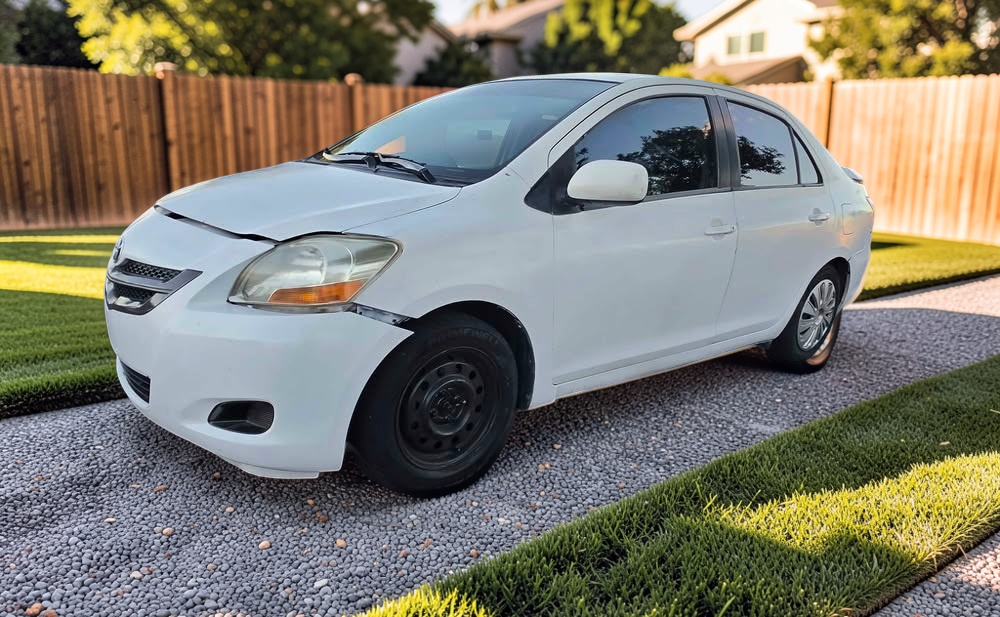
Owners of some 2007–2008 cars report cloudy patches and clear coat flaking across roofs and hoods. Those complaints do not show the share of cars affected or prove a factory defect. The paint condition on the car you’re viewing sets the repair scope.
Damage across several panels can turn a cheap Yaris into a costly repaint. Clear coat protects the color beneath it, and polish will not replace a layer that has peeled away. Get a written refinishing quote before you price the damage as a small touch-up.
Paint damage alone does not prove the engine or gearbox is worn out. Rust and poor shifts need separate repair estimates. Have Toyota check outstanding safety campaigns and confirm any no-charge recall remedy before you buy.
Let the test drive judge a 2009–2010
Treat 2009 and 2010 cars as purchases that depend on condition. Certain examples fall under airbag, power-window switch, and front-seat adjustment recalls. Have Toyota check the VIN and repair history, since the model year alone will not confirm coverage or completion.
Cabin shake at idle can point to worn engine mounts, but rough engine operation needs a different diagnosis. A steady idle with strong vibration gives the mechanic a reason to examine the mounts. Shaking that starts at road speed calls for checks beyond the engine bay.
Delayed engagement or slipping needs a gearbox diagnosis before purchase. Isolated complaints do not prove every automatic from these years has a built-in defect. Reject a car with severe structural rust unless a qualified repair assessment establishes a sound remedy.
Later cars need recall-specific checks
Certain 2012 cars need steering-assist recall checks. Targeted campaigns also cover suspension hardware on some 2015 cars and door-airbag wiring on certain 2015–2017 hatchbacks. A recall’s announcement year can differ from the affected model year.
The fuel-pump campaign covers certain 2019–2020 sedans, 2020 hatchbacks, and 2020 Yaris R vehicles. A failed pump can stall the engine and prevent a restart. Confirm the exact model, VIN, and completed repair before judging an individual car.
A completed recall repair changes the buying assessment, but it does not explain every remaining symptom. Persistent stalling still needs diagnosis after a pump replacement. An airbag warning that stays on requires fault-code checks even if Toyota lists the recall as complete.
2. The Yaris badge covers different hardware
Match the body style to the hardware
A 2017 Yaris hatchback and a 2017 Yaris iA sedan use different engines and gearboxes. Toyota built the hatchback around its own powertrain. The Mazda-derived iA sedan uses direct fuel injection and offers 6-speed transmission choices.
| U.S. version | Engine | Transmission choices |
|---|---|---|
| 2007–2018 Toyota-built Yaris hatchback | Toyota 1.5-liter 4-cylinder; confirm year-specific engine and fuel-system details | 5-speed manual or 4-speed automatic, depending on trim |
| 2016 Scion iA, 2017–2018 Yaris iA, 2019–2020 Yaris sedan | Mazda-derived 1.5-liter, direct injection | 6-speed manual or 6-speed automatic, depending on trim |
| 2020 Yaris hatchback | Mazda-derived 1.5-liter, direct injection | 6-speed automatic only |
Confirm the engine before pricing repairs
Match engine and fuel-system details to the exact model year and VIN before ordering parts. The broad year ranges above identify the main versions, not every engine code or trim detail. Do not carry a Toyota-built hatchback’s specifications over to the Mazda-derived 2020 hatchback.
Port injectors spray fuel ahead of the intake valves, washing their backs as fuel enters the engine. Direct injectors spray inside the cylinders, so fuel does not wash those valve surfaces. That difference alone does not prove a direct-injected Yaris needs carbon cleaning. Deposits need to match symptoms and inspection findings before you approve that work.
Gearbox diagnosis needs the same care. The Toyota 4-speed and Mazda 6-speed use different parts and repair procedures. A bulletin for one does not establish a fault in the other, even when both cars wear a Yaris badge.
Recall coverage also depends on which car you are buying. Campaign 21V-617 names certain 2019–2020 sedans, 2020 hatchbacks, and 2020 Yaris R vehicles. Shared Mazda hardware does not automatically include an earlier Scion iA or Yaris iA. Check those VINs separately for applicable campaigns.
3. Early Yaris repairs that can affect the purchase price
Peeling clear coat needs more than polish
Some owners report cloudy patches, bubbles, and lifting clear coat on 2007–2008 Yaris roofs and hoods. The complaint record does not establish how common this damage is. Once the clear coat flakes away, wax will not rebuild that layer.
A lasting repair needs sound paint beneath the new finish. A body shop must assess how far the coating has failed before it quotes sanding and refinishing. Damage across the roof and hood can put several panels on the bill.
Peeling clear coat does not establish a factory paint defect on an individual car. Poor past repairs can also leave lifting edges or weak adhesion. Rust bubbles need separate assessment because refinishing alone will not repair corroded metal.
Cabin shake and slipping gears need separate diagnoses
Worn engine mounts can pass engine vibration into the seats, steering wheel, and dashboard. The engine may idle steadily while the cabin shakes. Cracked or sagging mount rubber gives the mechanic evidence to pursue that diagnosis.
An uneven idle calls for checks beyond the mounts. A misfire can shake the engine before vibration reaches the body. On a manual car, judder as you release the clutch also warrants checks of the clutch and mounts.
Watch how an automatic engages Drive and Reverse, both cold and warm. A long pause before engagement needs diagnosis, especially if the gear then engages with a hard thump. During a shift, rising engine speed without a matching gain in road speed can signal slipping.
A seller’s mount quote does not cover an unconfirmed gearbox fault. Have a mechanic reproduce each symptom and identify which repair addresses it. Do not agree on a purchase price while the cause of slipping remains unknown.
Rust can become a serious structural concern
Inspect the rear suspension beam, its mounting points, and the body around them. Road salt and trapped moisture can leave far more damage underneath than the paint suggests. Flaking scale warrants a closer look at the metal beneath it.
Light surface rust differs from deep pitting, holes, or cracks. Metal loss can weaken the beam or the structure that holds it in place. Fresh undercoating can hide those surfaces, so a dark, tidy finish proves little.
Replacing a damaged beam will not fix weakened body mounting points. Those areas need their own repair assessment before anyone can quote the full job. Walk away from perforated or cracked suspension mounts unless a qualified shop establishes a sound repair.
4. Early Yaris safety repairs you need to verify
An old airbag receipt may leave a recall unfinished
A recalled Takata inflator can rupture when the airbag deploys, sending metal fragments into the cabin. Recall 19V-741 covers certain 2007–2012 Yaris vehicles whose earlier repairs used inflators of the same basic design. For vehicles included in 19V-741, those replacement inflators required another recall repair.
Body style matters within that year range. Toyota’s campaign records identify certain 2007–2011 hatchbacks and 2007–2012 sedans. A 2011 badge therefore does not put the car clear of the earlier airbag concern.
Ask Toyota to check the VIN against the campaign and completed repair records. An old invoice may document only the first replacement. A dash with no airbag warning does not prove the inflator is safe or that the final repair is complete.
Window switches, airbag wiring, and seat locks have separate faults
The window switch can overheat, the steering-wheel spiral cable can lose contact, and seat-lock springs can break. These campaigns have different year and body-style limits, including some 2006 vehicles in the official records. VIN, build details, and equipment determine coverage.
| Recall | Specified Yaris years and body styles | Fault and hazard | Repair |
|---|---|---|---|
| 15V-689 | Certain 2006–2010 vehicles | Window-switch contacts can short, overheat, and melt. | Inspect the switch. Apply specified lubricant or replace the circuit board as required. |
| 14V-168 | Certain 2006–2010 vehicles | Spiral-cable damage can break the driver-airbag electrical connection. | Replace the spiral cable assembly. |
| 14V-169 | Certain 2006–2010 hatchbacks and 2007–2010 sedans | Seat-adjustment springs can break, preventing the seat from locking securely. | Replace the affected seat-track assembly; the covered track depends on body style. |
The spiral cable carries electrical connections while the steering wheel turns. Damage can illuminate the airbag warning and prevent the driver’s airbag from deploying. Replacing the inflator will not repair that cable.
The seat campaign covers the driver’s seat and, on 3-door models, the front passenger seat. A broken adjustment spring can leave the seat unsecured after you move it. A seat that will not lock firmly in position needs repair before you drive.
5. Later Toyota-built cars have narrow recall risks
The 2012 steering recall covers just 74 U.S. cars
Recall 13V-292 covers 74 U.S. Yaris vehicles built from August 21–31, 2011, for the 2012 model year. A relay inside the electric power-steering control module could short. Losing power assist makes the wheel harder to turn, especially at low speeds.
Toyota’s remedy replaces the steering control module. That small build window does not support rejecting every 2012 Yaris. Have Toyota confirm whether the VIN falls within the campaign and whether the module replacement is complete.
Some 2012–2015 cars need a headliner repair
Recall 15V-134 concerns certain 2012–2015 Yaris vehicles first distributed in Puerto Rico. The headliner does not meet the required protection standard for a head impact. Toyota’s remedy replaces the headliner.
This matters when you compare 2013–2014 cars as used-buy candidates. A car first sold in Puerto Rico may later reach a mainland dealer. Its current location does not establish whether Toyota completed the headliner repair.
Two suspension recalls target certain 2015 cars
Recall 15V-098 concerns rear axle bearing bolts that were not properly tightened during assembly on certain 2015 cars. The bolts can loosen, damaging rear brake parts or causing a wheel to lock. Toyota’s published remedy calls for inspection and tightening as needed.
Recall 16V-367 addresses a separate fault in the front strut mounting bearings. A bearing can fail under a high load, allowing the strut rod to separate from its mounting point. The remedy replaces the affected bearings.
The strut campaign began in 2016, but it covers specified 2015 model-year cars. A listing that calls it a “2016 Yaris recall” can send you toward the wrong vehicles. A rear bearing-bolt repair also leaves the separate front strut campaign unresolved.
Door movement can damage airbag wiring on 2015–2017 cars
Recall 19V-319 covers certain 2015–2017 Yaris vehicles. Repeated door movement can crack insulation on wires in the door harness. Water entering those cracks can corrode the wires and break the electrical circuit.
That open circuit can prevent the front-seat side airbags and curtain airbags from working as intended. Toyota’s remedy replaces the affected door wiring harnesses. This campaign also needs checking before you buy a 2017 Toyota-built hatchback.
A completed harness repair does not explain an airbag warning that remains on. The mechanic must read the stored faults and trace the remaining cause. An open airbag circuit can leave the affected airbags unable to deploy.
6. Two 2016 Scion iA faults with defined repairs
Rear brake squeal may need cleaning and grease
Some 2016 Scion iA models squeal or squeak when you apply the brakes. Bulletin S-SB-0003-19 links this noise to insufficient grease at specified rear-brake contact points. Toyota describes a cleaning and lubrication repair.
The mechanic must confirm that the noise matches the bulletin before applying that fix. Grease belongs only at the specified contact points, away from the braking surfaces. Lubricating those points will not repair worn shoes, leaking wheel cylinders, or damaged drums.
The bulletin documents a noise complaint, not a finding that the brakes routinely fail. A car that pulls during braking or has a soft pedal needs separate checks. Do not accept a lubrication quote as the full repair for reduced stopping power.
A cold black screen may trace to the navigation card
Bulletin S-SB-0003-18 covers some 2016 iA units that reboot or show a black screen in a cold cabin. Toyota’s procedure checks whether the navigation SD card comes from an affected lot. The repair replaces a qualifying card when the symptoms match.
Test the screen before the seller warms the cabin. A fault tied to cold conditions may disappear by the time you start a warm test drive. Note whether the unit restarts, stays black, or works once the cabin heats up.
A matching symptom gives the shop a reason to follow the bulletin. It does not prove that every black screen needs an SD card or a new display. The bulletin also does not guarantee free repairs once warranty coverage expires.
7. Fuel-pump failure can stall a 2019–2020 Yaris
The campaign also names the 2020 Yaris R
Recall 21V-617 covers certain 2019–2020 Yaris sedans, 2020 Yaris hatchbacks, and 2020 Yaris R vehicles. Only specified vehicles and fuel pumps fall within the campaign. A failed low-pressure pump can cause rough running, a stall, or an inability to restart.
Shared Mazda hardware does not automatically bring earlier Scion iA or Yaris iA cars into this campaign. Have Toyota check their VINs separately for applicable recalls. A seller’s claim that “all these pumps were fixed” proves nothing about that vehicle.
Confirm the pump replacement, then judge any remaining symptoms
Toyota’s remedy replaces the low-pressure fuel pump with an improved unit at no charge on eligible vehicles. Ask for a repair record that identifies the VIN and completed campaign. A receipt for unrelated fuel work does not establish that Toyota installed the recall replacement.
A documented repair addresses the recalled pump defect and keeps an otherwise sound car worth considering. Persistent hesitation or stalling still needs its own diagnosis, even with the campaign marked complete. The shop should check fuel pressure and investigate the fault before you accept the car as repaired.
8. Compare later Yaris models by equipment and condition
2013–2014 hatchbacks keep the hardware simple
The 2013–2014 hatchbacks offer Toyota’s 1.5-liter engine with a 5-speed manual or 4-speed automatic, depending on trim. Those choices may suit buyers who want straightforward transport. They do not establish lower failure rates than other years. Service records and a pre-purchase inspection must support the buying decision.
Certain cars first distributed in Puerto Rico need the headliner repair covered by 15V-134. Confirm that history if the car has moved between markets. These years also lack the Toyota Safety Sense C package fitted to later hatchbacks.
The automatic has just 4 forward gears, which limits its choice of engine speed at a given road speed. Take the car onto the highway before deciding whether its noise level suits you. Delayed engagement or slipping still needs diagnosis, regardless of the powertrain’s reputation.
2017–2018 hatchbacks add driver assistance
Toyota’s 2017 and 2018 U.S. releases confirm standard Toyota Safety Sense C on those Yaris hatchbacks. The package includes pre-collision assistance, lane-departure warning, and automatic high beams. Those features do not establish better mechanical reliability.
Compare 2017 and 2018 hatchbacks on condition, repair records, and the equipment you want. Certain 2017 hatchbacks need the door-harness repair under 19V-319. Confirm that repair before treating a 2017 car as ready to buy.
Lane-departure warning alerts you when the car drifts; it does not steer the car back into place. Pre-collision assistance also has operating limits and cannot prevent every crash. You still need to steer and brake.
2017–2018 iA sedans offer 6-speed choices
The 2017–2018 Yaris iA offers the Mazda-derived sedan platform and 6-speed transmission choices. Toyota lists the 2017 automatic at 35 mpg combined, versus 34 mpg combined for the manual. These EPA ratings do not guarantee your fuel use or establish lower repair costs.
The iA’s standard low-speed pre-collision system differs from the hatchback’s Toyota Safety Sense C package. Do not assume the sedan includes lane-departure warning or automatic high beams because both cars carry Toyota badges. Compare the equipment on the exact car you’re viewing.
Repair records should support what you feel during the test drive. Check clutch take-up on a manual and gear engagement on an automatic, both cold and warm. Engine speed that rises without a matching gain in road speed needs diagnosis before purchase.
Sources & References
Recall records and service bulletins establish specific defects and repair procedures. Owner reports provide background but do not establish model-year failure rates. Confirm campaign coverage and completed repairs with Toyota using the vehicle identification number (VIN).
- NHTSA recall lookup
- Toyota recall lookup
- 2007 Toyota Yaris clear-coat complaints
- NHTSA 14V-168 spiral-cable recall
- Toyota 14V-169 seat-track campaign scope and remedy
- NHTSA 13V-292 steering-assist recall
- NHTSA 15V-098 rear axle-bearing-bolt recall
- NHTSA 15V-134 headliner recall
- NHTSA 16V-367 front strut-bearing recall
- NHTSA 19V-319 door-harness recall
- Toyota 19V-741 Takata recall instructions
- Toyota 21V-617 fuel-pump recall instructions
- 2017 Toyota Yaris specifications and Safety Sense C
- 2018 Toyota Yaris specifications
- 2017 Toyota Yaris iA specifications
- 2020 Toyota Yaris hatchback specifications
- 2016 Scion iA rear-brake service bulletin S-SB-0003-19
- 2016 Scion iA infotainment service bulletin S-SB-0003-18
- EPA 2017 Yaris iA automatic fuel economy
- EPA 2017 Yaris iA manual fuel economy