
A TRD Off-Road badge doesn’t lift the truck. Doesn’t bolt on a snorkel or toss in 35s. What it does is change how a Tundra handles traction, stability, and shockload without touching the ride height. Locker in. Bilsteins in. Terrain software in.
Toyota builds this package to split the difference; more than just 4WD, but not full Pro money. You get the key trail tools without eating a luxury trim’s comfort or towing guts.
This guide breaks down exactly what the TRD Off-Road Package adds, where it falls short, and how it holds up against the TRD Pro, base 4×4, and competitors like Ram Off-Road Group and FX4. If the terrain matters, the parts list matters more.
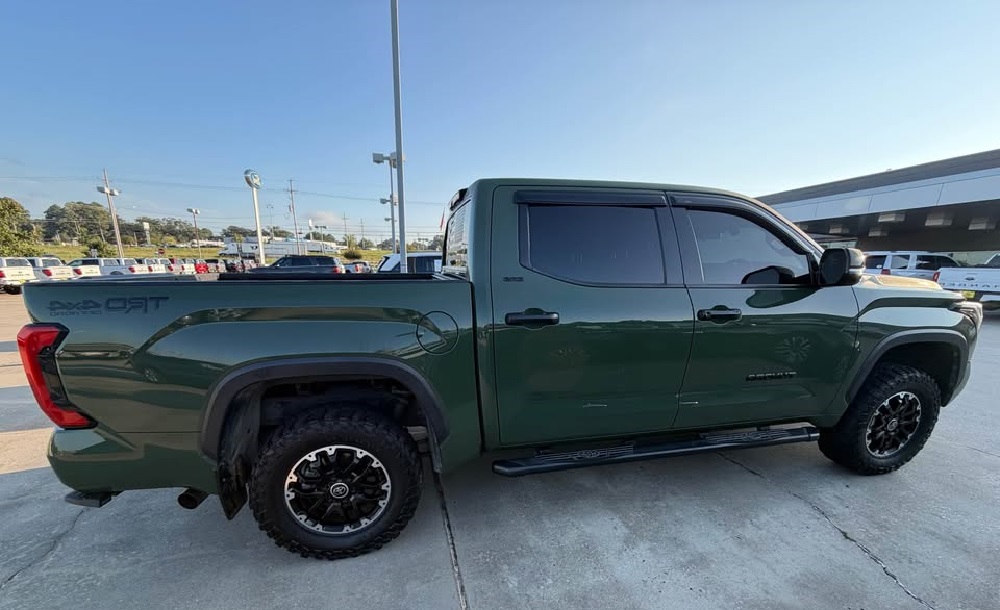
1. Package scope, trims, and powertrains
Where you can add it
Toyota keeps the TRD Off-Road Package tied to four-wheel drive. You can option it on the SR5, Limited, Platinum, or 1794 Edition; each pairing trail gear with different cabin luxuries.
That spread gives the package rare flexibility: you can spec the same locking diff and Bilstein shocks on a cloth-seat SR5 or a wood-trim 1794 without buying into the full TRD Pro price tier.
Engine pairings that matter
The package links up with both i-FORCE and i-FORCE MAX powertrains. The standard 3.4-liter twin-turbo V6 keeps payload and towing near their peaks, while the hybrid’s instant torque helps when crawling through sand or mud.
The trade is weight, roughly 300 lb more curb mass, cuts a few hundred pounds from payload headroom, and slightly lowers tow ratings.
What TRD Off-Road is not
This isn’t a lifted or wide-body trim. You don’t get FOX 2.5 shocks, aluminum skid plates, or the TRD Pro’s fascia and light bar. Geometry stays stock, about 9.3 in. clearance, 21° approach, 24° departure.
What you do get is the real traction gear: E-Locker, Bilsteins, and trail control software wrapped in a factory warranty.
2. The mechanical core, where traction and control come from
Rear locker, the torque equalizer you actually feel
The TRD Off-Road adds an electronically controlled locking rear differential. Hit the switch in low range, the axle shafts lock together, and both rear tires get the same torque.
That keeps you moving when one wheel unloads on a ledge or sinks in wet clay. Brake-based Auto-LSD can slow a spinner, but it loses heat and reacts late. A true lock is decisive, quieter, and kinder to pads on long climbs.
Bilstein monotubes, tuned to hold the truck up
Toyota spec’d TRD-tuned Bilstein monotube shocks for heat control and consistency. The single-wall body sheds heat fast, and the floating piston keeps the oil from foaming when the road turns to washboard.
Valving targets body control over repeated hits, so the cab stays calmer on broken pavement and forest roads. Push into long, high-speed chop and you’ll reach the ceiling sooner than a Pro with FOX, but for real-world trails, these dampers carry their weight.
Dual-rate front coils, soft to start, firm when it counts
Front springs use a dual-rate profile to balance street comfort with impact protection. The light initial rate takes the edge off small cracks and joints.
Deeper in the stroke, the coils ramp up, roughly a third stiffer in the last portion of travel, to resist bottoming on sharp compressions. That extra support matters if you add a skid, winch, or steel bumper later.
Skid coverage, the quiet insurance under your feet
Coverage focuses on the parts that leave trucks stuck, not trim. Engine, transfer case, and fuel tank get high-strength undercovers sized for real contact. Materials skew to steel or composite here, which trades a few pounds for dent resistance and easy field straightening.
The front aluminum plate is reserved for TRD Pro, but with smart tire placement and the locker working, this armor lets you brush rocks without punching holes in your day.
3. Geometry, wheels, and what actually clears
Clearance numbers that set your limits
Ground clearance stays stock at about 9.3–9.4 in. Approach holds near 21° and departure near 24°. That’s fine for ruts, bermed forest roads, and modest rock ledges.
Breakover is where long wheelbase trucks scrape, so pick lines and use the locker to crawl cleanly instead of bumping the belly.
Wheel and tire spec that earns grip
TRD Off-Road trims ship with 18-in TRD alloys and 275/65R18 A/Ts. Diameter is about 32.1 in, section width about 10.8 in, which gives real sidewall to air down without pinching rims.
Drop to 18–22 psi on slow rocky sections for bite and compliance, then air back to placard before towing. Mind load index and keep pressures up on highway haul days to protect shoulders and stay stable.
Geometry and hardware snapshot, stock configurations
| Package/Trim | Ground clearance | Approach | Departure | Front skid plate | Dampers |
|---|---|---|---|---|---|
| Standard 4×4 | ~9.3–9.4 in | ~21° | ~24° | Basic undercovers | Base shocks |
| TRD Off-Road | ~9.3–9.4 in | ~21° | ~24° | Strengthened undercovers | Bilstein monotubes |
| TRD Pro | ~10.9 in | ~26.2° | Higher | Aluminum front plate | FOX 2.5 IB, reservoirs |
4. Trail tech that earns its keep
Multi-Terrain Select, grip by software, not guesswork
MTS trims throttle, brake, and traction control for the surface under you. Rock and Rock & Dirt calm the pedal, allow controlled wheel slip, and clamp a spinning tire faster so the locker and low range do clean work. Mogul keeps momentum over offset ruts without surge.
Loose Rock softens tip-in to stop hop on shale. Mud & Sand lets more wheel speed to build a bite, then trims it before the truck digs. Pick the mode for the ground, let the mapping manage the micro-inputs you can’t time with your right foot.
Crawl Control and DAC, speed set low so you can steer
CRAWL is a fixed low-speed governor for obstacles. In 4WD-Low, you set one of five speeds, and the truck meters throttle and brake to keep it. That frees your hands to place tires and watch the belly.
On long descents, Downhill Assist Control keeps speed in check with smooth brake pulses, so you don’t cook pads or lock a wheel at the worst moment. Use CRAWL for ledges, step-ups, and deep sand starts. Use DAC when a steep, loose grade wants to run away.
Multi-Terrain Monitor, seeing the stuff that bends parts
MTM stitches front, side, and rear cameras into clear views of the trail edges and what hides under the nose. It saves tie-rod ends, sway links, and exhaust hangers by showing exactly where to set a shoulder against a rock or skirt a stump.
With TRD Off-Road geometry matching a standard 4×4, precise placement matters. The cameras give you inches, the locker gives you drive, and the skids take any light brushes while you keep the truck moving.
5. Daily manners, tow work, and upkeep that actually matters
Ride and handling you’ll feel on bad pavement
TRD-tuned Bilstein monotubes calm the head toss that stock shocks allow on patched asphalt and washboard. Small bumps get soaked up faster, so the cab stops bobbing sooner.
The A/T tires add a light growl at 50–70 mph and a firmer feel over sharp joints, but steering stays precise and body roll stays tidy. On long, high-frequency chatter, you’ll reach their limit sooner than a Pro, though day-to-day roads sit squarely in this package’s comfort zone.
Towing and payload, keep the numbers honest
Stick with the standard i-FORCE if you want the widest tow window. The i-FORCE MAX hybrid’s extra mass trims payload by roughly 300–400 lb and can shave trailer rating on some builds.
Run A/Ts at proper load pressure before hitching, and verify the tire’s load index against your actual tongue weight. Locker stays off on pavement, but it earns its keep launching a trailer on loose gravel or wet grass. Use low range on steep ramps, keep inputs smooth, and let the torque do the pull.
Fuel, wear, and service habits that save parts
Expect a small mpg dip from A/T tread and added armor, often 0.5–1.5 mpg depending on speed and wind. Rotate every 5,000–6,000 miles to prevent shoulder scallop, and schedule alignments after any hard trail day or curb strike.
After dirt runs, check skid fasteners, brake lines near brackets, and rear diff breather for caking. Keep shocks clean so they shed heat, and re-torque lug nuts after any air-down session once you’re back at highway pressure.
6. How it compares on real trails
Versus a standard 4×4, what changes under your boots
A base 4×4 relies on brake-based Auto-LSD and softer shocks. The TRD Off-Road swaps in a true rear locker, Bilstein monotubes, dual-rate front coils, stronger undercovers, and the full trail software stack.
On loose climbs, the locker pulls you through without heat soak or pad stink. On washboards, the Bilsteins keep the cab from pogoing. Geometry stays the same, but traction, control, and repeatability take a clear step up.
Versus TRD Pro, where the money goes
TRD Pro buys lift, clearance, and shock capacity. Factory height jumps to about 10.9 in of clearance with a stronger approach number. FOX 2.5 internal-bypass dampers with reservoirs carry speed through long chatter without fading, and the aluminum front skid shaves weight while spanning the nose. TRD Off-Road keeps the key drivetrain tools and trail software, skips the lift and FOX hardware, and stays thousands cheaper while fitting luxury trims that the Pro does not.
Cross-shop reality check, FX4, Z71, and Ram Off-Road Group
Ford FX4 brings tuned shocks, a locking rear diff on many builds, and hill-descent control. Chevy Z71 usually runs a G80 auto locker or e-locker with skid coverage and off-road calibration.
Ram’s Off-Road Group pairs skid plates, off-road shocks, rear e-locker availability, and 33-ish A/Ts. TRD Off-Road lands well in this set because the locker is standard with the package, MTS and Crawl Control are tightly integrated, and the camera suite helps place tires when clearance is the limiter.
7. Cost, resale, and upgrades that actually move the needle
Factory wins you can’t bolt on later
TRD Off-Road locks in the pricey bits at the build stage. The rear E-Locker, MTS/CRAWL, and MTM come calibrated, warrantied, and integrated. Replicating that later gets ugly.
A quality rear locker runs about $1,200–$2,000 in parts plus $800–$1,500 labor, then you’re still missing Toyota’s software logic and clean wiring. The package lets you spend aftermarket money on geometry and damping instead of chasing OEM brains you can’t truly copy.
Price tier and used-market pull
Stack the math. A 2025 TRD Pro starts near $72,510. A Limited with TRD Off-Road starts far lower, so real-world builds often sit $10,000+ apart before options.
On resale, clean TRD Off-Road trucks in snowbelt and mountain states list strong because buyers want a locker, cameras, and Bilsteins without the Pro premium.
Service history and uncut wiring sell the truck. The package on a 1794 or Platinum pulls extra attention since luxury plus locker is a rare combo.
Fix the limits, keep the manners
Address the two ceilings, clearance, and shock capacity, with measured parts. A 1–2 in coilover lift with corrected UCA geometry adds approach and breakover without wrecking alignment. Step to true 33–35 in A/Ts with proper offset, trim as needed, and recalibrate speedo.
For sustained chop, move to 2.5-body remote-reservoir shocks tuned for your weight. Budget roughly $2,000–$4,500 installed for lift and UCAs, $1,200–$2,000 for quality tires, and $2,800–$5,000 for premium dampers.
Keep tow manners by using E-load tires, verifying pressures, and adding simple rear air helpers if tongue weight squats the tail.
Where the TRD Off-Road package truly lands
The TRD Off-Road sits in the sweet middle of the Tundra lineup, the point where real trail hardware meets daily comfort. It gives you the tools that matter most: a mechanical locker, tuned Bilsteins, and a terrain management system built into the factory electronics.
That combo changes how the truck moves through mud, snow, and rock without touching its basic geometry.
It also hits a value zone that Toyota rarely misses. You avoid the high sticker and locked-in spec of the TRD Pro while keeping access to trims that carry heated leather, panoramic glass, and strong tow numbers.
The price difference, often around ten grand, buys plenty of room for smart aftermarket lifts or tires later.
For most owners chasing mountain roads, rutted worksites, or long overland weekends, this setup hits the right balance of traction, control, and comfort.
The hardware holds up, the calibration feels right, and the integration saves headaches down the line. Factory warranty, real parts, and no noise about compatibility, just a truck that knows where the pavement ends and keeps going anyway.
Sources & References
- The Off-Road Potential of the 2025 Toyota Tundra | Toyota Of Katy
- Toyota Tundra TRD Off-Road Package | Grand Junction, CO
- Looking to get a new Tundra. What is the difference between the TRD Pro and SR5 with TRD package? : r/ToyotaTundra
- Details of 2022 Toyota Tundra Suspensions
- TRD off road package worth it? : r/ToyotaTundra
- 2025 Toyota Tundra Trim Levels & Price
- 2025 Toyota Tundra | Towne Toyota
- Toyota Tundra Price & Trim Levels
- Toyota Tundra TRD Pro vs TRD Off Road Package. Which one is better for you? – YouTube
- 2025 Toyota Tundra Trims | Platinum vs. 1794 Edition vs. TRD Pro
- Toyota Tundra Trim Comparison Guide (With Charts!)
- Tundra TRD Pro vs. Tundra Limited TRD Off-Road – is the Pro worth the money?
- What’s New for 2025 Toyota Tundra
- 2020 Toyota Tundra TRD Pro Suspension Walkaround – See What Makes it Off-Road Ready
- First Impressions: 2022 Tundra TRD Pro With Off Road Xtreme
- ICON Vehicle Dynamics 51210 Toyota Tundra 2022-2025 Rear .5″ Multi Rate Coil Springs (pair) | Jack-It
- 2025 Toyota Tundra
- Discover the 2025 Toyota Tundra’s Off-Roading Capabilities – Longo Toyota of Prosper
- Standard Tundra models offer a ground clearance of 9.3 inches…
- 2025 Toyota Tundra Wheel and Tire Specifications: A Complete Guide
- Toyota Tundra Tire Size Selection Guide – RealTruck
- What Is Toyota Multi-Terrain Select? | Toyota Off-Road Specs
- TRD Pro Series | Toyota.com
Great article, thanks. I’m awaiting shipment on a 1794 iforce max. It has the TRD Off Road Package and the TRD 3 in suspension lift kit. What are your thoughts on that combo?
Thanks, and that’s a strong combo.
The 1794 with i-FORCE MAX, TRD Off-Road, and the TRD 3-inch lift gives you the nicer interior without giving up the hardware that actually matters off pavement. The off-road package adds useful trail bits, and the factory lift looks right on the truck without going full aftermarket science project.
One nice part of having the TRD 3-inch lift installed from the start is that warranty coverage is usually cleaner than adding a lift later. That can make a real difference once the truck has some miles on it.
The tradeoff is the usual one: a little more step-in height, a little more tire and wind feel, and some hit to efficiency versus a stock truck. But if you want a 1794 that still looks and sits like a real truck, it’s a very solid setup.