
Back up to the trailer, hit Tow/Haul, and the Colorado squats into its hitch like it means it. The steering firms up. Shifts hold longer. That 2.7L TurboMax doesn’t wheeze or hesitate; it digs in. This midsize hauls more than some old half-tons ever did.
With the full factory package, it’s rated for up to 7,700 lbs, but the real win isn’t just the number. It’s how the Colorado handles that weight: cooler temps, tighter shifts, safer stops.
Z82 adds the bones, hitch, wiring, alternator, cooling. ZL6 stacks the brains, trailer profiles, TPMS, gain control, backup cameras, and a light test built for one-person hookups. The whole thing’s baked in, not bolted on.
Skip it, and the base truck drops to 3,500–4,000 lbs of usable tow. Payload suffers. So does confidence. This guide breaks down what each package includes, which trims pull their weight, and how to match real trailers to the right build, without guessing.
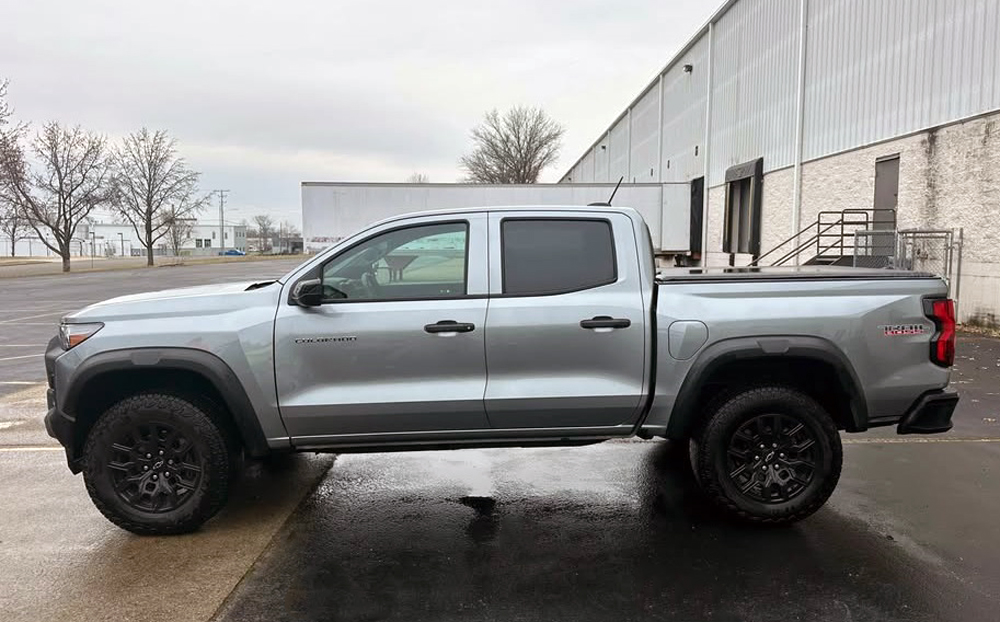
1. How Chevy Pushed the Colorado to 7,700 lbs
From inline-5 to TurboMax, how midsize towing climbed the ranks
Early Colorados pulled like they were built for lawn equipment, not trailers. The 2004–2007 models maxed out at 4,000 lbs with a wheezy 3.5L or 3.7L five-cylinder.
The 5.3L V8 that showed up in 2009 pushed it to 6,000 lbs, but it wasn’t until the second-gen 2015 model, with a stronger frame, stiffer brakes, and better cooling, that real midsize towing showed up.
The 3.6L V6 unlocked 7,000 lbs. Then the 2.8L Duramax diesel raised the bar to 7,700 lbs in 2016, backed by 369 lb-ft of torque and lower-RPM muscle that gas engines struggled to match.
That number stuck. And GM didn’t walk it back when the third-gen Colorado launched. Instead, they dropped the V6 and the diesel altogether, replacing both with one four-cylinder: the 2.7L TurboMax.
Colorado Tow Ratings by Era
| Model years | Max tow rating | Key engine | Notes |
|---|---|---|---|
| 2004–2007 | 4,000 lbs | 3.5/3.7 I-5 | Basic midsize, light trailers only |
| 2008–2012 | 6,000 lbs | 5.3 V8 | First real “towable” Colorado |
| 2015 | 7,000 lbs | 3.6 V6 | Second-gen frame/brake upgrade |
| 2016–2022 | 7,700 lbs | 2.8 Duramax | Diesel torque benchmark |
| 2023–2026 | 7,700 lbs | 2.7 TurboMax | Single gas turbo replacing V6 + diesel |
Why GM dropped diesel and doubled down on the 2.7 turbo
The TurboMax 2.7L didn’t show up to play backup. With 430 lb-ft of torque and early power delivery, it fills the diesel’s shoes and then some. It spools fast thanks to a dual-volute turbo and holds torque across a flatter band, which means fewer downshifts and stronger uphill pull.
Swapping diesel for turbo four means fewer emissions headaches, lower build costs, and smoother drive quality. No DEF, no soot traps, no diesel rattle. It also ends parts bin chaos, one engine, one torque spec, two tunes. That streamlines builds and makes max tow easier to spec.
What keeps Colorado ahead of the midsize pack
Ford’s Ranger climbs close at 7,500 lbs. Frontier hits 7,150. The Tacoma i-FORCE MAX torque number looks good on paper, but the tow cap hovers under 6,800 lbs. The Ridgeline, built like an SUV with a bed, tops out at 5,000.
GM still leads the class in raw tow rating. It’s not just bragging rights, it matters when your boat or camper tags 7,000+ lbs loaded. And Chevy ties the number to real trailering tech: app integration, cooling, harnesses, and even a 220-amp alternator built to handle trailer charge lines.
Midsize Tow Ratings at a Glance
| Truck | Max tow | Max torque | Notable tow tech edge |
|---|---|---|---|
| Colorado | 7,700 lbs | 430 lb-ft | Trailering app, camera suite, 220-A alt |
| Ford Ranger | 7,500 lbs | ~400 lb-ft | Pro Trailer Backup Assist |
| Toyota Tacoma | 6,500 lbs | up to 465 lb-ft* | Hybrid option, but lower tow rating |
| Nissan Frontier | 7,150 lbs** | 281 lb-ft | Simple, stout V6 |
| Honda Ridgeline | 5,000 lbs | 262 lb-ft | Unibody, light-duty towing |
* For hybrid i-FORCE MAX trims.
** 7,150 lbs is the rating for the 2025 model year; 2024 models were rated at 6,640 lbs.
2. The guts of Z82: what actually changes under the skin
Frame-mounted hitch and load-bearing steel, not bolt-on fluff
Every Z82-equipped Colorado runs a Class III 2-inch receiver welded into the fully boxed, hydroformed frame. This isn’t an accessory, it’s structure.
The hitch pulls from the rails, not the bumper. That matters when you’re dealing with tongue weights brushing 1,000 lbs. No flex, no looseness, no hunting for torque specs on rusty U-bolts.
Chain loops are built in. Frame rails are reinforced at the receiver pocket. A base truck with a bolt-on hitch might drag a garden trailer, but it’s not certified for full gross trailer weight. The sticker on a factory Z82 hitch shows the number, up to 7,700 lbs, because it’s been tested to it.
The wiring, the juice, and the heat sinks that keep it alive
Z82 swaps the bare-bones trailer plug for sealed 4-pin and 7-pin connectors tied to a full 7-wire harness. That includes a charge line to power trailer batteries and electric brakes.
Some trims run without this unless the package is ordered. The 7-pin feed also triggers the brake controller input and trailer sway control logic.
Under the hood, you’ll find the high-output 220-amp alternator on Z82 builds with ZL6 or tow-focused trims. That’s not just to run the stereo. It keeps trailer accessories alive, powers onboard sensors, and holds voltage on long grades with fan, pump, and controller draw all running hot.
Cooling is upgraded too. The radiator gets more surface area and higher-flow internals. Some trims with the base engine or no Z82 use a lighter-duty cooler, which can struggle with long mountain grades under full load. Fail the heat test, and the ECU pulls power to save itself.
Colorado Tow Package (Z82) Hardware vs Non-Tow
| Component | Base Colorado (no tow pkg) | With Z82 Tow Package |
|---|---|---|
| Receiver hitch | None / dealer add-on only | 2″ frame-integrated Class III |
| Trailer wiring | Often 4-pin or none | 4-pin + 7-pin sealed connectors |
| Harness / charge line | Not fully provisioned | 7-wire harness w/ charge feed |
| Cooling | Standard radiator | Heavy-duty cooling (varies by trim/engine) |
| Alternator | ~170-amp typical | 220-amp on tow-focused builds |
| Hitch label tow rating | Lower / unspecified | Up to 7,700 lbs when properly equipped |
Locking rear differential, real traction where it matters
The Eaton G80 locker shows up on many Z82 builds, either bundled or dealer-added. It’s not electronic. It’s not a fancy limited-slip. It’s a speed-sensing, clutch-based mechanical locker.
One wheel spins, the diff locks, and both axles turn together. That can be the difference between pulling your trailer out of wet grass or digging a trench.
The G80 is nearly invisible during normal driving. No buttons, no warnings. But once the tire speed delta hits its limit, usually around 100 RPM difference, it snaps both axles together until traction evens out.
If you’re launching a boat on slime-coated concrete, backing a camper into a campsite, or climbing a gravel trail to reach a hunting blind, G80 does the work. Without it, open diffs slip and spin. Towing doesn’t wait for dry pavement.
3. Trailering tech stack: how ZL6 turns sensors into pulling power
The trailering app that replaces guesswork with touchscreens
The Trailering App lives on the 11.3-inch screen, tied into the truck’s drive modes, lighting system, brake controller, and tire monitors. It builds per-trailer profiles, length, number of axles, brakes or no brakes, and stores them in memory. Every time you hook up, the truck knows what it’s dealing with.
You can run a light test solo, no more yelling at someone to “hit the brakes!” from behind the trailer. The system cycles through brakes, blinkers, reverse lights. It also tracks trailer mileage and flashes alerts when it’s time to repack bearings or toss cracked tires.
If your trailer has TPMS sensors installed, the truck reads live tire pressures and temps. No guessing. No surprises when a tire heat-soaks to 130°F in the Arizona sun and starts delaminating.
Key Trailering App Functions
| Feature | What it does | Why it matters when towing |
|---|---|---|
| Trailer profiles | Saves length/axles/brakes per trailer | Quick setup, fewer mistakes |
| Light test | Cycles lights while you walk around | True one-person hookup |
| Trailer odometer | Logs miles on the trailer | Stay ahead on bearings/tires |
| Trailer TPMS integration | Shows trailer tire PSI/temp | Early warning for blowouts |
Built-in brake control that talks to the truck’s brain
Forget the clunky aftermarket boxes zip-tied to the dash. ZL6 includes the JL1 integrated trailer brake controller wired straight into the ABS and stability control systems. Gain is adjusted with factory controls, no knobs or hidden menus, and synced with brake pedal input. Smooth stops, no jerks.
The system reads real braking pressure and modulates output to the trailer brakes accordingly. No surge. No lockups. It’s active on every downshift and every hard stop, and it scales gain output based on payload and drive mode. That matters when descending a wet grade with 6,500 lbs behind you.
Camera views that turn towing into precision work
Hitch Guidance overlays a steering line on the reverse camera so you can walk the coupler onto the ball without overshooting. Switch to Hitch View, and the camera gives you a zoomed top-down view of the hitch ball, tight enough to center the tongue by yourself. No spotter. No yelling. No chipped bumper.
When the truck detects it’s in Hitch View and shifted into Park, the electric parking brake fires instantly. That holds position without creep or rollback, locking your exact alignment for the pin or coupler drop.
The full camera suite includes rear view, bed view, and underbody angles, especially useful off-road. With a tongue drop on uneven ground or a steep ramp, these views prevent dragging the frame or twisting the jack stand.
4. Which trims tow hard and which ones trade it for trail cred
WT and LT, max rating without the fluff
The Work Truck and LT trims offer the cleanest path to full tow capacity. With the TurboMax engine and Z82 package checked, both hit the 7,700-lb ceiling without fuss. No lifted geometry, no oversized tires, just a frame, diff, and drivetrain doing the job.
Payload on WT builds can stretch past 1,650 lbs, which leaves enough headroom for tongue weight, passengers, and gear. That’s what makes them popular with contractors and RVers, not flashy, but rated and ready. If your trailer pushes 6,500 lbs loaded, these trims don’t flinch.
Trail Boss and Z71, off-road kit without cutting tow spec
Trail Boss adds a 2-inch factory lift, different bump stops, and off-road shocks, but it still keeps the full 7,700-lb tow rating. Same story with Z71, skid plates, off-road suspension, and no penalty to the number on the hitch.
What changes is payload. Expect around 100–150 lbs less than the WT or LT, thanks to heavier wheels and added hardware.
These builds split the difference for people who tow to the trailhead and don’t want to leave traction behind. They carry most of the load without sacrificing ride height or articulation.
ZR2 and Bison, off-road dominance, reduced tow margin
ZR2 trims cut the tow rating to 6,000 lbs. Add the Bison package, and it drops again to 5,500 lbs. Not because of power, it’s still the same TurboMax, but because of suspension travel, 35-inch tires, and added steel.
The Multimatic DSSV shocks soak up trail hits, but they’re not tuned for loaded stability. Long-arm geometry, heavier unsprung weight, and taller tires eat into payload too.
A small overland trailer, two-place sled hauler, or light aluminum boat is still fair game. But if you’re pulling a twin-axle camper across three states, ZR2’s not your tow rig.
Colorado Trim Tow and Payload Snapshot
| Trim | Engine | Max tow* | Typical payload** | Suspension highlight |
|---|---|---|---|---|
| WT | 2.7 Turbo / TurboMax | Up to 7,700 lbs | ~1,600–1,700 lbs | Base or optional G80 |
| LT | 2.7 Turbo / TurboMax | Up to 7,700 lbs | ~1,550–1,650 lbs | Comfort-tuned |
| Trail Boss | 2.7 TurboMax | 7,700 lbs | ~1,500–1,600 lbs | 2″ factory lift, off-road tune |
| Z71 | 2.7 TurboMax | 7,700 lbs | ~1,450–1,550 lbs | Off-road shocks/springs |
| ZR2 | 2.7 TurboMax | 6,000 lbs | ~1,300–1,400 lbs | DSSV dampers, wider stance |
| ZR2 Bison | 2.7 TurboMax | 5,500 lbs | ~1,200–1,300 lbs | 35″ tires, AEV armor |
*With proper tow equipment. **Ballpark ranges; actual payload is on the doorjamb sticker.
5. Payload squeeze, tongue weight hits, and what trailers really fit
Why that 7,700-lb number shrinks the moment you load people
Start with the rule: 10–15% of your trailer weight lands on the hitch. That’s tongue weight. On a 6,500-lb trailer, that’s 650–975 lbs pressing down on your frame before you’ve added a single body to the cab.
Now add two adults, two kids, a dog, a bed full of gear; tools, cooler, bikes. It stacks fast. WT and LT trims with the full TurboMax + Z82 combo average 1,600–1,700 lbs of payload. That leaves room, but not much.
Sample WT/LT Payload Use with a 6,500-lb Trailer
| Item | Weight (approx.) |
|---|---|
| Trailer (6,500 lbs) tongue @ 13% | 845 lbs |
| Driver + front passenger | 350 lbs |
| Two kids + dog | 250 lbs |
| Bed cargo (cooler, tools, gear) | 200 lbs |
| Total payload in use | 1,645 lbs |
Why the door sticker matters more than brochure specs
Forget the glossy number in the ad. What controls your legal limit is stamped on the VIN label inside the door: GVWR (truck only) and GCWR (truck + trailer). Go over either one, and you’re technically overloaded, even if you’re under 7,700 lbs on the hitch.
It gets worse after a crash. If you’re 300 lbs over GVWR and lose control, that insurance payout could vanish. Lawyers and investigators don’t care what accessories you added, they read door labels and pull scale tickets.
Aftermarket airbags and helper springs don’t change your legal payload. They level ride height. That’s it.
Which trailers pair cleanly with which builds
Light utility trailers, single-axle campers, and dual jet ski rigs stay well under the danger zone, even on ZR2 trims. But once you move into tandem-axle travel trailers, deck boats, or car haulers, you need the right build.
WT, LT, Trail Boss, and Z71 trims handle the 5,000–7,000-lb trailer class cleanly when built right. ZR2s lose margin fast. Pulling a 6,000-lb trailer with 1,300 lbs of payload and 1,000 lbs of tongue weight doesn’t leave room for passengers, let alone gear.
Towing works when the trailer fits the truck. Not when the truck has to carry the trailer’s weight on its back.
6. How it pulls, shifts, cools, and burns fuel under load
TurboMax grunt and transmission logic under pressure
Start on an incline with a 6,500-lb trailer and the TurboMax doesn’t hesitate. Torque lands early, 430 lb-ft right where you need it. No throttle delay, no gear-hunting. Tow/Haul mode kicks the shift points higher, tightens the converter lockup, and holds lower gears longer to keep the powerband loaded.
The 8-speed isn’t searching. It’s deliberate. The truck stays planted on grades, and engine braking locks in once you lift off. Powertrain Grade Braking and Cruise Grade Braking both trigger automatic downshifts without driver input. The system leans on engine compression to ease speed instead of overheating the pads.
Heat issues: how Colorado keeps it in check
Pulling weight builds heat fast. Engine oil, trans fluid, diff lube, they all spike when you’re loaded and climbing in August. The Z82 cooling upgrade swaps in a high-capacity radiator with better thermal conductivity. The trans cooler runs harder, and fan logic ramps earlier to hold target temp.
Without that upgrade, trucks start pulling timing and torque once coolant crosses the high side. Miss that drop on a mountain pass, and you’ll feel the ECU choke the power.
Brake fade sets in fast when the calipers heat-soak, which is why the trailering-grade braking system matters. It buys time between pedal pushes, and less time riding the rotors.
What fuel economy really looks like when dragging 7,000 lbs
Don’t trust the sticker. With no trailer, Colorado can hold 22–24 MPG on the highway. Add a trailer and the needle dives. At 60 mph with a 5,000-lb load, you might see 15–16 MPG. Push a 7,500-lb camper at 70+, and you’re in 10–11 MPG territory. Wind resistance slams the curve faster than weight does.
The 21.4-gallon tank doesn’t care. Fill range drops to 230–250 miles, sometimes less, depending on elevation and speed. That means tighter fuel planning, especially in mountain or rural zones.
Sample Colorado Fuel Use Towing vs Empty
| Condition | Speed range | Approx. MPG | Range on 21.4 gal tank |
|---|---|---|---|
| Empty highway | 65–70 mph | 22–24 MPG | 470–515 miles |
| 5,000-lb trailer | 60–65 mph | 15–16 MPG | 320–340 miles |
| 7,500-lb trailer | 60–65 mph | 12–14 MPG | 255–300 miles |
| 7,500-lb trailer, 75 mph | 70–75 mph | 10–11 MPG | 210–235 miles |
7. Factory tow gear vs aftermarket: what’s really on the line
Why GM’s Z82 cert matters when the load goes sideways
The Z82 tow package isn’t just parts, it’s a certified setup. GM tests the full combo, cooling, brake control, frame tie-in, sway logic, at the advertised 7,700 lbs.
That rating only applies to trucks built and validated as a system. Install a hitch from eBay, and the number on paper doesn’t mean anything in court or a crash report.
Insurance adjusters and investigators look at GCWR, axle weights, and how the hitch is mounted. If you bolt into a bumper crossmember not designed for shear loads, don’t expect the rating to hold up. And don’t expect a claim to pass clean if the trailer detaches or the frame bends under load.
Where warranty fights start and who loses them
Dealers can’t void a whole warranty just because you added a hitch. But if the install fries trailer wiring, shorts the BCM, or causes controller faults, they’ll bounce the claim. GM’s JL1 controller and sealed harnesses are built into the truck’s electrical map. Splice into those circuits wrong and you’re on your own.
Frame damage from improperly mounted hitches or overloaded rear suspensions? That won’t fly either. Z82 and ZL6 are pre-approved builds. Anything outside that setup turns into a question mark, especially for warranty or buyback disputes.
Factory Tow Package vs Aftermarket Mix-and-Match
| Aspect | Factory Z82/ZL6 | Aftermarket mix |
|---|---|---|
| Hitch/frame tie-in | Engineered and validated | Depends on installer |
| Wiring integration | OEM harness, sealed plugs | Splices/taps possible |
| Brake controller | Integrated in dash + ABS | Add-on box, separate wiring |
| Rated tow capacity | Backed by GM testing | Capacity unchanged legally |
| Warranty disputes | Less likely on tow-related issues | More room for finger-pointing |
When the bolt-on route still makes sense
Not every Colorado needs Z82 from the factory. If you’re pulling a 1,500-lb lawn trailer or a single dirt bike hauler, a quality aftermarket hitch and four-pin harness get it done. Just keep the load under the base truck’s lower GCWR, and stay away from surge or electric trailer brakes unless properly wired.
Add-ons like air springs or sway bars help balance the load, but they don’t raise payload or tow capacity. They’re ride-leveling tools. Same with upgraded brake controllers, fine for older trucks that lack JL1 but useless without a proper 7-pin and charge line.
Used-truck buyers should crawl under and trace every wire, bolt, and plug. Factory installs are clean and sealed. DIY jobs often aren’t, and one frayed splice could end lights, brakes, or both.
Ready when you are to knock out Section 9. It’ll match towing setups to actual owner profiles, weekend haulers, off-roaders, or full-time camper pullers.
8. Who needs what: tow setup picks by real-world use
Light haulers who just need to move stuff, not mountains
If you’re pulling jet skis, utility trailers, or a single-axle camper under 4,000 lbs, don’t overbuild. A WT or LT trim with the base 2.7 turbo and Z82 handles these jobs without breaking a sweat. No need for trailer TPMS or grade braking if you’re towing 10 miles across town on flat roads.
Most light-duty setups never touch the 7-pin connector. The 4-pin plug runs lights, and that’s it. No brake controller, no battery feed, no load-leveling hardware required. Spend the money on better tires or bed storage, not tech you won’t use.
Weekend campers, boat pullers, and the “every few weeks” crowd
Towing 5,000–7,000 lbs once or twice a month puts you in the sweet spot for a TurboMax LT or Z71 with Z82 and ZL6. You need the full 7-pin, the trailer brake controller, and the Trailering App.
If you’re driving hours to a state park with a 26-footer or launching a wake boat on steep ramps, those systems stop being extras, they’re necessary.
The 220-amp alternator becomes mandatory if your trailer has onboard batteries, fridges, or heavy lighting. You’ll burn up charge lines or sag voltage on the dash without it. The TPMS integration is more than convenience, it gives you warning before a blowout costs you a fender and three hours on the shoulder.
Off-road-first rigs pulling toys, not bunkhouses
Trail Boss hits the mark here. It keeps full tow rating, adds lift and off-road tuning, and plays nice with smaller campers, sled trailers, and RTT (rooftop tent) setups. G80 locker, solid articulation, and you still get the 7,700-lb rating with Z82.
ZR2 and ZR2 Bison aren’t built for big trailers. They’ll pull a two-place toy hauler, but if your tongue weight pushes 1,000 lbs, you’re out of room fast. Payload drops into the low 1,300s. Bison trims dip into the 1,200s. You’ll scrape max capacity without even loading the bed.
Recommended Colorado Tow Setups by Use Case
| Owner type | Recommended trim / engine | Tow packages | Typical trailer match |
|---|---|---|---|
| Occasional light tower | WT or LT, 2.7 Turbo/TurboMax | Z82 | Utility, single-axle 3–4k lbs |
| Frequent camper/boat use | LT or Z71, 2.7 TurboMax | Z82 + ZL6, 220-A alt | 5–7k-lb camper, wake boat |
| Off-road + toys | Trail Boss, 2.7 TurboMax | Z82 (ZL6 optional) | Sleds, small toy hauler, light RTT |
| Rock-crawler first | ZR2 / ZR2 Bison | Z82 where offered | Small overland trailer, under 5.5k |
Sources & References
- Chevy Colorado Towing Capacity By Year & Configuration – Bomnin Chevrolet
- Everything You Need to Know Before Buying a New 2026 Chevrolet Colorado in Grand Island, NE
- The 2026 Chevy Colorado: Specs, Trim Levels, and Features – Bale Chevrolet Blog
- 2023 Chevy Colorado Towing Capacity | Chevrolet Of Turnersville
- How Much Can a Chevy Colorado Tow? A Complete Guide to Towing Capacity & Specs | Riverton-Elko GM Superstore
- How Much Can a Chevy Colorado Tow? | 2021–2024 Towing Capacity – Cox Chevrolet
- 2025 Chevrolet Colorado Towing Capacity
- 2024 Chevy Colorado Engines & Towing – Medlin Chevrolet
- 2025 Chevy Colorado Towing Capacity – What to Expect – DELLA Chevrolet
- 2024 Chevy Colorado and the 2024 Ford Ranger Are At It Again – Edwards Chevrolet 280
- 2026 Chevy Colorado Guide | Towing, Trims, MPG & Off-Road – Starling Chevrolet GMC
- 2026 Chevy Colorado Trim Levels – Key Features – Cable Dahmer Chevrolet of Independence
- New 2026 Chevrolet Colorado LT – Mossy of Picayune
- 2024 Chevy Colorado Towing Capacity – Terry Labonte Chevrolet
- Towing & Hauling: What the 2025 Chevy Colorado Can Really Do | Legacy Chevrolet
- 2025 Chevy Colorado Towing Capacity | Pride Chevrolet
- Used 2024 Chevrolet Colorado For Sale at Larry H. Miller Chevrolet Murray | VIN: 1GCPTDEK3R1136976
- New 2024 Chevrolet Colorado Trail Boss Crew Cab in Nephi
- 2024 Trailering Guide – Chevrolet
- The 2026 Chevy Truck Towing Capacity Guide for Casa Grande Drivers
- 2024 Chevy Trailering Package – Yoder Chevrolet
- 2025 GMC Canyon 4WD AT4 – SVG Auto Group
- 2024 Chevrolet Truck Trailering Packages
- 2023 Chevy Trailering Guide
- 2026 Chevrolet Colorado WT – John Hiester Chevrolet of Fuquay-Varina
- Towing : r/chevycolorado – Reddit
- How much can the 2026 Chevrolet Colorado tow, and which setup is right for Watertown, WI?
- Chevy Colorado Tow Rating – Bobby Crabtree Chevrolet of New Haven
- 2024 Chevrolet Colorado 4WD Z71 – Egg Harbor Township NJ
- In-Vehicle Trailering App | Vehicle Support | Chevy
- Exploring Advanced Trailering Technology in the 2025 Chevrolet Colorado
- Tow with Confidence Using the Chevrolet Trailering App
- Chevy Colorado Towing Capacity | Galleria Chevrolet
- New 2026 Chevrolet Colorado WT Four Wheel Drive Crew Cab
- North Bay’s Top Truck: 2024 Chevrolet Colorado Beats 2024 Nissan Frontier
- 2026 Chevrolet Colorado Towing & Payload Capabilities
- Trailer Towing Views | Vehicle Support | Chevy
- Blind Zone Steering Assist | Vehicle Support – Chevrolet Canada
- New 2025 Chevrolet Colorado Z71 Four Wheel Drive Crew Cab
- 2025 Chevrolet Colorado Towing Capacity
- New 2026 Chevrolet Colorado Trail Boss Four Wheel Drive Crew Cab
- 2026 Chevrolet Traverse LT Muncy PA
- 2024 Chevrolet Colorado vs. 2024 Toyota Tacoma
- 2026 Chevy Colorado in Brainerd, MN
- 2026 Chevy Colorado: Midsize Truck | Chevrolet
- 2025 Chevy Tow & Trailer Package Overview with Price & Features
- Chevrolet Trailering Package
- The 2025 Chevy Traverse: Space for Every Adventure
- Gerry Raymond Chevrolet of Fairmont Blog
- Cadillac XT4 Towing Capacity
- 2024 Chevy Colorado Towing Capacity | Rick Hendrick Chevrolet
- 2024 Chevy Colorado Towing Capacity | George Weber Chevrolet Company
- 2026 Chevrolet Colorado Work Truck Baton Rouge LA
- 2025 Chevy Colorado Towing & Payload Guide
- Chevy Colorado Payload & Towing Capacity
- 2026 Chevrolet Colorado LT Platteville WI
- 2024 Chevy Colorado Trim Levels | WT vs. LT vs. Trail Boss vs. Z71 vs. ZR2
- 2025 Chevy Colorado Towing Capacity – Windy Chevrolet
- 2023 Chevrolet Colorado Towing Capacity
- How Does the 2026 Chevy Colorado Beat the Competition
- Ford Ranger vs. Chevy Colorado: Towing Truths, Bed Smarts, and Everyday Costs
- 2024 Ford Ranger vs. 2024 Chevy Colorado – Porcaro Ford
- Chevrolet Colorado vs Ford Ranger
- Tacoma vs Colorado: Battle of the Midsize Trucks
- Top Truck Showdown: 2024 Toyota Tacoma vs 2024 Chevrolet Colorado
- Chevrolet Colorado vs. Toyota Tacoma
- 2024 Chevy COLORADO ZR2 Gas Mileage | SHOCKING Fuel Economy!!! 20000km REVIEW
- 2024 Chevy Colorado Gas Mileage
- 2024 Chevy Colorado Gas Mileage
- 2024 Chevy Colorado MPG Ratings
- 2024 Toyota Tacoma vs. 2024 Chevy Colorado
- Upgrading towing capacity : r/chevycolorado – Reddit
- Would installing a third-party trailer hitch on a car void the power train warranty?
- Will Installing a Trailer Hitch On a 2021 Chevy Colorado Void the Factory Warranty
- Have factory tow package or after market? | Good Sam Community