
Stalls in traffic. No warning, no puddle, just a dead engine and a $7,000 problem no recall covers. The failure’s buried in the timing cover. Ford’s 3.5L and 3.7L Cyclone V6s hide the water pump behind the chain.
When that seal gives out, coolant cuts straight into the oil pan. No dashboard light. No easy fix. Just a milkshake in the crankcase and a block that might never turn over again.
Here’s what cracks, who’s at risk, why regulators walked, and how owners are getting stuck with engine totals, and the bill.
1. Why Ford’s buried water pump sets the whole system up to fail
Transverse engines shoved it behind the timing cover
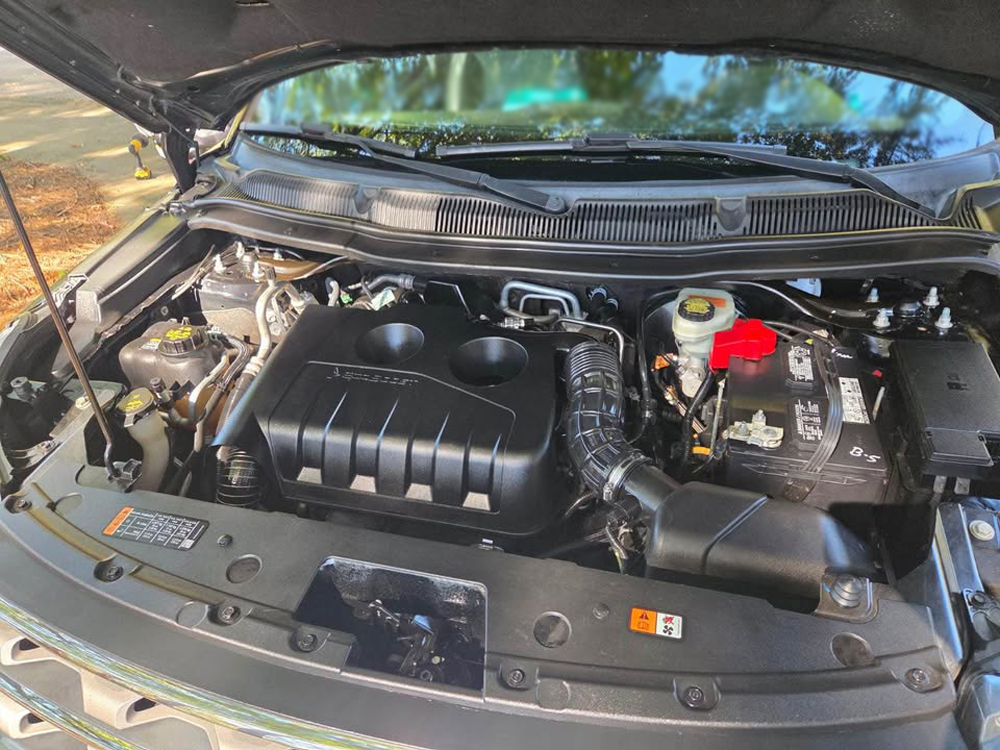
On the 3.5L and 3.7L Cyclone V6, the water pump sits inside the block, behind the timing cover, spinning off the primary chain. No gasketed front-mount. No quick access. No visual cues.
Only transverse layouts got this setup, Edge, Explorer, Taurus, Flex. Longitudinal builds like the F-150 or Mustang stayed with an external, belt-driven pump. When those fail, they leak on the ground. When this one fails, coolant blows into the timing case and oil pan.
A blocked weep hole sends coolant into the crankcase
Ford carved a weep passage into the block. It’s meant to vent early leaks near the alternator. But that hole clogs, often from leftover casting sand or rust flakes, and once it’s plugged, coolant has nowhere to go but through the second seal.
What should be a $300 fix turns into a bottom-end engine destroyer. Oil emulsifies. Bearings wash out. Tensioners collapse. The engine seizes before a warning light ever pops.
Design priorities kept it compact, and off the recall list
Ford didn’t bury the pump by mistake. The goal was faster warm-ups, tighter packaging, and one less belt to drive. It helped meet emissions targets and kept the engine bay compact for FWD crossovers.
But when it fails, there’s no visible clue and no safety trigger. NHTSA recalls fire risks and crash hazards, not slow coolant leaks that wipe engines outside warranty. That gives Ford cover. Engine dies? It’s just a “durability issue.” Not their legal problem.
2. How these water pumps fail, and what they take down with them
Bearing play turns a slow leak into a milkshake
The failure path always starts at the shaft. The timing chain loads the water pump with constant torsion. As miles stack up, the internal bearing wears down. The shaft begins to wobble. That wobble eats the seal. Coolant seeps into the timing cavity and drops into the oil pan.
The mix churns into a thick, frothy emulsion, coolant and oil, no longer either. Oil pressure tanks. Rods knock. The engine might idle fine at shutdown but fail to restart cold, already chewed from the inside out.
Orange coolant speeds the death spiral
Ford used Motorcraft Orange OAT coolant across most Cyclone years. It’s fine when fresh. But heat cycles break it down. Over time, it throws off abrasive particles, silicates and chemical fallout that shred pump seals from the inside.
Later engines switched to Motorcraft Yellow P-OAT. Better seal compatibility. Less fallout. It doesn’t fix the design, but it slows the rot. Swapping early helps. Sticking with Orange just feeds the problem.
Pump failure doesn’t stop at the pump
Once the coolant path collapses, circulation tanks. Hot spots build in the heads. The heater core can clog. Chain tensioners lose oil pressure and start to rattle.
Worst case? Coolant floods the combustion chamber through a failed gasket or warped head. On startup, a piston hits liquid and bends the rod. Now it’s not just a bad pump, it’s a hydrolocked engine with a twisted crank.
3. Which engines, models, and drivers get hit hardest
Internal-pump Cyclones only hit transverse setups
Not every 3.5L or 3.7L Cyclone engine carries this design risk. The engine destroyer combo is a transverse-mounted block with the internal timing-chain-driven pump. Those showed up in FWD and AWD crossovers and sedans, not trucks or vans.
The same basic engines in longitudinal form (like the F-150, Mustang, and Transit) run an external, belt-driven pump. That setup isolates the coolant from the crankcase. It may leak, but it won’t take out the bottom end.
Which models carry the internal pump risk
Ford buried the internal pump across dozens of models, mainly Explorer, Edge, Taurus, Flex, and Fusion Sport. Lincoln versions like the MKZ, MKT, and Continental used it too. So did the Mazda CX-9 before its switch to Skyactiv.
Here’s where they landed:
| Engine Variant | Vehicle Model | Model Years | Configuration |
|---|---|---|---|
| 3.5L Ti-VCT | Ford Edge | 2007–2018 | Transverse |
| 3.5L Ti-VCT | Ford Explorer | 2011–2019 | Transverse |
| 3.5L Ti-VCT | Ford Flex | 2009–2019 | Transverse |
| 3.5L Ti-VCT | Ford Taurus | 2008–2019 | Transverse |
| 3.5L EcoBoost | Explorer Sport, SHO, Flex EcoBoost | 2010–2019 | Transverse |
| 3.7L Ti-VCT | Lincoln MKZ, MKT, Continental | 2007–2020 | Transverse |
| 3.7L Ti-VCT | Ford Police Interceptor Utility | 2013–2019 | Transverse |
| 3.7L Ti-VCT | Mazda CX-9 | 2007–2015 | Transverse |
Every one of these puts the water pump inside the oil system. There’s no inspection window. When it fails, it fails big.
Age, idle time, and why fleets go first
Most pumps let go between 80,000 and 150,000 miles. But hours matter more than odometers here. High idle time accelerates wear, especially in fleets like police interceptors and city vehicles. Heat soak and vibration hammer the bearings harder when the car sits running.
Old coolant does the rest. If the factory fill is still in there at 100,000 miles, it’s grinding down seals by the day. Private owners can stretch the failure curve. Fleet rigs often never make it that far.
4. When a water pump takes the whole engine down with it
Why this job starts like a teardown, not a service
There’s no quick way in. To swap the internal pump, you’ve got to remove the timing cover. That means lifting the engine, unbolting mounts, pulling the front cover, and resetting the timing set. Skip steps, and the chain eats itself after reassembly.
EcoBoost versions are worse. Intercooler piping and turbo plumbing crowd the bay, adding time and extra disassembly. It’s not just the pump, it’s the price of admission to get near it.
Cost ramps fast, from a $300 pump to a $9,000 engine swap
| Repair Scenario | Labor Time (hrs) | Parts Estimate | Total Estimate | When It’s Usually Recommended |
|---|---|---|---|---|
| Internal water pump only | 10.5–12.0 | $150–$300 | $1,500–$2,500 | Early catch, no oil contamination |
| Pump + full timing set | 11.5–13.5 | $600–$1,000 | $2,000–$3,500 | High miles, chain noise, preventive combo job |
| Used engine replacement | 15.0–18.0 | $2,500–$4,500 | $5,000–$8,000+ | Milkshake wiped bearings, engine already gone |
| Reman engine with warranty | 16.0–20.0 | $3,500–$6,000+ | $6,500–$10,000+ | Long-term keeper, full reset with coverage |
Dealers stick to the book, indies bend the cost curve
Dealers won’t take risks. They follow labor guides, use OEM parts, and rarely extend goodwill without a CSP. If the engine’s gone, expect a straight quote, no patch jobs, no creative workarounds.
Good independents handle it differently. Some use dual-gasket pumps that reroute early leaks away from the pan. Others swap in low-mile used engines or offer bundled timing and pump kits to cut repeat labor.
A used Flex or Explorer might not justify a $7,000 bill, but a $2,500 job with upgraded parts and tight clearances? That keeps it on the road without draining dry.
5. Why Ford’s internal pump never made the recall list
Recalls need fire, stalls, or lawsuits that stick
NHTSA recalls don’t exist to cover high repair bills. They’re triggered by safety risks, fires, stalls, crash hazards. Internal water pump failure wipes engines, but it doesn’t light them up or shut down power at highway speed unless the failure’s already full-blown.
Ford dodges the net. They label it a wear item. When it lets go, it’s blamed on age, mileage, or poor maintenance. No open campaign, no free fix.
EcoBoost got coverage, Cyclone didn’t
Ford’s smaller EcoBoosts (like the 1.5L) suffer from coolant intrusion too. But the cause is casting flaws, not a buried pump. Ford created Customer Satisfaction Program 21N12, offering short-block replacements and reimbursement for early failures, VIN-specific, with a deadline.
The Cyclone engines never got that courtesy. No recall, no CSP. Same engine destroyer, different cause, no compensation. Owners of Flex, Explorer, Taurus, and MKT models are stuck footing $6,000+ repairs while Fusion and Escape drivers walk into free long blocks.
TSBs mop up the mess but stop short of fixing it
Ford issued Technical Service Bulletins for cooling complaints, lack of heat, or odd smells in the cabin. TSB 18-2266 even outlines a 9.3-hour flush procedure for heater core blockage tied to pump debris.
None of those bulletins address the underlying issue, the internal pump’s design. They treat symptoms: lost heat, dirty coolant, strange engine noises. Not one gives lifetime coverage. Not one upgrades the pump. Just flowcharts, fluid changes, and a bill the customer usually pays.
6. Why lawsuits haven’t forced Ford to recall these engines
U.S. class actions keep getting shut down
Militello v. Ford aimed big. It accused Ford of hiding a known defect that wiped engines without warning. Plaintiffs pointed to the internal pump’s location, the cost of repair, and lack of owner disclosure.
It didn’t stick. Judges sided with Ford. The engines often failed outside the factory warranty. Safety risks weren’t clear-cut. Courts labeled it economic loss, not a recall-level defect. By December 2023, the consolidated class action was dismissed. No settlement. No campaign.
Canadian courts took the opposite route
In Ontario, the court certified a nationwide class action over the exact same pump design. Owners across Canada who suffered damage before May 30, 2024, are now eligible to claim costs for repairs, parts, or loss of use.
The case didn’t stall on technicalities. The court saw enough evidence of a high-cost design flaw to move forward. U.S. owners still fight solo. Canadians now have a collective path to compensation.
Small claims court is where some owners win
Big lawsuits fail, but one-owner cases sometimes land. In Colorado, a 2017 Escape owner won $7,000 over engine damage tied to coolant intrusion. The judge ruled Ford breached the implied warranty of merchantability.
That win wasn’t about headlines, it was about receipts, timing, and state law. No precedent. But enough of these stack up, and they raise Ford’s legal risk without needing class action scale.
| Jurisdiction / Venue | Case Type | Core Allegation | Status / Typical Outcome |
|---|---|---|---|
| U.S. federal (e.g., Militello) | Nationwide class actions | Internal pump defect, nondisclosure, engine loss | Major consolidated actions dismissed; no nationwide settlement |
| Canadian provincial courts | Certified class action | Dangerous water pump defect causing engine damage | Class certified; compensation path open for affected owners |
| U.S. small-claims / state | Individual owner lawsuits | Breach of implied warranty / merchantability | Mixed, but some owners recover engine or repair costs |
7. How to catch it early, and when to throw in the towel
The warning signs drivers actually notice
Coolant level dropping with no leak on the ground? That’s the first red flag. Crusty white or rust-colored buildup near the alternator means the weep-hole might still be working, but not for long.
Spin the engine cold. If the pump bearing’s going, it growls and tracks RPM. Warm idle with no cabin heat points to circulation loss. Check the dipstick, any tan foam or gray streaks, and you’re already in milkshake territory. That engine’s on borrowed time.
Fluids buy time if you swap them early
Motorcraft Yellow P-OAT coolant cuts the risk of seal abrasion and sludge fallout. It doesn’t fix the design, but it keeps the pump alive longer than the old Orange OAT ever did. Flush interval shouldn’t go near 100,000 miles, cut that to 30,000–50,000.
Synthetic oil every 5,000 miles keeps the timing tensioners healthy. The cleaner the oil, the less wear on the chain and pump drive. Skip the intervals and you’re feeding the weakest part of the whole system.
When to replace the pump, or just walk away
Proactive pump replacement makes sense if the vehicle’s clean, under 120,000 miles, and still on its first pump. Once the timing cover’s off, it’s smart to do chains, guides, and tensioners in one shot.
But if coolant hit the oil and it’s already knocking, pricing a reman engine may beat wasting hours on teardown. For owners with a tired Flex or MKT worth $4,000 on a good day, the only smart move might be unloading it before the next cold start finishes it off.
8. What Ford changed, and what that means for owners today
The switch back to external pumps tells the real story
By 2020, Ford dropped the transverse Cyclone setup on the Explorer and moved to a new rear-wheel-drive platform. The new 3.0L and 3.3L V6s use external, belt-driven pumps, no oil-coolant crossover, no internal seals, no milkshake risk.
It wasn’t a recall. It was a redesign that quietly buried the problem.
Other cooling flaws got covered, this one never did
Ford launched CSPs for coolant intrusion in the 1.5L EcoBoost. It replaced short blocks. It offered refunds. It gave VIN-specific backing to customers with failed engines and fluid crossover.
Nothing like that exists for 3.5L or 3.7L Cyclones. No matter how many fail the same way, they’re still just “out of warranty.”
Know the engine. Know the pump. Or pay later.
If you’re shopping used, the block code and layout matter more than the badge. A 2017 Explorer with a 3.5L Cyclone is a risk. A 2022 with a 3.0L twin-turbo V6? External pump, safer cooling path.
For fleet techs and used-lot buyers, this engine’s a profit-maker, if you quote it right, explain the risk, and spec the job fully. For private owners, it’s a roll of the dice that starts ticking around 100,000 miles. Ignore it, and you’ll find out what happens when your coolant takes out your crank bearings overnight.
Sources & References
- Ford Water Pump Overview: Is There a Recall? – The Lemon Law Experts
- Ford Motor’s Water Pump Failure – Lemon Law attorney
- Here’s How A Bad Water Pump Design Can Total An Older Ford …
- Ford Cyclone engine – Wikipedia
- WHICH FORD ENGINES HAVE INTERNAL WATER PUMP – Durango Ford
- Tried using Google but it’s no help. Did the internal water pump only occur on the transverse mounted front wheel drive models or on the all-wheel drive as well where it was mounted longitudinal? : r/FordExplorer – Reddit
- Why did Ford put the water pump here? : r/Justrolledintotheshop – Reddit
- 3.5 NA vs 3.5 EcoBoost water pumps : r/Ford – Reddit
- Tips on preventing water pump failure on 3.7 and 3.5l Duratec Engines? : r/Ford – Reddit
- How do I prevent failure of internal water pump on Ford/Lincoln/Mazda Duratec engines?
- Ford | 3.5L and 3.7L Transverse-Mounted Duratec V6 Internal Water Pump Failure
- Which Ford Engines Have Internal Water Pump – Value Autos Durango
- How common is the water pump issue in the 3.5? : r/FordExplorer – Reddit
- What years have the water pump issue? : r/FordFlex – Reddit
- Updated TSB for coolant loss/coolant pump : r/BroncoSport – Reddit
- New TSB issued regarding water pumps | 2021+ Ford Bronco Sport Forum
- 2010 FORD Flex Recalls, Complaints and Investigations – The Center for Auto Safety
- Ford changed orange coolant to yellow? : r/MechanicAdvice – Reddit
- Orange versus yellow coolant? : r/FordEdge – Reddit
- Orange to yellow coolant : r/f150 – Reddit
- Motorcraft® Engine Antifreeze/Coolants – Usage Chart (Model Years 2018 and forward) – chemicals and lubricants
- Is the 3.5 duratec water pump failure caused by mileage or age? – Blue Oval Forums
- 3.5 cylinder internal water pump issue : r/Ford – Reddit
- Considering Explorer or Durango : r/FordExplorer – Reddit
- 3.7L ENGINE – COOLANT PUMP LEAK TSB 16-0074 – nhtsa
- TSB 09-8-3
- 3.5l ti-vct – rolling/surging or low idle during a/c operation tsb 15-0149 – nhtsa
- Chilton’s Ford Pick-Ups 2004-12 Repair Manual [26668] 1620920093, 9781620920091
- TECHNICAL SERVICE BULLETIN 3.5/3.7L – Lack Of Heat Or Uneven Heat From The Front Vents 18-2266 – nhtsa
- Militello v. Ford Motor Company (6:22-cv-06425), New York Western District Court – PacerMonitor
- Militello v. Ford Motor Company, No. 6:2022cv06425 – Document 26 (W.D.N.Y. 2023)
- Militello v. Ford Motor Company – Content Details – USCOURTS-mied-2_23-cv-11363-0 – GovInfo
- Ford Lincoln Water Pump Engine Failure | Kessler Topaz
- Kasowitz, on behalf of Ford Motor Co., Secures Twin Victories in Putative Class Action
- Ford Water Pump Class Action – Koskie Minsky LLP
- I Successfully Sued Ford in Small Claims Court in Colorado over the Coolant Intrusion Issue : r/fordescape – Reddit
- Ford Coolant Engine Defective Class Action Lawsuit | Sacramento Attorney
- Customer Satisfaction Program 21N12 Certain 2017-2019 Model Year Fu – nhtsa
- Consumer Class Action Lawsuit Against Ford
- Recall – Ford
- 3.7 V6 internal water pump. Worth it to fix? : r/Ford – Reddit
- Timing Chain Water Pump Kit With Tools For Ford 3.5L 3.7L V6 – Fits Edge Explorer Taurus Mustang
- Which engines have an external water pump? : r/FordExplorer – Reddit