
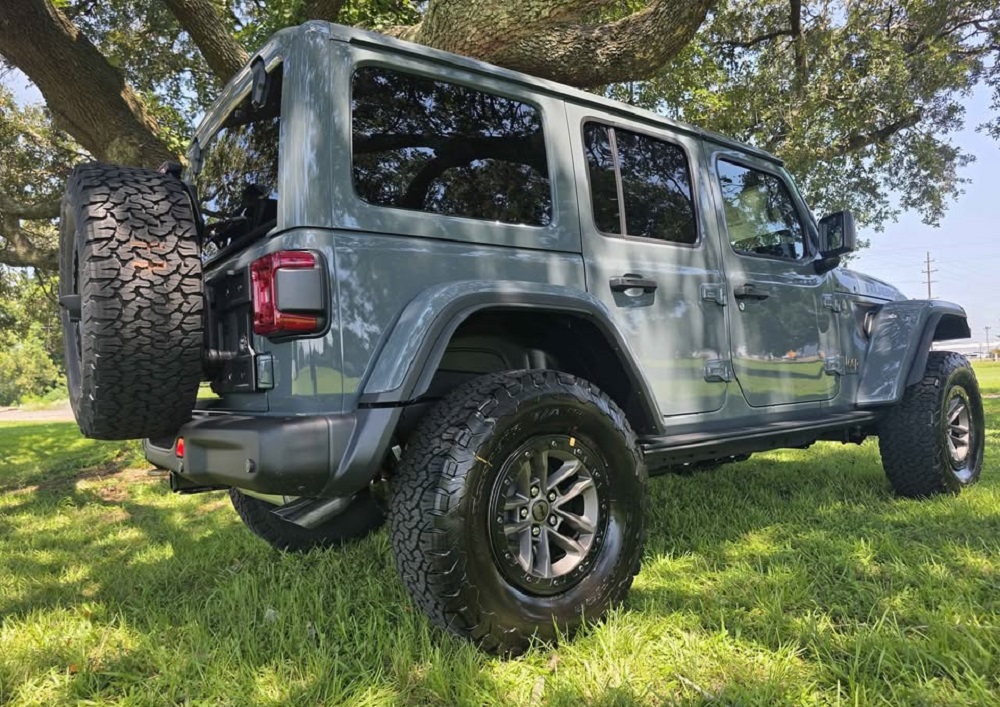
Slap 35s under a Wrangler, and the whole rig shifts; ride height, gearing, torque feel, tire howl. Jeep knew that, and in 2021, it stopped outsourcing the job to aftermarket lifts and started bolting it on at the factory.
The result: Xtreme Recon, then Xtreme 35. Taller rubber, steeper gears, reinforced gate, calibrated shocks. No guesswork, no warranty loopholes.
This guide tears down what that badge really means; what hardware you’re getting, what geometry changes on trail, and what kind of buyers benefit from 35s built on the line instead of the lot. Every trim, every year, every tradeoff. Let’s cut into it.
1. Why Jeep pulled the lift kit in-house and dropped 35s on the line
Bronco fired first with Sasquatch on 35s
Ford didn’t bluff. When the Bronco came back in 2021, it showed up with the Sasquatch package; 35-inch Goodyears, lockers front and rear, Bilstein dampers, 4.70 gears, and a wide stance that kept it planted. All from the order sheet. No dealer lift. No warranty gaps.
Jeep’s Rubicon, still rolling on 33s at the time, suddenly looked like it was missing a step. Bronco grabbed headlines for approach angles and breakover. Sasquatch didn’t just hit the trail hard, it hit Jeep’s image where it hurt: straight from the factory.
Dealer lifts were the loophole, until Jeep shut it
Before Xtreme Recon, some Jeep dealers would bolt on 35s and a Mopar lift right on the lot. Looked official, but the setup danced in a gray zone. No crash validation, no ESC reprogramming, and zero factory warranty on the suspension.
Jeep saw the risk. One rollover or failed axle and the blame game would hit fast. So they built the system in-house. Crash-tested. Brake-tuned. ESC recalibrated. When the Xtreme Recon hit the line, it came with a full Mopar part list, a Jeep VIN, and no wiggle room on warranty coverage.
Four years, four waves: how Xtreme Recon became Xtreme 35
| Model year | Name on window sticker | Key changes vs prior year | Eligible trims |
|---|---|---|---|
| 2021–2023 | Xtreme Recon | Launch of 35″ KO2s, 1.5″ lift, 4.56 gears | 4-door Rubicon, Rubicon 392 |
| 2024 | Xtreme 35 Tire Package | Renamed, added to 2-door trims and Willys | Willys, Rubicon, 2- & 4-door |
| 2025 | Xtreme 35 (refined) | Rolled into Rubicon X; bundled on more hybrid trims | Rubicon, Rubicon X, Willys, 4xe models |
| 2026 | Xtreme 35 + Moab 392 push | Standard on Moab 392; tied to “Twelve 4 Twelve” edition rollout | Moab 392, Rubicon, select 4xe variants |
2. What Jeep actually bolts on when you order Xtreme Recon or Xtreme 35
Thirty‑five‑inch rubber chosen for real miles, not spec sheets
Jeep spec’d LT315/70R17C BFGoodrich KO2s, a true 34.4–34.6 in tire once mounted and loaded. The C‑load matters. Sidewalls flex enough to work rocks at low psi without turning every pothole into a spine check. E‑loads last longer under heavy trailers, but they ride stiff and chatter on broken pavement.
KO2s also keep road noise in check at 70 mph, which matters on a brick-shaped Wrangler. Mud terrains would claw harder in soup, but they’d cost braking distance, MPG, and sanity on daily drives. Jeep picked balance, not bragging rights.
Beadlock‑capable wheels and why Jeep stopped short of true beadlocks
The package runs 17×8 beadlock‑capable wheels, drilled and reinforced to accept Mopar beadlock rings. From the factory, they ship as standard wheels, no rings installed. That’s not a tease. It’s a legal line.
True beadlocks raise inspection and liability flags in many states. Jeep sidestepped that by selling the wheels ready for rings, then letting owners decide. Air down into single digits on slickrock, add the rings. Daily commute and state inspections, leave them off.
The quiet lift doing the heavy work under the body
The suspension lift measures about 1.5 in, but the tuning does the real lifting. Springs and shocks are valved for heavier wheels, taller tires, and higher unsprung mass. Jeep kept bump travel intact instead of stacking pucks and calling it a day.
That calibration shows up on washboard roads and off‑camber climbs. The axle stays planted instead of pogoing, and the steering wheel stops fighting back over every ripple. Cheap lifts raise the body. This one manages motion.
Tailgate reinforcement that prevents the slow sag owners hate
A 35‑inch spare weighs enough to wreck a stock swing gate over time. Jeep adds a Mopar swing‑gate reinforcement and relocates the third brake light higher. Hinges stop drooping. The door stops creaking. Rear glass stays aligned.
Skip this on aftermarket builds and the failure shows up late, after warranty and patience are gone. Jeep handled it up front.
Gearing that puts torque back where your right foot expects it
Bigger tires stretch gearing tall and lazy. Jeep counters with 4.56 axle ratios as standard, and 4.88s on select manual setups. Throttle response comes back. Downshifts calm down. Low range regains control.
On a manual with 4.88s, the crawl ratio pushes toward 100:1. That’s slow enough to let tires work instead of spinning. Automatics land lower, but they keep highway manners livable without screaming RPM.
Brakes, calibration, and street legality nobody talks about
Heavier tires carry more rotational energy. Jeep upgraded to performance four‑wheel disc brakes and recalibrated ABS, traction control, and stability systems around the mass. Panic stops stay straight. ESC doesn’t freak out mid‑swerve.
That work is invisible until it’s missing. Factory tuning keeps the Wrangler legal, predictable, and insurable on 35s. Aftermarket builds rarely bother.
Core hardware snapshot
| Component group | Xtreme Recon / Xtreme 35 spec | Why it matters on 35s |
|---|---|---|
| Tires | LT315/70R17C BFGoodrich KO2 | Grip without harsh ride or constant howl |
| Wheels | 17×8 beadlock‑capable | Low‑psi crawling option without inspection issues |
| Lift | ~1.5 in factory suspension | Restores travel and control, not just height |
| Gears | 4.56 standard, 4.88 optional | Brings torque and crawl speed back |
| Brakes | Performance 4‑wheel discs | Manages added rotational mass |
| Rear gate | Reinforced swing gate | Prevents hinge sag with a 35 in spare |
Where the factory stops and the limits start
Steering links stay stock. Ball joints don’t grow thicker. Jeep tuned the system for 35s, not abuse on 37s with added leverage. Push past the design window and wear accelerates fast, especially on tie‑rod ends and unit bearings.
3. Geometry gains that change your line, not just the spec sheet
Why the 4-door gains mattered first
The 4-door Rubicon’s long wheelbase cuts into its breakover angle. That was always its weak point. With Xtreme Recon, Jeep gave it the clearance it needed to hang with shorter rigs without scraping its belly over every ledge.
Taller tires bump clearance to nearly 13 in, raise the axles, and give approach/departure angles a sharper cut. That’s not cosmetic. It decides whether you tag your front bumper on a rock face or float over it with inches to spare.
| Metric (4-door) | Std Rubicon (33s) | Xtreme Recon / Xtreme 35 | Trail impact |
|---|---|---|---|
| Ground clearance | ~10.8 in | ~12.9 in | Clears taller ledges and rock edges |
| Approach angle | ~43.9° | ~47.4° | Less bumper drag on steep climbs |
| Departure angle | ~37.0° | ~40.4° | Tighter drops without rear scrape |
| Breakover angle | ~22.6° | ~26.7° | Stops dragging the belly on crests |
| Water fording | ~30.0 in | ~33–34 in | Keeps intake dry in deeper crossings |
Two-door on 35s: shorter, sharper, tougher to match
The 2-door Xtreme 35 trims off length and turns up clearance. Less overhang, tighter wheelbase, better breakover. When Jeep added this option in 2024, it gave short-wheelbase fans the factory build they’d been rigging up for years on their own.
The breakover hits 32.4°, which punches far above anything in the factory SUV market. Drop that into a narrow rock chute, and it rolls through where longer rigs need a spotter or sliders.
| Metric (2-door) | Std Rubicon (33s) | Xtreme 35 (2-door) | Trail impact |
|---|---|---|---|
| Ground clearance | ~10.8 in | ~12.6 in | Higher diff pumpkin, fewer belly hits |
| Approach angle | ~44.0° | ~47.2° | Points harder at obstacles, climbs easier |
| Departure angle | ~40.4° | ~40.4° | Already maxed; tire helps more than math |
| Breakover angle | ~27.8° | ~32.4° | Major jump, key number for trail maneuver |
| Water fording | ~30.0 in | ~34.0 in | Keeps breather tubes dry even in washouts |
Where numbers matter and where driving still wins
On rock shelves and narrow ledges, those extra 2–3 degrees matter. They shift the line you can take without dragging metal. Same on rutted fire roads, taller clearance means less bottom-out over washboard and less stress on skid plates.
But geometry only takes you so far. Without throttle control and line judgment, 35s won’t save a rookie from high-centering or snapping a u-joint on an axle bind. Jeep sells capability. Drivers still have to earn it.
4. Gears, axles, and crawl ratios that turn 35s into trail tools
Crawl numbers that separate poser builds from real buggies
With 33s, a manual Rubicon clocks a crawl ratio around 84:1. Stretch to 35s and leave gearing stock, and that number drops fast; low-speed torque fades, clutch work gets sketchy. Jeep fixed that with deeper diffs.
Xtreme Recon / 35 comes standard with 4.56s across the board. Pair it with the 6-speed and you get ~77:1, which is still tight enough for rock gardens. Step up to optional 4.88s on the manual, and now you’ve hit ~100:1; full-buggy territory.
| Engine / trans | Axle ratio | Crawl ratio (approx.) | What it means on trail |
|---|---|---|---|
| 3.6 V6 + 6-MT | 4.56 | ~77:1 | Low-speed control, safe stalls, no throttle juggling |
| 3.6 V6 + 6-MT (4.88 opt) | 4.88 | ~100:1 | Creeps down ledges with foot off pedal |
| 3.6 V6 + 8-AT | 4.56 | ~48:1 | Smooth, balanced, easier on-road gearing |
| 2.0T + 8-AT | 4.56 | ~47:1 | Keeps spool boost and crawl torque usable |
| 6.4 V8 392 + 8-AT | 4.56 | ~44:1 | Big torque handles tall gears with throttle finesse |
Automatics stay in the 44–48:1 range, which won’t snap axle shafts but still gives solid engine braking. None of these need a doubler. The gearing’s there. The pedal work matters more.
Dana 44 HD full-float: Jeep borrows a ¾-ton solution
By 2024, Jeep stopped pretending a semi-float axle could hold up long under 35s and towing stress. It rolled out the Dana 44 HD full-float rear on Rubicon trims; something no other midsize SUV runs from the factory.
A full-float axle separates wheel load from shaft torque. That means zero bending load on the shaft, way lower risk of snapping under side hits, and simpler hub service. The wheel mounts to its own hub; the shaft just spins inside it. Same setup used on Ram 2500s.
It’s built for bigger tires and gear hauling. And it quietly bumps towing capacity to 5,000 lbs on some trims without frying the axle seals or wheel bearings at highway speed.
Where driveline upgrades help, and where they don’t
The gears, ratios, and axle upgrades all match the 35″ tire jump. But the rest of the driveline isn’t bombproof. Driveshaft joints still wear faster with steeper pinion angles. Front axles don’t get RCVs or billet shafts. The steering box stays recirculating ball, not rack-and-pinion.
Jeep upgraded the anchors. But if you’re stacking armor, towing heavy, or flirting with 37s, the stock driveline starts to tap out fast.
5. Trim paths, pricing jumps, and where Xtreme 35 hides in the build sheet
Rubicon and 392 led the launch, and priced it high
When Xtreme Recon dropped in mid-2021, it launched only on the top-tier trims: 4-door Rubicon and the Rubicon 392. Jeep wanted clean packaging, high-margin buyers, and no headaches explaining lift height to warranty adjusters.
MSRP bump? Roughly $3,995 for the package at launch. Some buyers paid it gladly to avoid post-title mods. Others didn’t blink; Xtreme Recon was bundled into builds already pushing $65,000.
No standalone sticker meant you had to know what to look for; tire size, lift height, and a swing gate bracket hidden under the third brake light.
Willys and 4xe brought factory 35s to the middle tier
By 2024, Jeep pushed Xtreme 35 into volume trims. Now Willys builds could check the same hardware, even on the 2-door. That lowered the entry point by more than $10,000 depending on spec. The plug-in 4xe joined in, too; electrified torque with full-travel clearance.
| Trim | Years with Xtreme 35 | Std or optional? | Approx package price bump | Buyer this trim targets |
|---|---|---|---|---|
| Willys (2 & 4-door) | 2024–2026 | Optional | ~$4,500–$5,000 | Budget trailers, self-build crowd |
| Rubicon | 2021–2026 | Optional on most | ~$3,995–$5,000 | Legacy Jeep buyers, Moab frequent flyers |
| Rubicon X | 2024–2026 | Often standard | Baked into MSRP | High-spec buyers who want turn-key capability |
| Rubicon 392 / Moab 392 | 2021–2026 | Standard | N/A | Max-output crowd, V8 loyalists |
| 4xe Willys / Rubicon | 2024–2026 | Optional or standard (X) | Similar to gas trims | Hybrid torque fans who still crawl hard |
The trick with 2024+ models is the bundling. Some Rubicon X builds include the package by default, but list it nowhere obvious. You’ll spot it by wheel/tire combo or VIN decoder, not a window sticker.
Moab 392 flipped the price script on V8 buyers
The 2026 Moab 392 dropped hard; $79,995 base, down from the 2025 Final Edition’s six-figure tag. Jeep stripped the fluff, kept the power, and shipped it standard with Xtreme 35.
You still get the 470 hp, the KO2s, and the 4.56s. What you lose: niche trim bits, bronze accents, and the chance to say you bought the last one. Most buyers didn’t care. The Moab 392 sells capability, not ceremony. And it sells it $20,000 cheaper.
6. Wrangler Xtreme 35 vs. Bronco Sasquatch: where specs land and traction wins
Solid axle keeps traction while IFS rides smoother
The Bronco’s independent front suspension moves each wheel separately. At speed, it’s planted. On-road, it soaks up uneven pavement better.
The Wrangler’s solid axle stays primitive but puts both front tires to work when the trail twists up hard. Articulation wins out, especially in rocks and off-camber shelves.
Sasquatch Bilsteins keep the Bronco more composed in desert whoops. Wrangler’s tuning feels busier unless you stay under 40. But when one tire lifts, the Bronco’s IFS hangs. Wrangler’s front end stays flexed, pushing down through the rocks.
Steering reflects it too. Bronco uses rack-and-pinion, tighter on center. Wrangler sticks with a recirculating ball box that’s vague above 65 mph and kicks on sharp inputs, especially on 35s with toe slightly out of spec.
Paper specs: where Jeep pulls ahead in raw numbers
| Metric / spec | Wrangler Xtreme 35 (Rubicon) | Bronco Sasquatch (Badlands) | What that means on the trail |
|---|---|---|---|
| Ground clearance | ~12.9 in | ~11.6 in | Wrangler clears taller rocks |
| Approach angle | ~47° | ~43° | Jeep gets nose up steeper climbs |
| Departure angle | ~40° | ~37° | Less bumper drag dropping off ledges |
| Tire size & type | 35″ KO2 A/T | 35″ Goodyear Territory MT | Jeep quieter on-road, Ford better in mud |
| Front suspension | Solid axle | Independent (IFS) | Wrangler flexes better, Bronco rides cleaner |
| Package cost range | ~$4,500–$5,000 | Up to ~$6,600 | Bronco costs more depending on trim pairing |
Wrangler wins on angles and clearance. Bronco bites back with more forgiving high-speed ride and tech options.
Cabin feel, road manners, and ownership quirks
The Bronco’s cabin feels wider, more modern, and quieter above 60. Bigger screen, better lane assist, and an independent rear suspension option on some trims if towing comfort matters more than crawl ratio.
Jeep leans old-school; upright glass, manual seat levers, and fewer assist systems to reset after trail days. But it counters with deep aftermarket support, tighter turning circle, and less tech to fault out in water or dust.
Where Bronco feels like a road-first SUV that can trail, Wrangler still feels like a trail-first rig that puts up with the road. One drives easier, the other recovers faster when things go wrong.
7. Daily-driver tradeoffs: MPG hits, cabin noise, and what 35s change off-trail
Fuel economy takes the first hit, and it doesn’t bounce back
Tall tires raise the revs. KO2s add drag. Weight climbs. No drivetrain combo escapes clean.
| Drivetrain | EPA (stock) | Real-world on Xtreme 35 | Notes |
|---|---|---|---|
| 2.0T gas | ~21 MPG | ~18–20 MPG | Revvier highway pull, smoother than V6 |
| 3.6 V6 gas | ~19–20 MPG | ~17–18 MPG | Teens on mixed driving are common |
| 392 V8 | ~14 MPG | ~13 MPG or less | Any gain disappears the second it idles |
| 4xe hybrid | 21 EV mi, ~20 MPG gas | ~15–18 EV mi, slight MPG drop | Drag trims range even with regen dialed in |
Low gearing helps trail crawl but punishes open-road RPM. Most see a 2–3 MPG drop across the board. V6 and turbo-four hold up best. The 392 burns what it wants and doesn’t apologize.
KO2s hum, the wind howls, and city streets bounce harder
The C-load KO2s stay quieter than mud terrains, but you’ll still hear them above 60 mph. Add the Wrangler’s flat windshield and slab sides, and wind noise becomes the loudest cabin sound by freeway speeds. The 1.5 in lift doesn’t help; it raises the roofline and exaggerates crosswind sway.
Ride comfort shifts too. On broken pavement or urban potholes, the added unsprung weight and stiffer rebound rates translate into a sharper punch. It’s not bone-jarring, but it’s not soft-roader smooth either. Parking garages? Some trims clear with inches to spare. Some don’t.
Bigger tires, factory warranty, and how long parts actually last
Jeep backs the full Xtreme 35 setup under its 3/36 basic and 5/60 powertrain warranty. The Mopar swing gate, lift, and tire calibration are all covered from the VIN; no dealer install disclaimer, no “you lifted it” denial games.
But wear still climbs faster. Ball joints, tie rods, front axle u-joints, and tires themselves take more load and more heat. Most factory KO2s show visible edge wear around 20,000–25,000 mi if rotated hard. Steering box lash and alignment creep show up earlier too, especially if you trail heavy or tow often. There’s headroom in the system, but not much slack.
8. Who Xtreme 35 was built for and who should leave it on the lot
Worth it for hard trail use and long-haul overlanding
If you run Moab, Uwharrie, Rausch Creek, or anything in the Sierra backbone, Xtreme 35 earns its keep. It gives weekend crawlers and overland rigs true 35-inch capability without breaking warranty coverage, guessing on alignment specs, or chasing tire rub with bump stops and angle grinders.
Willys trims with Xtreme 35 hit the value sweet spot; rear locker, solid gears, 35s, and factory-backed ride tuning for less than a fully built Sport. You lose lockers up front, but with good line choice and tire placement, it’s still trail-proven.
For overlanders, the swing gate reinforcement, tuned ride, and 4.56 gears make hauling rooftop loads and pulling over gravel climbs smoother, safer, and less twitchy.
Wrong fit for soft-roaders chasing the look
Street-only drivers buying for stance get hit first on fuel and ride. MPG dips by 2–4, wind noise climbs, and steering feel loosens up at 70 mph. The lift gets in the way more than it helps if all you’re doing is curbing into Whole Foods or jockeying for a parking garage spot downtown.
Bronco owners with Sasquatch already standard might see the Xtreme 35’s $4,500–$5,000 price as redundant, especially if they’re not pushing articulation limits.
And DIY builders may prefer $1,500 lift kits and 35s with custom control arms and track bars over factory geometry. They’re not wrong, just not covered.
Strong resale, clean platform for 37s, and less mod regret
Xtreme 35 lifts resale more than a random aftermarket setup. It’s printed on the build sheet, tied to Mopar parts, and dealer-supported for trade or CPO buyers. Used buyers know what it is, and more importantly, what it isn’t.
For future upgrades, the full-float Dana 44 rear and 4.56s give you room to bump to 37s without harming crawl ratio or damaging axle shafts. You’ll still need a track bar, steering brace, and probably driveshafts, but the big-ticket bones are already there. Factory-tuned and battle-tested.
Sources & References
- 2022 Jeep Wrangler Xtreme Recon Package | Details, Specs – Overland Expo
- 2022 Jeep® Wrangler Rubicon To Get New “Xtreme Recon …
- Jeep’s Xtreme Recon Package – 35’s & 4.56 Gears! – Modern Jeeper
- The New Jeep Wrangler Xtreme Recon Package
- Jeep® Brings The Xtreme 35 Package To The Wrangler 2-Door – MoparInsiders
- Jeep Releases Xtreme 35 Tire Package for 2024 Jeep Wrangler Rubicon
- Jeep launches the Xtreme Recon Package for the 2022 Jeep Wrangler Willys.
- Jeep® Brand Brings 35-inch Tires to Two-door 2024 Wrangler for the First Time Ever
- Press Kit: 2025 Jeep Wrangler:What’s New for 2025 – Stellantis Media
- 2025 Jeep Wrangler Exterior | McMurray
- A New Tire Package Comes To The 2024 Jeep Wrangler Models
- 2024 Jeep Wrangler Introduces Factory 35-inch Tire Package for Enhanced Off-Roading
- 2024 Jeep Wrangler 2-door adds 35-inch tire option – Motor Authority
- 2024 Wrangler Willys | Preferred CDJ | Great Lakes
- New 2024 Jeep Wrangler Houston, Sugar Land, Pearland, Bellaire, TX
- 2025 Jeep Wrangler Trim Levels – Turlock CDJR
- 2025 Jeep Wrangler Trim Levels & Specs | Lochmandy Motor Sales
- Jeep Wrangler Trim Levels Comparison
- 2025 Jeep Wrangler Trim Levels & Specs | Elk Grove Dodge Chrysler Jeep RAM
- 2022 Ford Bronco and Jeep Wrangler Prices and Trims Compared – Car and Driver
- 2025 Ford Bronco Vs. Jeep Wrangler: A Detailed Comparison
- Jeep less expensive than bronco : r/Wrangler – Reddit
- 2021 Jeep Wrangler Review & Ratings | Edmunds
- 2025 Jeep Wrangler Prices, Reviews, and Pictures | Edmunds
- 2025 Bronco vs 2025 Wrangler – Berglund Ford Of Bedford
- 2024 Jeep Wrangler 4xe Hybrid – Car and Driver
- What’s New for the 2026 Jeep Lineup
- 2026 Jeep Wrangler Major Updates
- The All-New Moab 392 – Born From a Powerful Lineage | Jeep
- 2026 Jeep Wrangler Moab 392 Overview
- The 2026 Wrangler Moab 392 Is Now $20,000 Cheaper
- What’s New for 2026: Jeep® Wrangler – Stellantis Media
- New 2026 Jeep Wrangler Moab 392 Sport Utility in #RFJ50706 | Earnhardt Auto Centers
- 2026 Jeep® Wrangler | Rugged Design, Refined Power
- 2026 Jeep Wrangler | Enhancements & Improvements