
Hook up an 8,000 lb camper, ease into the throttle, feel the rear settle. That’s where the Armada tow story starts. For years, a 5.6 V8 did the pulling. In 2025, a twin-turbo 3.5 V6 takes over with 516 lb-ft and a 9-speed behind it.
Paper says 8,500 lb across the board. Payload, tongue weight, and trim decide how that feels on the road. Most trims leave the factory with a Class IV hitch and 7-pin wiring already bolted on.
This guide breaks down what the tow package really includes, how the V8 and V6TT differ under load, and where the limits show up before the brochure does.
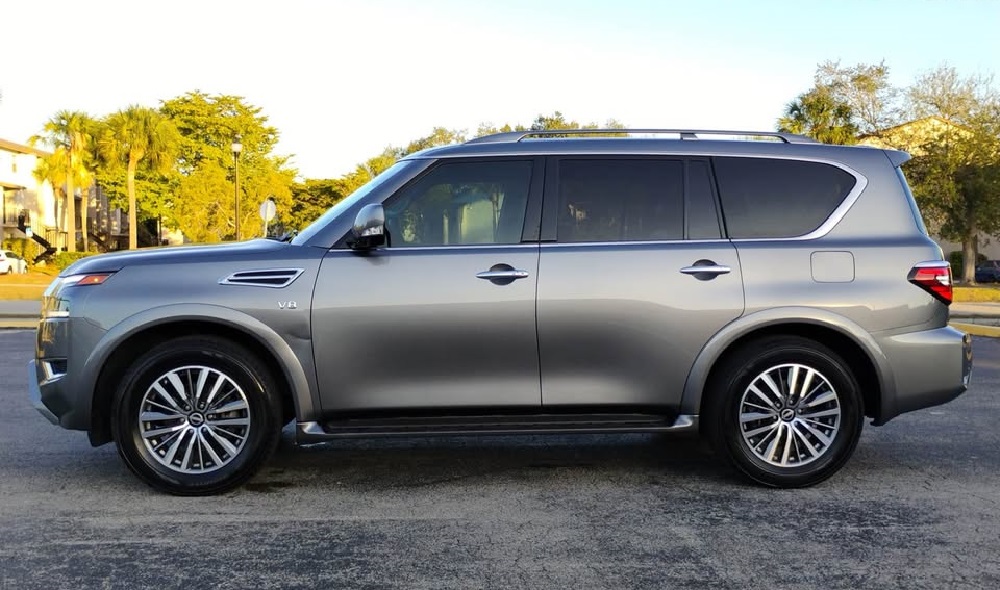
1. Armada towing basics and what “tow package” really means
When the Armada can actually pull 8,500 lb
Bolt a trailer to any 2020–2024 Armada and the rating tops out at 8,500 lb. The 5.6L Endurance V8 makes 400 hp and 413 lb-ft. Peak torque lands at 4,000 rpm, so grades push the tach past 3,500 fast. The 7-speed hunts between 4th and 5th on long climbs.
Step into 2025 and the hardware changes. A 3.5L twin-turbo V6 lays down 425 hp and 516 lb-ft at 3,600 rpm. That extra 103 lb-ft shows up right off the line. The new 9-speed uses shorter 1st and 2nd gears, which increases launch torque at the wheels.
Both generations carry the same 8,500 lb max rating under SAE J2807. That test holds 40 mph up a 12% grade and demands stable cooling. Real loads near 8,500 lb push tongue weight toward 850 lb at 10%. Many trims run out of payload before they run out of tow rating.
What Nissan builds into the Armada from the factory
Slide under a modern Armada and you’ll see a frame-mounted Class IV receiver. It bolts to the rear frame rails, not the bumper skin. The receiver is rated for up to 8,500 lb with a weight-distributing hitch. Dead-weight use caps lower and isn’t approved past 5,000 lb.
Every recent trim carries a 7-pin RV connector at the bumper. That plug feeds trailer brakes, charge line, reverse, and lighting circuits. The harness ties into the vehicle CAN system for sway control logic. No dealer add-on kit required on most units.
SV and SL trims ship pre-wired for a brake controller. A factory 6-pin connector sits under the dash. Plug-and-play harnesses from Tekonsha or Curt tap straight in. PRO-4X and Platinum trims add an integrated trailer brake controller with in-dash gain control tied into ABS.
Adaptive air suspension lands on PRO-4X and Platinum. Rear air bladders auto-level when tongue weight loads the hitch. The system maintains rear ride height within seconds of coupling. Nissan requires a weight-distributing hitch for trailers over 5,000 lb.
Towing and hardware overview
| Model Year | Max Tow (lb) | Standard Hitch | 7-Pin Wiring | Integrated Brake Controller | Notes |
|---|---|---|---|---|---|
| 2020–2024 | 8,500 | Class IV | Yes | No, pre-wired | 5.6L V8, 7-speed auto |
| 2025 SV / SL | 8,500 | Class IV | Yes | No, pre-wired | 3.5L V6TT, 9-speed auto |
| 2025 PRO-4X | 8,500 | Class IV | Yes | Yes | Air suspension, off-road tune |
| 2025 Platinum / PR | 8,500 | Class IV | Yes | Yes | Air leveling, full camera set |
Wheelbase measures 121.1 inches. Overall width runs near 80 inches. That footprint helps resist trailer-induced yaw at highway speed. The receiver remains capped at 850 lb tongue weight with a Class IV weight-distributing setup.
2. Powertrain and transmission, how the Armada actually pulls
V8 revs high, twin-turbo V6 hits hard down low
Press into a long grade with 7,000 lb behind you. The 5.6L V8 climbs past 3,500 rpm fast. Peak torque sits at 413 lb-ft at 4,000 rpm. Hold it there long enough and coolant and ATF temps creep upward.
The 2025 3.5L twin-turbo V6 changes the pull. It makes 516 lb-ft at 3,600 rpm. Boost builds early, so the engine doesn’t need to spin as high. Lower rpm under load reduces sustained heat in the heads and exhaust valves.
That 103 lb-ft gain shows up at the wheels. With the same 8,500 lb rating, the V6TT feels stronger in the 2,500 to 4,000 rpm band. Passing at 60 mph with a 6,500 lb trailer takes fewer downshifts.
V8 vs V6TT under tow load
| Spec | 2024 Armada V8 | 2025 Armada V6TT | Towing Impact |
|---|---|---|---|
| Engine | 5.6L NA V8 | 3.5L twin-turbo V6 | Earlier torque with V6TT |
| Horsepower | 400 @ 5,800 rpm | 425 @ 5,600 rpm | Slight gain up top |
| Torque | 413 @ 4,000 rpm | 516 @ 3,600 rpm | +103 lb-ft at lower rpm |
| Transmission | 7-speed auto | 9-speed auto | Shorter low gears, closer spacing |
| Max Tow | 8,500 lb | 8,500 lb | Same rating, different feel |
The 7-speed uses wider ratio gaps. It can drop two gears on a hard throttle stab. The 9-speed keeps the engine closer to peak torque. Gear spacing tightens, so rpm swings shrink under load.
Nine speeds, tow logic, and heat under pressure
Select Tow/Haul and shift maps change. The transmission holds lower gears longer. Converter lockup engages earlier under steady throttle. Downhill, the box downshifts to use engine braking and spare the pads.
Twin turbos add heat to the system. Exhaust temps spike during sustained boost. The factory auxiliary transmission cooler sits behind the grille and sheds fluid heat through airflow. Repeated 20 mph boat ramp pulls with a 7,000 lb trailer push ATF past 220°F if airflow drops.
Fluid condition decides longevity. Nissan flags towing as severe service. Replace ATF every 20,000 to 30,000 miles under heavy tow use. Neglect can lead to clutch slip, harsh 3-4 shifts, and full rebuilds that run $4,000 to $6,000.
3. Frame, suspension, and hitch, what actually carries 8,500 lb
Body-on-frame muscle and a 25% stiffer backbone
Load 800 lb of tongue weight and the structure takes the hit first. The Armada rides on a full ladder frame. Body mounts isolate the cabin from trailer twist. That layout keeps hitch loads out of thin sheet metal.
For 2025, Nissan raised torsional rigidity by about 25%. A stiffer frame cuts flex during crosswinds and fast lane changes. Less flex means fewer steering corrections at 65 mph. The Class IV receiver bolts straight to the rear frame rails with an 850 lb tongue cap when using a weight-distributing hitch.
Wheelbase measures 121.1 inches. Overall width sits near 80 inches. That footprint resists trailer yaw better than shorter SUVs. Shorter wheelbase rigs show more porpoising with heavy tongue weight.
Independent rear suspension and air leveling under load
The Armada uses independent rear suspension, not a solid axle. Each rear wheel moves on its own control arms. Ride quality improves, especially over broken pavement. Tire contact stays more consistent on uneven roads.
Heavy tongue weight changes rear camber and toe. Excess squat can tilt the tires inward. That accelerates inside-edge wear. Nissan mandates a weight-distributing hitch for trailers over 5,000 lb to shift load forward.
PRO-4X and Platinum trims add rear air suspension. Air bladders inflate when the rear sags. The system levels the body and restores headlight aim. Air suspension cannot increase payload beyond the listed 1,444 to 1,486 lb limits.
Trailer weight, hitch class, and tongue limits
| Loaded Trailer Weight | Hitch Type Required | Max Tongue Weight (lb) |
|---|---|---|
| Up to 2,000 | Class I / II | 200 |
| 2,000–5,000 | Class III (dead weight) | 500 |
| 5,000–8,500 | Class IV + weight-distributing | 850 |
Exceed 850 lb of tongue weight and the rear axle rating becomes the choke point. Overload the hitch and steering lightens. Overload the rear suspension and camber shifts beyond spec. Rear axle and hitch limits stay fixed at 850 lb tongue weight on this platform.
4. Electrical, braking, and digital control under trailer load
Seven pins, brake current, and what the harness actually carries
Plug into the 7-pin and the Armada feeds more than lights. The connector carries left and right turn, brake lamps, reverse, and ground. One pin supplies a 12V charge line for trailer batteries. Another sends variable current to electric trailer brakes.
On SV and SL trims, a factory 6-pin plug sits under the dash. Aftermarket controllers like Tekonsha Prodigy tie in without cutting wires. The system pulls brake signal data from the vehicle network. Factory wiring supports electric brake loads sized for 8,500 lb trailers.
PRO-4X and Platinum add an integrated trailer brake controller. Gain adjusts in the cluster screen. The module reads brake pedal force and wheel speed data. It sends proportional output, not time-delay pulses, to the trailer magnets.
Blind spots grow, sway gets corrected in milliseconds
Enter trailer length in the infotainment screen. The radar extends its blind-spot field past the bumper. Detection can cover trailers up to about 33 feet long. Lane changes at 65 mph become less guesswork.
Trailer sway control ties into Vehicle Dynamic Control. Sensors detect lateral oscillation through yaw rate changes. The system trims engine torque and taps individual brakes. Correction happens in fractions of a second once sway exceeds calibrated thresholds.
Hard crosswinds and sudden steering inputs can still overwhelm physics. Electronic sway control cannot raise hitch ratings. It cannot compensate for overloaded tongue weight. It operates within the same 8,500 lb and 850 lb tongue limits.
Tow-relevant tech by trim
| Feature | SV | SL | PRO-4X | Platinum / PR |
|---|---|---|---|---|
| 7-Pin Wiring | Standard | Standard | Standard | Standard |
| Brake Controller | Pre-wired | Pre-wired | Integrated | Integrated |
| Hitch Camera View | Rear camera | Enhanced view | Hitch View | Hitch View |
| Trailer Blind Spot | Optional | Optional | Standard | Standard |
| Trailer Sway Control | Standard | Standard | Standard | Standard |
The electrical system supports factory-rated brake output only. High-draw hydraulic-over-electric systems may require separate power management. The alternator and charge line are sized for standard RV brake and battery loads, not auxiliary inverters pulling hundreds of amps.
5. Payload, tongue weight, and where the real limit hits
Payload ends the dream before tow rating does
Read the door sticker, not the brochure. Most 2025 trims carry 1,444 to 1,486 lb of payload. That number includes people, cargo, and tongue weight. The hitch load counts the same as passengers.
Hook up an 8,500 lb trailer at 12% tongue weight. That drops about 1,020 lb on the hitch. Subtract that from a 1,444 lb payload and only 424 lb remains. Four adults can burn that margin in minutes.
Even at 10% tongue weight, 850 lb sits on the rear. Add a 200 lb driver and 150 lb of gear. The SUV crosses 1,200 lb before kids or coolers climb in. Exceed GVWR and the rear axle rating becomes the hard stop.
80% rule in real numbers
| Trim (2025) | Drivetrain | Max Payload (lb) | 80% Tow (6,800 lb) Tongue @ 12% (lb) | Payload Left (lb) |
|---|---|---|---|---|
| SV | 4×2 | 1,466 | 816 | 650 |
| SV | 4×4 | 1,444 | 816 | 628 |
| SL | 4×4 | 1,444 | 816 | 628 |
| PRO-4X | 4×4 | 1,444 | 816 | 628 |
| Platinum | 4×4 | 1,486 | 816 | 670 |
| Platinum Reserve | 4×4 | 1,486 | 816 | 670 |
Run 6,800 lb loaded at 12% tongue weight and about 816 lb lands on the hitch. That leaves 628 to 670 lb for people and cargo on most 4×4 trims. Two adults and two teens can weigh 600 lb together. Add luggage and the buffer disappears.
Full rating versus daily reality
Tow near 8,500 lb on flat ground with light cabin load and proper weight distribution. Engine and transmission can handle it within cooling limits. Stay within axle ratings and tire load indexes.
Climb mountain grades at 95°F with 8,500 lb and seven passengers. Coolant and ATF temps climb fast. Brake temps spike on long descents. The 80% rule lands near 6,800 lb for regular towing, leaving real payload margin before hitting the 1,444 to 1,486 lb ceiling.
6. Cooling, fluids, and what keeps the drivetrain alive
Transmission heat, SMOD history, and modern cooler layout
Cook the fluid and the gearbox follows. Early 2004–2015 Armadas suffered the “SMOD” failure. The radiator’s internal cooler cracked and mixed coolant with ATF. Pink milkshake fluid wiped out clutches and torque converters.
Repair meant a radiator, flush, and often a full transmission rebuild. Bills ran $4,000 to $6,000 once slip started. Later designs separated and reinforced the cooling path. The failure rate dropped after updated radiators and external coolers.
Current models use an auxiliary transmission cooler behind the grille. Fluid passes through a dedicated heat exchanger before returning to the 7-speed or 9-speed case. Low-speed towing with poor airflow still drives ATF past 220°F during heavy pulls.
Severe service intervals under tow load
| Component | Normal Interval | Severe / Towing Interval |
|---|---|---|
| Engine Oil & Filter | 7,500 mi / 12 months | 5,000 mi / 6 months |
| ATF | Inspect only | 20,000–30,000 mi replacement |
| Differential Fluid | Inspect only | 15,000–30,000 mi replacement |
| Brake Fluid | 30,000 mi / 36 months | 20,000 mi / 24 months |
Twin turbos raise oil temps under load. Long grades keep exhaust heat high for minutes at a time. Shorter oil intervals prevent varnish in turbo bearings. Fresh ATF preserves clutch friction material under repeated heat cycles.
Brake fluid absorbs moisture over time. Water lowers the boiling point. Heavy downhill braking with a trailer can boil old fluid and soften the pedal. Replace it every 20,000 miles under tow duty or risk fade during emergency stops.
7. Setup and driving technique under real trailer load
Dial the weight-distributing hitch before the air suspension wakes up
Set the spring bars for actual tongue weight, not brochure numbers. An 8,000 lb camper at 12% runs about 960 lb on the ball. Bars rated too low leave the rear sagging. Bars rated too high over-stress the trailer A-frame and hitch head.
Measure front fender height before coupling. Hitch up and tension the bars until the front returns close to baseline. Don’t crank bars until the nose rises. Over-tension unloads the rear axle and alters brake bias.
On air-suspension trims, let the system level after mechanical setup. The compressor inflates rear bladders to restore ride height. Air leveling cannot move weight to the front axle. Nissan still caps tongue weight at 850 lb with a Class IV weight-distributing setup.
Use Tow/Haul and engine braking to control heat
Engage Tow/Haul before merging with a heavy trailer. Shift points move higher under throttle. Converter lockup engages sooner to reduce slip. That cuts heat in the torque converter clutch.
Climb grades by selecting a lower gear early. Keep rpm in the 2,500 to 4,000 range on the V6TT. Avoid lugging below boost threshold. Downhill, drop a gear and let engine braking hold speed.
Ride the brakes and rotor temps spike fast. Repeated hard stops can push rotor surfaces past 500°F. Pad fade shows up as longer pedal travel. Heat-soaked brakes with a 7,000 lb trailer increase stopping distance beyond factory test limits.
Cameras and driver aids help, physics still rules
Use Hitch View to line up the coupler alone. The overhead camera centers the ball within inches. Fine adjustments reduce jackknifing risk in tight campsites. The intelligent rearview mirror keeps sight lines clear when the trailer blocks the glass.
Adaptive cruise and lane assist operate with limits while towing. Extra mass increases stopping distance. Radar cannot shorten braking physics. The 8,500 lb tow rating assumes proper loading, working trailer brakes, and a weight-distributing hitch over 5,000 lb.
8. Armada vs. Tahoe, Expedition, and Sequoia under real tow load
Paper ratings versus what’s actually on the lot
Shop full-size SUVs and ratings jump around fast. The 2025 Armada holds steady at 8,500 lb. Every trim carries a Class IV hitch and 7-pin wiring from the factory. No hunting for a max trailering code.
The Chevrolet Tahoe tops out near 8,400 lb with the right equipment. Base versions without the Max Trailering package rate much lower. Cooling, axle ratio, and hitch class vary by build sheet.
The Ford Expedition can hit 9,600 lb. That number requires the Heavy-Duty Trailer Tow package. Without it, many units sit closer to 6,000–6,600 lb.
The Toyota Sequoia reaches about 9,520 lb with its hybrid V6. Torque peaks around 583 lb-ft. Higher rating brings higher curb weight and tighter payload on some trims.
| Model | Max Tow (lb) | Engine | Tow Hardware Standard | Notes |
|---|---|---|---|---|
| Nissan Armada | 8,500 | 3.5L V6TT | Yes | All trims built tow-ready |
| Chevrolet Tahoe | 8,400 | 5.3L V8 / 3.0L D | No | Needs Max Trailering package |
| Ford Expedition | 9,600 | 3.5L V6TT | No | HD Tow package required |
| Toyota Sequoia | 9,520 | 3.4L V6 hybrid | Varies by trim | Solid rear axle, hybrid torque |
Tow ratings mean nothing without the right hardware. Many used Tahoes and Expeditions lack the heavy-duty package. The Armada’s 8,500 lb rating applies across the lineup with factory-installed Class IV hardware.
Suspension feel, third-row space, and trailer control
The Armada rides on independent rear suspension. The Sequoia runs a solid rear axle. Solid axles handle tongue load with less camber change. Independent setups ride smoother over broken pavement.
Sequoia’s solid axle raises the rear load floor. Third-row legroom tightens compared to the Armada’s layout. The Armada measures 121.1 inches of wheelbase and near 80 inches wide. That stance helps steady a 6,500 lb trailer at highway speed.
Expedition and Tahoe also use independent rear suspension. High tow ratings depend on specific axle ratios and cooling packages. Miss those options and capacity drops fast. The Armada caps at 8,500 lb regardless of trim, with an 850 lb tongue limit.
Sources & References
- 2025 Nissan SUV Towing Capacity & Cargo Specs | Near Bourbonnais, IL
- 2025 Nissan Armada: Specs, Release Date & Price
- 2025 Nissan Armada Towing Capacity
- 2025 Nissan Armada Towing Capacity | Round Rock Nissan
- 2025 Nissan Armada Specs
- 2025 Armada Press Kit – Nissan
- Ford Expedition Towing Capacity vs. Chevy Tahoe, Nissan Armada – Car and Driver
- Nissan Towing Guide – Nissan of Streetsboro Blog
- 2024 Nissan Armada Specifications – The Car Connection
- 2025 Nissan Armada Price, Reviews, Pictures & More | Kelley Blue Book
- 2025 Nissan Armada Specs & Features | Edmunds
- 2025 Nissan Armada Review, Pricing, and Specs – Car and Driver
- 2020 Nissan Armada vs. 2020 Toyota Sequoia Houston
- How Much Can the 2025 Nissan Armada Tow? A Complete Guide – Fredericton Nissan
- 2026 Nissan Armada Features: V8 Engine, 4×4, Towing & More
- 2023 NISSAN ARMADA – Modern Nissan of Hickory
- 2024 nissan towing guide
- 2025 Nissan Armada Weight and Dimensions
- 2024 Nissan Armada SV 4×2 Features and Specs – Car and Driver
- The Benefits and Drawbacks of an Air Suspension System – Car and Driver
- Comparison Test: Chevrolet Tahoe vs. Ford Expedition vs. GMC Yukon vs. Jeep Wagoneer vs. Nissan Armada vs. Toyota Sequoia – Car and Driver
- 2025 Nissan Armada Specs
- 2023 Nissan Armada Weight Distribution for Towing – RealTruck
- Nissan Armada 2021+. Q&A, air suspension, ownership costs, warranties – Reddit
- Nissan Armada Trailer Wiring Kits – Advance Auto Parts
- 2018 Nissan Armada Trailer Wiring Factory Tow Package – etrailer.com
- All-New 2025 Nissan Armada Gets Rugged PRO-4X Model – Kelley Blue Book
- 2023 Nissan Titan Towing Capacity and Features – Concord Nissan
- Trailer Brake Control for 05-24 Nissan Armada Frontier 05-15 Xterra w/ Plug Play Wiring Adapter Reese Brakeman IV Eletric Trailer Brakes Module Box Controller – TrailerJacks.com
- Trailer Brake Controller Harness, Select Nissan, Infiniti #51382 – CURT
- Tekonsha Brake Controller Wiring Harness For Nissan Armada, Titan, Frontier, Pathfinder, & Infiniti QX56, (3050) – Brechbill Trailers
- How to Install the Tekonsha Prodigy P2 Trailer Brake Controller on a 2018 Nissan Armada Video | etrailer
- 2025 nissan towing guide – Nissan USA
- For 2005-2015 Nissan Armada Trailer Hitch Fits All Models Curt 13188 2 inch Tow Receiver
- 2025 Nissan Armada SV 4×2 Features and Specs – Car and Driver
- All-New 2025 Nissan Armada® SUV | Towing Features – YouTube
- What New Safety Tech Comes in the 2025 Nissan Armada?
- 2025 Nissan Armada – Trailer Sway Control – YouTube
- 2026 Nissan Towing Guide: Frontier, Pathfinder & Armada Limits
- 2025 Nissan Armada Features: V8 Engine, 4×4, Towing & More
- 2025 Nissan Armada Towing Capacity
- 2025 Nissan Armada Towing Capacity – Newton Nissan of Gallatin
- 2025 Nissan Armada Towing Capacity
- 2 Steps for Finding the Right Weight Distribution Hitch Size – etrailer.com
- Nissan Towing Capacity & Towing Guide for Trucks & SUVs – Nissan USA
- Remanufactured Nissan Armada Transmissions
- 2012 Nissan Armada Transmission Cooler and Parts | Advance Auto Parts
- Oil Cooler for 2023 Nissan Armada
- Transmission Oil Cooler For Nissan Armada 2005-2015 (5.6L V8) – Replace OE 216069FD0A, NI4050103 – Zienna
- 2021 Nissan Armada Derale Series 9000 Plate-Fin Transmission Cooler Kit w/ NPT Inlets
- Transmission Oil Cooler For Nissan Armada 2005-2015 & Pathfinder Armada 2004 – 5.6L V8
- Automatic Transmission Cooler Sunbelt Automatic Transmission Oil Cooler For 2005-2015 Nissan Armada 5.6L (Replaces NI4050103) Heavy Duty Transmission Cooler
- Expert Q&A on Nissan Maintenance Schedules and Essential Vehicle Care at Nissan Of Orange Park
- Understanding Nissan Oil Change Intervals and Maintenance Alerts: Your Complete Guide
- Nissan Armada Maintenance Schedule
- Nissan Armada Maintenance Schedule
- 2024 Nissan Armada Maintenance Schedule – Pohanka Nissan of Fredericksburg
- 2025 Nissan Armada Automatic transmission fluid Service & Maintenance Guide
- 2026 Nissan Armada Competitors – The Car Connection
- Comparison Test: Chevrolet Tahoe vs. Ford Expedition vs. GMC Yukon vs. Jeep Wagoneer vs. Nissan Armada vs. Toyota Sequoia : r/cars – Reddit
- Looking to buy a new Large SUV. Which is best? Tahoe, Expedition, Yukon, or Sequoia? : r/askcarguys – Reddit
- 2024-Nissan-Armada-vs-Chevrolet-Tahoe-vs-Ford-Expedition-vs-GMC-Yukon
- 2026 Chevrolet Tahoe or Nissan Armada: Which Full-Size SUV Handles Hands-Free Driving and Towing Best near Beecher, IL?
- 2026 Toyota Sequoia vs 2026 Nissan Armada: 5 Key Differences – Autoblog
- 2025 Toyota Sequoia vs Nissan Armada, which is better for long distance travel – Reddit
- What Does Tow Haul Mode Do? | Indy Auto Man, IN
- Choosing the Right Full-Size SUV: Nissan Armada vs. Toyota Sequoia