
Hook up a 7,000-pound camper. Drop it in Drive. Feel the weight settle. That’s where the Audi Q7 tow package gets tested. Audi rates the V6 models at 7,700 lb with a 770-lb tongue cap. The 2.0T 45 TFSI stops at 4,400 lb because heat and torque limits show up fast under load.
Under the skin, the tow package swaps the rear crash beam for a structural hitch, adds an 850W cooling fan, and brings a trailer module online. Plug in a 7-pin and the engine, transmission, ESC, and air suspension all change behavior.
This guide breaks down the real limits, the hidden hardware, and the weight math that decides whether the Q7 tows clean or overheats on the first grade.
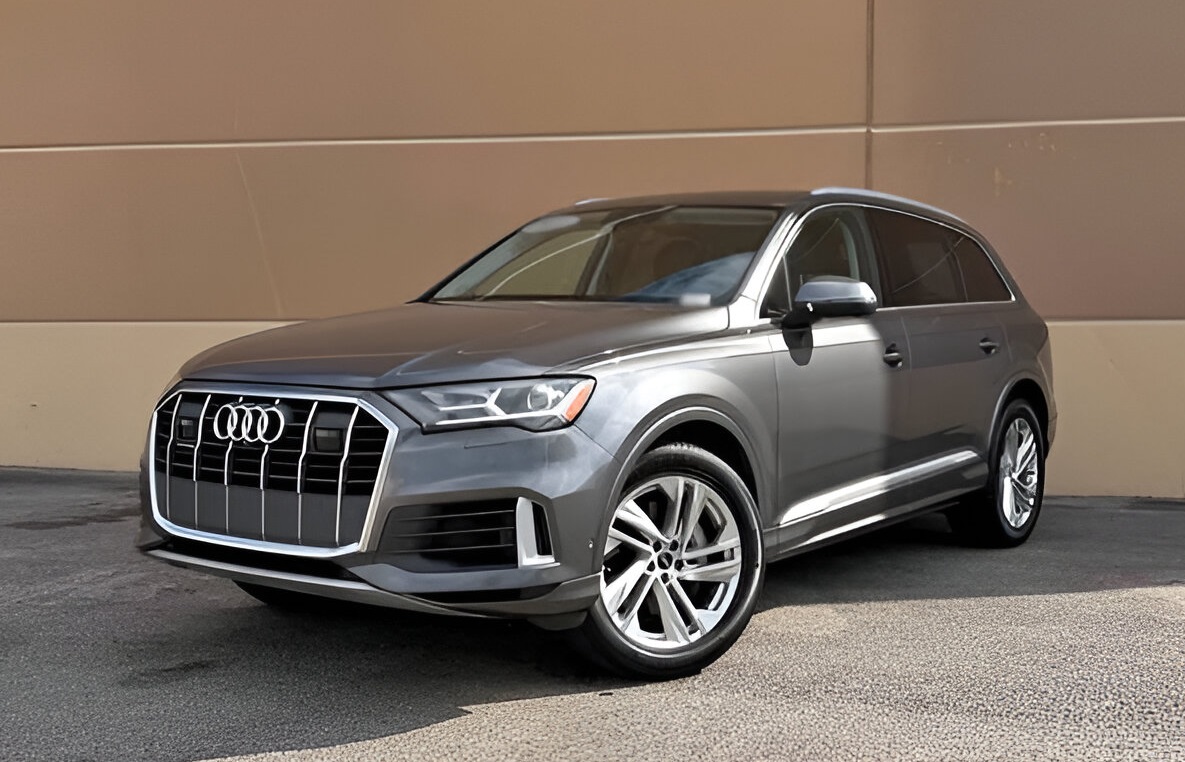
1. Tow ratings, engines, and where the Q7 really tops out
From 4L brute strength to 4M lightweight muscle
Launched in 2007, the 4L Q7 leaned on mass and steel. Early V6, V8, and TDI models topped out around 6,600 lb with a 660-lb tongue cap. The platform shared bones with Touareg and Cayenne, and it felt overbuilt.
Shift to 2017 and the 4M arrives on MLB Evo. Aluminum and hot-formed steel cut several hundred pounds. Tow rating jumps to 7,700 lb while curb weight drops, thanks to stronger rear rail integration and a hitch that replaces the crash beam.
Facelifted 4M.2 and 4M.3 trucks keep the 7,700-lb headline. The limit stays tied to a 770-lb tongue cap on V6 models. The 45 TFSI trims cap at 4,400 lb from the factory.
| Generation | Years | Max Tow (lb) | Max Tongue (lb) |
|---|---|---|---|
| 4L | 2007–2015 | 6,600 | 660 |
| 4M | 2017–2019 | 7,700 | 770 |
| 4M.2 | 2020–2023 | 7,700 | 770 |
| 4M.3 | 2024–2026 | 7,700 (V6) | 770 (V6) |
Rear structure carries the load directly into the longitudinal rails. Hitch bolts see high tensile forces during panic stops. Audi rates the V6 models for a maximum braked trailer of 7,700 lb in North America.
Engine codes, torque curves, and why the 2.0T stops early
The 45 TFSI runs a 2.0L turbo four. Output sits at 261 hp and 273 lb-ft. Under steady boost on grades, exhaust gas temps climb and cooling demand spikes, so Audi caps towing at 4,400 lb.
Step up to the 55 TFSI 3.0L turbo V6. Output jumps to 335 hp and 369 lb-ft. Peak torque arrives low in the rev range, which matters when pulling off a ramp or climbing at 3,000 rpm.
Modern 55 TFSI models add a 48-volt mild hybrid system. The belt alternator starter smooths restart events and feeds up to 8 kW back into the system during decel. With a trailer attached, restarts feel controlled instead of abrupt.
SQ7 brings a 4.0L twin-turbo V8 with 500 hp and 568 lb-ft. Tow rating stays at 7,700 lb. The cap reflects structural and cooling limits, not engine output.
| Powertrain | Output (hp / lb-ft) | Max Tow (lb) |
|---|---|---|
| 45 TFSI 2.0T | 261 / 273 | 4,400 |
| 55 TFSI 3.0T | 335 / 369 | 7,700 |
| SQ7 4.0T V8 | 500 / 568 | 7,700 |
Thermal load climbs fast above 6,000 lb in hot weather. Oil temps can exceed 250°F on long grades. The 2.0T has less thermal headroom under sustained boost.
Quattro, wheelbase, and axle limits that decide real capacity
Permanent quattro uses a self-locking center differential. Torque splits proactively, which helps on wet ramps or gravel inclines. No waiting for slip before sending power rearward.
Wheelbase measures about 117.9 inches on 4M models. Longer wheelbase reduces yaw input from trailer sway. Rear track width also improves lateral stability at highway speeds.
Rear GAWR becomes the choke point near max tow. Load a family of five and stack 750 lb on the hitch, and rear axle weight climbs fast. Many 55 TFSI models carry GVWR around 6,900 lb, so payload shrinks quickly once tongue weight is added.
Exceed rear GAWR and stability control works harder. Brake temps rise under repeated sway correction. The hard stop remains 770 lb of tongue weight on V6 models.
2. What the factory tow package really changes under the skin
PR-1D6 and the hardware most buyers never see
Order PR-1D6 and the rear crash beam comes out. In its place goes a structural hitch beam that bolts into the longitudinal rails. The receiver sits at 2 inches and ties directly into the rear structure.
A 7-pin connector mounts cleanly in the bumper trim. The harness runs to the J345 trailer module in the left rear quarter. The module sits on the CAN-bus and reports trailer status to engine, ABS, and chassis control.
Cooling hardware upgrades with the package. Many V6 models receive an 850W radiator fan instead of the standard 600W unit. Under load at low speed, that extra 250W keeps coolant and transmission temps from spiking past 230°F.
Higher-output alternators appear on tow-equipped builds. Units rated around 220 amps show up on 3.0T models. Trailer battery charge and lighting load can draw over 20 amps continuous through the 7-pin.
The hitch becomes part of the crash structure
The 4M hitch replaces the aluminum bumper reinforcement. It bolts into the same rail points using high-grade fasteners. Torque spec on mounting bolts sits in the triple-digit Nm range, and improper torque risks rail distortion.
Under hard braking with 7,000 lb behind it, longitudinal forces surge through that beam. Panic stops can push several thousand pounds of compressive load into the rear rails. The unibody carries both crash energy and trailer stress through the same structure.
Aftermarket “under-bumper” hitches often attach lower or use thinner side plates. Some lack full integration into the rail ends. In repeated heavy towing, those designs can flex and fatigue weld points over 50,000 miles.
Improper corrosion protection at the mounting points leads to rust creep. Rail-end corrosion weakens the bolt interface. Audi rates the system for 7,700 lb braked trailers only when mounted to factory spec.
Cooling maps and transmission survival under load
Plug in a trailer and the engine control module shifts its thermal map. Fan duty cycle increases earlier and stays high longer. Coolant temps stay tighter under 225°F on long grades.
The ZF 8HP Tiptronic adjusts shift logic with trailer detection. It holds lower gears during climbs to reduce clutch slip. Clutch clamping pressure increases under high torque demand.
Tow without the factory coding and those maps stay in standard mode. Transmission fluid can exceed 240°F in hot weather with a 6,500-lb trailer. Fluid shear accelerates above that threshold.
Audi labels the transmission fluid “lifetime.” Heavy towing changes that math. Many independent shops recommend service every 40,000 to 50,000 miles under regular tow use, with fluid and filter costs running $600 to $900.
3. Hitch geometry, leverage, and why 6.193 inches can save your rails
The 6.193-inch rule and lever-arm reality
Measure from the hitch pin hole to the ball center. Audi caps that distance at 6.193 inches, about 157 mm. Exceed it and leverage multiplies fast.
Add 2 extra inches of shank length and vertical load spikes. A 770-lb tongue can apply well over 1,000 lb of effective force at the rail mounts during a bump. Side loads from sway events compound that stress.
Unibody rails flex differently than ladder frames. Long ball mounts increase bending moment at the rear structure. Audi forbids longer setups because the rail ends carry both crash and tow loads, and the limit remains 6.193 inches maximum.
Receiver height, drop mounts, and air suspension traps
Load the Q7 to travel weight before measuring hitch height. Receiver height changes once 600 to 800 lb settles on the rear axle. Air suspension self-levels, but it must be in normal ride mode.
Set ball height to match the trailer coupler when both sit level. Most travel trailers want a level tongue within 1 inch front to rear. Excessive drop shanks add length and violate the 6.193-inch spec.
Air suspension offers loading level that drops the rear about 2.6 inches. Hitch up in loading mode and you’ll mis-measure. Return to normal ride height before locking in final ball height.
Tongue weight targets and hard limits
Audi caps tongue weight at 770 lb on 7,700-lb V6 models. The general rule runs 9 to 15 percent of gross trailer weight. Hit 12 percent on a 7,000-lb camper and tongue weight lands at 840 lb.
Exceed 770 lb and rear GAWR gets stressed first. Rear axle load climbs quickly with passengers and cargo. A 55 TFSI with a 6,900-lb GVWR can run out of rear axle capacity before hitting full trailer weight.
Running under 9 percent tongue weight invites sway. Tandem-axle campers shift tongue load as tanks fill or empty. A dedicated tongue-weight scale costs about $150 and gives a hard number instead of a guess.
4. When you plug in, the Q7 rewrites its own behavior
J345 wakes up the network
Plug a 7-pin into the socket and the J345 trailer module sees load. It measures resistance across the lighting circuits. Within seconds, it flags trailer present over the CAN-bus.
Engine control, transmission, ABS, chassis, and parking modules all receive that signal. The system changes maps before you even leave the driveway. Without module 69 registered in the gateway, none of that logic activates.
The J345 unit sits behind the left rear trim panel. Part numbers like 4M0 907 383 F or G show up in factory-equipped builds. A hardware-only hitch without J345 never triggers trailer stabilization.
ESC trailer stabilization and sway correction
Electronic Stability Control monitors yaw rate and steering angle. Trailer sway has a distinct oscillation pattern. The brake control module looks for that signature.
Once detected, the system brakes individual wheels. It may cut engine torque through the throttle body. Brake pressure pulses can occur in fractions of a second to counter yaw.
Rear brake temps rise quickly during repeated sway events. Aggressive intervention on a 7,000-lb trailer can push rotor surface temps past 500°F. The system only works when trailer coding is active in the ABS module.
| Module ID | Function | Change with Trailer Detected |
|---|---|---|
| J623 | Engine control | Higher fan duty, torque map |
| J217 | Transmission control | Holds gears, higher clutch pressure |
| J104 | ABS / ESC | Activates sway mitigation |
| J446 | Parking aid | Disables rear sensors |
| J769 | Side assist radar | Adjusts blind-spot zone |
| J345 | Trailer detection | Signals all modules |
No coding means no ESC sway logic. Under heavy crosswind, the system won’t intervene without that handshake.
Trailer Maneuver Assist and low-speed control
Early 4M models used a drawbar angle sensor in the hitch neck. The G820 sensor reported articulation angle over a LIN-bus. Remove that sensor and the system went blind.
Facelifted 4M.2 models switched to camera-based angle detection. Rear cameras track the trailer’s drawbar in real time. The MMI lets the driver dial in direction while the steering motor handles the wheel.
System operates up to 6.2 mph. Exceed that and control hands back fully to the driver. If jackknife angle approaches a set limit, the system triggers automatic braking.
5. Payload math that ends the 7,700-lb fantasy
GVWR, GCWR, and where the numbers collide
Start with the door jamb sticker. A typical 55 TFSI shows GVWR around 6,900 lb. Curb weight runs close to 5,000 lb with fuel.
That leaves roughly 1,900 lb of payload. Payload must carry passengers, cargo, and trailer tongue weight. Tongue weight counts as cargo sitting on the rear axle.
GCWR sets the total of SUV plus trailer. Hit GCWR and engine and transmission see sustained high load. Hit GVWR or rear GAWR and suspension and brakes take the beating first.
| Item | Example (lb) | Running Total (lb) |
|---|---|---|
| Curb weight | 5,000 | 5,000 |
| GVWR | 6,900 | – |
| Driver + 3 passengers (4 × 180) | 720 | 5,720 |
| Cargo in cabin | 200 | 5,920 |
| Trailer tongue (7,000 lb @ 12%) | 840 | 6,760 |
That 840 lb tongue exceeds the 770 lb cap. Rear GAWR can be exceeded before GVWR shows a violation.
Realistic trailer weights by engine
The 45 TFSI 2.0T handles light duty well. Keep trailers around 3,000 to 3,500 lb for daily sanity. Sustained grades above 4,000 lb push oil temps and boost pressure hard.
The 55 TFSI V6 sits in a stronger zone. A 5,000 to 6,500 lb trailer with moderate cabin load fits its torque curve. Push to 7,000 lb and payload margin shrinks fast.
SQ7 brings power in reserve. Grades feel shorter with 568 lb-ft on tap. Payload and 770 lb tongue limit still cap usable trailer weight.
Tall campers load aero drag into the equation. A 6,000-lb box trailer can feel heavier than a 7,000-lb boat. Crosswinds amplify yaw and demand more brake intervention.
Weigh it or guess wrong
Weigh the Q7 alone at a certified scale. Hitch the trailer and weigh again. Subtract to find actual tongue load.
Shift gear in the trailer and tongue weight moves. Fresh water tanks forward of the axle add 100 to 300 lb fast. Rear-mounted bike racks reduce tongue load and increase sway risk.
Under 9 percent tongue weight invites oscillation. Over 770 lb violates Audi’s hard limit. A tongue scale under $200 prevents a $2,000 rear suspension repair from overload fatigue.
6. Trailer brakes and controllers that match Q7 refinement
Find the factory pre-wire before cutting anything
Pull the lower dash trim on tow-prepped Q7s. A 4-pin connector often hides near the steering column, wrapped in foam. That plug carries fused 12V power, ground, brake signal, and brake output.
Use that harness and the controller integrates cleanly. Splice into tail lamp wires and the car throws bulb-out warnings. The J345 never sees proper brake output feedback without correct wiring.
Many 2017–2025 4M models with PR-1D6 include this pre-wire. A proper plug-in harness costs about $20 to $40. Cutting factory wiring can create intermittent faults that take hours to trace.
Proportional controllers keep the combo straight
Proportional controllers read deceleration through an internal accelerometer. Brake harder and trailer braking ramps up in sync. Gentle stops stay smooth and controlled.
Time-delay controllers apply preset power after a delay. That causes a shove from the trailer in light braking. In a 5,500-lb SUV, that shove shows up fast in wet conditions.
Popular proportional units like Tekonsha Prodigy series run $120 to $200. Wireless units that plug at the 7-pin sit closer to $250 to $350. Properly adjusted gain prevents trailer lockup above 25 mph.
Dialing gain so the trailer works with you
Set initial gain around mid-scale. Test at 20 to 25 mph on dry pavement. Use manual override and feel for firm but smooth deceleration.
If trailer wheels chirp, reduce gain. If the trailer pushes through intersections, increase gain slightly. Wet roads require backing off 1 to 2 clicks from dry settings.
Re-check settings after brake service or load changes. Fresh trailer brake shoes can grab harder than worn ones. Incorrect gain can overheat trailer drums past 400°F on long descents.
7. The weight-distribution hitch ban and what actually works
Why Audi flat-out forbids spring-bar systems
Read the owner’s manual and the warning is blunt. Never use a weight-distribution hitch on the 4M Q7. The receiver bolts into the unibody rails, not a ladder frame.
Spring bars apply rotational torque at the receiver head. Under tension, they can load the hitch with thousands of lb-ft. That torque feeds straight into the rear rail ends.
Repeated torsional load can deform mounting points. Rail fatigue shows up as elongated bolt holes or cracked seam sealer around the rear structure. Audi’s limit remains zero approval for WDH use on 4M models.
Friction sway control without twisting the rails
Friction sway bars mount between the trailer frame and the ball mount. They damp side-to-side motion through adjustable friction pads. No spring bars, no vertical weight transfer.
Dual-friction hitches offer built-in damping without heavy torsion arms. They add modest static weight to the tongue, often under 50 lb. That still counts against payload.
Proper tongue weight and tire pressure matter more than hardware. Run 12 percent tongue and correct tire inflation, and sway events drop sharply. The Q7’s ESC then has less work to do above 55 mph.
Let air suspension and ESC do the heavy lifting
Adaptive air suspension self-levels under load. Rear ride height stays stable even with 600 to 700 lb on the hitch. Headlight aim and front axle contact stay in check.
ESC trailer stabilization intervenes when yaw oscillates. Selective braking and torque reduction pull the trailer back in line. All-wheel steering reduces low-speed scrub in tight maneuvers.
Air springs cannot increase rear GAWR. They manage ride height, not axle rating. The hard ceiling remains 770 lb tongue weight and 7,700 lb max braked trailer on V6 models.
8. Factory tow package vs retrofit on the used market
Spot a real factory tow Q7 in five minutes
Look under the rear bumper. A factory setup shows a cleanly integrated 2-inch receiver through a trimmed diffuser panel. The 7-pin socket sits in a molded bracket, not dangling on a pigtail.
Scan the vehicle with VCDS or a factory tool. Module 69, Trailer Detection, should appear in the gateway installation list. Long coding in engine, ABS, and central electrics should reflect trailer installed.
Check cooling hardware if you can access parts data. Many factory V6 tow builds carry the 850W fan assembly. A standard 600W fan on a heavy-tow Q7 raises questions.
Factory-equipped trucks cost more on the used market. Expect a $1,000 to $2,000 premium over identical non-tow models in similar condition.
OEM-style retrofit versus basic bolt-on hitch
A full OEM-style retrofit replaces the crash beam with the correct hitch carrier. It adds the factory harness, J345 module, and requires coding across multiple controllers. Parts alone can run $1,200 to $2,000 before labor.
A basic aftermarket hitch bolts on under the bumper. Many use a 4-flat harness that splices into tail lights. No module, no CAN integration, no fan or shift-map changes.
Hardware-only installs won’t trigger trailer stabilization. Rear parking sensors may scream in reverse with a trailer attached. Engine and transmission stay on non-tow thermal maps.
Improper bumper trimming during retrofit shows up fast. Jagged cuts or misaligned diffusers hurt resale. Clean OEM-style installs take 2 to 4 labor hours plus coding time.
Coding steps that separate safe from sloppy
Engine module 01 needs long coding updated for trailer present. ABS module 03 must enable trailer stabilization logic. Central electrics 09 activates correct light output and fog light behavior.
Gateway 19 must register module 69. Chassis control 74 adjusts air suspension logic under trailer load. Side assist 3C may alter blind-spot monitoring zones.
Skip coding and the car behaves like no trailer exists. No fan map change, no shift logic update, no sway mitigation. Tow 6,500 lb uphill in summer heat without those changes and transmission fluid can exceed 240°F within minutes.
Sources & References
- Audi Q7 Towing Capacity By Year & Engine – Audi West Palm Beach
- Audi Q7 trailer assistant – Audi Technology Portal
- Audi Q7
- Audi Q7 Towing Capacity Devon, PA
- How Much Can a 2025 Audi Q7 Tow & How is Towing Capacity Rated? – Audi Mission Viejo
- Discover the Pinnacle of Audi’s Towing Capacity: A Guide to Audi’s Towing Powerhouses
- SSP 632 Audi Q7 Type 4M | PDF | Transmission (Mechanics) – Scribd
- The Audi Q7
- Audi Q7 without air suspension as tow vehicle for Elite II? – Oliver Travel Trailers
- 13277 INSTALLATION INSTRUCTIONS 6″ – – Hitch Warehouse
- 2026 Audi Q7 | Luxury SUV | Audi USA
- Audi Q7 45 vs 55 Guide: How to Choose the Right Engine – CarInterior
- Your Guide to Tow Package Installation – Car and Driver
- 2024 Audi Q7 Towing Capacity – Lafayette Audi
- 2025 Audi Q7 Towing & Engine Options | Hoffman Estates & St. Charles, IL
- 2025 Audi Q7 Engines, Horsepower, & Specs – Valparaiso, IN
- 2020 Audi Q7 brings significant updates including new engine, refreshed design and advanced technology
- 2020 Audi Q7 Technology – Mild Hybrid, Air Suspension, Trailer Assist – YouTube
- The new Audi Q7 and SQ7 TDI – TheNewsMarket
- 2025 Audi Q7 Performance, Design, Comfort & Specs
- Genuine OEM Starters, Alternators, ECUs & Wiring for Audi Q7 – eBay
- Audi Right Electric Cooling Fan Motor (600W) 8W0959455N – Wolf Auto Parts
- A-Premium Radiator & Cooling Fan Assy Kits for Audi Q7 09-13 VW Touareg 09-10 | eBay
- Audi Q7 3.6L Alternator Parts – ECS Tuning
- New Alternator For 2013-2015 Audi Q7 3.0L – 220A, 12V, Replaces 11821 FG23S065
- The Towing Capacity of the Audi Q7
- 23 SQ7 – No factory trailer hitch, can I add? : r/AudiQ7 – Reddit
- Had an OEM trailer hitch installed on my ’23 Q7 by a local dealership. They trimmed the bumper- does this look janky to anyone else? : r/Audi – Reddit
- Trailer Tow Hitch For 17-25 Audi Q7 All Styles 2″ Towing Receiver – TrailerJacks.com
- 2022 Q7 3.0T without factory tow package : r/AudiQ7 – Reddit
- Recommended Towing Setup For 2017 Audi Q7 – etrailer.com
- Why Cant 2019 Audi Q7 Use Weight Distribution System – etrailer.com
- Audi Airstream Weight Distribution Hitch – Reddit
- Payload and Towing Capacity Unveiled: What You Need to Know | Reading Truck
- How to Calculate Your Vehicle’s Maximum Towing Capacity
- Payload Towing Capacity Measurement Guide: GVWR, GCWR – Enterprise Fleet Management
- New to sway hitchs : r/RVLiving – Reddit
- How to Measure Tongue Weight: Step-by-Step Guide | Weigh Safe
- Everything You Need to Know Before Buying a New 2026 Audi Q7 near Wasco, CA
- Everything You Need to Know Before Buying a New 2026 Audi Q7 near Monterey, CA
- SSP 636 Audi Q7 Type 4M Trailer Assist | PDF – Scribd
- Trailer Hitch Retrofitting for Audi Q7 (4M) – Ross-Tech Wiki
- 5 Things to Know About Weight Distribution Hitches – etrailer.com
- AUDI Adaptive Air Suspension in 2015 Q7 Demonstration – YouTube
- Genuine Volkswagen Audi – 4M0907383F – Trailer Detection Control Unit (4M0 907 383 F)
- NEW AUDI Q7 4M TRAILER DETECTION CONTROL UNIT 4M0907383G | eBay
- Guide: Check Your ECU/TCU Box Code & Software Version – Audi/Volkswagen
- Trailer Hitch Retrofitting (4F) – Ross-Tech Wiki
- Driver assistance systems > Audi Owners > Audi Ireland
- Audi Side Assist – Euro NCAP
- Assistance systems – Audi MediaCenter
- Trailer Brake Controller Installation How-To – 5 Easy Steps! – CURT
- How to Install a Trailer Brake Controller – AutoZone
- For 2007-2024 Audi Q7 Trailer Brake Controller + 7 Pin Trailer Wiring by: Tekonsha | TrailerJacks.com
- For 2007-2024 Audi Q7 Trailer Brake Controller + 7 Pin Trailer Wiring by: Tekonsha | TrailerJacks.com
- 2025 Audi Q7 Tekonsha Plug-In Wiring Adapter for Electric Brake Controllers – etrailer.com
- For 2007-2024 Audi Q7 Trailer Brake Controller + 7 Pin Trailer Wiring by: Tekonsha
- Aftermarket Towing Kit : r/AudiQ7 – Reddit
- 10 Minute Electric Brake Controller Installation – Elecbrakes
- 17 – 25 Audi Q7 CURT Trailer Brake Controller 7-Way Upgrade Kit 7WK69 – TowUniverse
- 2023 Audi Q7 Weight Distribution for Towing – RealTruck
- How to Choose the Best Weight Distribution Hitch – CURT
- 2025 Audi Q7 Premium Specs & Features – Edmunds
- 2026 Audi Q7 Review, Pricing, and Specs – Car and Driver
- 2012 Audi Q7 Trailer Hitches – Advance Auto Parts
- Q4 Factory trailer hitch kit vs aftermarket : r/etron – Reddit
- Audi Q7: 2025 Performance Specs, Features & Size – Audi Indianapolis
- 2026 Audi Q7 | Luxury SUV | Audi CA
- SSP362 Audi Q7 – VolksPage.Net
- Towing capacities of Audi SUVs: Q3, Q5, Q7, and Q8 | Audi Anjou