
Reverse disappears. The engine revs, but the Acadia won’t back out of its parking space. Inside the six-speed automatic, a cracked clutch wave plate can knock out 3rd, 5th, and reverse. GM documented that failure in certain 2007–2009 Acadias under special coverage 14404A.
That’s how a low asking price turns into a transmission teardown. Fresh fluid can’t mend broken steel, and a seller’s claim of “transmission work” needs an itemized invoice. This guide sorts the GMC Acadia years to avoid, separates their faults, and explains which repairs deserve your trust.
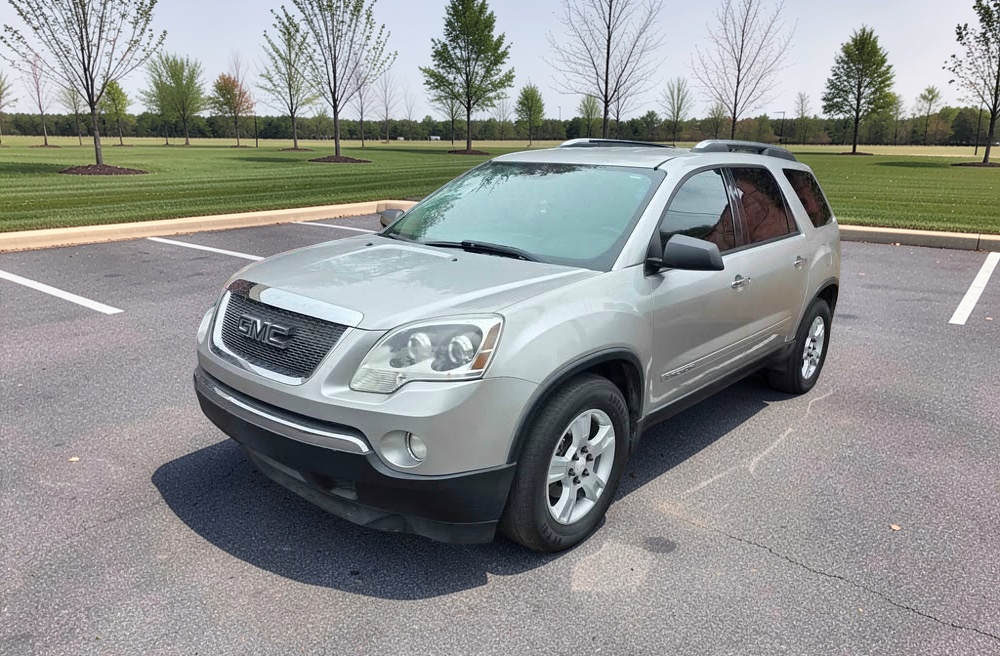
1. The Acadia years that can turn cheap into costly
Start with the repair history on 2007–2009 models
The 2007–2009 Acadias deserve the most caution when major repair records are missing. Certain vehicles from all 3 years are included in GM’s VIN-specific wave-plate program. Timing-chain and steering-pump issues present separate repair risks, but their service bulletins and special-coverage programs have different eligibility rules.
A receipt marked “transmission replaced” leaves key questions open. An undocumented used gearbox may carry the same worn parts. An itemized rebuild invoice should identify the parts replaced, repair mileage, and warranty.
These buying positions reflect documented faults and repair exposure. They do not measure how often each model year fails. A service bulletin identifies a condition and repair procedure, but it does not establish a failure rate.
| Model years and version | Buying position | What needs closer scrutiny |
|---|---|---|
| 2007–2009 | Strongest caution without major repair records | VIN-specific wave-plate coverage applies to certain vehicles in all 3 years. Engine and steering repair history also matter. |
| 2010–2012 | Require strong engine and transmission records | GM timing-chain guidance covers selected applications, not every vehicle. The earlier wave-plate program does not list these years. |
| 2013–2016 and 2017 Limited | Judge each vehicle separately | Check timing faults, steering operation, rear A/C leaks, and applicable safety campaigns. |
| 2017 GMC Acadia | Check bulletin applicability for the exact version and VIN | Bulletin 19-NA-206 lists GMC Acadia model year 2017; confirm the build-date and vehicle-specific applicability. |
| 2020 | Assess the revised transmission separately | Nine-speed automatics replace the earlier six-speed lineup. Recall eligibility depends on the VIN. |
| 2021–2023 | Consider with documented service and a clean inspection | Later production does not rule out transmission faults or applicable camera recalls. |
| 2024 onward | Long-term durability data remain limited | The 2.5-liter turbo and eight-speed automatic need their own repair record. |
A 2017 badge can hide 2 different Acadias
The 2017 Acadia Limited carried over the larger first-generation body, 3.6-liter V6, and six-speed automatic. The redesigned Acadia used a smaller body and different engine and electrical configurations.
That split changes which faults you should investigate. Do not assign the redesigned model’s shifter guidance to a Limited based on model year alone. Confirm the version through the VIN and factory build information before matching bulletins or ordering parts.
The redesigned 2017 Acadia offered a 2.5-liter four-cylinder or a 3.6-liter V6. Both used six-speed automatics. The nine-speed arrived with the 2020 refresh.
2. The broken plate that takes reverse with it
One clutch fault can wipe out 3 gears
The early six-speed automatic uses a shared clutch assembly for 3rd, 5th, and reverse. A steel wave plate cushions that clutch’s engagement. When the plate cracks or breaks, the clutch can lose its ability to hold.
You may feel the engine rev without a matching rise in road speed. Reverse can stop working, and shifts into affected gears can slip. Those symptoms need diagnosis, but losing this specific gear group points toward the shared clutch assembly.
GM Special Coverage Adjustment 14404A includes VIN-identified 2007–2009 Acadias with specified six-speed automatic configurations. That makes 2009 part of the documented wave-plate group. The program does not list 2010–2012 models; that exclusion does not establish that those vehicles cannot experience the same mechanical failure.
Metal left behind can wreck the repair
A broken plate leaves fragments inside the transmission. Installing a new plate without removing that debris leaves the repair unfinished. GM’s procedure requires transmission removal and disassembly, thorough debris cleaning, replacement of the pump fluid filter and control-solenoid filter plate, and valve-body cleaning.
The teardown also determines which other parts need replacement. A fractured plate does not automatically mean every valve, clutch, or hydraulic part must be replaced. GM allows internal repair when the remaining parts meet its inspection requirements.
Fresh fluid can’t restore a broken plate or repair damaged clutch surfaces. A flush alone also leaves the failed part inside. The repair must address both the fracture and the debris it produced.
Make “rebuilt transmission” earn its asking price
Ask for an invoice that names the wave plate and lists the internal work. It should show the repair mileage, replaced parts, and warranty terms. A receipt for a used gearbox documents a swap, but leaves its internal condition unknown.
Check whether the shop recorded debris removal and filter replacement. Then compare the repair mileage with the vehicle’s current odometer. Continued slipping or delayed reverse engagement still needs diagnosis, even after a documented rebuild.
For eligible vehicles, GM’s original coverage lasted 10 years or 120,000 miles, whichever came first, from the original in-service date. It documents the defect, but does not promise free repairs today. A used purchase does not restart that coverage clock.
3. Timing-chain wear can turn a warning light into engine work
Worn chain joints throw the cams out of time
The GM High Feature 3.6-liter V6 applications covered by these procedures use 3 timing chains: one primary and two secondary chains. Wear at the chain joints adds slack. As that wear grows, cam timing can drift beyond the engine computer’s allowed range.
GM Special Coverage 11340C states that, under certain driving conditions and with the original oil-change intervals, timing-chain wear could occur prematurely. That record does not establish that one oil type or interval alone causes every failure, and it does not support blaming every failure on skipped service or one fixed mileage interval.
GM Special Coverage 11340C lists certain 2007 and 2009 Acadias among specified GM applications, with VIN-specific eligibility. Bulletin 12-06-01-009B gives timing-chain service guidance for listed applications within its engine, RPO, VIN, and build-date limits. Those different document scopes do not establish a clean cutoff for later chain failures.
A timing code doesn’t tell you which part to buy
Codes P0008 and P0009 flag engine-position performance faults. P0016, P0017, P0018, and P0019 flag crankshaft-to-camshaft correlation faults. These codes can point toward incorrect mechanical timing, but they do not prove the chain caused it.
GM’s diagnostic guidance identifies a shifted crankshaft reluctor as another possible cause. That reluctor provides the reference the crankshaft sensor reads. If it shifts, the computer can detect a timing mismatch even when replacing the chains won’t fix it.
A cold-start rattle also needs more than a quick listen. The noise alone can’t identify a worn chain, failed tensioner, or another cause. Replacing a camshaft sensor without checking the timing relationship can leave the same codes active.
A complete repair starts with inspection
A useful timing-repair invoice identifies the chain kit, tensioners, and other parts the shop replaced. It should also record inspection findings for the guides, sprockets, and camshaft actuators. GM warns against automatically replacing those parts when inspection shows no wear.
The oil-life calibration needs separate attention where an update applies. Revised software changes when the vehicle calls for an oil change. It can’t remove slack from worn chain joints.
GM acknowledged that reprogramming didn’t fully correct every affected vehicle. Persistent rattling, poor running, and correlation codes need diagnosis before purchase. An oil-life update provides no proof that the chains still hold correct mechanical timing.
4. Heavy steering and warm rear vents can raise the repair bill
Heavy steering doesn’t always mean a bad rack
You may first feel lost steering assist while backing out or turning into a parking space. The wheel takes more effort at low speed. GM Special Coverage 14329A applies by VIN to certain 2007–2011 Acadias with pump wear that can reduce hydraulic pressure and cause intermittent low-speed or low-RPM loss of steering assist. Its coverage period is 10 years or 150,000 miles from the original in-service date, whichever comes first.
Low fluid, an external leak, and internal pump wear need separate checks. A leaking rack can lower the fluid level, but heavy steering alone doesn’t prove the rack failed. GM also warns that staining around a steering boot does not automatically establish a leak.
For the covered pump condition, GM specified a hydraulic flush and pump replacement. Some vehicles also needed a steering-gear valve-housing update, depending on previous work. That repair scope does not call for a complete rack replacement in every case.
Blower dust can eat through the rear evaporator
Warm air from the rear vents can point toward a refrigerant leak. On certain Acadias, GM found rear evaporator corrosion caused by copper-containing dust from the auxiliary blower’s brushes. The dust can collect on the evaporator and speed corrosion until refrigerant escapes.
GM bulletin 16-NA-046 applies to certain 2013–2016 Acadias built before October 6, 2015, equipped with auxiliary A/C (RPO CJ2). After normal diagnosis confirms a leak at the auxiliary evaporator, its repair links 3 jobs: replace the leaking evaporator, replace the auxiliary blower motor assembly, and clean the housing to remove copper dust. Replacing only the evaporator leaves the dust source in place.
A rear cooling complaint still needs a confirmed leak location. Damaged refrigerant lines and a leaking front evaporator require different repairs. Warm vent air alone does not prove that blower dust caused the leak.
Find the leak before accepting dashboard labor
Front and rear evaporators sit in different parts of the vehicle. Their access work differs, so a generic “evaporator replacement” quote leaves too much unclear. Ask the shop to name the leaking part and itemize the labor.
For the blower-dust condition, the estimate should include the rear evaporator, auxiliary blower, and housing cleanup. A separate line leak needs its own repair scope. Replacing the rear evaporator does not automatically require dashboard removal.
5. “Shift to Park” can leave the Acadia powered up
The lever reaches Park, but the signal doesn’t
You stop, select Park, and press the ignition button. GM describes an intermittent “Shift to Park” message after the vehicle has been shifted into Park and the ignition has been turned Off. The shifter’s electrical Park-confirmation switch may have failed to send the correct signal to the body control module.
GM’s guidance lists B000A as a possible trouble code. This electrical fault alone does not prove the transmission’s parking mechanism failed. Any actual vehicle movement needs separate diagnosis.
If the vehicle remains powered after an attempted shutdown, active electrical loads can drain the 12-volt battery. Moving the lever again may clear the message for that attempt, but it does not establish that the switch or wiring now works correctly.
Confirm the bulletin’s exact GMC model-year scope
GM’s March 2024 revision of bulletin 19-NA-206 lists GMC Acadia model year 2017 with a date breakpoint prior to April 2, 2019. Its separate 2019–2020 Acadia entry is for Holden, not U.S. GMC Acadia. Confirm the vehicle’s model year, build date, VIN applicability, and repair history.
The bulletin calls for a new shifter harness and an inline jumper harness (part 84733196). An invoice that says only “shifter inspected” does not confirm either part was installed. Look for the listed parts and the work performed.
A cleared warning needs a completed repair behind it
After an applicable repair, confirm that the vehicle recognizes Park and completes its shutdown. If the battery still goes flat, it needs further testing. A weak battery or another electrical draw can remain after the Park-signal fault is fixed.
Keep the repair bulletin separate from recall, warranty, or settlement coverage. Each has its own eligibility terms. Bulletin 19-NA-206 gives repair instructions; its existence alone does not entitle every affected Acadia to a free repair.
6. The 2020 nine-speed brings a different set of faults
Match the gearbox to the engine first
The 2020 refresh brought nine-speed automatics across the Acadia’s engine lineup. The 2.5-liter four-cylinder uses the 9T50, while the 2.0-liter turbo uses the 9T60. The 3.6-liter V6 pairs with the 9T65.
These transmissions need their own diagnosis and repair history. The early six-speed wave-plate coverage does not apply to them. A complaint about “Acadia transmission failure” means little until you identify the model year, engine, and gearbox.
Shudder and shift flare leave different clues
A torque-converter clutch fault can produce a vibration as the clutch applies or holds. Shift flare feels different; engine speed rises during a gear change without a matching gain in road speed. A technician needs to reproduce the event and compare it with scan data.
Fluid level, fluid condition, pressure checks, and stored codes help narrow the cause. A vibration alone does not prove the converter failed. Likewise, a flare does not establish that the whole transmission needs replacement.
GM bulletin 20-NA-136 includes applicable 2020–2023 Acadias with the 9T65 transmission. It directs technicians through different diagnostic paths rather than prescribing one repair for every complaint. Its special procedure applies below 12,000 miles; higher-mileage vehicles require normal service diagnosis.
The missing-bolt recall covered only 6 Acadias
Recall 20V668 addresses missing transmission start/stop accumulator bolts on certain 2019–2020 Acadias. Missing bolts can let transmission fluid leak, causing loss of propulsion. Escaping fluid also creates a fire risk.
GM’s remedy calls for inspection and accumulator replacement when bolts are missing. The filed recall population identifies only 6 Acadias within the larger campaign. Confirm eligibility by VIN before assigning this defect to a vehicle.
That population count gives no measure of general nine-speed reliability. The recall addresses a specific assembly defect. Completing its repair does not establish the condition of the converter, clutch packs, or other hydraulic parts.
7. Safety defects can hide behind a clean test drive
A smooth-running Acadia can still need recall work
An engine that pulls cleanly won’t reveal a defective airbag inflator. A brief test drive may also miss an intermittent camera fault. Check campaign completion by VIN, then match the repair records to the affected parts.
| Campaign | Acadia application | Defect and required repair |
|---|---|---|
| 23V334 | Certain 2014–2017 Acadias with suspect original-equipment driver inflators; certain 2007–2013 vehicles may also need a separate VIN-specific check for suspect ARC service-replacement inflators. | The driver’s airbag inflator can rupture during deployment. The remedy replaces the front-driver airbag module for involved vehicles. |
| 17V516 | Certain redesigned 2017–2018 models with the 2.5-liter engine and front-wheel drive. | The right-front intermediate driveshaft can fracture. Dealers replace the affected shaft assembly. |
| 18V358 | Certain 2017–2018 vehicles with suspect original or service-replacement fuel pumps. | A defective pump weld can allow movement that damages the high-pressure fuel line. The repair replaces the pump and pipe. |
| 22V709 | Certain 2020–2021 vehicles equipped with Surround Vision. | Faulty coaxial connections can interrupt the rear camera image. The repair replaces affected cables. |
A fractured driveshaft creates a separate rollaway risk
The driveshaft campaign identifies possible vehicle movement when parked on a grade without the parking brake. A fractured shaft interrupts the mechanical connection that helps hold the vehicle through the transmission. The shifter can remain in Park while that connection fails.
This differs from the electrical “Shift to Park” warning. A missing Park-confirmation signal alone does not establish that a shaft broke or the parking mechanism disengaged. A shifter-harness repair cannot restore a fractured driveshaft.
An earlier repair can change recall eligibility
Replacement-part history matters when the model year appears outside a campaign’s main range. GM’s airbag instructions address suspect service parts installed in some older vehicles. An earlier airbag replacement therefore needs closer inspection of the invoice and installed part.
The fuel-pump campaign also includes suspect service-replacement pumps in its affected population. “Fuel pump replaced” does not establish that the installed pump escaped the defect. Have the dealer check the VIN and prior repair details against the campaign instructions.
Retain invoices that identify replacement airbags and fuel pumps. Those records can help trace parts that a model-year list misses. A past repair date alone does not identify the part installed or confirm recall completion.
8. Later Acadias worth a closer look
The larger body comes with older hardware
The 2015–2016 Acadia and 2017 Limited offer the larger first-generation body. They are options for buyers who need that space, provided the engine, transmission, steering, and A/C pass inspection. Their later build dates do not prove that every chain or gearbox concern disappeared.
GM’s first-generation timing diagnostic guidance extends through 2016. A quiet start helps, but it does not replace a scan for stored faults or documented diagnosis. If the engine previously set timing codes, the invoice should identify the cause and completed repair.
Inspect the transmission both cold and fully warmed. Delayed engagement or an engine-speed flare needs diagnosis before purchase. On applicable 2015–2016 vehicles, rear evaporator repair records should also identify the blower replacement and housing cleanup.
A 2019 GMC badge does not establish shifter-bulletin coverage
A 2019 registration does not establish the model year, build date, or applicability of a service bulletin. Do not apply bulletin 19-NA-206 to a U.S. GMC Acadia solely because it is a 2019 model; the March 2024 bulletin lists GMC Acadia model year 2017, while its separate 2019–2020 entry is for Holden Acadia. Check the VIN and dealer repair history for other applicable campaigns.
For a GMC Acadia listed in bulletin 19-NA-206, check for both harness replacements specified by the procedure. An invoice that says only “shifter inspected” does not confirm either part was installed. Test Park recognition and shutdown, and investigate any warning that returns.
Choose the newer engine for the load it must pull
The 2021–2023 Acadias offer later second-generation choices, with different engines and equipment to compare. For 2023, GMC rates the 2.0-liter turbo at 228 hp and the 3.6-liter V6 at 310 hp. Those figures describe output; they do not establish which engine lasts longer.
Repair records and a road test still matter with either engine. Check for vibration during converter-clutch operation and flare during shifts. The applicable 9T65 diagnostic bulletin includes 2023 vehicles, so a newer badge does not rule out transmission faults.
Towing capacity also depends on the exact equipment. GMC’s 2023 brochure advertises maximum towing of 3,500 pounds for the 2.0-liter and 4,000 pounds for the V6 with the available Trailering Package. The 2023 Owner’s Manual chart lists 3,250 pounds for the 2.0-liter LSY with the V92 package and 4,000 pounds for the 3.6-liter LGX with V92. Verify the rating for the specific vehicle and account for passengers, cargo, and equipment.
9. The 2024 redesign needs its own reliability record
The new turbo leaves the old V6 behind
The third-generation Acadia arrived for 2024 with a 2.5-liter turbocharged four-cylinder and eight-speed automatic. GMC rates it at 328 hp and 326 lb-ft of torque. This engine differs from the naturally aspirated 2.5-liter offered in the previous generation.
The earlier V6 timing-chain record does not establish how this turbo engine will age. Nor does the first-generation wave-plate defect establish a fault in its eight-speed. Both need evidence tied to their own parts, mileage, and repair history.
Brake-assist complaints put newer models under scrutiny
NHTSA opened engineering analysis EA26006 on August 21, 2026. Its scope includes 2024–2026 Acadias equipped with GM’s eBoost braking equipment. The agency is examining reported loss of brake assistance and possible increases in stopping distance.
GM described a possible spindle fracture inside the eBoost assembly. Some reports describe assistance disappearing during braking, which differs from GM’s account of loss after stopping. That difference forms part of the agency’s investigation.
NHTSA’s September information request lists longer stopping distances, stiff steering, reduced propulsion, and multiple warning lights. Those reports span several GM models. Their totals cannot serve as Acadia-only incident counts or failure rates.
A hard brake pedal needs more than reassurance
An engineering analysis does not establish a confirmed defect in every vehicle within its scope. It also does not, by itself, announce a recall remedy. Early quality scores cannot establish how the engine, transmission, or brake-assist hardware will perform after years of use.
A hard pedal or brake warning needs diagnosis before a purchase proceeds. Ask for the stored codes, test findings, and completed repair. The investigation records do not establish that a software update alone resolves every reported loss of brake assistance.
Sources & References
- GM Special Coverage Adjustment 14404A – Transmission Clutch Wave Plate
- GM Customer Notification for Special Coverage 14404
- GM Special Coverage 11340C – Timing Chain Wear
- GM Corporate Bulletin 12-06-01-009B – High Feature V6 Timing Chain Kits
- GM Preliminary Information PIP4384G – High Feature V6 Timing Procedure
- GM Preliminary Information PIP3423P – Crankshaft Reluctor and Timing Codes
- GM Special Coverage Adjustment 14329A – Steering Assist
- GM Technical Bulletin 16-NA-046 – Auxiliary Evaporator Corrosion
- 2017 GMC Acadia Catalog
- 2017 GMC Acadia Limited Brochure
- GM Service Bulletin 19-NA-206 – Shift to Park Message, March 2024
- 2020 GMC Acadia Catalog
- 2020 GMC Trailering Guide – Acadia Transmission Specifications
- GM Service Bulletin 20-NA-136 – Diagnostic Tips for 9T65 Transmissions
- NHTSA Part 573 Safety Recall Report 20V-668
- GM Recall Bulletin N202313440 – Transmission Accumulator Bolts
- NHTSA Part 573 Safety Recall Report 23V-334 – Driver Airbag Inflator
- GM Recall Bulletin N232404980 – Driver Airbag Inflator
- GM Frequently Asked Questions for Recall N232404980
- NHTSA Part 573 Safety Recall Report 17V-516 – Intermediate Driveshaft
- GM Recall Bulletin 17329 – Front Right Intermediate Driveshaft
- NHTSA Part 573 Safety Recall Report 18V-358 – High-Pressure Fuel Pump
- GM Recall Bulletin 18268 – High-Pressure Fuel Pump and Pipe
- NHTSA Part 573 Safety Recall Report 22V-709 – Rear View Camera
- GM Recall Bulletin N222378380 – Rear View Camera Cables
- 2023 GMC Acadia Features, Specs and Options
- 2023 GMC Acadia Owner’s Manual – Towing Chart
- GMC Newsroom – All-New 2024 GMC Acadia
- 2024 GMC Acadia Features, Specs and Options
- NHTSA Engineering Analysis EA26006 Opening Resume – Gen 2 eBoost
- NHTSA Information Request EA26006-01 – Gen 2 eBoost