
The dash goes dark mid-turn, steering stiffens, and warning chimes start firing. On certain Silverado 1500s, loose battery cable connections or a high-resistance ground can disrupt several modules at once. GM bulletin 18-NA-161 documents steering complaints linked to battery cable connections, turning a wiring problem into a costly misdiagnosis.
Other Silverados drain their batteries overnight, refuse to start, or lose their infotainment screens without warning. The cause changes with the model year, wiring layout, and software. Replacing the wrong part can cost hundreds without fixing anything.
This guide tracks the failures behind those symptoms, the GM bulletins and recalls that apply, and the tests and repair costs that matter.
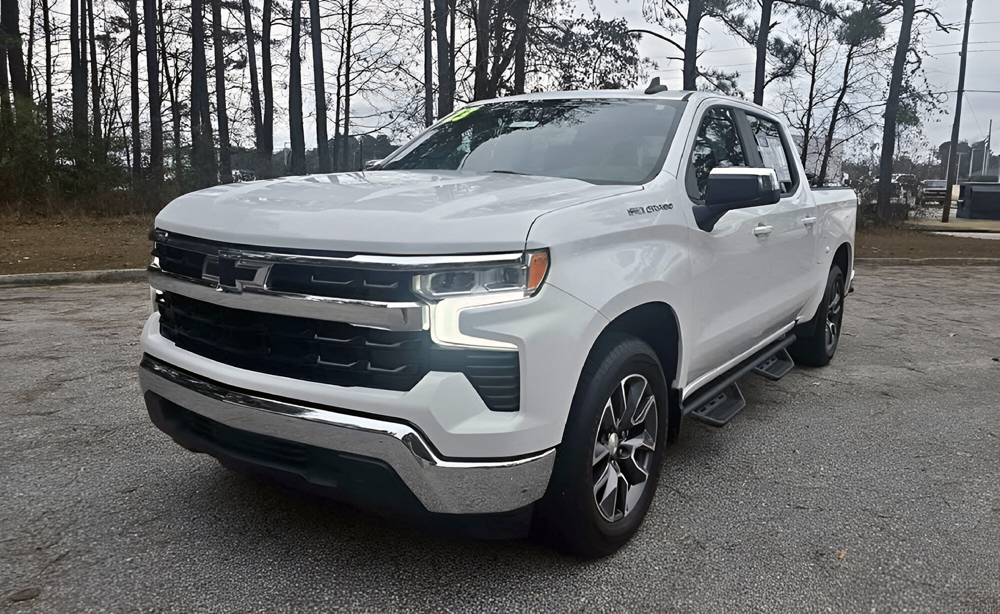
1. Match the Symptoms to the Right Silverado
Why the Model Year Can Point to the Wrong Repair
A 2005 Silverado with a stuck speedometer needs a different diagnosis than a 2024 truck with a dead screen. Older trucks often develop worn gauge motors, ignition lock cylinder faults, and corroded connectors. Newer models bring more software faults, sensitive power circuits, and networked control modules.
The 2022 Silverado 1500 makes this especially tricky. GM sold the older LTD version with RPO J21 alongside the refreshed truck with RPO J22. Both carry the same model year, but their wiring, radio equipment, and software can differ.
Silverado 2500HD and 3500HD trucks also follow different equipment and production schedules. The Silverado EV adds a separate 12-volt battery and high-voltage electrical hardware.
Before applying a service bulletin, check the truck’s series, engine, build date, and equipment codes. A repair written for a 2022 Silverado 1500 LTD may not apply to the refreshed version.
What Fails Together Points Toward the Real Fault
A Silverado can flash several warnings when one power connection drops voltage. The timing of those warnings matters. So does whether the engine cranks, the battery dies while parked, or one feature quits working.
| What you notice | Possible fault | First diagnostic check |
|---|---|---|
| Dash and radio go blank during turns, steering gets heavy | Battery cable or ground resistance | Loaded voltage-drop test and module codes |
| Battery dies overnight but accepts a jump | Weak battery or excessive parked draw | Battery load test and parasitic-current logging |
| Starter clicks or won’t turn | Poor starter power or missing start command | Cranking voltage and starter command |
| Engine cranks but won’t start | Fuel delivery or theft-deterrent fault | Fuel pressure, security light, and fault codes |
| One gauge sticks or pegs | Cluster stepper motor or sensor fault | Compare scan data with gauge reading |
| Bluetooth works, but wireless CarPlay fails | Radio software fault | Radio RPO, software version, and key-cycle behavior |
A low-voltage event may set P0562 (system voltage low), B1325, or communication codes in several modules. Those codes help trace the power loss. They don’t prove that each reporting module needs replacement.
Save a full-module scan before clearing codes or disconnecting the battery. GM bulletin 18-NA-161 specifically calls for checking current and history codes before repairs.
2. Voltage Loss Can Look Like Several Failed Modules
A Moving Voltmeter Doesn’t Mean the Alternator Is Failing
A Silverado’s charging voltage can change while the engine runs. GM uses regulated charging to adjust alternator output based on battery condition and electrical demand. The reading may drop during light loads and climb when the battery needs more charge.
GM’s 2024 Silverado 1500 electrical manual lists a normal operating range of 12.5-15.5 volts, depending on conditions. A running system-voltage reading near 12.6 volts doesn’t automatically mean the alternator has failed. The charging controller may be reducing output on purpose.
Dimming headlights, repeated dashboard resets, and charging warnings deserve closer attention. The shop should compare commanded alternator output with actual voltage, then test battery capacity under load.
A Bad Battery Cable Can Knock Out Steering Assist
A loose battery connection can look fine until the starter draws heavy current. Resistance builds across the cable or terminal, cutting voltage to the truck’s electronics. Steering assist may drop, the radio may restart, or the instrument cluster may go dark.
GM bulletin 18-NA-161 covers several faults on 2014-2018 Silverado 1500, 2019 Silverado LD, and 2015-2019 Silverado HD trucks. It identifies high-resistance or loose battery cable connections, loose connections at the battery fuse block, and a shorted positive cable at the starter solenoid.
On the listed light-duty trucks, these faults can also cause steering jerks or kickback during turns and reduced or loss of power steering assist. Codes P0562, B1325, and communication loss codes can help narrow the search. Replacing the steering gear without testing power delivery risks leaving the fault untouched.
GM specifies loaded voltage-drop tests performed while cranking the engine at a steady crank. The bulletin flags readings above 100 mV across the short positive battery cable or 200 mV across the negative cable, using its stated test points. These limits shouldn’t be applied to unrelated wiring tests.
The same bulletin calls for inspecting the poor BCM ground at G218 on applicable light-duty trucks built before June 2015. Loose hardware or trapped insulation at that ground can disrupt electrical power. The repair depends on what the loaded tests and connection inspection reveal.
Hidden Ground Straps Can Cut Steering and Brake Assist
Ground faults didn’t disappear with the newer Silverado generation. GM bulletin 23-NA-201 covers certain 2019-2022 Silverado 1500 configurations with high resistance at grounds G132 and G133.
These grounds sit behind the right front wheelhouse liner, away from a quick underhood inspection. Corrosion, loose fasteners, or damaged ground straps can disrupt the return path for electrical current. The resulting voltage loss may trigger several module warnings at once.
Some affected trucks can lose steering assist or power brakes assist. A clean battery terminal won’t rule out trouble farther along the ground circuit. The shop needs to inspect the engine-to-body and frame-to-body ground connections covered by the bulletin.
Repair may involve cleaning and securing a connection or replacing a damaged strap. The correct fix depends on resistance and voltage-drop testing, not the number of warning lights.
If steering suddenly gets heavy or brake assist disappears, stop safely and arrange recovery. A restart that clears the warnings doesn’t prove the ground connection has recovered.
3. Why a Charged Battery Goes Flat Overnight
A Weak Battery and a Truck That Won’t Sleep Need Different Repairs
A Silverado starts fine after a jump, then sits overnight and won’t crank the next morning. The battery may be worn out, or something may be draining it while parked. Both can leave the starter clicking against a nearly dead battery.
A weak battery loses usable capacity as its cells age. A parasitic draw comes from electronics that keep pulling current after the truck should be asleep. Either fault can leave the battery too weak to crank the engine.
The shop should test battery capacity first, then measure parked current after the modules shut down. Opening a door or waking the truck during testing can restart the shutdown cycle. Sleep times and acceptable current draw vary by model and equipment.
A new battery may hide an ongoing drain for several days. Ask for the battery test results and measured parked current before approving another replacement.
GM’s Gateway Update Targeted an Overnight Battery Drain
Some newer Silverados can drain their batteries after an over-the-air software update. GM addressed this under Customer Satisfaction Program N242435631, revision 05, issued in October 2024.
The program covers certain 2022-2024 Silverado 1500 and 2024 Silverado 2500HD/3500HD trucks. An OTA-related fault can leave the battery at risk of discharge. GM’s repair calls for reprogramming the K56 Serial Data Gateway Module.
Earlier versions included radio programming. The October 2024 revision removed that step, leaving the gateway update as the specified correction. No replacement parts are required for the campaign repair.
The program expired on October 31, 2026. Owners now need a dealer VIN check to confirm campaign history and any remaining warranty coverage. A battery damaged by repeated deep discharges may still need replacement after the software repair.
Aftermarket Accessories Can Drain 6 Amp-Hours a Day
A small plug-in accessory can keep a Silverado’s battery draining long after the ignition shuts off. GM documented this in bulletin PIT6031B, issued in August 2026.
The bulletin covers the 2019 Silverado 1500 new model, 2020-2021 trucks, and the 2022 Silverado 1500 LTD with RPO J21. It describes an approximately 250 mA parasitic draw linked to certain aftermarket auto-stop eliminators and rear taillights.
An auto-stop eliminator is installed inline with the factory auto start/stop switch wiring. Some aftermarket rear lamps can cause a similar drain, even when they resemble factory parts. GM states that removing BCM fuses F45DR and F49DR eliminates the draw during testing.
The specified repair removes the aftermarket auto-stop eliminator or restores the factory taillights. Check for parts installed by a previous owner, especially on used trucks. GM states that repairs caused by these aftermarket devices aren’t covered under factory warranty.
At a steady 250 mA, the unwanted load consumes 6 amp-hours every 24 hours. Over 3 parked days, that’s 18 amp-hours taken from the battery before the starter even turns.
4. No-Starts and Stalls Need More Than a Battery Guess
A Flashing Security Light Can Stop an Older Silverado Cold
The starter turns, the engine fires briefly, then stalls. On older Silverados, a flashing security light points toward the Passlock theft-deterrent system.
Passlock checks the ignition lock cylinder before allowing fuel delivery. If the signal fails, the engine may crank normally but refuse to run. Worn ignition lock sensors, damaged wiring, or a failed relearn can interrupt authorization.
The 2003 Silverado owner’s manual gives a specific instruction when the engine stalls and the security light flashes. Wait until the light stops flashing before trying again.
Later Silverados use different theft-deterrent hardware and programming rules. A universal 10-minute key trick won’t fix every truck. If the fault returns, the shop needs security-module codes and ignition authorization data.
A starter that never turns needs a separate diagnosis. Passlock won’t explain every no-crank complaint.
A Bad Fuel-Pump Controller Can Leave the Engine Cranking
Some 2007-2012 Silverados use a separate Fuel System Control Module, often called the FSCM or FPCM. This module controls fuel-pump operation based on commands from the engine computer.
On equipped older trucks, the controller sits along the frame rail, where moisture and road salt can reach it. Corrosion at the housing or connector can interrupt pump operation. The engine may crank normally without enough fuel pressure to start.
A failed fuel pump, damaged wiring, or missing module power can produce similar symptoms. The shop should check fuel pressure, controller power, ground, and pump commands before replacing either part.
Code P069E deserves special attention. It means the fuel-pump control module requested the check-engine light. The code doesn’t identify the failed part.
GM’s diagnostic guidance treats P069E as an informational code. The technician must read the fuel-pump module’s own faults to find the cause. Replacing the engine control module based on P069E alone isn’t justified.
GM’s Fuel-Module Campaigns Target Specific Silverados
Fuel-pump controller failures also affect certain newer trucks. GM issued emissions recall N262558690 for a defined group that includes 2022-2023 Silverado 1500 models.
The affected fuel-pump power control module can fail and interrupt fuel flow. GM’s September 23, 2026 revision confirmed that the phased campaign launch was complete.
The specified repair replaces the fuel-pump power control module. Eligibility depends on the VIN, since the campaign doesn’t cover every 2022 or 2023 Silverado.
GM also issued service update N252526150 in November 2025. It covers certain 2026 Silverado 1500 and 2025-2026 Silverado 2500HD/3500HD trucks. This program addresses a fuel-pump power control module that may fail and interrupt fuel delivery.
The service update calls for module replacement on eligible trucks. GM’s dealer instructions require checking Investigate Vehicle History (IVH) to confirm that the action remains open.
A truck outside either campaign still needs normal fuel-pressure and electrical testing. The model year alone doesn’t qualify it for a replacement module.
5. Stuck Gauges and Water Leaks Leave Different Clues
A Pegged Speedometer Can Point to a Bad Gauge Motor
The speedometer sticks at 60 mph while the truck sits still. On 2003-2006 Silverados and some early 2007 models, worn instrument cluster stepper motors can cause this behavior.
Each gauge uses a small motor to position its needle. When that motor fails, the needle may stick, jump, drop to zero, or peg at maximum. One gauge can fail while the others still work.
A technician should compare the displayed reading with live scan data. If the engine computer reports the correct speed but the needle stays stuck, the cluster becomes the main suspect.
A dim odometer or missing gear display points toward different circuit-board faults. Those repairs may involve solder joints or display circuits rather than gauge motors.
Specialist cluster rebuilds can repair these internal faults without replacing the whole assembly. But a pegged oil-pressure gauge needs further testing. The needle alone can’t confirm whether the engine has safe oil pressure.
A Leaking Rear Window Can Leave Wiring Exposed to Moisture
Water stains behind the rear seats deserve attention, especially on newer Silverados equipped with the power sliding rear window. Moisture can enter around the window and soak nearby trim.
GM bulletin 24-NA-103 covers certain 2022-2025 trucks equipped with the A48 power sliding rear window. GM identifies pinholes in the rear-glass adhesive as a possible leak path.
Wet trim doesn’t prove an electrical module has failed. Still, moisture near wiring and connectors calls for inspection. Corroded terminals can create resistance, while water across exposed contacts can cause shorts.
GM’s specified repair seals the affected rear-window area. The bulletin doesn’t require replacing the glass for this condition.
After sealing, GM requires waiting at least 24 hours before a car wash. Any wet connectors need separate inspection before electrical repairs are approved.
6. Screen Failures Can Start in the Radio Software
Bluetooth Works, but Wireless CarPlay Refuses to Connect
The phone pairs through Bluetooth, but Apple CarPlay never appears on the screen. On some newer Silverados, the radio software can cause this exact failure.
GM bulletin PIT6545, issued in September 2026, covers 2022-2026 Silverado 1500 and 2024-2026 Silverado HD trucks equipped with the IOK infotainment system.
The fault appears when Bluetooth connects during the first key cycle, but wireless Apple CarPlay or Android Auto fails. Manual connection attempts may also fail. GM identifies a software anomaly and says cycling the ignition may restore operation.
The bulletin tells dealers not to replace parts for this specific condition while engineering investigates. A radio-only connection fault also needs a different diagnosis from a truck whose dash and radio lose power together.
A 20-Second Reboot Can Restore a Frozen Screen
A frozen display doesn’t always need a new radio. Chevrolet provides a reboot method for trucks equipped with Google built-in.
With the truck in Park, press and hold the steering-wheel End Call button for about 20 seconds, then keep holding until the center display turns off. A service screen may appear, but you don’t need to select anything.
The welcome screen should return after roughly 5-10 seconds. This restarts the infotainment software without disconnecting the battery.
A reboot can clear a temporary software lockup. It won’t repair a damaged power cable, corroded connector, or failing radio circuit. If the display keeps shutting down alongside the instrument cluster, the shop needs to test power and ground.
Updated Software May Save an Expensive Module Replacement
A radio that repeatedly freezes can look like failed hardware. Yet the control module may still work once its software is corrected.
In August 2025, GM updated its diagnostic guidance for programmable control modules. When testing points toward replacing a module, technicians must reprogram it with the latest available software and retest before replacement.
If an update is available, the technician should install it using GM’s Service Programming System and retest the fault. If the problem disappears, the module stays in place.
A simple reboot restarts the existing software. Reprogramming installs an updated calibration or software version. Replacing the module involves new hardware and may require programming and setup.
If no newer software exists, diagnosis continues under GM’s service procedures. The same applies when an update fails to correct the fault. A module already running current software still needs circuit and communication testing before replacement.
7. Electrical Recalls Can Affect Steering, Lighting, and Tailgates
Four Recall Campaigns Worth Checking by VIN
Some Silverado electrical faults have led to federal safety recalls. These cover defects that can affect steering, exterior lighting, brake warnings, or tailgate operation.
GM’s repair depends on the campaign and the truck’s VIN. Some fixes require software updates, while others involve replacing faulty hardware.
| NHTSA recall | Affected Silverado models | Electrical defect | Required repair |
|---|---|---|---|
| 18V-586 | Certain 2015 Silverado 1500 trucks | Electric steering assist can disappear and return suddenly during low-speed turns | Reprogram the electric power steering module |
| 22V-903 | Certain 2022-2023 Silverado 1500 trucks | Daytime running lights may stay on with the headlights, creating excess glare | Update body control module software |
| 24V-674 | Certain 2023 Silverado 1500 trucks | Low brake fluid may not trigger a warning soon enough | Update electronic brake control module software |
| 24V-060 and 24V-894 | Certain 2020-2024 Silverado 2500HD/3500HD trucks | Water can short the exterior tailgate switch, allowing the gate to unlatch while parked | Replace the exterior tailgate release switch; some earlier repairs disabled it |
The steering recall deserves special attention on 2015 Silverado 1500 models. A brief voltage drop can interrupt electric power steering during a low-speed turn. Assist may return suddenly, making steering harder to control.
Recall 18V-586 addresses that behavior through updated steering software. Trucks with similar symptoms still need battery cable and ground testing if the recall repair doesn’t resolve them.
A Clear Recall Search Doesn’t Prove Every Repair Was Done
NHTSA’s VIN lookup shows outstanding safety recalls. It doesn’t provide a complete repair history or list every GM service bulletin and customer satisfaction program.
A truck can show zero open recalls while still having an unresolved electrical fault. Completed recalls also disappear from the open-recall results. The dealer’s vehicle-history record can confirm past software updates, campaign repairs, and remaining service actions.
The Silverado HD tailgate recall shows why those records matter. GM initially disabled the exterior release switch on some affected trucks. A separate customer satisfaction program, N232426401, later covered replacement of those disabled switches.
A seller may claim the tailgate recall was completed even though the exterior button remains disabled. Check the repair order for the replacement switch and confirm that exterior release operation works.
Until the applicable repair is complete, GM instructs affected owners to check that the tailgate is fully closed and latched before driving. A shorted switch can unlatch it while the truck is parked, leaving cargo at risk when the vehicle moves.
8. Silverado EV Brings Different Battery and Electrical Faults
A Full Driving Range Doesn’t Mean the 12-Volt Battery Is Healthy
The Silverado EV can show plenty of driving range and still suffer a low-voltage failure. It uses a high-voltage traction battery for propulsion and a separate 12-volt battery for low-voltage electronics.
The 12-volt battery helps power control modules, vehicle controls, and electrical accessories. If its voltage drops too far, the truck may not start. Warning messages can appear even when the traction battery holds a healthy charge.
Chevrolet specifies an AGM/VRLA 12-volt battery for the Silverado EV. Installing a conventional replacement battery reduces its service life, and an incorrect charger can damage it.
A charging failure, weak 12-volt battery, and propulsion warning require different tests. High-voltage battery repairs belong with technicians trained to work on EV power circuits.
GM’s 2026 Software Update Targets Battery Drain
A battery drain on a newer Silverado EV may have a software cause. GM released over-the-air update 662.40 for the 2026 Silverado EV.
The update changes software in the Vehicle Integration Control Module (VICM). GM lists added battery-drain protection, improved charging messages, and better vehicle diagnostics among its changes.
These changes can help with certain software-related battery faults. They don’t establish that every reduced-power warning, charging failure, or no-propulsion complaint comes from the VICM.
The shop should check software status alongside stored fault codes and battery test results. Update 662.40 applies to the specified 2026 vehicles, not every Silverado EV model year.
A Trailer’s Solar Charger Can Shut Down Trailer Braking
A trailer with its own battery charger can create an unexpected electrical fault. GM bulletin 23-NA-149, revised in October 2024, addresses this condition on certain 2024 Silverado EV trucks.
The fault appears when a trailer battery receives power from solar charging equipment or a generator. If that battery becomes fully charged and holds a higher charge than the truck’s battery, current can feed backward into the trailer brake control module.
That backfeed can shut down the module and disable trailer braking. Drivers may see a Check Trailer Wiring message, sometimes accompanied by diagnostic code C1114.
GM’s repair calls for an updated trailer brake control module after confirming the fault and vehicle eligibility. The bulletin lists a production cutoff of January 21, 2024, for the affected application.
The October revision also removed Silverado 2500HD and 3500HD trucks from this bulletin. Its repair instructions shouldn’t be applied to those models without separate supporting service information.
If trailer braking drops out, stop towing until the cause is found. The truck’s own brakes may still work, but they must handle more of the trailer’s stopping load.
9. Repair Costs Depend on the Proven Fault
Battery Cables, Alternators, and Electrical Diagnosis Carry Different Bills
A Silverado with several warning lights can need a $300 battery cable or a much more expensive repair. The bill depends on which part failed and how long the fault takes to trace.
RepairPal’s U.S. estimates, updated September 3, 2026, show how costs vary by model year. These figures include typical parts and labor but exclude taxes, fees, and location adjustments.
| Repair | Silverado application | Estimated cost |
|---|---|---|
| Electrical diagnosis | Silverado 1500 | $122-$179 |
| Battery cable replacement | 2018 Silverado 1500 | $322-$373 |
| Battery cable replacement | 2024 Silverado 1500 | $297-$320 |
| Alternator replacement | 2018 Silverado 1500 | $746-$939 |
| Alternator replacement | 2024 Silverado 1500 | $837-$1,036 |
An initial electrical diagnosis may uncover a loose connection or failed battery cable. Intermittent faults can take longer, especially when the truck only drains its battery overnight.
Parasitic-draw testing may require several hours of current logging after the modules shut down. The shop may also need to isolate circuits and repeat the test. That extra work can raise the diagnostic bill beyond the initial estimate.
Replacing a Control Module Can Add Programming Costs
A failed radio, body control module, or gateway can cost more to repair than the replacement part suggests. Modern Silverados often need software programming and vehicle-specific setup after certain modules are installed.
GM’s Vehicle Intelligence Platform (VIP) adds another layer of security and communication checks. Modules must exchange data correctly across the truck’s networks. An invalid learn after a Serial Data Gateway Module replacement can store an invalid or incompatible configuration fault.
GM’s March 2021 TechLink guidance explains the Serial Data Gateway Module learn procedure. When the gateway is replaced on an applicable VIP vehicle, the technician must complete the required SPS learn process. Simply plugging in a replacement won’t finish the repair.
A proper estimate should separate electrical diagnosis, wiring repairs, replacement hardware, programming, and setup. Not every failed module requires dealer-only replacement, and healthy controllers shouldn’t be replaced without supporting test results.
On VIP-equipped trucks, an unfinished gateway learn procedure can set communication faults after the new module is installed.
Sources & References
- GM Global B VIP Module Programming | ST Mobile Auto
- Service Bulletin TECHNICAL – nhtsa
- Chevy Silverado Gauges Not Working? Causes & Fixes
- Repairing Chevy Silverado ground straps – Vehicle Service Pros
- GMT K2XX – Wikipedia
- Vehicle Intelligence Platform – TechLink
- Chevy Silverado EV Receives Battery Software Update To Improve
- Silverado, Sierra Battery Drain: GM Blames Auto Stop Eliminators
- GM Passlock Fix: Cluster Swap, BCM, Key (2026 Guide)
- Wireless Apple CarPlay Not Connecting in Your Silverado or Sierra
- GMT900 – Wikipedia
- GM Smart Charge RVC Manual Overview | PDF – Scribd
- PRELIMINARY INFORMATION – nhtsa
- GM Over-The-Air (OTA) Software Update – nhtsa
- New Diagnostic Strategy: Reprogram Control Modules … – TechLink
- Understanding GM’s Regulated Voltage Control | PDF – Scribd
- N242435631-05 Service Campaign – OEMDTC
- My 2026 Chevy Silverado 5K Miles In, Touchscreen Went Dark
- Ultimate Guide to GM Gauge Cluster Repair – Dr.Speedometer
- Fuel Pump Control Module (FPCM) | Hollenshade’s Auto Repair
- FSCM Diagnosis — No Fuel, P069E, Dead Pump on GMT900 Trucks
- Service Trailer Brake System – Why Your 2023 or 2024 Chevy / GMC
- Chevrolet Silverado 1500 Electrical System Diagnosis Cost Estimate
- Chevrolet Silverado 1500 Battery Cable Replacement Cost Estimate
- Troubleshooting Google Built-In Capability – Chevrolet
- Service Bulletin 23-NA-201 – Loss of Steering Assist and/or Loss of Brake Assist – NHTSA
- Service Bulletin 24-NA-103 – Water Found in Rear Interior of Cab, Water Leak at Rear Sliding Window – NHTSA
- Preliminary Information Report PIT6031B – Battery Draw / Approximately 250 mA Draw – NHTSA
- Emission Recall N262558690-02 – Fuel Pump Power Control Module – NHTSA
- Service Update N252526150 – Fuel Pump Power Control Module – NHTSA
- Recall Report 18V-586 – Electric Power Steering Assist – NHTSA
- Recall Report 22V-903 – Daytime Running Lamps – NHTSA
- Recall Report 24V-674 – Brake Fluid Warning – NHTSA
- Recall Report 24V-060 – Tailgate Release Switch – NHTSA
- Recall Report 24V-894 – Tailgate Release Switch – NHTSA
- Customer Satisfaction Program N232426401 – Disabled Liftgate Exterior Release Switch Assembly Replacement – NHTSA
- Customer Satisfaction Program N242435631 Revision 05 – Battery Drain Concern Following OTA Update – NHTSA
- 2024 Chevrolet Silverado 1500 Electrical Body Builder Manual – GM Upfitter
- 2003 Chevrolet Silverado Owner’s Manual – GM
- P069E Fuel Pump Control Module Requested MIL Illumination – Chevrolet Silverado 1500 Service Information
- 2018 Chevrolet Silverado 1500 Battery Cable Replacement Cost – RepairPal
- 2024 Chevrolet Silverado 1500 Battery Cable Replacement Cost – RepairPal
- 2018 Chevrolet Silverado 1500 Alternator Replacement Cost – RepairPal
- 2024 Chevrolet Silverado 1500 Alternator Replacement Cost – RepairPal