
You want more power, better sound, and an exhaust system that actually delivers. But when it comes to true duals versus an X-pipe, the debate can get heated.
Some swear by the raw, untamed growl of true duals, while others praise the smoother flow and performance gains of an X-pipe. So, which setup is right for your ride? Let’s break it down—no fluff, just the facts you need to make the best choice.
1. Configuration and Design Philosophy
True Duals: Classic Separation
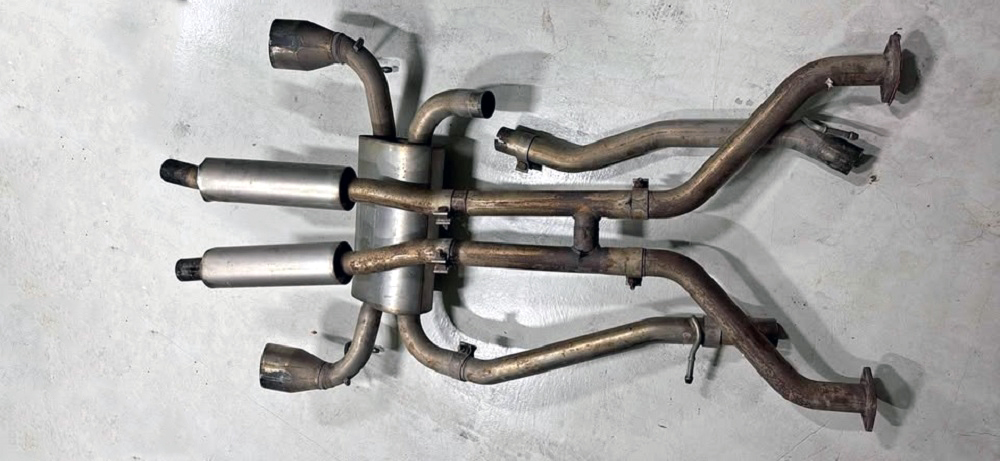
A true dual exhaust system keeps the exhaust streams from each cylinder bank completely independent. This setup runs separate pipes from the headers to the tailpipes, preserving distinct exhaust pulses on each side.
The result is a deep, aggressive sound with a signature rumble, a trait often associated with classic muscle cars and performance trucks.
Beyond sound, the separation can maintain low-end torque when paired with the right pipe diameter and engine tuning.
However, without a crossover, exhaust pulses remain independent, which can slightly reduce scavenging efficiency at higher RPMs. This may lead to less efficient gas evacuation compared to a merged system, potentially affecting peak horsepower.
While some engines are tuned to handle this, others might experience slightly higher backpressure, reducing peak horsepower potential compared to a merged system.
X-Pipe: Balanced Flow for Performance
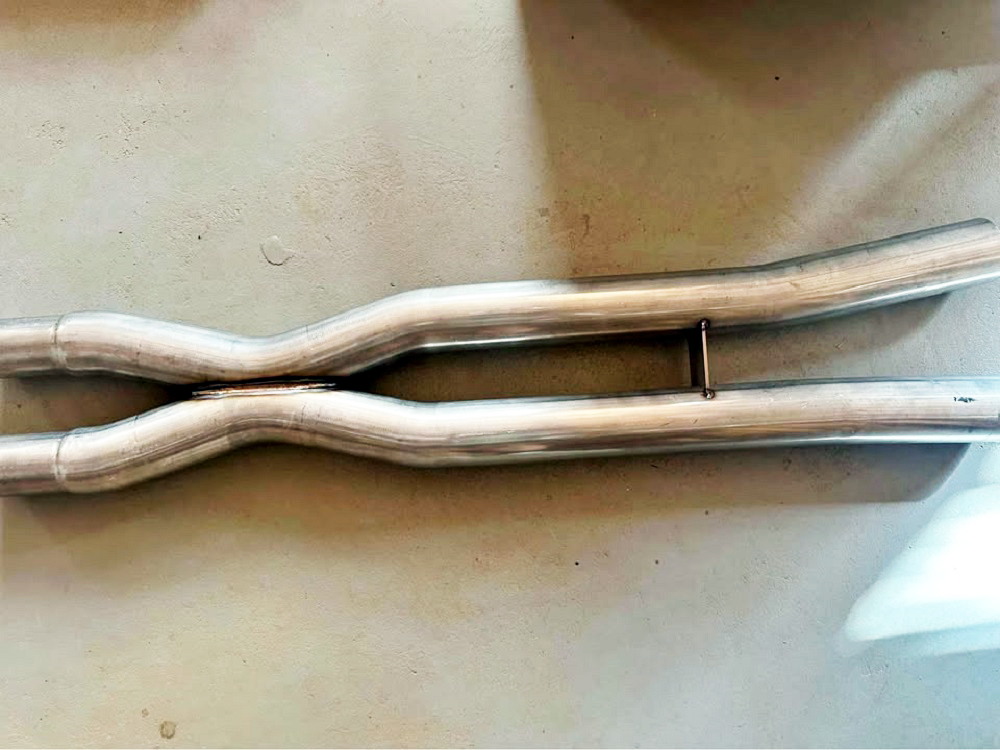
An X-pipe merges the two exhaust streams in an “X” shape, allowing gases to cross between banks. This design smooths out pulses and reduces turbulence, helping to improve scavenging efficiency.
The balanced flow results in better mid-range and high-RPM performance, as exhaust gases are pulled out of the cylinders more effectively.
By improving scavenging, an X-pipe can enhance mid-range torque and throttle response. While horsepower gains are typically modest, the smoother exhaust flow can make the engine feel more responsive, especially in high-RPM applications.”
While some enthusiasts prefer the unfiltered aggression of separate pipes, others appreciate the refined, freer-flowing character of an X-pipe-equipped system.
2. Performance Impact and Flow Dynamics
True Duals: Raw Power with a Traditional Feel
Running separate exhaust paths for each cylinder bank creates a setup that’s all about maintaining a strong, distinct exhaust pulse.
This design works well for engines tuned to prioritize low-end torque, where the unmerged exhaust streams help maintain cylinder scavenging at lower RPMs.
That deep, throaty rumble isn’t just for sound—it reflects the independent firing pulses that make a true dual system so appealing.
However, without a crossover, uneven backpressure can occur, which can slightly reduce high-end power compared to a more balanced setup.
Engines that operate at high RPMs for extended periods, such as road-course cars or high-revving builds, can lose efficiency in expelling gases and experience a slight power loss at peak output.
In trucks and muscle cars, true duals often shine because of their ability to deliver strong, low-end grunt. However, tuning is key.
Pipe diameter, muffler choice, and even the length of the pipes all affect whether this system enhances performance or introduces unwanted restrictions.
A poorly matched true dual setup can lead to uneven exhaust pulses, which may rob an engine of some potential horsepower, especially on a naturally aspirated build.
X-Pipe: Smoother Flow, Stronger Mid-Range Performance
The X-pipe’s advantage comes from its ability to equalize pressure between the two cylinder banks. Instead of exhaust gases fighting to escape in separate paths, they merge in the crossover, improving scavenging by helping to pull gases out of the cylinders more efficiently.
This process reduces backpressure at higher RPMs, freeing up additional horsepower and making the engine breathe more easily.
Many drivers notice better throttle response and improved power delivery, especially when accelerating through the mid-range.
The benefits are particularly noticeable on high-performance applications where maintaining balanced exhaust pulses is crucial.
Engines that see frequent high-RPM use, like those in track cars or aggressive street builds, often benefit from the improved scavenging effect.
Although the power gain might not be dramatic, even a few extra horsepower, combined with smoother acceleration, can make a noticeable difference in how the car feels under load.
3. Sound and Aesthetic Considerations
True Duals: Classic Muscle with a Bold Edge
Nothing quite matches the aggressive growl of a true dual exhaust system. With each bank of cylinders pushing out its own exhaust stream without interference, the result is a raw, throaty rumble that muscle car enthusiasts crave.
The sound carries a deep, rolling resonance, especially in V8-powered vehicles, making it a popular choice for those who want their car or truck to announce itself before it even comes into view.
Whether at idle or under full throttle, true duals emphasize separation, giving the exhaust note a distinct and powerful character.
That said, while the classic roar is unmistakable, it isn’t always the most refined. The independent exhaust paths can sometimes lead to an unbalanced sound, particularly at certain RPM ranges where exhaust pulses don’t harmonize as smoothly.
Some drivers enjoy this variation, appreciating the way it adds to the mechanical, old-school feel of the system. Others might find that, at highway speeds, the drone can become more pronounced, particularly without resonators or carefully tuned mufflers.
Aesthetically, true dual setups often stick to a factory-inspired look, running two pipes straight to the rear. For vehicles that originally came with dual exhausts, this keeps everything looking clean and symmetrical.
In some cases, builders take it a step further, opting for side-exit configurations or rear dump exhausts to emphasize the aggressive styling. Regardless of placement, true duals tend to look as serious as they sound.
X-Pipe: Smoother Tone with a Balanced Finish
Where true duals keep the exhaust streams separate, an X-pipe blends them, creating a smoother and more uniform exhaust note.
The difference is noticeable, especially at higher RPMs, where the crossover effect helps even out the pulses, reducing the choppiness that can sometimes come with an independent dual system.
Instead of a raw, separated rumble, the X-pipe blends exhaust pulses, creating a smoother, more refined tone. While it can result in a slightly higher pitch at wide-open throttle, the final sound depends on muffler selection, pipe length, and engine characteristics.
For those who prefer a clean, consistent exhaust note that isn’t as abrupt or aggressive as true duals, the X-pipe is a solid choice.
Many performance-oriented builds, especially those focused on track driving or high-rev applications, benefit from this smoother flow.
The crossover design doesn’t just improve performance—it also cuts down on droning frequencies that can become annoying on long drives.
This is particularly helpful in modern muscle cars and sports cars, where comfort and refinement matter alongside performance.
Visually, an X-pipe setup doesn’t differ much from a standard dual-exhaust setup. The difference lies beneath the car, where the merging section is closer to the transmission tunnel.
Since it still retains dual tailpipes, it maintains the aggressive look many enthusiasts want while introducing a more balanced and performance-tuned feel to the setup.
4. Installation, Tuning, and Practical Considerations
True Duals: Straightforward but Requires Balance
Installing a true dual exhaust system is straightforward for vehicles already designed for dual pipes. However, converting a single-exhaust car requires additional fabrication, a second catalytic converter in emissions-compliant setups, and potential tuning adjustments to avoid check engine lights.
Since each bank remains completely independent, there’s no need to worry about crossover points, making it a relatively straightforward setup.
For older muscle cars, performance trucks, or factory dual-exhaust vehicles, this means less fabrication and a more traditional layout. However, keeping the exhaust streams separate does require careful planning.
If pipe diameter, muffler selection, or routing isn’t optimized, one side of the system can end up flowing differently than the other. This can lead to uneven performance, with some cylinders experiencing more backpressure than others.
Additionally, since true duals don’t naturally balance exhaust pulses, tuning becomes more critical to ensure smooth power delivery and avoid any flat spots in the torque curve.
In terms of compatibility, true duals are a great fit for vehicles built for aggressive performance and high-displacement engines that can fully take advantage of unrestricted exhaust flow.
That said, in applications where scavenging efficiency needs to be maximized—such as in smaller-displacement engines or forced induction setups—true duals may require additional tuning or resonator adjustments to prevent unwanted turbulence.
X-Pipe: More Complex Installation, but Gains in Efficiency
Adding an X-pipe to an exhaust system involves a bit more complexity, but the payoff is a more balanced airflow. Since the two exhaust streams merge at a central crossover point, proper placement is crucial.
The X-pipe needs to be installed at a precise location where the exhaust pulses can mix most efficiently—usually near the point where the individual banks’ primary tubes converge.
If positioned too far forward or backward, it might not achieve the desired scavenging effect, potentially negating its benefits.
Vehicles that don’t come with an X-pipe from the factory may require extra fabrication to integrate one properly.
Unlike true duals, which simply follow the natural routing of each cylinder bank, an X-pipe demands that the pipes be joined and carefully welded to maintain symmetry.
While many aftermarket kits simplify this process, some setups may still require custom work, especially if clearance issues arise near the driveshaft or transmission tunnel.
From a tuning standpoint, an X-pipe system is generally easier to dial in for consistent performance. The balance between banks helps smooth out airflow, reducing the likelihood of one side flowing differently than the other.
This not only improves midrange power but also leads to a more predictable and linear throttle response. However, in some cases, the added efficiency can slightly mute the aggressive characteristics of a raw true dual setup, which might not appeal to those seeking maximum sound over performance.
5. Cost and Value Proposition
True Duals: Simple Setup but Costs Can Stack Up
Installing a true dual system can be relatively straightforward and cost-effective for vehicles that are factory-equipped with dual exhausts.
Since each bank has its own dedicated piping, there’s no need for additional crossovers or merging points, simplifying the layout.
Off-the-shelf kits are widely available and often require minimal fabrication, making them an appealing option for DIY installations.
However, depending on the level of customization, costs can add up quickly. If a vehicle originally had a single exhaust, converting to true duals may require extra piping, additional hangers, and a second catalytic converter for emissions compliance.
Muffler selection and pipe diameter also impact cost—choosing components that optimize flow without creating backpressure imbalances can lead to higher expenses.
For those wanting a perfect balance, adding resonators or an H-pipe (a simpler crossover than an X-pipe) can improve flow characteristics but adds to the overall cost.
Despite these potential expenses, true duals remain a popular choice among muscle car and truck owners who prioritize a classic, aggressive exhaust note over peak horsepower gains.
When properly set up, they offer long-term value for enthusiasts looking to retain the raw, independent exhaust pulse sound of a traditional V8.
X-Pipe: More Cost Upfront, But Added Efficiency
An X-pipe setup usually costs slightly more due to the extra materials and labor involved in merging the exhaust streams.
While some vehicles come with a factory-installed crossover, retrofitting an X-pipe onto an older exhaust system requires precise placement, cutting, and welding to ensure optimal scavenging effects.
Aftermarket kits that include an X-pipe are generally more expensive than standard dual-pipe kits, and professional installation can add to the cost if custom fabrication is needed.
However, the X-pipe justifies its cost through performance gains and long-term efficiency. By reducing uneven pressure buildup and improving exhaust flow balance, an X-pipe can unlock additional horsepower and torque, especially in high-revving applications.
This means that for owners focused on extracting every bit of power from their engine, the added investment can be well worth it.
Also, the smoother, more refined exhaust note can make highway driving less droning, which can be an appealing benefit for daily drivers or long-haul vehicles.
Final Thoughts
If you’re torn between the two, it comes down to what matters most to you. True duals deliver that raw, aggressive exhaust note, keeping pulses separate for a classic muscle car sound.
They’re easy to install on vehicles built for dual exhausts but might not optimize horsepower. An X-pipe, on the other hand, balances exhaust flow, improving mid-range power and throttle response while producing a smoother tone.
If you’re after a deep, raw muscle car growl and don’t mind a bit of uneven exhaust pulse variation, true duals deliver that aggressive tone.
If smoother flow, refined sound, and improved mid-range response are your priorities, an X-pipe offers better scavenging efficiency, especially at higher RPMs.