
Plug in the trailer. Hit the brakes. Feel the trailer tug wrong. That’s how many Curt Echo brake controller problems start. The Curt Echo Mobile 51180 does not work like an old brake box under the dash.
It plugs into the 7-way and uses a phone app for setup and manual control. That adds more failure points, power at the plug, ground, pairing, and calibration.
Most trouble starts in 4 places. Weak 7-way power. Loose or dirty ground. Phone app or Bluetooth issues. Wrong settings or a sloppy setup. Sometimes the Echo takes the blame when the truck or trailer wiring is the real problem.
That is the job here. Sort the controller faults from the wiring faults before you spend money.
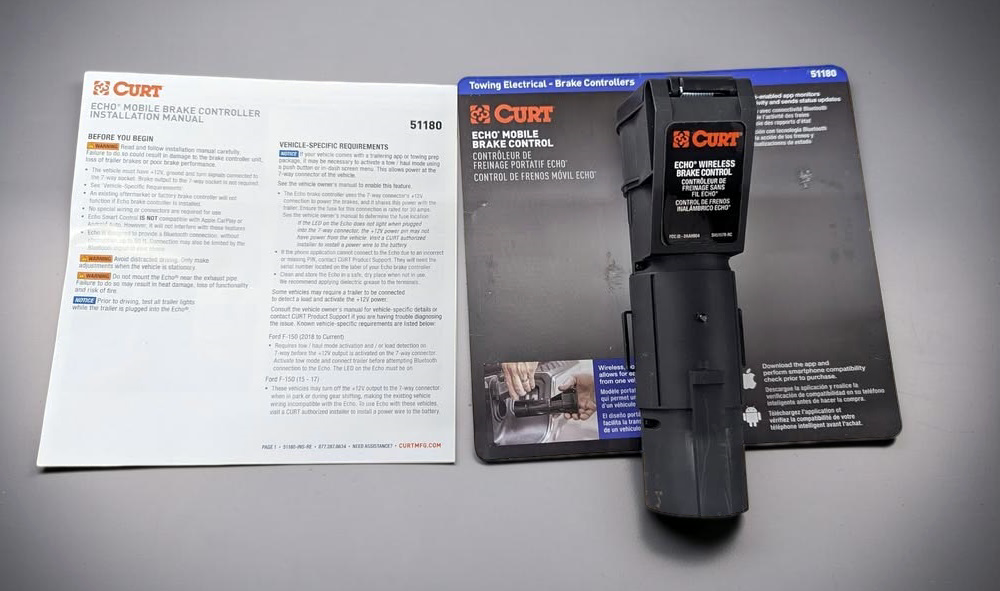
1. Start with how the Echo is built, or the diagnosis goes crooked
It lives at the 7-way, not under the dash
Miss that layout and the rest of the job goes sideways. The Curt Echo Mobile 51180 plugs into the truck’s 7-way socket and sits outside the cab. It uses Bluetooth, a phone app, and a tri-axis motion sensor to run proportional trailer braking. It is rated for 1 or 2 axles.
That changes the fault map. An old hardwired controller sends you under the dash first. The Echo sends you to the rear plug, the ground path, the phone, and the trailer harness. The control head is hanging off the bumper, not bolted inside the cab.
A lost phone link does not end base braking
Bluetooth matters, but not in the way many owners think. The Echo stores the last saved profile in the unit. If the phone link drops, the controller can still apply proportional braking from its own sensor data. Manual override is what you lose.
That is a hard limit. If sway starts, there is no physical lever to grab. You need the app or the optional Bluetooth button for manual brake input. No phone control means no fast thumb hit from a dash-mounted slider.
The trouble usually sits in one layer first
| Layer | Job | Common failure |
|---|---|---|
| 7-way power and ground | Feeds the Echo and brake circuit | No power, weak output, false disconnect |
| Echo hardware | Reads decel and sends brake output | Red fault light, calibration trouble |
| App and Bluetooth | Pairing, profiles, manual control | No pairing, lag, wrong saved settings |
| Trailer wiring and brakes | Takes output and applies braking | No brake response, grabby stops, overload |
This controller asks more from the truck
The Echo pulls its power through the 7-way. Pin 4 has to feed the controller and the trailer brake circuit. CURT says that feed needs a 30-amp fuse for full operation on up to 2 axles.
Some trucks do not keep that circuit live all the time. Some wait for trailer detection. Some cut 12-volt feed in Park or during shifts. On those rigs, the Echo can go dark even when the controller itself is fine.
2. Power at Pin 4 is where the fight usually starts
Start with the 12-volt feed, or nothing else matters
Lose power at the 7-way and the Echo goes dark. CURT says the unit uses the socket’s 12-volt auxiliary feed to power itself and the trailer brake circuit. That feed is usually Pin 4 on a standard 7-way RV blade plug. For full use on up to 2 axles, CURT calls for a 30-amp fuse on that circuit.
A weak fuse setup can fake a controller failure. Some factory tow packages use a lower fuse, and some older vehicles do not wire the charge pin to the battery at all. Hit the brakes hard with a loaded trailer and the fuse can open right then. The Echo LED goes dark when the 12-volt feed disappears.
Some trucks do not wake the 7-way the way owners expect
A lot of no-power complaints start in the tow vehicle logic, not in the Echo. CURT notes that some vehicles only energize the 7-way after trailer detection. Some require tow mode or a connected load before the circuit wakes up. Some can cut the 12-volt feed in Park or during gear changes.
That can make the controller look flaky at the worst time. Pairing may drop when you stop. Calibration may fail when power cycles at the plug. On a vehicle that cuts rear-socket power, the Echo can lose feed before the trailer brakes ever get a clean command.
Ground faults can make the Echo lie to you
A weak ground does more than dim lights. High resistance in the return path can stop the Echo from seeing the trailer cleanly. It can pair with the phone, sit there awake, and still fail to detect the trailer brake load. Owners often see this as a solid-blue or no-brake complaint.
Corrosion is the usual issue here. Rust, white powder, loose female terminals, and heat-darkened pins all add resistance. CURT’s troubleshooting flow ties no-brake response, disconnect messages, and weak output to poor ground or corroded wiring. Voltage drop at the ground side can fake a dead trailer.
Test the socket before blaming the controller
Check the truck-side socket first. Pin 4 needs a solid 12-volt feed, and the ground pin needs low resistance back to battery negative.
If the LED stays off with known-good power and ground at the socket, the unit itself moves higher on the suspect list. No power at the plug means no braking command from the Echo, no matter what the app shows.
3. The LED tells the truth before the app does
Plug order matters, and the Echo will punish a sloppy start
Plug the Echo into the truck first. Then plug the trailer into the Echo. CURT warns that doing it backward can throw off calibration and brake response.
Calibration has its own rules. The truck and trailer need to stay still on level ground while the unit learns zero. During that step, the LED flashes yellow for 5 to 8 seconds. If the rig is moving or parked on a slope, the controller can learn the wrong baseline and brake too hard or too late.
Read the light before you grab a meter
| LED pattern | What it means |
|---|---|
| Flashing blue | Not paired, no trailer connected |
| Solid blue | Paired, no trailer connected |
| Flashing green | Trailer connected, not paired |
| Solid green | Trailer connected and paired |
| Flashing yellow | Calibrating |
| Flashing red | Wiring error |
| Solid red | Hardware fault |
| No light | No power |
Flashing red, solid red, and no light are three different fights
A solid red light that stays on more than 10 seconds points to an internal hardware fault. A flashing red light points toward wiring trouble, plug contamination, brake-circuit overload, or an accelerometer error. No light points back to missing 12-volt feed or missing ground at the 7-way.
Those faults can feel the same from the seat. The trailer may stop braking, brake in bursts, or never wake up at all. The fix path does not overlap much. One needs power and ground checks, one needs trailer-side wiring checks, and one can end with controller replacement if the light stays solid red past 10 seconds.
4. Your phone can foul the job even when the Echo is fine
Pair it in the app, or the controller can vanish in plain sight
Start in the OneControl Auto app. Do not pair the Echo first through the phone’s normal Bluetooth menu. CURT says the app handles discovery, pairing, and profile control. If the phone grabs the unit the wrong way, the app may never see it right.
Location access matters too. On many phones, Bluetooth scan will not work unless location permission is on. GPS does not run the brakes, but the app may refuse to find the controller without that permission. A controller can sit powered and ready while the phone keeps saying no device found.
Background app lag can end manual override timing
Manual override needs the app awake. CURT says the OneControl Auto app should stay in the foreground when you want manual brake control. Put the app in the background and response can lag.
That lag matters on a swaying trailer. A half-second delay feels long when the trailer starts pushing the truck. Base proportional braking can still work from the saved profile, but the fast hand-save is gone without live app control.
Battery saving modes can cut the link mid-trip
Modern phones love to end apps in the background. Android battery optimization and similar power-saving tools can freeze the Echo app during a long tow. That can drop the Bluetooth link even when the controller still has power.
The fix sits in phone settings, not trailer wiring. Samsung, Pixel, Huawei, LG, and Motorola phones often need the app set to unrestricted or excluded from battery saving. On iPhone, Background App Refresh needs to stay on for the app. A phone set to save battery can cost manual override at highway speed.
Stored profiles can make the brakes feel broken
The Echo stores up to 5 recent settings in the unit. That helps when you swap trailers or lose phone signal. It also creates a new failure path, the wrong profile can stay loaded and make the trailer brake too hard or too soft.
That shows up as a brake feel complaint, not always a pairing complaint. A borrowed trailer, an old camper profile, or a gain setting from last season can all change stop feel fast. The controller can work exactly as told and still feel wrong at 25 mph.
5. Grabby, pulsing, or weak braking usually points to setup mismatch
Split output from sensitivity or the brakes will feel wrong fast
Max output and sensitivity do different jobs. Max output sets the ceiling for brake force. Sensitivity sets how fast the Echo climbs to that ceiling. CURT tells users to set output first, then fine-tune sensitivity with test stops around 25 mph.
A lot of “lockup” complaints start here. Set sensitivity too high and the trailer can hit hard at low speed. Set output too low and the trailer feels lazy and late. Those are setup faults, not proof of a dead controller.
Plug order can make it worse. If the trailer goes into the Echo before the Echo goes into the truck, the unit can skip the soft-start calibration. Some owners see the app shoot straight to 100% output on the first brake touch.
Hazard lights can make the trailer brake in pulses
Hazard-light pulsing sounds like a wiring short, but it often is not. CURT says the trailer brakes can pulse on and off with the flashers if the hazard-light setting is not turned on in the app. The brake circuit and the light logic share enough signal traffic for the Echo to react to the flashing pattern.
That shows up as a rhythmic tug. The trailer jerks in time with the hazards instead of rolling smooth. On a light trailer, that can upset the rig more than the driver expects.
Some vehicles send ugly signals through the 7-way
Not every truck or SUV feeds the 7-way like an old dumb plug. Some European vehicles use pulse-width-modulated bulb checks on the brake and turn circuits. The Echo can read those pulses as brake commands and start cycling the trailer brakes on and off.
That can feel like random pulsing with your foot off the brake. In harder cases, repeated switching can heat the controller and push it into a fault state. Mercedes, BMW, Audi, and Volkswagen rigs show up in this lane more than old-school tow platforms.
Tesla adds a different headache. Model 3 and Model Y can cut 12-volt power at the 7-way in Park or during shifts to Neutral. That power drop can break pairing and calibration, which is why many techs steer those rigs toward the Echo Under-Dash 51190 or another hardwired controller.
6. The hanging box brings its own hardware trouble
The socket carries more strain than many buyers expect
The Echo hangs off the truck’s 7-way. Then the trailer plug hangs off the Echo. That puts weight and harness pull on the rear socket every mile.
Road shock makes that load worse. Bumps, washboard pavement, and a stiff trailer cord can rock the unit in the plug. Over time, socket tension can loosen, pins can spread, and contact pressure can drop. That is how intermittent power loss starts without a burned fuse or a dead controller.
Corrosion can turn a good controller into a liar
The Echo lives outside in rain, dust, road salt, and spray. Corrosion on the blades or inside the socket raises resistance and scrambles clean signal flow. That can show up as flashing red, reduced braking force, false disconnect warnings, or a trailer that comes and goes on the app.
CURT calls for dry storage, terminal cleaning, and dielectric grease on the contacts. That is not excessive on this unit. A light film of corrosion at the plug can act like a wiring fault deeper in the trailer.
Vibration, weather, and theft all hit the mobile Echo harder
| Weak point | What it causes | Best prevention |
|---|---|---|
| Socket leverage | Dropouts, loose connection, socket fatigue | Use the retention strap and check socket tension |
| Exposed terminals | Corrosion, false trailer detect, weak output | Clean contacts and apply dielectric grease |
| Outside mounting | Water, salt, impact damage | Remove and store it when not towing |
| Plug-and-play design | Easy theft or loss | Do not leave it on an unattended vehicle |
The retention strap is not decoration
CURT includes a strap and locking tab for a reason. Without support, the Echo can bounce against the socket and the trailer cord can pull it downward. Some owners add extra support with hook-and-loop straps or tied harness slack to cut movement on rough roads.
If the strap fails or the socket door loses tension, the controller can shift enough to break contact. At highway speed, that can mean sudden trailer brake loss without a cab-side warning lever to grab. The whole unit still depends on a clean, tight rear plug connection.
7. Pick the right controller for the job
The Echo fits light-duty, part-time, multi-vehicle towing best
The Echo makes the most sense when the tow setup changes a lot. One truck this month. A second SUV next month. Maybe a rented trailer in between. Plug-in setup takes minutes, not a dash tear-down. It also stores up to 5 recent profiles, which helps when you swap trailers.
That portability saves real hassle. No bracket under the dash. No hardwire kit on every vehicle. No need to dedicate one tow rig to one controller. The Echo is built for 1 to 2 axles, and that ceiling matters once trailer weight and brake demand climb.
Heavy towing and frequent hauling expose the Echo’s weak spots faster
Tow every week and the work gets rougher. The rear socket takes more strain. The phone has to stay ready. Manual override still lives on a screen unless you add CURT’s Bluetooth button. That is slower and less natural than a real slide lever when sway hits hard.
Long-haul rigs punish the mobile Echo more too. Rain, salt, dirt, cord pull, and vibration all add up at the bumper. A hardwired or under-dash controller cuts out that hanging connection and removes one failure layer. The Echo Mobile still tops out at 2 axles.
Some vehicles are a poor match even when the Echo works as designed
A truck with quirky 7-way power can waste hours fast. If the rear plug cuts 12-volt feed in Park, during shifts, or until trailer load is sensed, the Echo can drop pairing or fail calibration without any internal fault. Tesla, some European vehicles, and some late-model smart tow systems land in this lane more often.
Those rigs usually do better with the Echo Under-Dash 51190 or another hardwired controller. A constant power feed and in-cab control remove the rear-plug power drama. That is not a style choice. It is a system match problem.
Buy the mobile Echo for convenience, not for maximum control feel
| Towing situation | Better fit |
|---|---|
| Occasional towing with more than 1 vehicle | Echo Mobile |
| One trailer, one tow rig, frequent hauling | Under-dash or hardwired controller |
| Drivers who lean on manual override often | Physical lever controller |
| Vehicles with picky 7-way power logic | Under-dash or hardwired controller |
| Dirty, salted, high-vibration use | Hardwired controller |
The real cutoff is simple
Most Curt Echo brake controller problems start with weak 7-way power, poor ground, app-side lag, wrong setup, or the limits of a controller hanging outside the truck. If the rig tows a few weekends a year, the Echo can fit well.
If the trailer works hard, the road is rough, or manual override matters a lot, the better answer is usually a hardwired box with a real lever and a constant 12-volt feed. The Echo Mobile is capped at 2 axles.
Sources & References
- CURT Echo Family of Brake Controllers
- Echo: A Wireless Brake Controller for Your Smartphone – CURT Manufacturing
- Towing a Trailer? Let’s Talk About Brake Controllers – etrailer.com
- The Best Bluetooth® Brake Controller for Modern Towing – Lippert
- How to Select the Best Brake Controller for Your Vehicle – CURT Manufacturing
- CURT | Echo™ Mobile Brake Controller Support | Trailer Profiles & Settings – YouTube
- For GMC Sierra 1500 Brake Controller Module Box Curt Echo 51180 Wireless Bluetooth
- Curt Echo Mobile Brake controller | Setup and Review | CMF51180 – YouTube
- ECHO™ MOBILE BRAKE CONTROL INSTALLATION MANUAL – NAPA Auto Parts
- Tekonsha Prodigy P3 And Curt Echo Under Dash Brake Controller Comparison Video
- Echo Mobile Trailer Brake Controller, 7-Way, Bluetooth® Smartphone Connection #51180
- CURT 51200 In Line Trailer Brake Controller Instruction Manual – device.report
- Anyone have experience with Bluetooth trailer brakes? Also I’m looking into camping trailers and having a hard time figuring what brand to get or what to look for. We know the layout we like. : r/GoRVing – Reddit
- Physical break controller vs Bluetooth. : r/GoRVing – Reddit
- ECHO® MOBILE BRAKE CONTROLLER INSTALLATION MANUAL
- CURT 51180 Echo Mobile Brake Controller Instruction Manual – device.report
- Urgent: Problem With Echo Wireless Brake Controller Need Help –SOLVED – T@B Forum
- Troubleshooting No Power on Curt Echo Brake Controller – etrailer.com
- Troubleshooting Curt Echo Brake Controller that Only Works with Manual Override | etrailer
- Troubleshooting Intermittent Curt Echo Mobile Brake Controller Connection to Phone App
- Expert Answers about Mercedes-Benz malfunction – etrailer.com
- Troubleshooting Solid Blue Light on Curt Echo Brake Controller – etrailer.com
- Troubleshooting A Curt Echo Brake Controller That Activates The …
- Battery Optimization & Background Restrictions – Onfleet Support
- Why does the app keep shutting down on my android device? – Best Accountability Support
- ECHO® UNDER-DASH TRAILER BRAKE CONTROLLER INSTALLATION MANUAL – Tractor Supply
- Brake Lag Troubleshooting When Using Curt Echo Wireless Brake Controller – etrailer.com
- Turn off this one setting to save your smartphone battery – CREDO Mobile Blog
- LPT: Turn off nearly all apps’ Background App Refresh (iOS settings –> general), they drain battery, and many are tracking and selling your location, and unnecessary : r/LifeProTips – Reddit
- Echo Brake Controller and Grabby Brakes Question – Page 3 – T …
- Troubleshooting Bluetooth Pairing of Curt Echo Controller | etrailer
- ECHO® IN-LINE TRAILER BRAKE CONTROLLER INSTALLATION MANUAL – Curt Manufacturing
- CURT | Echo™ Mobile Brake Controller Support | Connecting and Pairing Issues – YouTube
- Expert Answers about Mercedes-Benz Trailer Brake Controller malfunction | etrailer
- Troubleshooting Jerking/Grabbing Brakes when Using Curt Echo # C51180 | etrailer
- Troubleshooting Curt Echo Mobile Brake Controller that Applies Brakes Hard – etrailer.com
- Curt echo Bluetooth brake controller? : r/RVLiving – Reddit
- Fix For Curt Echo Wireless Brake Controller Locking Up Trailer Brakes At Low Speeds
- Curt Echo Under-Dash Electric Trailer Brake Control w/ 7-Way Wiring Kit For 20-23 Tesla Y
- Looking for input from people that tow with their Model Y. : r/TeslaModelY – Reddit
- Electric Trailer Brake Question | Good Sam Community – 1855724
- Pulse Width Modulation (PWM) – Premier Auto Trade
- Change is Inevitable: Pulse Width Modulation – MB Wholesale Parts
- Wireless Brake Controller – Curt Echo vs Tekonsha Prodigy RF – etrailer.com
- Curt Echo Full Review | etrailer
- Tekonsha Prodigy RF vs Curt Echo Trailer Brake Controllers – BMW X5 Forum (G05)
- Curt Echo vs Tekonsha Prodigy RF brake controller – T@G & Small Teardrop Trailer Forum
- Which brake controller? : r/traveltrailers – Reddit
- Curt Echo Brake Controller Will Not Pair To Phone With Working Bluetooth Connection