Spot the 37s in the lot. Notice the stance. Hear the sidewall hum before it even moves. That’s where the Ford Raptor 37 package story starts.
Since 2021, this truck has rolled out of Dearborn as Equipment Group 802A, the first factory 37-inch setup on a light-duty pickup. The 3.5L high-output EcoBoost stays at 450 hp and 510 lb-ft.
What changes is the hardware around it, frame kick-outs for a true 37 spare, thicker 1.0-inch shock rods, revised geometry, and different travel limits.
Some buyers see bigger tires and stop there. The spec sheet shows more, 13.1 inches of clearance, sharper approach and breakover angles, but one inch less suspension travel than the 35 truck. Clearance rises. Nimbleness shifts. Let’s separate what’s engineering from what’s ego.
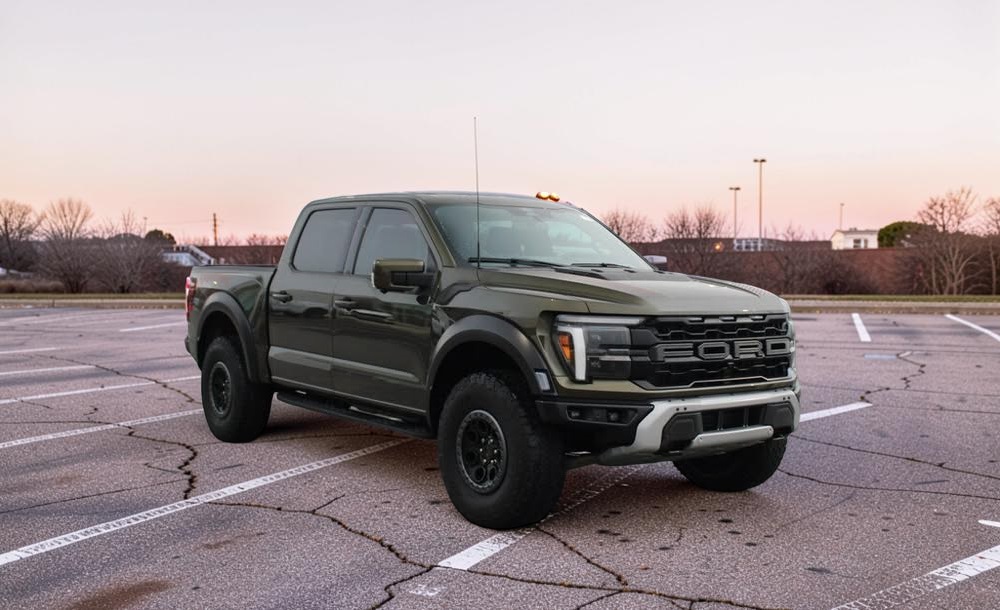
1. The Raptor 37 lives in a narrow slot between 35 and Raptor R
The lineup splits cleanly at 801A, 802A, and 803A
Start with the order guide. 801A brings the 3.5L high-output EcoBoost and 35-inch LT315/70R17 tires. 802A keeps that same 450 hp and 510 lb-ft, swaps in factory 37×12.5R17, and adds the hardware to support them. 803A Raptor R keeps the 37-inch chassis concept and bolts in a 720 hp supercharged 5.2L V8.
All three run a 10-speed automatic and 4.10 gears. All three use a 2-speed torque-on-demand transfer case with mechanical lock. Only one of them carries a factory 37 spare under the bed from day one.
Pricing shows the separation clearly. Base Raptor stickers around $78,440. The 802A package pushes that near $89,910. Raptor R jumps past $110,000 before options.
The 37 package changes how the V6 works against the ground
Power stays flat on paper. Tire diameter grows roughly 2 inches over the 35 setup. That effectively tallens gearing, even with the same 4.10 axle ratio.
Basic drivetrain math shows about a 5 percent effective gearing change from diameter alone. Added rotating mass pushes the theoretical acceleration penalty into the high single digits. Ford has not published an official percentage loss figure.
Independent testing shows the 35-inch V6 truck reaching 60 mph in about 5.2 seconds. The 37-inch version has recorded closer to 5.6 seconds in instrumented runs. Calibration softens the hit, but the taller tire does cost measurable time.
Where each configuration sits mechanically
| Configuration | Equipment Group | Engine | Factory Tire Size | Core Mechanical Focus |
|---|---|---|---|---|
| Standard Raptor | 801A | 3.5L HO EcoBoost V6 | 35-inch LT315/70R17 | Maximum suspension travel, lighter steering feel |
| Raptor 37 | 802A | 3.5L HO EcoBoost V6 | 37×12.5R17 | Higher clearance, factory spare packaging, heavier-duty shock rods |
| Raptor R | 803A | 5.2L Supercharged V8 | 37×12.5R17 | 720 hp output, strengthened front axle carrier, higher tow rating |
Tow ratings stay close. Raptor 37 rates 8,200 pounds. Raptor R bumps to 8,700 pounds with a stronger front axle carrier casing. Rear axle ratio listed as 4.10 for current V6 configurations.
2. Bigger tires force suspension and frame surgery
Fox Dual Live Valve works harder to control 37-inch mass
Bolt on 37-inch KO2s and unsprung mass jumps fast. Each 37 tire weighs about 70 pounds. A comparable 35 runs closer to 64 pounds. That extra rotating mass loads the shock on every hit.
The Raptor 37 runs 3.1-inch Fox Dual Live Valve dampers. Front shock rods grow to 1.0 inch in diameter. The 35 truck uses 0.875-inch front rods.
Dual Live Valve adjusts compression and rebound independently. The system samples data about 1,000 times per second. Damping stiffens under heat and high shaft speed to resist fade during desert runs above 70 mph.
Travel shrinks so the tire doesn’t carve the fender
Longer tires need room at full bump. Ford limits travel to prevent contact at the wheel arch. Reinforced bump stops cap suspension stroke earlier.
Front travel drops from 14.0 inches on the 35 truck to 13.0 inches. Rear travel drops from 15.0 inches to 14.1 inches. Ramp Travel Index falls from 618 to 537.
The sidewall absorbs part of that loss. A 37 carries more air volume and deflects more under load. Physical shock stroke still measures 1 inch less up front.
Frame kick-outs and Panhard geometry change in the rear
A true 37 spare won’t tuck under a standard 35 frame. The 802A frame widens between the rear rails. Ford shifts the Panhard rod mounting point inboard for clearance.
Axle-end brackets clear the spare at full articulation. Frame sections gain reinforcement to handle the added wheel mass. Aftermarket attempts often require under-inflating the spare or strapping it tight.
Factory 802A trucks carry a full-size 37 spare under the bed without deflation.
3. Geometry shifts the truck’s real-world limits
Clearance rises where rocks actually hit
Axle centerline climbs with the 37-inch tire. That lifts the differential housings and the frame. Ground clearance moves from 12.0 inches to 13.1 inches.
Approach angle jumps from 31.0 degrees to 33.1 degrees. Breakover improves from 22.7 to 24.4 degrees. Departure moves from 23.9 to 24.9 degrees.
Those numbers change how the truck handles ledges and whoops. Belly strikes happen later. Frame crossmembers sit 1.1 inches higher off the dirt.
Track width and height grow with the tire
Front track widens from 74.0 inches to 74.3 inches. Rear track grows from 73.6 to 73.9 inches. Overall height climbs from 79.8 inches to 80.6 inches.
That extra width and height alter body roll feel. The center of gravity rises with the tire mass. Steering loads increase at low speed, especially aired down below 20 psi.
Electric power steering works harder against the larger contact patch. Steering rack effort rises under high-grip pavement and tight rock turns.
Turning circle and tight-space behavior take a hit
Turning circle stretches from 48.0 feet to 50.0 feet. The wider arc shows up in parking garages and tight trail switchbacks.
Front tire scrub increases at full lock. U-joint angles and steering linkage see more leverage from the taller tire.
The spec sheet calls it a 2-foot increase in turning circle. On the ground, that’s a wider swing every time the wheel hits the stop at 50.0 feet.
4. Road manners and braking change in ways numbers barely show
Acceleration math shows a measurable penalty
Larger tires stretch effective gearing. The axle ratio stays 4.10, but the taller circumference reduces leverage at the contact patch. Engineering math suggests roughly a 5 percent effective gearing change, with added rotational mass pushing the theoretical loss into the high single digits. Ford has not published an official percentage figure.
Independent testing shows the 35-inch V6 truck reaching 60 mph in about 5.2 seconds. The 37-inch V6 truck has recorded closer to 5.6 seconds in instrumented runs. Calibration helps soften the hit, but the taller tire does cost measurable time.
Throttle response feels heavier off the line. The 10-speed masks some of it with aggressive downshifts, but the extra rotating mass remains part of the equation.
Sidewall volume softens chop and sharpens the contact patch
A 37 carries more air than a 35. That extra volume absorbs small, fast hits before the shock moves. Washboard and broken pavement feel smoother at 40 to 60 mph.
Highway body motion changes with it. Some drivers call it float above 70 mph. The taller tire flex and higher center of gravity shape that sensation.
Braking data cuts against common assumptions. One instrumented test stopped the 37 truck from 70 mph in 200 feet. That measured 14 feet shorter than the 35-inch truck.
Heat, load, and brake work rise with tire mass
Heavier wheels demand more brake torque to slow. Calipers clamp harder under repeated high-speed stops. Rotor temperature climbs faster under desert use.
Contact patch size and compound matter as much as weight. The larger footprint helps under threshold braking.
Stopping distance in testing reads 200 feet from 70 mph. That number holds on stock 37-inch BFGoodrich KO2 tires.
5. Factory integration separates 802A from driveway builds
Software arrives calibrated for 37-inch rolling radius
Roll a factory 802A off the lot and the modules already know the tire size. The PCM and TCM carry shift maps built around the taller circumference. Speedometer scaling matches the 37-inch diameter from day one.
That keeps the 10-speed from short-shifting or hanging gears. It keeps fuel economy math honest on the dash. No wrench light. No adaptive relearn drama.
Aftermarket 37 swaps on a 35 truck often require BCM edits. Owners use FORScan to input tire circumference around 2,700 mm. Skip that step and the transmission can hunt between gears under light throttle.
Adaptive tables and driveline logic stay stable
The 10R80 transmission learns clutch pressure over time. A tire diameter change without recalibration skews load calculations. That can trigger harsh 3–4 shifts or delayed downshifts under part throttle.
Factory 802A trucks ship with adaptive tables built around 37-inch inertia. Driveline shock stays controlled under Baja mode pulls. Transfer case logic matches the taller tire during low-range crawl.
Converted trucks often need a PCM relearn and TCM reset. Without it, shift timing drifts and torque converter lockup feels inconsistent at highway speeds.
Warranty and hardware alignment remain intact
Dealer warranty sees one configuration. No argument over tire size or module coding. Frame, shock rods, and axle geometry match the tire mass.
A 35 truck running 37s depends on dealer tolerance. Steering rack loads rise. Wheel bearing stress increases with offset and weight.
Factory 802A trucks leave with the 1.0-inch front shock rod, reinforced rear frame kick-out, and a warrantied full-size 37 spare under the bed.
6. Cabin hardware locks the driver in when the chassis gets violent
Recaro seats clamp you during real articulation
Slide into an 802A and the first change hits your ribs. Black leather and Alcantara Recaros come standard. Bolsters run higher and tighter than the 801A buckets.
Hard cornering off-road exposes the difference fast. Lateral support keeps your torso planted over off-camber rocks. Less bracing against the wheel means cleaner steering input.
Foam density runs firmer than the base seats. Long highway runs feel stiffer. The difference shows up the first time the truck leans hard at 30 mph over a rutted shelf.
Modular front bumper improves approach clearance
The 802A includes a Ford Performance modular front bumper. Removable end caps expose more tire at full lock. That reduces bumper contact on tight ledges.
Accessory mounting points support factory LED light bars. The steel structure handles winch loads without cutting the fascia.
With end caps removed, approach angle holds at 33.1 degrees. Plastic trim no longer scrapes first.
Digital cluster and telemetry support off-road modes
A 12-inch digital gauge cluster comes standard. Off-road screens show steering angle, pitch, roll, and drivetrain status. SYNC 4 runs on a 12-inch center display.
Terrain Management offers Baja, Rock Crawl, and Off-Road modes. Throttle mapping, shift points, and damper control change with each selection.
Dual Live Valve damping adjusts in milliseconds. The system samples chassis data about 1,000 times per second.
7. Long-term wear rises with tire mass and leverage
Steering rack and front end take higher load
Heavier 37-inch tires increase steering effort at low speed. The EPAS motor works harder during tight turns. Aired down below 18 psi, scrub load climbs fast on dry rock.
Tie rods and ball joints see more leverage from the taller sidewall. Impacts transmit higher force into the knuckle. Hard desert runs heat the rack and assist motor.
Alignment drift shows sooner with larger rubber. Toe settings matter more at 70 mph across washboard. A slight toe-out can wear front tires in 10,000 miles.
Wheel bearings and hubs live under more stress
Each 37-inch wheel and tire assembly weighs several pounds more than the 35 setup. That mass hangs farther from the hub centerline. Load multiplies with offset and suspension travel.
Front hub bearings absorb that extra rotating weight. Aggressive driving and heavy landings shorten service life. Replacement front hub assemblies often run $400 to $700 per side in parts alone.
Brake components also feel the strain. Rotors handle more inertia under repeated 70 mph stops. Heat cycles rise during long downhill runs in Baja mode.
Tire cost and rotation discipline matter more
A single 37-inch BFGoodrich KO2 can cost $450 to $550 depending on market. A full set pushes past $2,000 before mounting and balancing.
Improper rotation accelerates edge wear with this mass. Six-tire rotation including the full-size spare keeps wear even.
Ignore rotation and alignment and 37s can show uneven wear patterns by 8,000 to 12,000 miles.
8. The real decision starts at 35 versus 37
The 35-inch truck keeps more suspension stroke
Front travel measures 14.0 inches on the 35 setup. Rear travel reaches 15.0 inches. That extra inch at each end shows up at full droop and hard compression.
Higher RTI score backs that up, 618 for the 35 truck. The 37 drops to 537 due to earlier bump stop contact. That difference matters on cross-axle rock shelves.
Steering feels lighter with less tire mass. Turning circle tightens to 48.0 feet. The truck rotates easier in tight trail cuts.
The 37-inch truck raises the floor under everything
Ground clearance climbs to 13.1 inches. Approach angle hits 33.1 degrees. Breakover reaches 24.4 degrees.
Full-size 37 spare fits under the bed from the factory. No deflation. No ratchet straps.
The 802A package adds roughly $11,470 over base MSRP. That premium buys geometry, frame changes, and Dual Live Valve hardware.
Where each Raptor makes the most mechanical sense
| Priority | 35-inch Raptor (801A) | 37-inch Raptor (802A) | Raptor R (803A) |
|---|---|---|---|
| Maximum suspension travel | Best fit | Reduced by 1 inch front and rear | Reduced by 1 inch front and rear |
| Tight trail maneuvering | 48.0 ft turning circle | 50.0 ft turning circle | 50.0 ft turning circle |
| Factory clearance on V6 | Limited to 12.0 in | 13.1 in clearance | 13.1 in clearance |
| Engine output | 450 hp / 510 lb-ft | 450 hp / 510 lb-ft | 720 hp / 640 lb-ft |
| Entry price point | Around $78,440 | Around $89,910 | Over $110,000 |
Raptor R adds a strengthened front axle carrier and 720 hp. It also adds roughly $32,000 over the base truck.
Sources & References
- 2024 Ford Raptor and Raptor R Tech Specs.pdf
- 2021 Ford F-150 Raptor 37 Performance Tested: A Two-Inch Flex – Car and Driver
- 2024 Packages/Options Comparison : r/FordRaptor – Reddit
- 2024 Ford F-150 Raptor Pricing, Photos & Specs – CarBuzz
- Ford F-150 Raptor R Vs. F-150 Raptor: What’s The … – CarBuzz
- 2026 Ford F-150 Raptor – Albuquerque – Model Research – Rich Ford
- 2024 Ford F-150 Raptor 4WD SuperCrew 5.5′ Box – Colley Ford
- 2024 Ford F-150 Raptor Review, Pricing, and Specs – Car and Driver
- Standard or 37 package?? : r/FordRaptor – Reddit
- 2022 Raptor 35 vs 37 : r/FordRaptor – Reddit
- How Much Does The 2024 Ford F-150 Raptor Cost? – Ken Grody Ford Orange County
- 2024 Ford F-150 Raptor: A Guide On Features, Specs, And Pricing
- Gen 3 37s vs 35s : r/FordRaptor – Reddit
- 2025-2026 Ford Raptor vs RAM TRX: The Ultimate Off-Road Showdown
- 2026 Ford F-150® Raptor® Truck | Model Details & Specs | Ford.com
- FORD F-150 RAPTOR | 3.2 FACTORY RACE SERIES | LIVE VALVE – RideFOX
- Ford Raptor 37 Suspension Deep Dive | Look ma, no leaf springs …
- TECHNICAL SPECIFICATIONS – Motor1.com
- 37s on a “35” truck… : r/FordRaptor – Reddit
- What will I loose if I don’t get 37 pakage? : r/FordRaptor – Reddit
- 35’s or 37’s : r/FordRaptor – Reddit
- 2024 35s vs 37s : r/FordRaptor – Reddit
- Is a 37 in the spare location under the bed possible on a gen 1? : r/FordRaptor – Reddit
- Spare Tire Fitment : r/FordRaptor – Reddit
- Off the Grid: The 2022 Ford F-150 Raptor – Exclusive Resorts
- How to Remove the End Caps on the Heavy Duty Modular Front Bumper of a 2021 Ford Bronco
- 2024 Ford F-150 Raptor Has Cool New Shocks and up to 720 HP – Car and Driver
- Are 37s Necessary? – YouTube
- Ford F-150 Raptor vs Raptor R? You’ll Be Wowed By How Much Faster One Of These Trucks Is To 60 MPH! – YouTube
- 35 vs. 37 again.. : r/FordRaptor – Reddit
- 2024 Ford F-150 Raptor | Features | Fort Mill SC
- How to Change Tire Size in FORScan | Ford Ranger Raptor Speedometer & Transmission Fix – YouTube
- Fixing speedometer for 37’s : r/FordRaptor – Reddit
- Adjusting Tire Size with FORScan – YouTube
- 2023 Ford Raptor 37 Performance Package VS 2023 Ford Raptor 35 Package: Are The 37s Worth It? – YouTube
- 2024 Ford Raptor 35 VS 2024 Ford Raptor 37: Are The 37’s Really Worth $12K More??? – YouTube
Was This Article Helpful?