
Hear a lifter tick at idle. Watch the oil gauge sag in traffic. Smell burnt oil after a hard pull. That’s when Lucas Oil Stabilizer enters the chat.
Since the 1980s, Lucas has sold three very different stabilizers. The original Heavy Duty formula pours thick, around 110 cSt at 100°C. The Pure Synthetic version lands near 44 cSt. The Low Viscosity formula sits close to 10 to 11 cSt, much nearer modern 0W-20 and 5W-30 behavior.
Those numbers matter. Older pushrod V8s with loose clearances react very differently than tight VVT four-cylinders and turbo engines. Add 20% of a thick bright-stock blend, and the oil film changes, the pressure changes, and sometimes the cam phasers change their mood.
Some engines quiet down fast. Others throw codes like P0011 or start phasing slow. Let’s separate real mechanical benefit from thick-oil folklore.
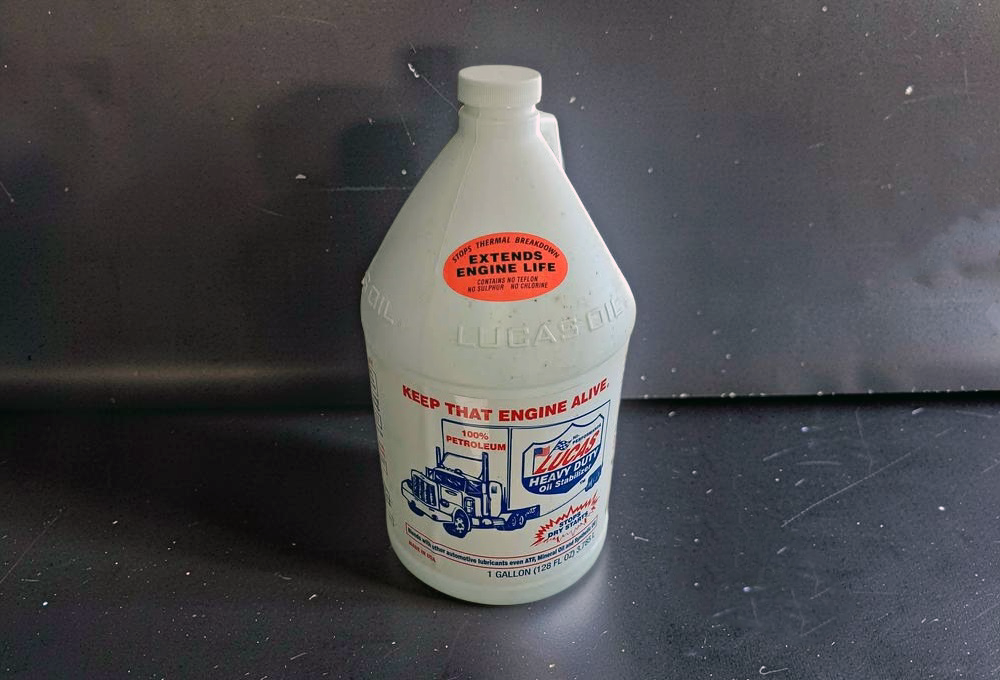
1. What Lucas Oil Stabilizer actually is, because one name hides three different fluids
The original Heavy Duty formula hits like a viscosity hammer
Heavy Duty Oil Stabilizer uses 100% petroleum bright stock. Its viscosity at 100°C sits around 110 to 112 cSt. A typical 5W-30 runs near 10 to 12 cSt at the same temp. That’s a tenfold jump in thickness.
Pour it at a 20% treat rate and the host oil’s viscosity curve shifts fast. Many users report hot idle pressure increases after adding 20% Heavy Duty Stabilizer. Gains commonly fall in the 3 to 10 psi range on worn engines.
The effect varies by clearance, oil grade, and temperature, and often narrows as the oil reaches full operating heat. Bearing leakage slows because thicker oil escapes clearances more slowly. Dash gauges react immediately.
Bright stock carries high film strength and strong surface cling. It also lacks a full detergent and TBN package. Lab reports have shown negligible TBN in the Heavy Duty blend. Replace 20% of crankcase volume and you cut acid-neutralizing reserve by roughly the same margin.
At higher ratios, 50% or more, it behaves closer to a straight heavy base oil. In manual transmissions and differentials, that extra film can quiet gear whine. In a modern crankcase, it can push viscosity outside OEM targets within minutes of warm idle.
The Pure Synthetic formula targets heat without going syrup-thick
Pure Synthetic Oil Stabilizer lists viscosity at 100°C around 44.1 cSt. That places it well below the Heavy Duty version. It still thickens the host oil, but not by an order of magnitude.
The base stock shifts to synthetic chemistry. Flash point drops slightly, around 425°F versus roughly 470°F for Heavy Duty. Thermal stability improves under sustained heat cycles. Air-cooled engines and high-rpm setups benefit from that stability.
At a 20% treat rate, a 5W-30 can edge toward the upper end of a 40-weight. Oil pressure rises, but usually less dramatically than with Heavy Duty. Additive dilution still applies, because the product remains a supplement, not a fully balanced API oil.
The Low Viscosity formula exists for tight hydraulic engines
Low Viscosity Stabilizer lands near 10.7 cSt at 100°C. That sits close to modern 0W-20 and 5W-30 oil behavior. It uses hydrotreated distillates and a proprietary dispersant-friction modifier package.
Viscosity shift stays modest at typical treat rates. Cam phasers and VVT solenoids see less hydraulic drag than with the older formula. The product focuses on anti-wear and cleanliness rather than brute thickening.
Some user demonstrations report noticeable noise reduction with the Low Viscosity formula. Public, peer-reviewed lab data confirming a specific decibel reduction are not available.
Some informal demonstrations suggest minor operating temperature changes under load. No published laboratory studies confirm a consistent temperature reduction tied specifically to the Low Viscosity formula.
Any observed change would likely relate to friction and surface-film behavior rather than a major viscosity shift.
Product Comparison
| Product | Viscosity @ 100°C | Core behavior | Mechanical effect at 20% treat rate |
|---|---|---|---|
| Heavy Duty | 110–112 cSt | Bright stock thickener | Sharp pressure rise, major thickening |
| Pure Synthetic | 44.1 cSt | Synthetic film support | Moderate pressure rise |
| Low Viscosity | ~10.7 cSt | Modern-engine treatment | Minimal viscosity shift |
Swap 1 quart in a 5-quart system and the oil chemistry changes by 20%. On a tight-tolerance engine calibrated for 0W-20, that 20% shift can push hot viscosity outside factory spec within a single oil change cycle.
2. Why some engines calm down fast with thicker oil
Worn bearings and the pressure bump that buys time
Watch oil pressure dip hot at idle. Hear rod knock fade as rpm climbs. That pattern screams clearance.
As bearings wear, oil escapes faster from the journal. Film pressure drops. Dashboard gauges sag below 15 psi at idle on high-mile engines.
Add Heavy Duty at 20%. Hot idle pressure can jump 5 to 15 psi. Thicker oil leaks slower across worn shells and restores hydrodynamic wedge support.
Reynolds lubrication math backs it up. Raise viscosity and film pressure rises in the same geometry. That’s why old small-block Chevys and farm tractors often quiet down within minutes of treatment.
This does not resize a bearing. It only slows leakage across clearances already out of spec. A spun bearing still wipes the crank at 3,000 rpm.
Cold starts and upper valvetrain survival
Pop a valve cover on a high-mile engine. Cam lobes often look dry after long storage. Oil drains off overnight, especially low-HTHS blends.
Heavy bright stock clings harder to metal. Surface tension and tack leave a visible film. Builders report parts still coated after weeks of sitting.
That film reduces boundary friction during the first two seconds of startup. Most engine wear occurs in that window. Dry starts score cam journals fast.
Residual film buys protection. It does not fix a collapsed lifter or a weak oil pump.
Oil burning and blow-by control
Blue smoke on throttle lift usually points to worn rings or guides. Blow-by pushes combustion gases past ring lands. Oil slips into the chamber and burns.
Thicker oil resists slipping through those micro gaps. Some users report visible smoke reduction up to 50 to 80% on tired diesels and gas engines. Compression readings can climb a few psi after treatment.
Oil consumption may drop from a quart every 800 miles to a quart every 1,500. The rings are still worn. Cylinder walls are still glazed.
A full ring job runs $2,500 to $4,000 on most V6 and V8 engines. A $15 bottle that cuts smoke can delay that bill, but it cannot stop metal loss already measured in thousandths of an inch.
3. Why some mechanics push back hard on stabilizers
Additive dilution and the TBN problem
Modern engine oil carries a full additive package. Detergents hold soot in suspension. Dispersants prevent sludge. ZDDP handles boundary wear. TBN neutralizes acids from combustion blow-by.
Heavy Duty Stabilizer shows little to no measurable TBN in lab reports. Replace 20% of a 5-quart system and you remove 1 quart of fully formulated oil. Acid-neutralizing reserve drops by roughly 20%.
Stretch oil intervals to 7,500 miles with reduced TBN and corrosion risk climbs. Short-trip engines build acids fast. Bearings and cam journals don’t tolerate acidic oil for long.
Cutting additive reserve without shortening change intervals can shave thousands of miles off bearing life.
Why a thicker oil grade can solve the same pressure issue
Low hot idle pressure often pushes owners toward additives. A move from 5W-30 to 5W-40 raises viscosity across the curve. That change keeps a balanced additive package intact.
A typical 5W-40 runs around 14 to 15 cSt at 100°C. That’s thicker than 5W-30 without adding a non-detergent supplement. Oil pressure can climb 3 to 8 psi on worn engines with this switch alone.
High-mileage oils also include seal conditioners and boosted anti-wear chemistry. They’re built as complete formulations. No additive math required.
On engines still within factory spec, changing grade costs the same as a normal oil change. A rebuild still runs $3,000 and up.
Film thickness versus oil system design
Older pushrod engines tolerate wide viscosity swings. Large oil galleries and simple hydraulic lifters forgive thicker blends. Dash gauges react slowly and rarely trigger DTCs.
Modern engines run tight tolerances and oil-driven controls. Cam phasers, tensioners, and solenoids depend on precise flow. Oil viscosity feeds directly into ECU timing strategy.
Raise viscosity too far and phaser response slows. Codes like P0011 or P0012 can appear within a single drive cycle. Some Ford 5.4L and GM HFV6 engines show performance complaints within 50 to 100 miles after viscosity changes.
Oil chemistry and system calibration were engineered as a matched set. Change one variable too far and the control system fights back with fault codes and limp mode.
4. Modern engines flip the answer fast
Cam phasers react to viscosity in milliseconds
Start a late-model 2.0L with VVT. The ECU commands cam advance within seconds. Oil pressure feeds the phaser through a PWM solenoid.
Hot viscosity controls how fast that phaser moves. Thicken the oil too much and response slows. The cam lags behind the target angle.
The ECU sees the error and flags P0011 or P0012. Some engines drop into reduced power mode within one drive cycle. Cam phaser replacement often runs $800 to $1,500 per bank.
Heavy Duty stabilizer can push a 0W-20 blend far beyond its intended hot flow window.
Timing chains and tensioners need clean, fast oil
Modern chains rely on hydraulic tensioners. Oil feeds through ports often under 2 mm wide. Sludge or varnish blocks those passages quickly.
Higher viscosity increases resistance in those small feeds. Delayed tensioner response allows chain slack at startup. Rattle at cold start often follows.
Chain whip accelerates guide wear. Plastic guides crack around 100,000 to 150,000 miles when oil quality falls off. A full timing job on a DOHC V6 can hit $2,000 to $3,500.
Oil flow speed matters as much as oil thickness in these systems.
Why the Low Viscosity formula exists
Low Viscosity Stabilizer sits near 10.7 cSt at 100°C. That keeps hot flow close to common 5W-30 and 0W-20 oils. The formula leans on dispersants and friction modifiers.
Viscosity shift stays small at typical 10 to 20% treat rates. Cam phasers and turbo feed lines see less hydraulic drag. Oil pressure stays within factory bands more often.
Independent sound checks show up to 4 dB noise reduction. Some tests report temperature drops near 8°F under load. Gains show up without doubling oil thickness.
On engines built around tight hydraulic control, the safe viscosity window is narrow. Exceed it and the ECU responds with fault codes, not gratitude.
5. Foam, air bubbles, and the debate most people oversimplify
Air in oil destroys pressure fast
Whip oil full of air and pressure drops. Foam compresses. Bearings need solid fluid, not bubbles.
Entrained air reduces film strength under load. Cavitation can pit bearing surfaces. Oil also cools less effectively when air replaces liquid volume.
High-rpm engines shear oil hard. Aeration risk climbs as sump levels fall or crank windage increases. Turbo engines suffer first because they run hot and fast.
Oil pressure loss under aeration can drop 5 to 20 psi in extreme cases. Bearings don’t survive long under that condition.
What ASTM D892 actually measures
ASTM D892 tests foaming tendency and foam stability. The oil is aerated at 24°C and 93.5°C. Foam volume is measured immediately and after a 10-minute settle time.
If foam collapses to 0 mL after settling, stability passes. Many new oils are designed to hit that mark. Lab procedure controls airflow and temperature tightly.
Cold beaker demos on social media skip those controls. Room temperature thick oil traps bubbles longer. That visual does not equal a failed ASTM sequence.
Real test standards matter. A viral garage demo does not replace controlled lab data.
Where thicker blends can raise aeration risk
Heavy bright stock changes oil rheology. At lower temperatures, viscosity rises sharply. Thick, cold oil releases trapped air more slowly.
High treat rates, 40% or more, amplify that behavior. Windage trays and crank scrapers reduce aeration, but many older V8 sumps lack effective baffling. Air stays suspended longer when oil is overly thick.
At full operating temperature near 100°C, viscosity drops and air release improves. Short trips and cold starts remain the higher-risk window for aeration issues.
Severe aeration can disrupt oil pressure and reduce bearing film strength under load. Sustained pressure loss can lead to bearing damage and a spun shell, often turning into a $3,000 to $5,000 rebuild.
6. Where Lucas makes the strongest mechanical case
Manual gearboxes and differentials love thick film
Hear a rear diff whine at 55 mph. Feel a notchy 5-speed on cold mornings. That noise often points to worn gear faces and loose backlash.
Heavy Duty Stabilizer raises film thickness between gear teeth. Treat rates in gearboxes often run 20% to 50%. In badly worn units, some techs push higher.
Gears don’t rely on millisecond hydraulic control. They care about film strength under shock load. Thick oil cushions the contact patch during torque spikes.
A used manual transmission swap can cost $1,200 to $2,500. A quart of stabilizer costs under $20.
Marine engines and seasonal storage
Boat engines sit for months. Oil drains off cylinder walls and cam lobes. First crank after storage runs dry for a few seconds.
Bright stock leaves a tacky film behind. That film slows corrosion and metal scuffing during long idle periods. Marine engines also run steady high load, which benefits from strong oil film.
Salt air and humidity accelerate internal rust. Residual oil coating reduces that exposure. A marine long block can exceed $6,000 before labor.
Engine assembly and break-in protection
Builders coat bearings and cam journals with tacky oil during assembly. Stabilizer products serve that purpose well. They cling while the oil pump primes.
Initial startup can take 5 to 10 seconds to build full pressure. During that window, boundary lubrication rules. Thick film reduces metal contact.
Once normal oil circulation begins, the engine transitions to its chosen oil grade. Assembly lube protects parts before the pump reaches 40 to 60 psi on most street engines.
7. Where Lucas becomes the wrong wrench
New engines under warranty and tight factory specs
Modern engines are calibrated around specific oil grades. Many late-model Fords and Hondas call for 0W-20. Hot viscosity often lands near 8 to 9 cSt at 100°C.
Add 20% of a 110 cSt stabilizer and the blend shifts fast. Hot viscosity can move well beyond factory targets. Oil control rings, cam phasers, and tensioners respond to that change.
Warranty claims often depend on maintenance records and oil choice. OEMs expect oil that meets spec, not modified blends. A denied engine claim can exceed $7,000 on a turbo four-cylinder.
Factory viscosity windows exist for emissions, fuel economy, and durability targets. Step outside that window and the ECU does not care about brand loyalty.
Sludge-prone engines and neglected maintenance
Some engines already struggle with sludge. Early 2000s 2.7L and 3.0L designs showed varnish buildup under long intervals. Dirty oil clogs narrow passages first.
Thick additives do not dissolve sludge. They can slow flow through already restricted feeds. VVT screens and tensioner ports measure only a few millimeters across.
Chain rattle at startup often relates to dirty oil, not thin oil. Ignoring 5,000-mile intervals and adding stabilizer won’t clean varnish from a cam journal.
A timing chain job on a transverse V6 can run $2,500 to $4,000. Sludge cleanup rarely costs less once metal damage starts.
Turbochargers after hard use
Turbo bearings spin above 100,000 rpm. They depend on fast oil flow and stable cooling. Oil also carries heat away from the center housing.
Increase viscosity too far and oil flow slows at startup and shutdown. Heat soak after a hard pull can cook oil in the bearing housing. Coked oil blocks feed lines.
Modern turbos use small oil passages. Restriction shows up as whining, shaft play, or oil smoke under boost. A single turbo replacement often runs $1,200 to $3,000.
Turbo oiling systems have little tolerance for viscosity experiments. One clogged feed line can wipe a bearing in minutes under full boost.
8. Lucas versus other additives, different tools for different problems
Film thickness versus surface chemistry
Lucas Heavy Duty works by raising viscosity. Thicker oil builds a stronger hydrodynamic film. Oil pressure climbs and leakage slows.
Liqui Moly MoS2 and Cera Tec follow a different path. MoS2 plates metal surfaces with a solid lubricant. Cera Tec uses ceramic particles and friction modifiers to smooth contact zones.
Those products barely change hot viscosity. Oil pressure stays near baseline. Protection comes from surface interaction, not bulk thickening.
Film-thickening changes the oil’s rheology. Surface modifiers change boundary friction at the contact patch.
Matching the additive to the failure mode
Low oil pressure at hot idle points to clearance wear. Heavy Duty can help slow internal leakage. That’s a mechanical bandage for loose bearings.
Healthy modern engines chasing smoother operation may benefit from low-viscosity friction modifiers. They don’t need a 10x viscosity spike. They need clean oil and stable film at tight tolerances.
Air-cooled engines and track cars face high oil temps. Pure Synthetic Stabilizer handles heat better than bright stock. Flash points around 425°F to 470°F matter under sustained load.
Choose the wrong mechanism and the problem remains. Choose the wrong viscosity and new problems appear.
Additive Comparison
| Additive type | Main mechanism | Best mechanical use case |
|---|---|---|
| Lucas Heavy Duty | Raises viscosity, boosts pressure | Worn engines, low idle pressure, noisy gears |
| Lucas Low Viscosity | Anti-wear and dispersancy support | Modern VVT engines needing minimal thickening |
| Lucas Pure Synthetic | Synthetic film stability | High-heat, air-cooled, performance applications |
| MoS2 / Cera Tec style | Surface friction reduction | Tight-tolerance engines seeking smoother operation |
A bottle won’t fix broken metal. A spun bearing, cracked ring land, or scored cam still requires parts and labor measured in thousands of dollars.
9. The real answer on Lucas Oil Stabilizer
When the answer is yes
Hot idle at 10 psi. Rod knock fades above 2,000 rpm. Oil disappears every 1,000 miles. That’s worn clearance talking.
Heavy Duty can raise hot pressure 5 to 15 psi. It can cut visible smoke and quiet valvetrain tick. In a tired 200,000-mile small-block, that buys time.
Manual transmissions and differentials also benefit from thicker film. Gear whine often drops after treatment. In those systems, viscosity support matches the failure mode.
When the goal is extending life on worn hardware, the physics line up.
When only the right formula makes sense
Modern VVT engines run narrow viscosity windows. Cam phasers react to small changes in flow. Turbo feed lines measure only a few millimeters across.
Low Viscosity Stabilizer stays near 10 to 11 cSt at 100°C. That keeps hot flow close to factory 0W-20 and 5W-30 behavior. It supports wear control without dramatic thickening.
Pure Synthetic fits high-heat air-cooled or performance setups better than bright stock. It handles sustained temperature without the syrup effect. Wrong formula choice can trigger P0011 within a single drive cycle.
When the answer is no
Brand-new engines under warranty don’t need viscosity experiments. Tight-tolerance oiling systems demand spec-compliant blends. Sludge-prone engines need cleaning and short intervals, not thicker oil.
Turbochargers depend on fast, clean flow. Over-thick oil can slow circulation and raise heat soak risk. One wiped turbo can cost $1,500 to $3,000.
Lucas works best as a targeted tool, not a universal fix. Use it on the wrong engine and the repair bill climbs into four figures fast.
Sources & References
- LUCAS OIL HEAVY DUTY OIL STABILIZER – Castor Trading
- Lucas Oil Products Low Viscosity Stabilizer, Designed to amplify the life of modern engines, 12 oz. – Advance Auto Parts
- ENGINE OIL ADDITIVES – Lucas Oil Products, Inc.
- SAFETY DATA SHEET – Lucas Oil
- lucas oil stabilizer -12/1q – Major Brands Oil
- PURE SYNTHETIC OIL STABILIZER – Lucas Oil
- Low Viscosity Stabilizer – Safety Data Sheet – Lucas Oil
- Lucas Oil Low Viscosity Stabilizer – Lentus, LLC
- HEAVY DUTY OIL STABILIZER – Lucas Oil
- HEAVY DUTY OIL STABILIZER – Lucas Oil
- lucas – ornance – oil products inc. – MSC Industrial Supply
- Lucas Heavy Duty Oil Stabilizer
- Does anyone else still use Lucas stabilizer when changing their oil – Reddit
- Lucas Oil 10001 Heavy Duty Stabilizer 32 Oz Bottle for sale online – eBay
- Heavy Duty Oil Stabilizer – Lucas Oil Products, Inc. – Keep That Engine Alive!
- High Mileage Oil Stabilizer – Lucas Oil Products, Inc. – Keep That Engine Alive!
- Lucas High Mileage Engine Oil Stabilizer 1 Quart 10118 | O’Reilly Auto Parts
- Lucas oil stabilizer: What do you guys think about it? I’ve heard mixed reviews. – Reddit
- Lucas Oil Stabilizer, 1 Qt., Model# 10001
- Why do people use lucas “oil stabilizer”? | TruckersReport.com …
- Customer reviews for Low Viscosity Stabilizer | Walmart.com
- Lucas High Milage oil stabilizer : r/MechanicAdvice – Reddit
- Lucas Oil Products | Heavy Duty Oil Stabilizer 10001 – Arnold Motor Supply
- Effects of Dirty Oil and Other Issues on Newer Cars with Variable Valve Timing Solenoids
- Tech tip 144.indd – Mighty Auto Parts
- The Crucial Role of Motor Oil in VVT Systems – Amsoil Blog
- Bad VVT Solenoid Symptoms: What You Need to Know – In The Garage with CarParts.com
- The Importance of Clean, Quality Oil in Timing Chain Systems – Cloyes
- Lucas Oil Low Viscosity Stabilizer – YouTube
- Low Viscosity Stabilizer – Lucas Oil Products, Inc. – Keep That Engine Alive!
- Lucas Oil Lucas Low Viscosity Additive – 12.00 Ounce | Performanc – EVO Lube Supply
- Lucas oil stabilizer vs Engine knock! – YouTube
- Lucas Oil Additive, anyone here use it? – Page 2 – the Pelican Parts Forum!
- Lucas Oil Stabilizer question – the Pelican Parts Forum!
- Analyzing Foaming Tendency: Foam Test – TestOil
- ASTM D892 Standard Foam Test Procedure | Ayalytical
- Lubricant Foaming: How to Diagnose and Eliminate the Problem
- Foam Challenges in Lubricating Oils – Savant Labs
- ASTM D892 – SPL
- Lucas oil stabilizer safe for your engine? – YouTube
- Project Farm engine oil test | OrangeTractorTalks – Everything Kubota
- Which engine self-destructs first? Lucas or STP? – YouTube
- Which Engine Self-Destructs First? Prolube, Lucas, Marvel, or Mobil 1? – YouTube
- Lucas Oil Stabilizer – The Ultimate Test – TOMAD International
- Battle against engine wear: Our oil additives in comparison | LIQUI MOLY
- Reducing Friction: Liqui Moly MoS2 vs Cera Tec
- 6 Best Oil Additives: Complete Guide – Cadence Petroleum
- Pure Synthetic Oil Stabilizer – Lucas Oil Products, Inc.
- Lucas Oil Oil Additive (MPN: 10130) – Sprinter Parts Depot
- Reviews for Lucas Oil 32 oz. Synthetic Heavy Duty Oil Stabilizer | Pg 1 – The Home Depot