Pull the plug. Oil splashes black. That blue Motorcraft bottle waits on the bench. Modern Fords run tight clearances and hot turbos. EcoBoost engines deal with LSPI that can crack pistons. Some 1.0L motors even spin a timing belt in oil. Chemistry matters here, not just viscosity.
Motorcraft is the factory fill and the dealer default. Most grades carry API SP and ILSAC GF-6. The 5W-50 backs cars like the GT500 under brutal sump temps.
So here’s the job. Figure out whether Motorcraft truly protects under heat, fuel dilution, and real miles, or whether better options earn their price. Let’s tear into it.
1. Ford builds engines around oil specs for a reason
Factory default carries weight in real warranty fights
Check the owner’s manual for any late-model F-150 or Escape. Ford points first to Motorcraft engine oil. Alternatives are allowed, but they must match the exact viscosity and current API mark.
That language matters when an engine fails at 42,000 miles. A spun rod bearing or stretched timing chain triggers a paper trail. Service records showing Motorcraft oil and filter shut down arguments fast.
Ford calibrates oil-life monitors around specific additive chemistry and viscosity behavior. Deviate too far, and the monitor’s 7,500 to 10,000-mile guidance may no longer track real degradation.
OEM-correct and best-on-earth are two different fights
Motorcraft is engineered to meet Ford’s internal WSS-M2C specs. Those specs target chain wear, sludge control, turbo coking, and LSPI suppression. The oil must pass those tests before it ever hits a bottle.
Premium brands like Mobil 1 and Amsoil often chase lower volatility and longer drain claims. Some post stronger Noack numbers or extended-interval marketing. That appeals to drivers pushing 12,000-mile intervals.
Most stock Fords running 5,000 to 7,500 miles won’t see measurable wear differences. Warranty simplicity and spec compliance carry more weight than boutique bragging rights at that interval.
The five questions that actually decide this debate
| Question | Why it matters |
|---|---|
| Does Ford officially recommend it? | Confirms it aligns with factory-fill and WSS material specs |
| Does it carry API SP and ILSAC GF-6? | Ensures LSPI and timing-chain protection for TGDI engines |
| Is it built for turbo heat? | Turbo bearings see oil temps above 250°F under load |
| Is the price sane per 5,000 miles? | Oil changed on time beats premium oil left too long |
| Does the Motorcraft filter strengthen the system? | Base-end bypass and silicone ADBV reduce dry starts |
API SP and ILSAC GF-6 certification require LSPI testing under low-speed, high-torque conditions. Fail that test and pistons can crack during heavy throttle at 1,800 rpm. That standard is not optional on modern EcoBoost engines.
2. Base oil chemistry decides how long the film survives heat and shear
Group III is refined hard, not cheap filler
Motorcraft synthetic and synthetic blend oils use highly refined Group III base stocks. These oils are hydrocracked under high pressure with hydrogen. Sulfur and nitrogen get removed. The result is a cleaner, more stable base fluid than old Group I or II oils.
Group III holds viscosity under load better than conventional oil. It resists oxidation when sump temps push past 230°F in traffic. Most Ford daily drivers never exceed what a modern Group III can handle at a 7,500-mile interval.
PAO Group IV oils flow colder and resist heat slightly better. They cost more and target extended drains. For normal Ford service intervals, Group III already clears the durability bar.
The data sheet shows real numbers, not mystery marketing
Motorcraft 5W-30 full synthetic lists a viscosity index around 160. Kinematic viscosity at 100°C sits near 10.5 cSt. Pour point falls near -39°C.
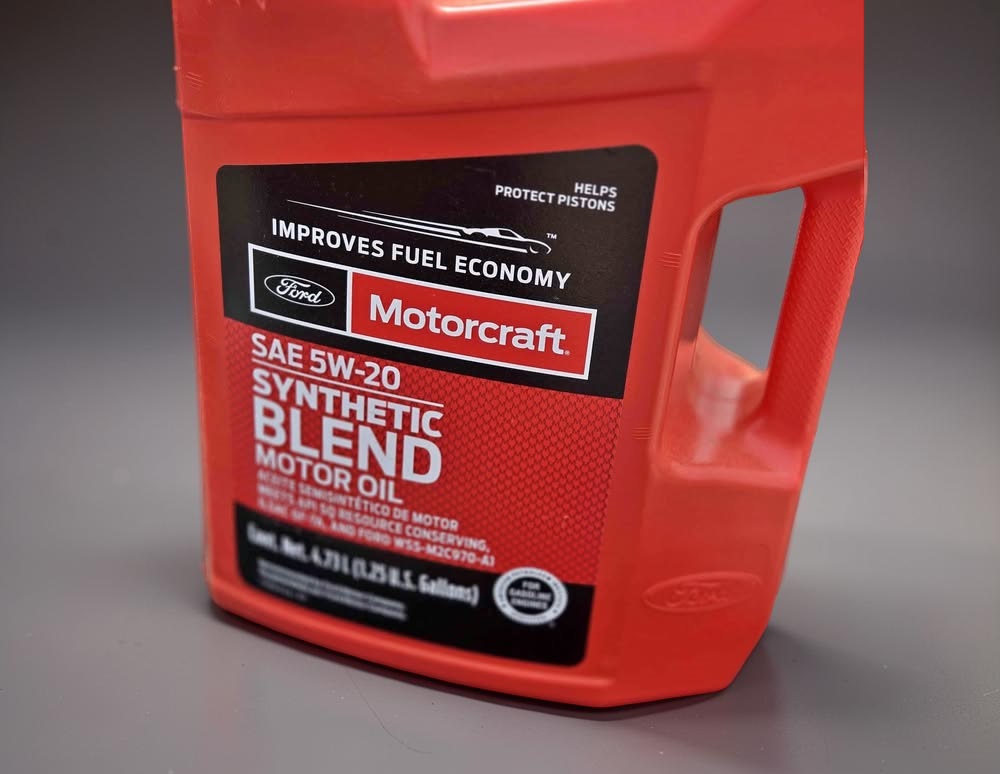
The 5W-20 synthetic blend carries a VI around 150. Viscosity at 100°C runs about 8.5 cSt. Flash point lands near 218°C in testing.
Those numbers matter in cold starts and hot highway pulls. A higher VI means the oil thins less as temperature climbs. At 250°F oil temp during towing, film strength still holds within spec.
Cold flow protects chains and phasers before pressure stabilizes
Chain stretch often starts at cold start. Oil drains back overnight. The pump needs seconds to build pressure. Thin, stable oil reaches cam phasers and tensioners faster.
Pour points under -35°C mean winter cranking does not starve upper valvetrain parts. Cold crank viscosity limits are tested under SAE J300 standards. Fail that test and lifters tick, chains slap, and wear accelerates before the engine ever warms up.
Ford calibrates variable cam timing around rapid oil pressure response. Slow flow on startup can trigger rough idle and DTCs tied to cam timing performance. That damage begins long before 100,000 miles.
3. Modern EcoBoost engines punish weak oil fast
LSPI can shatter pistons below 2,000 rpm
Roll into the throttle at 1,800 rpm in a 2.0L EcoBoost. Cylinder pressure spikes hard. Low-speed pre-ignition can fire the mixture before the spark plug. The pressure wave slams the piston crown and rod bearing.
API SP and ILSAC GF-6 were built to fight that event. Motorcraft 5W-30 synthetic blend tested by PQIA showed about 1,429 ppm calcium and 452 ppm magnesium. That detergent balance helps suppress LSPI in turbo direct-injection engines.
Cracked pistons from LSPI do not limp home. They score cylinders and wipe bearings in minutes.
Ford WSS specs target chain wear and sludge, not just viscosity
Ford does not stop at API certification. Internal specs like WSS-M2C961-A1 and WSS-M2C960-A1 set tighter limits on wear and deposits. These specs address timing chain stretch seen in high-torque turbo engines.
Chain wear shows up as cam correlation codes like P0016 and P0017. Cold start rattle follows. Left alone, stretched chains jump teeth and bend valves.
An oil that misses the Ford material spec can meet viscosity and still fail chain durability targets.
Turbochargers cook oil above 250°F
Boost builds heat fast. Turbine housings glow under load. Oil entering the turbo bearing sees sustained temps above 250°F during towing or track use.
Oxidation resistance matters here. Sludge in a turbo feed line restricts flow. That restriction wipes out the bearing and sends metal through the engine.
Motorcraft 5W-30 full synthetic carries a viscosity index near 160 and holds grade at operating temp. Lose film strength in that bearing and a turbo replacement runs $1,200 to $2,500.
Wet timing belts demand chemical discipline
Some 1.0L EcoBoost engines run a belt in oil. That belt depends on stable additive chemistry. Wrong oil can swell or degrade the belt material.
Belt debris clogs the oil pickup. Oil pressure drops. Rod bearings follow.
Ford designed those engines around approved oil chemistry. Stray from spec and belt failure can hit before 100,000 miles.
4. 5W-50 proves Motorcraft can survive brutal heat
GT500 oil lives at redline, not in grocery traffic
Ford specifies Motorcraft 5W-50 full synthetic for GT500, GT350, Boss 302, Focus RS, and Ford GT. Those engines see sustained high rpm and oil temps that climb past 280°F on track.
The 5W-50 carries Ford spec WSS-M2C931-E1. Viscosity at 100°C runs about 18.6 cSt. Viscosity index sits near 183. Cold crank viscosity at -30°C is about 5,400 cP.
That spread keeps the film thick at redline while still flowing on startup.
Shear resistance matters when boost and rpm spike together
Supercharged V8s hammer rod bearings under full boost. Oil shear forces rise as rpm climbs past 7,000. Polymer stability becomes critical.
A low VI oil thins too fast under heat. Bearing clearance grows. Oil pressure drops at hot idle.
The 5W-50’s VI near 183 signals strong resistance to thinning across temperature swings. Lose that film at 7,500 rpm and a forged crank will not save a wiped bearing.
Thick oil in the wrong engine creates its own damage
Pour 5W-50 into a 2.0L EcoBoost tuned for 5W-30. Cold flow slows. Fuel economy drops. Oil pressure rises higher than intended at startup.
Variable cam timing can react slower. In extreme cold, slow circulation increases wear during the first seconds after crank.
Ford limits 5W-50 to engines calibrated for it. Use it outside those specs and the oil life monitor will not correct for that viscosity change.
5. Diesel oil lives in a different war zone
Soot and acid attack from the first mile
Fire up a 6.7L Power Stroke. Combustion pressure climbs higher than a gas engine. Soot loads the oil fast, especially under towing.
Motorcraft Super Duty diesel oil meets API CK-4. Ford ties it to WSS-M2C171-F1 for modern emissions systems. That spec targets wear control and aftertreatment compatibility.
High soot without proper dispersants thickens oil. Thick oil starves bearings at hot idle.
Phosphorus and TBN carry the load
Motorcraft 10W-30 Super Duty lists phosphorus above 1,000 ppm. That level strengthens anti-wear protection on cam lobes and lifters. Diesel valvetrains run heavy spring pressure and high contact stress.
Total Base Number sits near 9.6 mg KOH/g. TBN neutralizes acid formed during combustion. Let TBN crash and corrosive wear starts inside the bearings.
Run long intervals with fuel dilution and low TBN, and rod bearings pay first.
Cold pumpability decides winter survival
Super Duty oil is tested for borderline pumping viscosity down to -35°C. Cold cranking without flow wipes cam journals in seconds.
Pour point for the 10W-30 diesel grade drops near -48°C. That protects fleets operating in severe winter climates.
Oil starvation during a -20°F start can score a crank journal before oil pressure stabilizes.
6. Lab reports expose what survives after real miles
Fresh oil specs flatter every brand
Virgin oil data sheets look clean. Viscosity, flash point, and pour point sit in range. That tells you what left the blender, not what comes out at 7,000 miles.
PQIA tested Motorcraft 5W-30 synthetic blend and confirmed it met SAE J300 viscosity limits. Additive levels showed about 1,429 ppm calcium, 452 ppm magnesium, 801 ppm zinc, and 162 ppm molybdenum. Silicon measured near 6 ppm, consistent with antifoam use, not dirt.
That establishes chemical credibility before the oil ever sees fuel dilution.
Used oil analysis shows how it handles shear and fuel
A 2.0L EcoBoost Maverick sample ran Motorcraft 5W-30 full synthetic for 3,200 miles. The report showed minimal shear and stable viscosity. The lab noted the oil still had usable life left.
Short trips usually spike fuel dilution in direct-injection engines. That sample did not show problematic fuel levels. Thin oil from fuel wash can trigger low oil pressure warnings under load.
Field data has limits
One clean UOA does not crown a champion. It reflects one engine, one interval, one duty cycle.
Severe towing, track use, or 10,000-mile drains stress oil harder. Shear rates climb. Oxidation accelerates.
Push a turbo engine past recommended intervals and oxidation thickens oil fast above 260°F sump temps. Bearing clearance does not forgive that mistake.
7. Oil and filter work as one mechanical system
A weak filter can undo good oil
Oil carries debris. The filter decides what stays out of the bearings. Cheap media collapses under cold pressure spikes.
Motorcraft FL-series filters are built to Ford’s design targets. Many use a base-end bypass valve instead of a dome-end design. That layout prevents dirty oil from washing back through trapped debris during bypass.
Bypass events happen during cold starts and high rpm. Poor bypass design can reintroduce metal into the oil stream.
Silicone anti-drainback valves protect the first crank
Motorcraft filters use silicone anti-drainback valves. Silicone stays flexible in cold weather. Nitrile hardens and leaks.
When oil drains out overnight, the next start runs dry for seconds. Dry starts account for a large share of long-term wear.
A collapsed anti-drainback valve increases start-up clatter. Repeated cold starts with delayed pressure shorten cam and bearing life before 100,000 miles.
Correct filter flow keeps oil pressure stable
Ford engines rely on calibrated oil flow rates. Too restrictive a filter drops pressure at hot idle. Too loose allows debris through.
Oil pressure warnings often show up below 20 psi at idle. Low pressure under load can trigger rod knock fast.
Match oil and filter as designed, or risk a $6,000 long-block replacement.
8. Head-to-head with Mobil 1, Pennzoil, and Amsoil
Mobil 1 brings broad prestige and strong heat control
Mobil 1 5W-30 lists a flash point around 235°C. Viscosity index sits near 163. It carries API SP and often meets Ford WSS specs depending on grade.
Mobil 1 leans on a premium full synthetic image. It performs well in high-heat use and extended drains.
Motorcraft wins on factory alignment and price at common 5,000 to 7,500 mile intervals. Mobil 1 often costs several dollars more per quart for similar wear protection at that range.
Pennzoil Platinum pushes GTL chemistry
Pennzoil Platinum uses gas-to-liquid base stocks. Pour point drops near -48°C in 5W-30. Viscosity index can reach around 170.
That cold flow margin helps in harsh winters. Volatility numbers often look strong on paper.
In short, standard Ford intervals, measurable engine wear rarely separates it from Motorcraft. Cost per oil change often runs higher with no proven wear advantage at 6,000 miles.
Amsoil targets long drains and low volatility
Amsoil Signature Series relies on high-end base stocks and extended drain claims. Noack volatility numbers often fall below 8%.
Lower volatility reduces oil consumption under heat. That matters in turbo engines that already burn some oil.
Extended 12,000 to 15,000 mile intervals demand tight monitoring. Run long without oil analysis and a $12,000 engine pays for that risk.
| Brand | Main strength | Main issue |
|---|---|---|
| Motorcraft | Ford spec alignment and value | Less premium branding |
| Mobil 1 | Broad retail trust and heat stability | Higher cost per change |
| Pennzoil Platinum | Strong cold flow and GTL base | Often pricier at short OCIs |
| Amsoil | Extended drain and low volatility | Highest upfront cost |
9. Real cost per mile decides the argument
Oil price matters less than interval discipline
A 5-quart jug of Motorcraft full synthetic usually lists around $27 to $30 at major retailers. Mobil 1 and Pennzoil Platinum often sit in the $26 to $32 range during normal retail cycles. Amsoil Signature Series typically runs $70 to $80 for 5 quarts when purchased direct.
Most Ford oil life monitors call for 5,000 to 10,000 miles depending on duty cycle. Short trips, towing, heavy boost, and cold weather shorten that interval fast. Fuel dilution and oxidation accelerate under those conditions.
Stretch a 7,500-mile recommendation to 12,000 without oil analysis and sludge risk rises. A 2.7L EcoBoost long block can exceed $8,000 installed.
Fuel dilution punishes long drains in DI engines
Direct injection sprays fuel late in the cycle. Cold starts and short trips wash fuel into the crankcase. Fuel thins oil and drops viscosity below grade.
Viscosity loss reduces film strength at rod bearings. Oil pressure at hot idle can dip under 20 psi. Run that thin oil under boost and bearings show copper before 60,000 miles.
Warranty compliance carries legal weight
Ford warranties require oil meeting specific WSS standards. Receipts and documented intervals matter during engine claims. Use oil outside spec and a denied claim can follow.
A denied turbo failure on a 3.5L EcoBoost can cost $2,500 to $3,500. A short block claim can exceed $7,000.
Sources & References
- What is the recommended engine oil for my vehicle? – Ford
- Motorcraft 5W-20 Synthetic Blend Motor Oil, 1 Quart – Walmart.com
- Ford Motorcraft full synthetic oil worth the premium price? – Reddit
- SAE 5W-30 Synthetic Blend Motor Oil | Motorcraft®
- Digital Handbook | Passenger Car Motor Oils – Petro-Canada Lubricants
- Motor Oil Comparison Testing – Amsoil
- Ford – Motorcraft® 5W-20 Synthetic Blend Motor Oil – Ascension Parish Government
- Motorcraft® 5W-30 Full Synthetic Motor Oil – PRODUCT TYPICALS
- Ford Motorcraft SAE 5W-30 API SP Synthetic Blend Motor Oil | The …
- Oil Sample Report on Motorcraft Full Synthetic Oil …
- Who Makes Motorcraft Oil? The Real Manufacturer (Not Ford) – YouTube
- Looking for opinions on Ford Motorcraft oil. How does it compare to expensive oils and oils at lube places? – Reddit
Was This Article Helpful?