
Pull the drain plug and that purple stream hits the pan. Looks cool, but it’s the chemistry that counts. Royal Purple uses Synerlec, a film-strength additive that clings to metal and protects before oil pressure builds.
The numbers hold. Stronger film, lower wear, and solid LSPI defense for GDI turbos. But volatility tops 11%, and turbo deposits run hotter than with other top synthetics.
So, where does it earn its keep, and where does it fall short? Time to strip off the label and judge it by performance, not color.
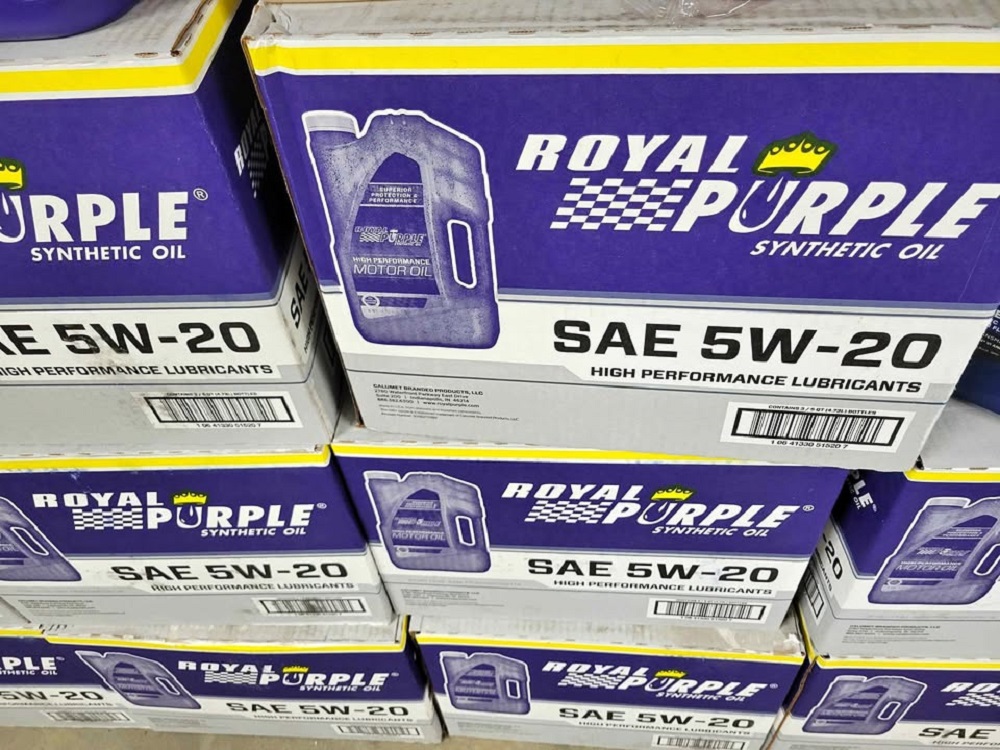
1. What Royal Purple Really Puts In the Bottle
The full lineup, not just the color
Royal Purple built its reputation on Synerlec, then expanded it into a full line of fluids. The base oil is High Performance Motor Oil, the API-certified blend for newer engines. HPS steps it up with more ZDDP for high-load work. XPR sits at the top, made for engines that see sustained heat and heavy stress.
For gearboxes, there’s Max Gear and Synchromax, both offering GL-5 load protection without chewing up brass. Max ATF and Max EZ follow the same logic for automatics and power steering. Even their industrial fluids stay on-theme, filter clean, shed water, and hold up under pressure.
Synerlec’s job when pressure isn’t there
Synerlec bonds to bare metal and hangs on. It keeps a film in place when oil pressure hasn’t caught up, cold starts, idling in traffic, or pulling hard at low speed. That’s where boundary wear kicks in, and Synerlec is built to stop it.
Every cycle smooths the micro peaks that scrub power and trap heat. Bearings stay quiet, lobes stay polished, and wear backs off.
What’s under the label, base oils, ZDDP, detergents
Royal Purple runs true synthetics with strong thermal stability and low volatility. HPS combines Synerlec with extra ZDDP, giving it a two-layer defense for hauling, boost, and high temps. The wear advantage lands at 43% below GF-7 thresholds and holds up in GDI turbo applications.
The detergent load works just as hard. It keeps ring lands, oil galleries, and turbo feeds clean, with double-digit gains in sludge and varnish control. That’s key for short-trip engines or anything exposed to moisture. Clean metal cools faster, and keeps the oil alive longer.
2. How Royal Purple Handles Wear, Heat, and Crud
Where engines take real damage
Wear piles up during cold starts and under heavy load when oil film runs thin. That’s Synerlec’s turf. It clings to metal before the pump builds pressure, keeping lobes, rings, and bearings from rubbing dry.
Lab tests show ~40% better wear protection than GF-7, and real-world teardown reports back it up, especially on tow rigs and turbo cars that run hot.
As mileage builds, Synerlec smooths metal on contact. Every stroke trims high spots, reducing drag and keeping parts cleaner and quieter.
Oxidation and carbon kept in check
Heat wrecks weak oils, turning them into varnish and sludge. Royal Purple’s synthetic base and antioxidants push back, claiming ~50% stronger oxidation resistance. That keeps viscosity stable and stops oil from thickening late in the interval.
The detergents handle buildup. Cleaner internals mean less carbon on rings, valves, and pistons, especially in GDI setups where fuel dilution and valve deposits are common.
Fighting moisture and metal damage after shutdown
Short trips and cold storage draw in water, and that water invites rust. Synerlec forms a barrier after shutdown, keeping moisture off bearing surfaces. Royal Purple’s base oils also reject water instead of emulsifying, so the oil stays stable and doesn’t go cloudy or corrosive.
Their industrial background shows here too. Tight filtration and low particulate levels bleed into the automotive line, cutting grit-based wear in power steering, valve bodies, and differentials. Clean oil, less damage.
3. Bench tests that show the good and the ugly
How far past the spec sheet it runs
Royal Purple High Performance Motor Oil checks every box, API SP, ILSAC GF-7, and dexos1 Gen 3 for newer GM engines. It’s warranty-safe and street-legal.
But it’s the excess that makes it interesting. Independent tests show ~53% better oxidation resistance and ~43% stronger wear protection than GF-7 requires. In LSPI testing, it delivered 5× the protection for GDI turbos, where a bad combo of tune, fuel, and low-rpm load can destroy pistons.
This isn’t an oil that barely clears the bar. It packs extra headroom for heat, soot, and knock-prone engines that see more than daily-driver abuse.
Volatility and the turbo deposit tradeoff
In the NOACK volatility test, Royal Purple clocked a bit over 11%. That’s under the 15% limit, but not as tight as top synthetics that stay below 10%. More volatility means more oil burned off, more top-ups, and more vapor fouling up intake valves and cats.
Turbo deposit tests back that up. In one third-party trial, Royal Purple built up 3.6× more hot-zone residue than an Issue synthetic. That’s the penalty, solid film strength, but not the cleanest performance when turbos are baking hot mile after mile.
Wear rigs and how it holds under load
On high-pressure wear rigs, Royal Purple consistently lands near the top. These setups hammer metal-on-metal until film gives out. Royal Purple’s 3–4× film strength claim shows here, those oils take longer to fail, which translates to more real-world cushion for cams, followers, and bearings under stress.
It’s not a full engine simulation, but it’s one of the best ways to compare how oils hold up when protection matters most.
How it compares against a Tier-1 synthetic
| Parameter | Royal Purple (street oil) | Typical Tier-1 synthetic | Real-world impact |
|---|---|---|---|
| Base oil / type | Full synthetic + Synerlec | Full synthetic | Both meet spec; RP leans on additive tech for its edge. |
| Relative film strength (index) | ~3–4× baseline | ~1–2× baseline | RP carries more boundary cushion under shock loads. |
| Anti-wear vs spec (ILSAC/API) | ~+40% over limit | Meets or slightly over | More margin when service is late or duty is severe. |
| LSPI protection (GDI turbo) | 5× over spec | Varies; usually compliant | Extra safety for small turbos prone to low-speed events. |
| NOACK volatility (%) | >11% | Often <10% | RP may burn off faster and send more vapor into the burn. |
| Turbo deposit test (lower=better) | Higher deposits | Lower deposits | Some Issues keep turbo hardware cleaner in torture runs. |
4. What each Royal Purple product really brings to the table
Street oils that hold up under pressure
High Performance Motor Oil is the daily blend. It holds viscosity under heat and gives a little extra cushion in tougher driving, but gains stay mild in low-load use. HPS turns it up, more ZDDP, more Synerlec, and a film that holds under towing, boost, and long uphill pulls.
In light service, both stay clean. Under strain, they give you more margin when intervals stretch or temps spike.
XPR: built for high output and sustained heat
XPR is made for engines that run hard and hot. It holds its film under shock loads, keeps friction low, and stays stable under extended stress. It’s popular in high-power builds because internals still look clean after repeated heat cycles.
For light-duty driving, it’s overbuilt. But if you’re pushing boost, towing in heat, or logging long highway pulls under load, XPR holds the line when others break down.
Max Gear, Synchromax, and driveline durability
Max Gear packs full GL-5 protection without chewing brass, solving the problem that ruins a lot of older manuals. It also runs cooler and shrugs off water, which protects gears and bearings under load.
Synchromax improves shift feel in gearboxes spec’d for ATF or light oils and keeps synchros from glazing. Max ATF and Max EZ bring the same protection to automatics and power steering.
Matching the right Royal Purple product to the job
| Use case / component | Recommended RP product | Core advantage | Value rating |
|---|---|---|---|
| Conventional street engine, non-GDI | High Performance Motor Oil | Clean operation, small gains | Low–Medium |
| GDI/turbo daily | High Performance / HPS | LSPI margin and steadier boundary film | Medium–High |
| High-output or heavily loaded build | HPS / XPR | Strong film and thermal stability | High |
| Manual trans with brass synchros | Synchromax / Max Gear | GL-5 strength with GL-4 safety | Very High |
| High-load diff (towing, off-road) | Max Gear | Cooler temps and reduced wear | Very High |
| Severe-duty engine use | XPR | Maximum protection under sustained stress | Very High |
5. When Royal Purple’s chemistry actually pays off
Commuter cycles don’t push it
A mild commute with two oil changes a year won’t stress a solid synthetic. Royal Purple runs clean and stable in this setting, but its extra film strength barely gets used. No cold-load scuffing, no heat-soaked boost, no real boundary wear.
You still get smooth operation and clean internals, but if the driving’s light and intervals are fixed at 7,500 miles, the price premium rarely returns much.
Short trips, heavy heat, and load make it count
This is where the chemistry starts earning its keep. Short runs pull in moisture and fuel, but Synerlec clings to metal and shields during cold starts, while the base oils separate water instead of emulsifying. Long grades, towing, and hot idle send oil into thin-film zones, this is the turf Synerlec was built for.
GDI turbos win twice: stronger LSPI protection and film strength that holds when turbos are glowing and pistons are fighting heat soak.
Built engines and high-dollar parts need the margin
Drop-in turbos, forged internals, tight clearances, these builds run hot and hard. A $20–$60 annual premium disappears when the parts behind it are worth $5,000+. Every cold crank, dyno pull, or hot lap hits the oil hard. Synerlec’s wear margin and surface conditioning give room where cheaper oils fold.
Max Gear follows the same rule. Built diffs and lifted trucks push gears hard, and it solves a brass-eating problem that cheap gear oil creates.
6. What the purple premium really costs
How much more at checkout
Royal Purple usually lands about $4 more per quart than a name-brand synthetic. That means $60 vs. $40 for a 5-quart change, an extra $20 per service. At 2–3 oil changes a year, the bump totals $40–$60 annually in oil cost alone.
Can longer intervals balance the price?
At 7,500-mile changes, Royal Purple costs more per mile, about $0.0080, vs $0.0053 for a Tier-1 synthetic. The math shifts only if the oil holds up to 10,000–12,000 miles, where the cost per mile drops to around $0.0050.
Let the lab confirm it, not the label
Don’t assume longer drains. Fuel dilution, coolant leaks, or blow-by will wreck oil before miles do. The only real answer is a used oil analysis, measuring viscosity, oxidation, TBN, wear metals, and fuel content. If it stays clean past 10,000 miles, the premium starts looking like even value, not waste.
Back-of-envelope math on cost per mile
| Oil type | Cost/qt (USD) | Cost/change (5 qt) | Interval (miles) | Cost per mile |
|---|---|---|---|---|
| Tier-1 synthetic (baseline) | $8 | $40 | 7,500 | $0.0053 |
| Royal Purple (no extension) | $12 | $60 | 7,500 | $0.0080 |
| Royal Purple (extended) | $12 | $60 | 12,000 | $0.0050 |
The math only works if the oil holds up across longer intervals. The rest of the value? That’s in the parts that don’t end up trashed.
7. When Royal Purple is worth it, and when it’s not
Drivelines under real pressure
Max Gear and Synchromax solve a mechanical mismatch most gear oils ignore. They pack GL-5 load protection without corroding brass. That’s a big win for manual boxes, older synchros, and differentials that tow or lock up under load. Less noise, cooler temps, and gears that stop eating themselves.
Turbo GDI engines and hot street builds
Small turbo GDI engines live on the edge. LSPI hits hard at low rpm, and heat-soaked oil thins when parts need it most. Royal Purple’s strong film and LSPI control give these motors breathing room.
But volatility matters, long heat runs can burn it off faster and haze turbo hardware. It’s still a smart pick for hard-driven street builds, as long as oil changes don’t get stretched.
Mild commutes don’t need it
For a non-GDI daily with factory intervals, Royal Purple’s chemistry stays in the dugout. A name-brand synthetic already clears the bar, and the extra margin rarely gets used. The oil runs clean, sure, but the gains are too thin to justify the price.
High-load engines and serious power
When temps climb and power rises, Royal Purple starts pulling its weight. XPR and HPS blends hold film under shock, keep friction in check, and help critical parts stay clean under extended load.
Whether it’s boost, towing, or long climbs in heat, this is where the chemistry shows up, and where the extra cost fades next to the hardware it’s guarding.
Who gets the payoff, and who doesn’t
| Owner / scenario | Main RP product | Worth it? | Why it lands there |
|---|---|---|---|
| Stock non-GDI commuter | HP Motor Oil | No | Extra margin unused in gentle duty |
| GDI/turbo daily | HP / HPS | Conditional yes | LSPI buffer and stronger film |
| Lifted/towing truck, hot climate | HP / HPS + Max Gear | Yes | High load and heat match the chemistry’s strengths |
| Manual trans needing GL-4 safety | Synchromax / Max Gear | Strong yes | Load capacity without yellow-metal damage |
| High-output or severe-duty engine use | XPR + Max Gear | Strong yes | Film strength and thermal stability protect critical parts |
Sources & References
- The Exceptional Benefits of Synerlec® Additive … – Royal Purple
- High Performance Motor Oil – Royal Purple
- High Performance Motor Oil | Royal Purple
- AMSOIL vs Royal Purple Motor Oil – Test Results – Haldimand Synthetic Oil
- Mobil 1 vs. Royal Purple vs. AMSOILl Motor Oil – YouTube
- Royal Purple – Pit Stop USA
- Frequently Asked Questions – Royal Purple
- Max Gear® High Performance Gear Oil | Royal Purple
- HPS® High Performance Street Motor Oil – Royal Purple
- INDUSTRIAL LUBRICATION – Lubritec
- Daily short driving distances, Blackstone engine oil analysis… – Maverick Truck Club
- Can only Royalty afford Royal Purple oil? Full synthetic price comparison. – YouTube
- MOTOR OIL ENGINEERING TEST DATA | 540 RAT – Tech Facts, NOT Myths
Was This Article Helpful?