
The Sedona’s temperature needle creeps toward hot halfway through the test drive. A sweet coolant smell follows. Certain 2015–2016 vans can leak coolant around the head gasket, and continued driving can cause further engine damage.
Older Sedonas hide a different risk underneath. Road salt can weaken front lower control arms on affected 2006–2012 vans until they break. Either fault can turn a low purchase price into a repair bill you did not plan for.
Model year helps narrow the search, but repair history can change the buying decision. A completed recall deserves different treatment from an engine that still loses coolant. This guide explains which years deserve caution, what fails, and which repairs to verify before buying.
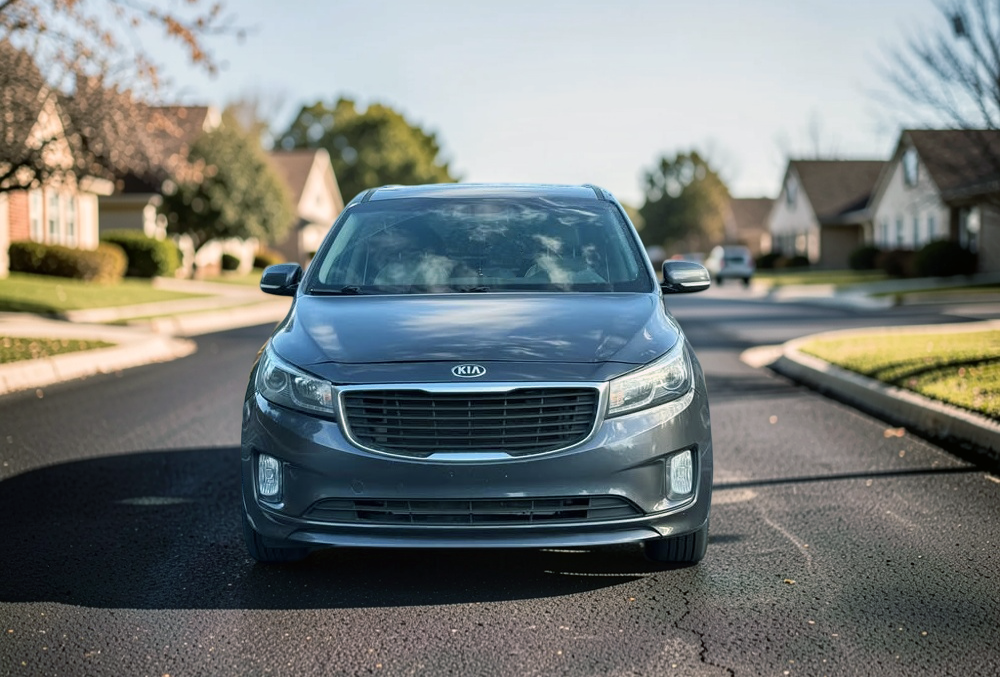
1. Which Sedona years deserve the closest look
Engine leaks and salt damage lead the risk list
The 2015–2016 Sedona deserves careful inspection for possible engine repair costs. Kia documents coolant leaks around the cylinder-head-gasket area on certain 3.3-liter GDI Sedonas. Kia’s WTY039 coverage is limited to eligible vehicles within a specific production-date range, and a model-year match alone does not establish eligibility or a covered repair. A van that needs repeated coolant top-ups needs a diagnosis before you discuss price.
For certain 2006–2007 Sedonas, Kia’s SC133 campaign required replacement of the front lower control arms if they had not already been replaced. The campaign population was limited by location, production date, VIN, and prior campaign history. Certain 2008–2012 vans had a different repair path: inspection, replacement if the arms failed, or additional corrosion protection if they passed. Salt exposure and campaign status both matter.
These priorities reflect documented defects and their possible repair consequences. They do not establish which year fails most often. A completed repair can change the assessment, but the invoice should show what work was done and whether it addressed the relevant campaign or diagnosed issue.
| Model years | Buying position | What needs attention |
|---|---|---|
| 2002–2005 | Lower priority for a family daily driver, depending on condition | Age, accumulated wear, and older crash-test results. Evidence does not justify treating 2005 as uniquely defective. |
| 2006–2007 | Strong caution after salt exposure | Check VIN-specific SC133 status, prior SC100 work, control-arm replacement records, and surrounding metal. |
| 2008–2010 | Consider after inspection and recall checks | SC133 control-arm campaign eligibility and repair; SC186 ABS/HECU fire-recall status on certain vehicles. |
| 2011–2012 | Consider with documented recall checks | Control-arm corrosion campaign eligibility, SC188 fuel-rail recall, and SC165 airbag-control-unit campaign. |
| 2014 | Possible lower-budget choice | SC134 secondary hood-latch recall, age-related repairs, and the 2006–2014 Poor IIHS roof-strength rating. |
| 2015–2016 | Highest priority for engine checks | Coolant loss, overheating history, and records of head-gasket-area or engine repairs. WTY039 applies only to eligible vehicles. |
| 2017–2018 | Judge each van on its records and equipment | Certain sliding-door and passenger-seat airbag campaigns. These years fall outside the published Sedona WTY039 production range, but that does not rule out coolant leaks. |
| 2019–2021 | Reasonable starting point if budget allows, subject to condition | Later production and an eight-speed automatic. Neither establishes a lower failure rate. |
Complaint counts can hide the risk
This guide covers U.S.-market Sedonas. Kia did not sell a U.S. 2013 model year, then returned with the 2014 Sedona without a significant redesign. An overseas listing or registration date may explain a van advertised as a 2013, but verify its VIN, market specification, and title before relying on that explanation.
Raw complaint totals leave gaps. Older vans have had more time to accumulate mileage and wear, while higher sales put more vehicles into service. Mileage and owners’ reporting habits also affect counts. The article does not establish Sedona-specific failure rates from complaint totals, and those totals should not be used alone to rank model years.
Owner reports can flag coolant loss, stalling, or harsh shifts worth investigating. They cannot establish how often every Sedona experiences a fault. Kia bulletins and recall filings define the affected populations and prescribed repairs more precisely, though recall eligibility still needs VIN-specific confirmation.
A cheap 2002 or 2005 can run out of savings fast
First-generation Sedonas now have more than 20 years of potential wear and repair history. A low-mileage example still needs close inspection of its brakes, cooling hoses, wiring, and transmission behavior. Age alone does not prove a defect, and mileage alone cannot clear those parts.
Brake shake, stalling, and charging faults need separate diagnoses. Do not assume every 2005 van shares one bad sensor or brake defect. The available evidence does not support that claim.
During the test drive, watch for delayed engagement or rising engine speed without matching acceleration. Those symptoms need a transmission diagnosis before purchase. An invoice for fresh fluid does not establish the condition of the internal clutches.
2. Why a 2015–2016 coolant leak can threaten the engine
The leak starts where the head meets the block
The head gasket seals the joint between the cylinder head and engine block. It keeps combustion pressure, oil, and coolant in separate passages. Kia’s WTY039 notice covers certain 2015–2016 Sedonas with the 3.3-liter GDI engine and a qualifying coolant leak associated with the head gasket or head bolts. The listed production range is July 21, 2014 through March 17, 2016.
Repeated coolant top-ups deserve attention, even when the van still runs smoothly. Kia lists coolant leakage, a coolant smell, or a temperature indicator near “H” among the symptoms. Continued driving with an unrepaired qualifying leak can overheat and further damage the engine.
Kia’s notice does not establish that every eligible engine has stripped bolt threads. It also does not identify one cylinder that always fails first. The repair should follow the diagnosed leak, not an assumed failure pattern.
A clean oil cap can miss the problem
An engine can lose coolant without leaving creamy sludge under the oil cap. Coolant may escape outside the engine or pass between a combustion chamber and a coolant passage. The cap alone cannot rule out a head-gasket leak.
Kia’s diagnostic procedure uses a cooling-system pressure test and, when the pressure test does not confirm a leak, an engine-block or combustion-leak test. A pressure test pressurizes the cooling circuit so the technician can check for leakage. A combustion-leak test checks for combustion gases entering the coolant.
Those tests answer different questions. An external coolant leak does not automatically prove that combustion gases are entering the cooling circuit. Kia’s procedure specifies additional diagnostic steps and conditional repair paths; coolant loss or a failed test alone does not automatically authorize engine-subassembly replacement.
An engine repair needs more than a receipt
A useful invoice names the failure and shows what the shop replaced. “Coolant leak repaired” leaves too much unknown. That entry could describe a hose repair without establishing whether the head-gasket area was inspected or whether a qualifying leak was repaired.
For major engine work, look for the replacement assembly or specific repair details. The invoice should also identify the repair date, mileage, and any applicable parts-and-labor coverage. A seller’s claim that the engine is “new” does not establish whether the shop fitted a new or rebuilt assembly.
An independent inspection still needs to assess the cooling system’s current condition. Past repairs do not explain fresh coolant loss or a rising temperature gauge. Repeated top-ups after the repair require another diagnosis before purchase.
Older startup rattles need a different diagnosis
The earlier 3.8-liter Sedona has a separate engine-noise bulletin, ENG028. Kia distinguishes a brief cold-start rattle that fades as oil pressure builds from prolonged chain noise or valve tapping. A short rattle that fades within about three to four seconds does not carry the same diagnosis as noise that persists.
For the bulletin’s covered 2006-and-later Sedona 3.8-liter and 3.3-liter engines, prolonged chain noise or valve tapping may call for replacement of both timing-chain tensioners under the procedure. Kia also identifies heat-shield buzzing as another possible noise source. The heat-shield adjustment applies only to 2006 and 2007 Sedonas produced through October 9, 2006. A loose shield does not call for the same repair as a faulty chain tensioner.
3. Rust can take a 2006–2012 Sedona off the buying list
A lower control arm can rust until it breaks
The front lower control arm helps hold the wheel in position as the suspension moves. On affected Sedonas, road salt can corrode that arm until it breaks. A failure can affect vehicle control and increase crash risk.
Kia issued SC133 after earlier SC100 recall work left some vehicles exposed to continued corrosion. Some vehicles previously treated under SC100 could remain at risk if the arms had not been replaced or adequate corrosion protection had not been applied. That does not mean every SC100 repair was deficient.
SC133 did not cover every U.S. Sedona from 2006 through 2012. The campaign population was based on production date, specified salt-belt locations, VIN and campaign history. NHTSA reported that the condition had manifested almost exclusively in 2006 models. Check the VIN and inspect the actual vehicle rather than assuming that every year in the range has the same risk.
Past location matters as much as the seller’s current address. A van advertised in a warm state may have spent years on salted roads. Fresh undercoating can hide the surface, so it does not prove the metal underneath remains sound.
Recall completed does not always mean new arms
SC133 sets different repair paths by model year. For affected 2006–2007 vans, both front lower control arms had to be replaced if they had not already been replaced. An additional coating alone did not satisfy that replacement requirement.
For affected 2008–2012 vans, the campaign calls for an inspection first. Arms that fail the inspection need replacement. Those that pass receive additional corrosion protection, so a completed campaign may leave the original arms installed.
The repair invoice should distinguish replacement from inspection and coating. A professional inspection should also assess the attachment areas and surrounding underbody. New control arms cannot restore strength to badly corroded metal elsewhere.
Keep destructive checks out of a driveway inspection. Kia’s campaign includes shop procedures for assessing arm strength. Visible perforations or open cavities in either arm call for replacement under the campaign procedure.
A hood that closes can still have a faulty catch
Certain 2006–2014 Sedonas fall under the SC134 secondary hood-latch recall. The secondary latch serves as the backup when the primary latch has not engaged. If that backup sticks, it may fail to hold the hood down.
A seller can close the hood normally without proving the secondary catch works. The prescribed campaign repair varies with location and latch condition. Check the service record for the work performed rather than accepting “the latch works.” Confirm recall status by VIN because model year and production date alone do not establish eligibility.
The lower control-arm and hood-latch campaigns cover separate parts and different model-year ranges. Completion of one does not establish completion of the other. A sticking secondary catch can let the hood open if the primary latch remains disengaged.
4. Fire risks that a clean test drive will not reveal
The ABS unit can short with the engine off
Certain 2006–2010 Sedonas fall under Kia’s SC186 campaign and NHTSA recall 20V-088. The affected population was based on production records, and not every vehicle in those model years is necessarily included. Moisture can cause an electrical short inside the ABS hydraulic electronic control unit. The short can start an engine-compartment fire even while the van sits parked with the ignition off.
This defect is separate from worn brake pads or shaking rotors. Normal braking during a test drive does not establish that the recall repair is complete. Kia’s remedy adds a relay to address the electrical fire risk.
Confirm completion through Kia’s campaign records and the repair invoice. Until repaired, Kia instructs affected owners to park outside, away from buildings and other vehicles.
Fuel odor can point to a cracked rail
Certain 2011–2012 Sedonas fall under Kia’s SC188 campaign, listed by NHTSA as recall 20V-101. Heat can cause the fuel rail to crack and leak gasoline. The rail supplies fuel to the injectors, placing the leak in the engine compartment.
A fuel smell during a viewing needs immediate attention. Do not continue the test drive to see whether it clears. Kia’s notice directs owners who smell fuel to contact the dealer and have the van towed.
The recall remedy replaces the fuel rail. An invoice for an ABS relay or routine brake work does not address this defect. Affected vans with fuel odor need towing, not a drive to the repair appointment.
5. Sliding doors can move smoothly and still need recall work
Smooth travel does not prove safe obstacle detection
Certain 2015–2018 Sedonas fall under SC164, NHTSA recall 18V-338. The campaign applies to some vehicles with power sliding doors and the automatic stop-and-reversal feature, produced from July 21, 2014 through December 6, 2017. The door-control software may fail to recognize some obstructions during closing. That fault raises injury risk even when the door moves without noise or binding.
Kia’s remedy updates the door-module software. It does not replace worn rollers, cables, or actuators. A receipt for mechanical door repairs therefore does not establish that the shop completed this recall. Confirm VIN eligibility and campaign completion through Kia’s records.
Then check unobstructed door operation using the normal controls. Keep hands, bodies, and improvised objects out of the closing path when assessing a used van. A routine operation check does not independently prove that the obstruction-detection feature works correctly.
A failed actuator needs a separate diagnosis
Kia’s ELE201 bulletin covers certain 2015–2021 Sedonas with lock, unlock, or release-actuator faults. It is a service bulletin, not a recall, and does not mean every vehicle in those model years is affected. The bulletin addresses specified electrical-command failures in the sliding-door system.
The bulletin states that this concern does not affect door latching and that the manual handles override the controller. ELE201 does not support claims that affected doors routinely fly open or trap passengers.
An ignored electrical command needs a different diagnosis from grinding, binding, or failure to latch securely. Those symptoms can point beyond the actuator concern covered by ELE201. A door that will not latch needs its own inspection before the van returns to use.
The repair estimate should name the failed part
ELE201 provides a partial repair approach for the covered actuator fault. A shop should not assume every case needs a complete controller assembly. The written estimate should identify the failed actuator and explain the required repair.
Mechanical drag needs separate attention. Replacing an actuator will not repair a worn roller or damaged cable. A software update likewise will not remove physical binding from the door’s travel.
Check both sliding doors through full, unobstructed opening and closing cycles. Note which control fails and whether the manual handle still works. A completed obstruction-detection recall does not establish the condition of the cables, rollers, or actuators.
6. Wrong signals and Park-release faults need separate repairs
The opposite turn signal can flash
Certain 2015–2017 Sedonas fall under SC217, NHTSA recall 21V-725. The affected population includes vehicles produced from July 21, 2014 through June 10, 2016; production dates and model year alone do not establish VIN eligibility. The Smart Junction Box can misread the driver’s turn-signal command and activate the opposite signal. Other drivers may then see an indication that conflicts with your intended move.
Kia’s repair updates the Smart Junction Box software. A bulb replacement will not correct that command error. Confirm the campaign repair, then check the exterior lamps while someone operates the turn-signal stalk.
Watch both sides from outside the van. Dashboard indicators alone do not establish which exterior lamps flash. A left-turn command must activate the left signals, and a right-turn command must activate the right signals.
Working headlights can still light the road poorly
Flickering or intermittent headlights need a separate electrical diagnosis. A technician should confirm the fault and check the bulbs, connectors, wiring, and power supply. The turn-signal recall does not explain every lighting complaint.
IIHS rated both tested 2020 Sedona headlight configurations Poor overall. The SX LED configuration had good low-beam visibility on the straightaway and curves, but excessive glare and inadequate high-beam visibility on curves. The other tested configuration, offered on L, LX, and EX trims, also received a Poor overall rating. IIHS lists the SX rating as applicable to 2019–2021 models and the other configuration as applicable to 2016–2021 models.
Assess the actual van’s lights after dark before committing to a purchase. Flickering needs fault diagnosis, while weak road coverage needs assessment of beam performance and lamp condition. The SX’s LED equipment did not earn a better overall IIHS headlight rating than the other tested configuration.
A shifter that leaves Park can hide a shift-lock defect
Recall SC246, NHTSA 22V-612, includes certain 2016 Sedonas built from April 27 through June 27, 2015. The defect can let the shifter leave Park without brake-pedal pressure. That creates a rollaway risk if someone moves the lever unintentionally.
The repair calls for a dealer inspection of the shift-lock assembly and replacement of the shift-lock lever and holder if necessary. It does not repair slipping clutches, delayed engagement, or harsh shifts inside the transmission. An invoice for transmission service does not establish that the shop completed this recall.
Use the VIN to confirm whether the van falls within the campaign. A 2015 build date can belong to a 2016 model, so the registration year alone will not settle eligibility. The shift lock should prevent movement out of Park until the driver presses the brake pedal.
7. Crash ratings leave gaps worth checking
Good scores in one test do not cover every crash
The Sedona’s crash protection changed across generations. IIHS tests assess specific crash types, so a Good score in one test does not settle the others. Ratings also cannot establish how an individual van’s rust or past crash repairs affect its structure.
| Model years or configuration | IIHS finding | Detail that matters |
|---|---|---|
| 2002–2005 | Acceptable in the original moderate-overlap front test | For 2002 builds before April, the restraints/dummy-kinematics subrating was Poor; later 2002 builds were rated Marginal in that subcategory. The overall moderate-overlap rating remained Acceptable. |
| 2006–2014 | Poor roof strength | The strength-to-weight ratio measured 2.31. Good results in other original tests do not remove this weakness. |
| 2015–2021 | Good driver-side small-overlap and roof-strength ratings | The driver-side result followed an autolock change and retest. Earlier 2015 builds need campaign-history checks. |
| 2018–2021, built after January 2018 | Acceptable passenger-side small-overlap rating | The production-date boundary matters; do not apply the result indiscriminately to every vehicle in those model years. |
The first 2015 crash test exposed a door-lock problem
The driver’s door opened during the original IIHS driver-side small-overlap test of the redesigned Sedona. Kia then changed the autolock programming for vans built after November 2014. It also started a service campaign for earlier 2015 builds.
IIHS based the published Good rating on a retest with locked doors. That makes the programming update relevant when assessing an early-build 2015 van. Its model-year rating alone does not establish that someone completed the campaign.
Ask Kia to check the van’s build date and campaign history. A power sliding-door software receipt does not document this separate autolock update. The Good driver-side rating reflects the retested configuration.
Older airbag faults can disable crash protection
Certain 2011–2012 Sedonas fall under SC165, NHTSA recall 18V-363. The campaign covers a defined production population, so confirm coverage by VIN. Electrical overstress may damage the airbag control unit’s application-specific integrated circuit during certain frontal crashes. The fault can prevent frontal airbags and seat-belt pretensioners from deploying when needed.
Pretensioners tighten the belts during a crash to help restrain occupants. Losing them alongside the frontal airbags removes two parts of the restraint system. An unlit airbag warning lamp does not prove that Kia completed the recall repair.
The passenger seat changes which recall applies
SC175, NHTSA recall 19V-109, covers certain 2015–2018 Sedonas produced from July 29, 2014 through July 17, 2017 with a manually adjustable front passenger seat. Damage to the seat’s wiring harness can interfere with passenger-airbag suppression. That function determines when the passenger airbag should remain disabled.
The prescribed repair removes a harness-retaining clip. If the harness is damaged and the specified SRS warning-light and diagnostic-code conditions are present, the procedure also calls for seat-cushion replacement. A generic airbag inspection receipt does not establish that the shop performed the required steps.
Confirm the seat equipment and VIN-specific campaign record. This recall concerns the passenger-seat harness, separate from the older airbag-control-unit defect. Seat-cushion replacement depends on the bulletin’s diagnostic conditions, not simply the presence of any harness damage.
8. Which Sedona years make better buying targets
Start with 2019–2021, then check the repair history
The 2019–2021 Sedona is a reasonable starting point if your budget allows. These later vans pair the 3.3-liter GDI V6 with an eight-speed automatic. Kia introduced that transmission for 2019, replacing the six-speed.
That change does not prove a lower failure rate or a redesigned engine block. It also does not establish a permanent fix for every earlier cooling complaint. You still need records that explain coolant leaks, overheating, or major engine work.
Test the transmission from cold, then again once the van reaches normal operating temperature. Watch for delayed engagement, harsh shifts, or rising engine speed without matching acceleration. Missing repair records make those symptoms harder to price before purchase.
Check both sliding doors, too. Later production does not exclude these vans from the actuator concern covered by ELE201. An eight-speed transmission adds nothing to the condition of a worn door roller or failed release actuator.
Give 2017–2018 a close look without assuming immunity
The 2017–2018 models can offer a middle ground between price and age. They fall outside the published Sedona model-year range for WTY039. That exclusion does not prove their cooling systems cannot leak or overheat.
The available public documentation reviewed for this article does not establish that every 2018 Sedona received redesigned head-bolt hardware. Judge coolant loss by its diagnosed cause. A seller’s claim that “Kia fixed those engines” needs specific repair or manufacturing evidence.
Relevant sliding-door and passenger-seat airbag campaigns still need confirmation. SC164 depends on the applicable power sliding-door equipment, and SC175 applies to certain vehicles with a manually adjustable front passenger seat. A completed campaign record must match the VIN and the work required for that van.
A 2014 offers a different engine and older crash protection
The 2014 Sedona uses a 3.5-liter V6 and six-speed automatic. The redesigned 2015 model introduced the 3.3-liter GDI engine. That distinction keeps the 2014 outside the specific 2015–2016 WTY039 extension.
The older design brings its own limits. Its IIHS roof-strength rating is Poor, and the secondary hood-latch recall needs attention. Lower purchase costs do not change either fact. The roof-strength result is one specific crash-test rating, not an overall finding that every aspect of the 2014’s crash protection is Poor.
Inspect the cooling system, suspension, brakes, and transmission for age-related wear. Repair records should explain any leaks, overheating, or shift complaints. A different engine does not clear a van that still loses coolant.
Check the safety equipment on the actual van
Late Sedonas do not all carry the same driver-assistance features. For 2020–2021, IIHS identifies the evaluated forward collision-avoidance system as standard on the SX. The EX needs the Premium package for that equipment.
Verify the trim and installed options through the vehicle’s equipment records. Do not assume a late model year includes the evaluated system. A 2020–2021 EX badge alone does not establish that the van has the Premium package.
9. Warranty coverage can change the bill, but the VIN decides
WTY039 covers a specific failure within set limits
Kia’s WTY039 extension covers certain 2015–2016 Sedonas with the 3.3-liter GDI engine, produced from July 21, 2014 through March 17, 2016. Coverage lasts 15 years or 180,000 miles, whichever comes first, measured from the original in-service date.
The program may apply to eligible vehicles regardless of ordinary subsequent transfer, but do not assume automatic coverage. Kia requires validation and identifies additional review steps for salvage-title, used-car dealer, franchise, and auction vehicles. A qualifying symptom and diagnosis must support the covered repair, and program limitations and claim approval apply.
This coverage does not authorize preventive engine replacement on every eligible van. Kia requires symptoms and a diagnosis that supports the covered repair. A model-year match alone does not establish that Kia will pay for the engine. Confirm any specific exclusions and claim requirements with Kia before relying on coverage.
Get coverage confirmed before paying the seller
Ask a Kia dealer to confirm eligibility against the VIN and the diagnosed fault. Get that answer in writing before treating warranty coverage as part of the purchase value. “Still under warranty” does not identify which failure qualifies.
The repair bulletin requires validation and extra handling for certain salvage-title, dealer-owned, or auction vehicles. Those details can affect how the dealer handles a claim. Confirm them before assuming you can buy a leaking van and immediately receive a covered repair.
An earlier engine replacement also needs its own paperwork. Check the repair scope and any remaining parts-and-labor coverage. Do not assume a replacement engine restarts the original vehicle’s warranty clock.
The advertised 10-year warranty does not transfer unchanged
Kia’s original-owner powertrain warranty generally runs 10 years or 100,000 miles. An ordinary used sale does not transfer those terms unchanged. For the 2021 Sedona warranty, later owners generally receive only the remaining 5-year/60,000-mile basic coverage for powertrain repairs, measured from the vehicle’s original in-service date. Kia specifies an exception for an original lessee who buys the vehicle at the end of the lease.
Both time and mileage limits run from the vehicle’s original in-service date. Buying the van does not restart either period. WTY039 remains separate from those standard warranty terms.
Certified-used coverage or a third-party contract may add different protection. Read the actual agreement for covered parts, exclusions, deductibles, and claim requirements. A dealer’s advertisement does not establish coverage for an existing coolant leak.
Price the diagnosed repair, not an average bill
A software recall, failed door actuator, corroded control arm, and damaged engine carry very different repair costs. Get a written estimate for the fault on the van you are considering. The estimate should include labor, related damage, and the repair warranty.
A model-wide annual repair average cannot price an engine that has already overheated. Nor can it show whether rust extends beyond a replaceable control arm. Those findings can change the required work before the shop orders parts.
Recall records also have limits. NHTSA’s VIN lookup does not show recalls more than 15 years old, completed recalls, or non-safety manufacturer campaigns, among other categories. Pair that search with Kia’s campaign history and repair invoices; a blank result does not prove every required repair is complete.
Sources & References
- Kia WTY039 Dealer Notice, NHTSA-hosted
- Kia ENG254 Rev. 3, Engine Sub Assembly Inspection and Replacement
- Kia Engine-028 Bulletin, Engine Noise Diagnosis
- NHTSA Safety Recall Report 16V-387, Front Lower Control Arms
- Kia SC133 Campaign Bulletin, Front Lower Control Arm Corrosion
- Kia SC100 Campaign Bulletin, Front Lower Control Arms
- Kia SC133 Owner Notice, Front Lower Control Arms
- NHTSA Safety Recall Report 16V-389, Secondary Hood Latch
- NHTSA Safety Recall Report 20V-088, ABS Hydraulic Electronic Control Unit
- Kia SC186 Safety Recall Campaign Q&A, ABS Fire Risk
- NHTSA Safety Recall Report 20V-101, Fuel Rail
- Kia SC188 Owner Notice, Fuel Rail Recall
- Kia SC164 Campaign Bulletin, Power Sliding Door
- Kia SC164 Safety Recall Campaign Q&A
- Kia ELE201 Service Bulletin, Sliding Door Actuator
- NHTSA Safety Recall Report 21V-725, Turn Signal Operation
- NHTSA Safety Recall Report 22V-612, Shift Lock
- IIHS 2020 Kia Sedona Ratings and Headlight Results
- IIHS 2002 Kia Sedona Ratings
- IIHS 2012 Kia Sedona Ratings
- IIHS 2014 Kia Sedona Ratings
- IIHS 2015 Kia Sedona Ratings and Driver-Side Retest
- NHTSA Safety Recall Report 18V-363, Airbag Control Unit
- Kia SC165 Safety Recall Campaign Q&A, Airbag Control Unit
- Kia SC175 Safety Recall Campaign Q&A, Passenger Seat ODS Wiring Harness
- Kia SC175 Repair Bulletin, Passenger Seat ODS Wiring Harness
- Kia 2014 Sedona Overview and Specifications
- Kia 2015 Sedona Overview and Specifications
- Kia 2019 Sedona Overview and Powertrain
- Kia 2021 Sedona Specifications
- NHTSA Office of Defects Investigation Close Resume, PE23-019
- Kia 2016 Warranty and Consumer Information Manual
- Kia Warranty Information
- NHTSA Check for Recalls
- NHTSA Datasets and APIs, Complaints Information