
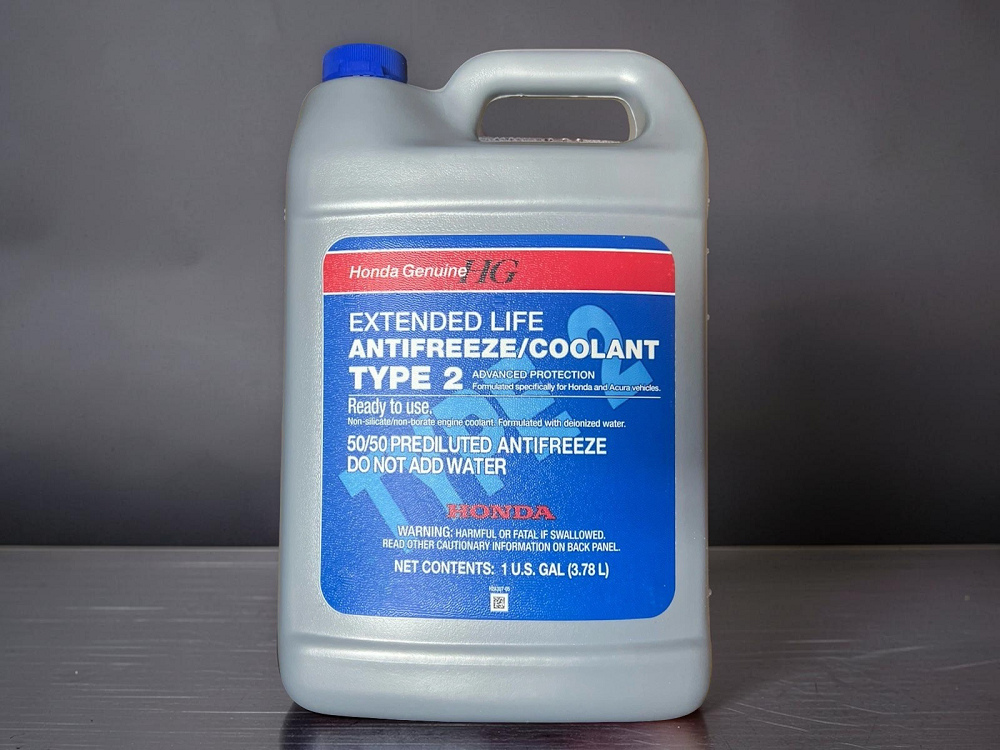
Grab the blue jug at the parts counter. Now check the label before it costs a heater core. Honda Type 2 coolant uses Asian P-OAT chemistry, not dye.
The safe matches need the same basic profile: silicate-free, borate-free, amine-free, nitrite-free, and preferably 2-EHA-free. Honda’s own Type 2 comes premixed at 50/50, so topping off with straight concentrate or tap water starts the job wrong.
Zerex Asian Blue, PEAK OET Asian Blue, Pentofrost A3, Beck/Arnley Blue, and Aisin Blue can fit when the label backs up Honda/Acura use. Random universal blue coolant doesn’t get that pass.
Mix the wrong chemistry, and the cooling system can trade a cheap top-off for sludge, seal wear, weak heat, or a plugged radiator tube.
1. Start with the straight answer, because Honda Type 2 has real matches
Honda Type 2 equivalents need the right chemistry first
Honda Type 2 coolant equivalents are blue Asian P-OAT coolants built for Honda and Acura cooling systems. The strong matches use phosphate-enhanced organic acid chemistry, not old silicate green coolant logic.
The safe label matters. Look for silicate-free, borate-free, amine-free, nitrite-free, and preferably 2-EHA-free. Honda’s own Type 2, part OL999-9011, comes as a 50/50 premix with antifreeze and clean water already blended.
That premix detail cuts off many garage mistakes. Straight concentrate can skew the freeze point. Plain water can bring minerals that coat radiator tubes and heater-core passages.
Blue dye doesn’t prove the coolant belongs in a Honda
Blue coolant can mean several things on a parts shelf. Asian blue, European blue, and universal blue can carry different inhibitor packages inside the same-looking jug.
Honda wants the Asian-style chemistry. The label should point to Honda/Acura use, Asian vehicles, phosphate-enhanced OAT, ASTM D3306, or JIS K2234. Color only gets you close enough to read the back of the bottle.
The wrong blue fluid can still cool the engine short-term. Long-term, mismatched inhibitors can leave sludge, attack seals, or choke small heater-core tubes. That’s where a cheap top-off turns into a flush.
The bottles worth comparing
| Coolant | Best use | Why it fits | Hard caution |
|---|---|---|---|
| Honda Type 2 / OL999-9011 | Safest factory match | Honda-specified 50/50 premix for Honda and Acura cooling systems | Costs more than most aftermarket Asian blue coolants |
| Zerex Asian Vehicle Blue | Strong everyday substitute | Phosphate HOAT, Honda/Acura listed, no silicates, borates, 2-EHA, amines, or nitrites | Use Asian Blue, not a random Zerex formula |
| PEAK OET Asian Blue | Easy retail substitute | POAT formula for Asian blue applications, with Acura/Honda listed | Best after a clean top-off match or proper flush |
| Pentofrost A3 | Specialist-shop match | Phosphated Asian coolant profile for import cooling systems | Verify A3, not another Pentofrost color |
| Beck/Arnley Extended Life Blue | Import-service match | Built for Asian blue coolant systems | Less common on retail shelves |
| Aisin Blue / ACB 003 | OEM-style aftermarket route | Strong fit for Asian cooling systems and Honda-adjacent service work | Availability varies by seller |
| Universal “all makes” coolant | Emergency-only top-off | May prevent overheating long enough to get home | Chemistry may not match Honda seals, aluminum, or heater-core passages |
2. Honda Type 2 works because of P-OAT, not blue dye
The real protection starts with ethylene glycol and phosphate OAT
Honda Type 2 uses ethylene glycol for freeze and boil protection. In a 50/50 mix, that base fluid protects down to about -34°F and raises the boiling point to about 265°F with a 15 psi cap.
The inhibitor package does the metal work. Honda Type 2 uses phosphated organic acid technology, often shortened to P-OAT. That chemistry protects aluminum heads, radiator cores, heater-core tubes, solder joints, seals, and water pump surfaces.
The SDS for Honda Type 2 identifies OL999-9011 as a 50/50 prediluted coolant. Ethylene glycol and water make up the bulk of the bottle. The additive package handles corrosion control in the small, hot passages where coolant chemistry gets tested.
Phosphates protect Honda aluminum fast
Honda uses phosphates because aluminum needs quick protection. That matters around water pump passages, cylinder heads, radiator cores, and heater-core tubes.
Phosphates form a fast protective film on metal. Organic acids then support longer-life corrosion control as the coolant ages. That mix helps explain why Honda moved from older green Type 1 coolant to long-life blue Type 2.
European coolant logic often avoids phosphates because hard water can make scale. Honda avoids that trap with premixed coolant and clean water. Tap water breaks that control and brings calcium and magnesium into the cooling loop.
Silicates are the old abrasive Honda left behind
Older green coolant used silicates and borates. Those inhibitors worked in older cast-iron, brass, and copper-heavy cooling systems.
Modern Honda engines lean hard on aluminum and tight coolant passages. Silicate particles can drop out of suspension and scrape water pump seals. Once the seal lip wears, coolant can leak from the pump weep hole.
That’s why “green coolant worked in my old car” doesn’t carry much weight here. A modern Honda cooling system needs silicate-free coolant. Old-school green coolant belongs on the wrong side of the flush machine.
3. Zerex, PEAK, Pentofrost, Beck/Arnley, and Aisin don’t all win the same way
Zerex Asian Blue is the easiest aftermarket match to defend
Zerex Asian Vehicle Blue is one of the cleanest Honda Type 2 substitutes. Its product data lists Honda and Acura use, and the chemistry lines up with Asian blue coolant systems.
The key detail is the inhibitor package. Zerex Asian Blue uses a phosphate organic acid formula and leaves out silicates, borates, 2-EHA, amines, and nitrites. It also lists ASTM D3306 and JIS K2234, the 2 standards that matter most here.
That no-2-EHA claim carries real weight. Some universal OAT coolants use 2-ethylhexanoic acid, which can soften certain gasket and seal materials over time. Use Zerex Asian Vehicle Blue, not a different Zerex bottle with a similar cap.
PEAK OET Asian Blue is the easy shelf pick
PEAK OET Asian Blue makes sense when you need a common retail bottle. PEAK markets it for Asian vehicles that require blue phosphate-enhanced OAT coolant, with Acura and Honda listed.
The spec sheet matters more than the front label. PEAK states ASTM D3306 and JIS K2234 compliance, and the line includes both 50/50 premix and concentrate. The 50/50 jug fits normal top-offs and drain-and-fills better.
Concentrate belongs in a different job. Use it after a flush, where distilled water remains trapped in the block, heater core, and hoses. For a simple reservoir top-off, concentrate can make the mix too strong and hurt heat transfer.
Pentofrost A3 and Beck/Arnley Blue fit import-shop service
Pentofrost A3 fits the specialist-shop lane. CRP’s Pentofrost A3 uses a phosphated OAT profile and is commonly sold as a blue premixed Asian coolant.
The part number matters with Pentofrost. A3 is the Honda-style discussion. Another Pentofrost color can carry different chemistry for a different OEM family.
Beck/Arnley Extended Life Blue also fits import-service work. Its data sheet points to Asian cooling systems and excludes silicates, amines, and borates. Shelf availability is the weak point, not the chemistry claim.
Aisin Blue earns attention because it shows up near water pump jobs
Aisin Blue deserves its own look because Aisin sits close to Honda service work. Many shops see Aisin timing belt and water pump kits during V6 service, so the coolant can appear in the same repair conversation.
The same chemistry rule still applies. If the bottle supports Asian blue P-OAT or HOAT use and lists Honda/Acura fit, it can work as an OEM-style aftermarket route. Brand comfort alone doesn’t protect a water pump seal.
Aisin ACB 003 is often treated as an Asian blue coolant match in aftermarket catalogs. Availability varies, and some sellers list it better than others. If the label can’t prove Honda/Acura use and JIS K2234 support, leave it on the shelf.
4. Premix versus concentrate is where DIY coolant jobs go sideways
Honda’s 50/50 premix rule saves the cooling system from bad water
Honda Type 2 comes premixed at 50% antifreeze and 50% water. That matters because Honda controls the water before it reaches the bottle.
Clean water keeps minerals out of the system. Calcium and magnesium from tap water can build scale inside radiator tubes and heater-core passages. Scale acts like a blanket on hot metal and slows heat transfer.
For most owners, premix is the right bottle. Top off the reservoir with Honda Type 2 or a verified Asian blue 50/50 coolant. Don’t pour straight antifreeze into a low Honda reservoir.
Concentrate belongs after a flush, not a quick top-off
Concentrate can make sense after a full flush. A shop may run distilled water through the system, then drain it before refill.
Some water stays trapped anyway. The block, heater core, hoses, and lower passages don’t empty like a bucket. Concentrate helps bring the final blend back near 50/50 after that trapped water dilutes the refill.
A normal top-off works differently. The system already holds mixed coolant, so concentrate can push the antifreeze level too high. Too much antifreeze can carry heat worse than a proper 50/50 mix.
Tap water should be treated like contamination
Tap water doesn’t belong in a Honda cooling system. It brings minerals, and those minerals don’t burn off or disappear.
Mineral scale narrows small passages first. Heater cores, radiator tubes, and water pump surfaces take the hit before the temperature gauge warns you. Weak cabin heat can show up before a full overheat.
Use distilled water only as a short-term correction if water has to go in. Then drain and refill with Honda Type 2-style coolant as soon as possible. Leave tap water in the loop, and the heater core becomes the filter.
5. Blue plus blue can still make sludge
Old green coolant is the worst mix for Honda Type 2
The worst mix is Honda Type 2 and old silicate green coolant. That old formula can carry silicates and borates Honda moved away from years ago.
Silicates can fall out of suspension when the chemistry turns ugly. Then the coolant loop starts carrying grit, gel, and deposits through narrow passages. The heater core and radiator tubes usually feel it before the whole engine overheats.
Water pump seals don’t like that mix either. Abrasive silicate particles can wear the seal lip and start a leak at the weep hole. Once green coolant gets into a Type 2 Honda system, a top-off won’t fix the chemistry.
2-EHA is the hidden risk in some universal coolants
Some all-makes OAT coolants use 2-ethylhexanoic acid, usually shortened to 2-EHA. It works in some coolant families, but Honda owners should treat it with caution.
The concern sits around seals and gasket materials. 2-EHA can soften certain silicone-based parts over long service intervals. That’s why a no-2-EHA claim matters on an Asian blue coolant label.
Zerex Asian Blue gets attention here because its product data excludes 2-EHA. It also excludes silicates, borates, amines, and nitrites. A universal blue jug with no clear Honda/Acura claim doesn’t clear that bar.
Match the coolant in the system before topping off
| Existing coolant in the Honda | What to add | Risk level | Best move |
|---|---|---|---|
| Clean Honda Type 2 blue | Honda Type 2 or verified Asian Blue P-OAT | Low | Top off normally |
| Clean Zerex/PEAK Asian Blue | Same product or verified Honda-compatible Asian Blue | Low | Keep records and avoid frequent brand mixing |
| Unknown blue coolant | Honda Type 2 only after inspection, or flush first | Medium | Don’t trust dye alone |
| Green silicate coolant | Do not top off with Honda Type 2 and walk away | High | Flush and refill with Type 2-style coolant |
| Orange Dex-Cool-style coolant | Avoid as a Honda equivalent | High | Flush if chemistry is unknown or 2-EHA-based |
6. Coolant intervals change after the first factory fill
Factory-fill coolant gets the longest runway
Honda Type 2 is long-life coolant, but the first fill gets the best conditions. It starts clean, sealed, and blended at 50/50 before the car leaves the factory.
Older Honda maintenance schedules often put the first coolant change around 120,000 miles or 10 years. After that, the interval usually drops to 60,000 miles or 5 years. The second fill inherits old coolant trapped deep in the system.
That mileage split matters on used Hondas. A 100,000-mile Civic with original coolant is near the service edge. A 160,000-mile Accord with no coolant receipts is past the safe guessing point.
A drain-and-fill leaves old coolant behind
A radiator drain doesn’t empty the whole cooling system. Coolant stays inside the block, heater core, hoses, thermostat housing, and low pockets.
That leftover fluid carries aged inhibitors. It also carries any minerals, rust, casting debris, or mixed chemistry already floating in the loop. Fresh Type 2 can’t erase that load in one drain pan.
This is why later coolant changes come sooner than the factory fill. The system no longer starts from a clean assembly-line fill. A drain-and-fill usually removes only part of the total coolant volume.
Hybrids and extra cooling loops need more care
Modern Honda hybrids can use more than one cooling loop. The engine, inverter, and battery-related hardware may each have separate fill points and bleed routines.
Don’t treat every blue reservoir as the same job. Engine coolant still needs Honda Type 2-style chemistry, but electric-drive loops can have different fill paths. Air trapped in an inverter loop can create heat problems without a classic engine overheat.
Follow the manual before opening a hybrid loop. Some systems need a scan-tool bleed or a specific pump command. Guess at the fill path, and the coolant may sit full in the reservoir while air stays trapped at the pump.
7. Bad coolant usually shows up as weak heat, crust, or repeat top-offs
Heater-core trouble can show up before the gauge moves
A clogged heater core can warn you before the engine overheats. You may get weak cabin heat, uneven vent temperature, or one side blowing warmer than the other.
Honda’s CR-V heater-core bulletin shows how tight those passages are. The 2012–2014 CR-V could lose heat from the driver’s side vents when debris restricted heater-core flow. The repair called for a heater-core flush, then a refill with genuine Honda Type 2 coolant.
Small tubes plug before big hoses do. Mixed chemistry, casting debris, mineral scale, and old coolant can all slow flow through the core. If the cabin heat fades at idle, don’t keep adding coolant and calling it fixed.
Crust around hose necks points to age, seepage, or bad chemistry
White crust near a hose neck means coolant has dried there. Check the radiator neck, thermostat housing, water pump weep hole, hose clamps, and plastic tank seams.
Heat soak makes small leaks easier to find. Shut the engine off hot, then smell around the front of the bay. A sweet coolant smell after shutdown often points to a seep that pressure testing can catch.
Bad coolant can leave stain, grit, or crust as it ages. Mixed chemistry can make the residue heavier and rougher. A water pump with crust at the weep hole needs inspection before the bearing starts to drag.
Stop guessing once the coolant changes color or the reservoir keeps dropping
| What the owner sees | Likely coolant-related cause | Smart next step |
|---|---|---|
| Brown or muddy coolant | Mixed chemistry, rust, or old fluid | Flush and refill with Honda Type 2-style coolant |
| Weak heat at idle | Heater-core restriction or air pocket | Bleed the system, inspect flow, flush if needed |
| White crust at hose joints | Dried coolant seepage | Pressure test and inspect clamps, hoses, and radiator necks |
| Coolant smell after shutdown | Small leak under heat soak | Check cap, pump, hoses, radiator, and thermostat housing |
| Repeated low reservoir | Leak, trapped air, cap fault, or head-gasket risk | Pressure test before another top-off |
| Sludge after topping off | Chemical mismatch | Stop mixing and flush before overheating starts |
Sources & References
- Engine Coolant – honda tech info
- Cooling System – honda tech info
- What Type Of Coolant Does Honda Use?
- Honda Type 2 Anti-Freeze Engine Coolant OL999-09011 – Hybrid Racing
- PEAK OE Asian Vehicles Blue OAT Antifreeze + Coolant Ready To Use 1 gal (US) PEA PABB53 | Buy Online – NAPA Auto Parts
- PEAK ORIGINAL EQUIPMENT TECHNOLOGY™ Concentrate Antifreeze + Coolant For Asian Vehicles – BLUE – 1 Gal.
- PEAK OET Asian BLUE SPEC SHEET
- Guide To Antifreeze & Coolants – Morris Lubricants
- valvoline™ zerex™ asian vehicle blue antifreeze coolant – CARiD.com
- Honda Engine Antifreeze Coolant Has Long Service Life – Accurate Automotive
- Antifreeze Reference Chart – O’Reilly Automotive
- 252-1501 Extended Life Blue – Beck/Arnley
- Pentosin Blue Pre-Mixed Engine Coolant / Antifreeze – AutoZone.com
- Honda HP Coolant for Aluminum Engines
- Zerex™ Asian Blue Vehicle Antifreeze / Coolant – Valvoline™ Global
- Use special coolant for Japanese and Korean car brands | Hírek | MPM Oil
- Honda blue coolant vs Asian blue : r/crv – Reddit
- Seriously is there really any difference between using Acura long life antifreeze coolant type 2 vs other branded Blue coolant that meets specs in a 2020 Acura RLX SH-AWD? – Reddit
- Honda Type 2 Anti-Freeze Engine Coolant – JHPUSA
- SAFETY DATA SHEET Honda Genuine Coolant Type 2 … – Inter Cars
- Zerex | Asian vehicle blue antifreeze/coolant ready-to-use 1 ga …
- More Information for PENTOSIN 8115207 – RockAuto
- Honda Long Life Antifreeze / Coolant Type 2 50/50 Prediluted MSDS | MsdsDigital.com
- Mixing Honda coolant with universal blue? – Reddit
- SAFETY DATA SHEET
- Zerex Antifreeze Provides Customized Value vs Universal Coolant – Valvoline™ Global
- Pentofrost A3 | CRP Automotive
- Valvoline Zerex Asian Vehicle Blue 50/50 Prediluted Antifreeze 1 GA – Target
- Is OEM Honda Coolant Type 2 the same as Prestone / Zerex Asian Blue? – Reddit
- Coolant (Type 2) OL999-9011 – Honda Factory Parts
- Customer reviews for Zerex Asian Vehicle Blue Antifreeze Coolant 50/50 Ready-to-Use 1 GA – Walmart
- Question about Honda Coolant : r/Cartalk – Reddit
- PEAK OET Asian Antifreeze/Coolant, 50/50 Prediluted Barbados | Ubuy
- PEAK Original Equipment Technology Asian Blue Concentrate Engine Coolant / Antifreeze
- 252-1501 Extended Life Blue – Beck/Arnley
- BECK/ARNLEY ENGINE COOLANT / ANTIFREEZE – 252-1501 | partzilla.com
- Beck Arnley 252-1501 Engine Coolant / Antifreeze + Cross Reference – FinditParts
- What company makes timing belt and water pump kits for 07-08 TL Type-S : r/Honda
- Timing belt replacement question AISIN or OEM (2016 EX-L V6) : r/accord – Reddit
- GOLDEN CRUISER | Engine coolant and brake fluid | Products – CCI
- Anyone used AISIN parts before? Dealership quoted me 835$ for timing belt kit – Reddit
- Honda Coolant/Antifreeze – Advance Auto Parts
- Cooling System – Honda TechInfo
- Cooling System – honda tech info
- Mixing Coolant Types : r/hondafit – Reddit
- Pentosin Pentofrost A3 HOAT Phosphated Asian 50/50 Prediluted Antifreeze / Coolant – 1 Gallon – Walmart.com
- Pentosin Pentofrost A3 HOAT Phosphated Asian 50/50 Prediluted Antifreeze / Coolant – 1 Gallon 8115207 – Advance Auto Parts
- Service Bulletin – nhtsa
- Service Bulletin – nhtsa
- Magnuson-Moss Warranty Act Explained | AmericanTrucks
- The Magnuson-Moss Warranty Act For Cars – LLGP – Lemon Law Group Partners
- Magnuson Moss Warranty Act – Florida Department of Financial Services
- Magnuson-Moss Act, Aftermarket Auto Parts and Oil Change Facts
- Consumer Warranty Information Enforcement | Specialty Equipment Market Association (SEMA)
- SAFETY DATA SHEET – BellevueWA.gov
- Zerex Asian Vehicle Blue Antifreeze/Coolant 50/50 Pre-Mix Asian (Blue)
- PEAK OET Asian Antifreeze/Coolant, 50/50 Prediluted Blue POAT, 400,000 Miles/15 Years for Car, SUV & Truck, 55-gal Drum, PEAK Accessories Included – Walmart.com
- Do I need to use Honda Coolant for a coolant change? : r/hondacivic – Reddit
- Any problem using two diff coolants? : r/CivicSi – Reddit